Why Don’t Paper Cups Get Soggy? How Linings Prevent Leaks & Liquid Penetration
Why Don’t Paper Cups Get Soggy? Leak-Proof Barrier Science
Foodservice Packaging Guide
Why Don’t Paper Cups Get Soggy? How Linings Prevent Leaks & Liquid Penetration
A paper cup holds a steaming latte or an iced soda for hours without collapsing. That’s not luck—it’s a precision-engineered barrier system that blocks liquid from entering the paper’s porous fiber network. Here’s how it works and what determines how long a cup stays leak-proof.
A paper cup is a paradox: it’s made from a material that readily absorbs water, yet it holds hot coffee and iced soda for hours without leaking. The answer lies not in the paper itself, but in the engineered barrier system that transforms a porous sheet into a liquid-tight container. This guide explains the physics of paper porosity, the chemistry of barrier coatings, and the manufacturing details that determine whether a cup leaks—or stays crisp and dry.
For related guidance on food packaging that performs under real-world conditions, explore the food packaging solutions that match your menu and delivery window.
Why Does Ordinary Paper Get Soggy?
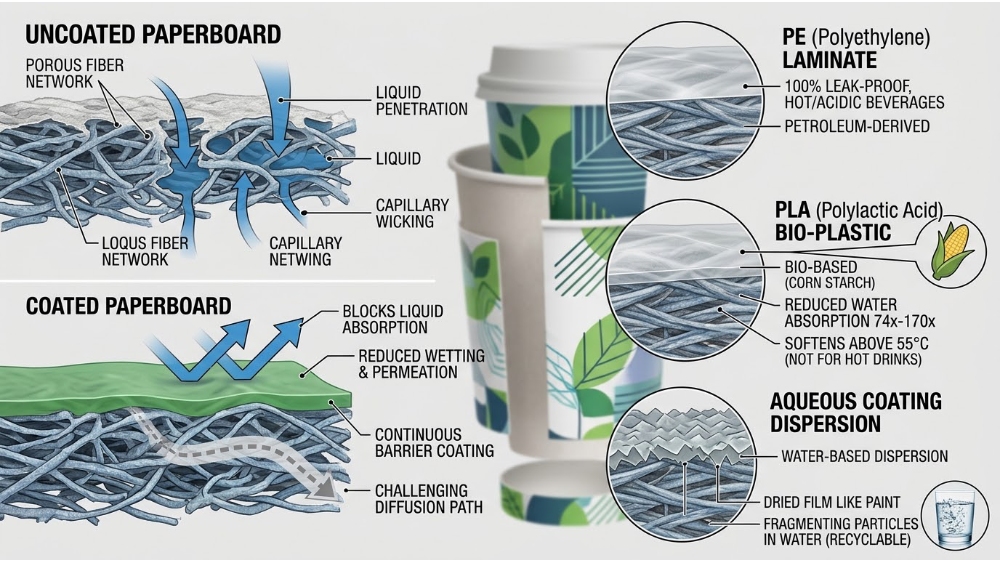
Paper is made from cellulose fibers that are intrinsically hydrophilic—they love water. These fibers are pressed into a sheet that, at a microscopic level, is a porous capillary network. When liquid contacts the surface, it’s drawn into the voids between fibers through capillary action, the same force that makes a paper towel soak up spills. Once water enters the fiber network, it causes the fibers to swell, lose their rigid structure, and weaken the bonds that hold the sheet together.
The speed of this process is striking. Pour a 90°C espresso into an unlined paper cup, and the fibers absorb liquid almost instantly, lose bond strength, and the cup collapses in seconds. That’s because paper thickness alone does not make a paper cup waterproof—the fiber network is always porous, regardless of how many layers are stacked. The only thing that stops liquid penetration is a barrier that seals those pores. Click to explore durable lined paper cups
How Does a Barrier Layer Stop Liquid From Entering Paper?
A barrier coating is a thin film applied to the paperboard surface that fills the micro- and nano-scale voids in the paper structure. Rather than changing the bulk paper, the coating engineers the surface to reduce wetting, pore penetration, and permeation. Once applied, it forms a continuous film that reduces capillary wicking and creates a longer, more challenging diffusion path for migrating molecules. You could understand paper cup coatings in detail by Paper Cup Coatings: PE vs PLA vs Water-Based – Performance & Sustainability.
The coating industry has developed three primary barrier families:
Polyethylene (PE): A petroleum-derived plastic film, laminated onto the board as a solid sheet. It’s cheap, 100% leak-proof, and survives hot and acidic beverages. The film is typically 15–20 microns thick—a fraction of the paperboard beneath it.
Polylactic acid (PLA): A bio-based plastic from fermented corn starch, applied the same way as PE. PLA coatings can reduce water absorptiveness of paperboard by 74 to 170 times and water vapor permeability by 6.3 to 22.1 times. However, PLA softens above roughly 55°C, which limits its use with hot beverages.
Aqueous coating: A water-based polymer dispersion applied and dried onto the surface—more like printing a layer of paint than sticking on a film. Under mechanical shear and warm water, it fragments and disperses into fine particles instead of forming a plastic net. This makes aqueous-coated cups more recyclable than PE-lined cups.
The key insight is that the barrier layer must be continuous and free of pinholes. Any gap in the coating—even microscopic—allows liquid to contact the paper fibers and initiate capillary uptake. This is why coating coverage and uniformity are as important as the material itself.
Fill the micro- and nano-scale voids in the paper structure
Form a continuous film that blocks capillary wicking
Create a longer diffusion path for migrating molecules
Reduce water absorptiveness by 74–170× with PLA coatings
How Do Side Seams Prevent Leakage?
The side seam of a paper cup is where the flat paperboard blank is joined into a cylindrical shape. This overlap zone is a critical leak path because it’s where the barrier coating must seal to itself. In modern cup manufacturing, the side seam is formed by applying heat and pressure to activate the coating—melting the PE or PLA layer so it fuses into a continuous, liquid-tight seal.
If the temperature is too low, the coating doesn’t fully activate, leaving a micro-channel that allows liquid to weep through slowly. If the temperature is too high or inconsistent, the coating can degrade or the paper can scorch, creating weak spots. The seam overlap is typically 3–5mm with 100% glue coverage to ensure a reliable bond. Quality control in high-speed production requires precise temperature monitoring because considerable variations in temperature between the side seam and bottom indicate possible difficulties in preserving structural integrity.
How Does the Bottom Seal Prevent Leakage?
The bottom seal is the most common failure point in paper cups. It’s formed by folding the bottom blank into a U-shaped channel and sealing it to the sidewall under heat and pressure. The bottom knurling wheel—a spinning, concave tool—forces the heated parts of the cup walls into a curve that creates a mechanical and adhesive bond.
If the knurling wheel is worn or the pre-heat temperature is incorrect, the seal fails. Leaks typically originate at the bottom seal or the side seam. The pre-heating plate is critical: if the paper isn’t heated enough before forming, the PE layer won’t activate. Different paper weights—ranging from 190 to 350 GSM—require different heat levels. This is why regulating bottom temperature is vital to lessen sealing issues. Click to learn paper weights in detail by Paper Cup GSM Selection Guide.
Why Can a Cup Leak Even When the Paperboard Is Strong?
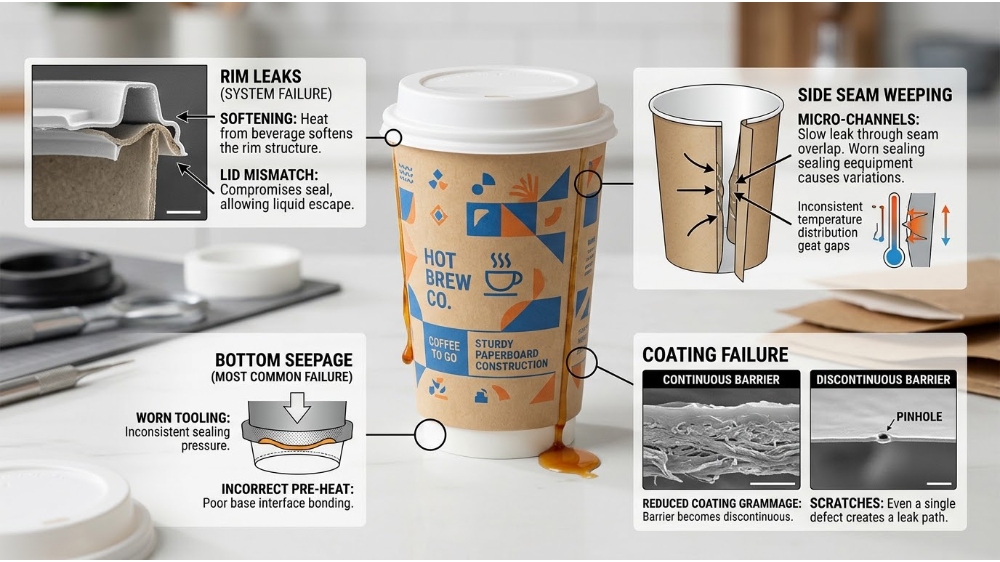
A cup can have strong, thick paperboard and still leak because leakage is a system failure, not a material failure. The three primary leak paths are:
Rim leaks: Caused by rim/curl collapse or lid mismatch. Heat from hot beverages softens the rim, allowing liquid to escape around the lid.
Side seam weeping: A slow leak through a micro-channel in the seam overlap. This is often caused by inconsistent temperature during sealing.
Bottom seepage: Leakage from the bottom knurl or base interface. This is the most common failure mode and is often caused by worn tooling or incorrect pre-heat.
The coating itself can also fail. If the coating grammage (weight per unit area) is reduced too much, the barrier becomes discontinuous. Even a single pinhole or scratch in the coating creates a direct path for liquid to reach the paper fibers. In real-world use, “leak” is not one problem—it’s a family of failure modes that require different control points.
Common leak paths and their triggers:
Rim: Heat softening, lid mismatch
Side seam: Inconsistent temperature, incomplete coating activation
Even when a cup doesn’t leak, it can soften and lose structural integrity over time. This happens through two mechanisms: internal moisture migration and external condensation. Will the paper cups expire? Read Paper Cup Shelf Life Guide: 7 Storage Factors & B2B Best Practices to find out the answer.
Internal moisture migration occurs when hot liquid heats the paperboard, driving moisture vapor through any uncoated areas or through the coating itself (which is never 100% vapor-impermeable). The paperboard absorbs this vapor, causing the fibers to swell and lose stiffness. For cold beverages, external condensation is the dominant softening mechanism. A 16oz cold drink cup can accumulate 15–25ml of exterior condensation in 20 minutes at 30°C ambient temperature. This condensation is absorbed by the outer paper fibers, causing them to swell and soften.
Research published in International Journal of Heat and Mass Transfer (Elsevier, 2026) shows that once condensation occurs, water content on a dry basis rises sharply, approaching pore-filling conditions. The process follows a two-stage pattern: an initial rapid uptake linked to condensation and filling of accessible pores, followed by a slower diffusion- and capillary-controlled regime. This means that even a cup with a perfect internal barrier will eventually soften if the exterior is exposed to moisture for long enough.
Why Doesn’t Thicker Paper Automatically Mean Better Leak Resistance?
It’s a common misconception that a thicker paperboard—measured in GSM (grams per square meter)—provides better leak resistance. In reality, paper thickness alone does not make a paper cup waterproof. The paperboard provides rigidity, stiffness, and formability, but the plastic layer ensures liquid tightness.
Typical paper cup GSM ranges from 170 to 350, depending on cup size and application. A 4oz espresso cup might use 170–190 GSM, while a 12oz coffee cup uses 240–260 GSM as the industry standard. However, a 350 GSM cup with a poor coating or a faulty bottom seal will leak faster than a 200 GSM cup with a perfect barrier.
The coating weight matters more than the paper weight for leak resistance. Standard PE coating is 15–20 GSM, while advanced low-gram coatings reduce this to 8–12 GSM while maintaining leak resistance. The key metric is coverage and continuity, not thickness. A thin, continuous coating is far more effective than a thick, pinhole-ridden one.
How Do Manufacturers Test Paper Cup Leak Resistance?
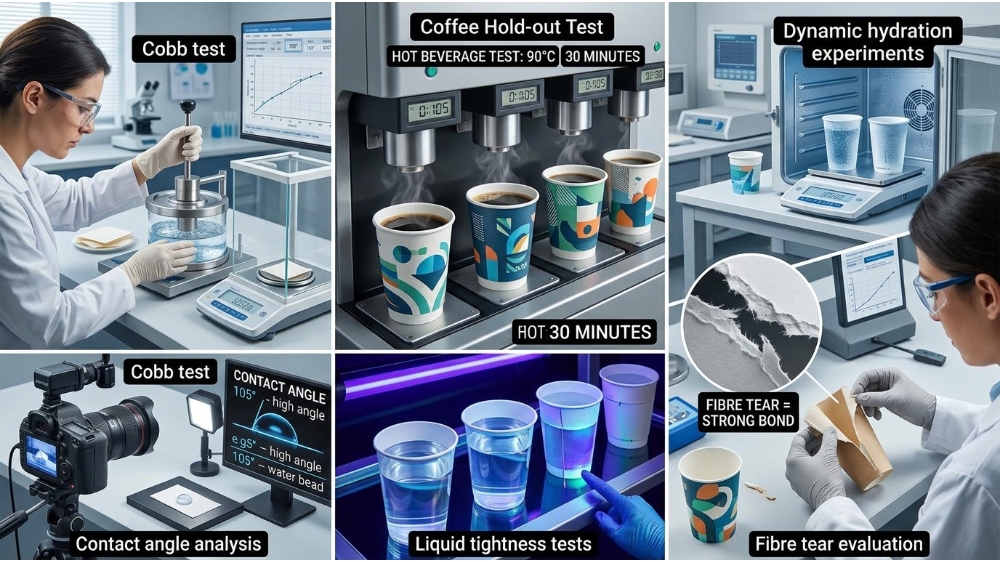
Manufacturers use a combination of laboratory tests and real-world simulations to validate leak resistance. The most common tests include:
Cobb testing: Measures water absorptivity by exposing the paper surface to water for a set time and weighing the absorbed amount.
Contact angle analysis: Measures how readily a liquid spreads on the surface—a higher contact angle suggests a more water-repellent surface.
Coffee hold-out test: Cups are filled with hot coffee (typically 90°C) and held for 30 minutes. The cup passes if no leaking or staining is visible after 30 minutes.
Liquid tightness tests: Cups are filled with water at specified temperatures (e.g., 90°C for hot beverages) and held for a defined time. The bottom and side seams must show no leakage or weeping.
Fibre tear evaluation: Seals are pulled apart to check whether the paper fibers tear—indicating a strong bond—or whether the seal separates cleanly—indicating a weak bond.
Industry standards for leak testing are defined in specifications that set test conditions for hot beverages (90°C) and cold beverages, and require that cups show no leakage from the bottom or side seams. For real-world validation, manufacturers also conduct dynamic hydration experiments—filling cups with iced water and measuring weight gain over time to quantify moisture uptake under condensation-prone conditions.
Why doesn’t paper instantly get soggy when you pour liquid into a paper cup?
Paper doesn’t get soggy immediately because a barrier coating—PE, PLA, or aqueous—seals the porous fiber network. The coating prevents liquid from reaching the cellulose fibers, stopping capillary action and absorption before they start.
What’s the difference between PE, PLA, and aqueous coatings for paper cups?
PE is a petroleum-based plastic film that’s cheap and 100% leak-proof but difficult to recycle. PLA is a plant-based plastic that’s compostable industrially but softens above 55°C. Aqueous coating is a water-based polymer dispersion that’s more recyclable than PE but may have slightly lower heat resistance.
Why do paper cups sometimes leak from the bottom even when the paper seems thick?
Bottom leaks are almost always a sealing failure, not a paper failure. The bottom knurl or pre-heat temperature may be incorrect, preventing the coating from forming a continuous seal. Thick paper can’t compensate for a faulty seal.
How long can a paper cup safely hold liquid without leaking?
A properly manufactured cup with a continuous barrier coating should hold hot liquid for at least 30 minutes without leaking under standard test conditions. Cold cups with exterior moisture protection can last several hours, though external condensation may soften the cup over time.
Need paper cups that stay leak‑proof through long deliveries?
Talk to a packaging specialist about coating options, seal integrity, and cup design matched to your menu and hold times.