How Long Do Paper Cups Last? 7 Factors That Affect Shelf Life, Storage & Quality
Paper Cup Shelf Life Guide: 7 Storage Factors & B2B Best Practices
B2B Foodservice Packaging Guide
How Long Do Paper Cups Last? 7 Factors That Affect Shelf Life, Storage & Quality
A paper cup isn’t a static product. It’s a composite structure of paperboard, functional coating, and seam adhesive—each with its own degradation timeline. For B2B buyers, understanding shelf life means controlling the variables that ruin inventory before it ever reaches the customer. Here’s the definitive guide to paper cup longevity.
The standard industry answer—”paper cups last 1 to 2 years”—is technically correct but practically useless. That range assumes ideal storage conditions, but a commercial warehouse rarely provides ideal conditions. A cup that degrades at 12 months in a humid coastal warehouse might last 30 months in a climate-controlled facility in Arizona. The difference isn’t luck; it’s material science and storage discipline.
This guide breaks down the seven distinct factors that determine paper cup shelf life, from the microscopic behavior of polyethylene coatings to the real-world pressures of FIFO inventory management, seasonal printed cup runs, and cross-climate shipping. For B2B foodservice operators, distributors, and packaging buyers, understanding these factors is the difference between a write-off and a reliable supply chain.
Paperboard Base: The Foundation of Cup Longevity
Every paper cup begins as a roll of paperboard—typically a solid bleached sulfate (SBS) or solid unbleached sulfate (SUS) board. The paperboard’s inherent pH, fiber length, and refining process directly influence how well it resists aging. Over time, paperboard undergoes a natural acid hydrolysis reaction where residual lignin and hemicellulose break down, shortening the cellulose fibers. This makes the board brittle and reduces its mechanical strength.
According to industry guidance from Graphic Packaging International, paperboard with a neutral or slightly alkaline pH (7.0–8.5) exhibits significantly slower aging compared to acidic boards. The rate of fiber degradation doubles for every 10°C increase in storage temperature, which is why climate control matters far more than most operators assume. Additionally, the caliper (thickness) of the board affects its resistance to moisture ingress from the environment—a heavier 18-pt board provides a longer barrier path for water vapor than a 12-pt board, effectively extending shelf life by several months under identical humidity conditions.
The paperboard base is also the substrate that receives the coating. If the base board has surface pinholes or inconsistent formation, the coating cannot form a continuous barrier, creating weak points where moisture and grease penetrate during storage, causing localized delamination that worsens over time.
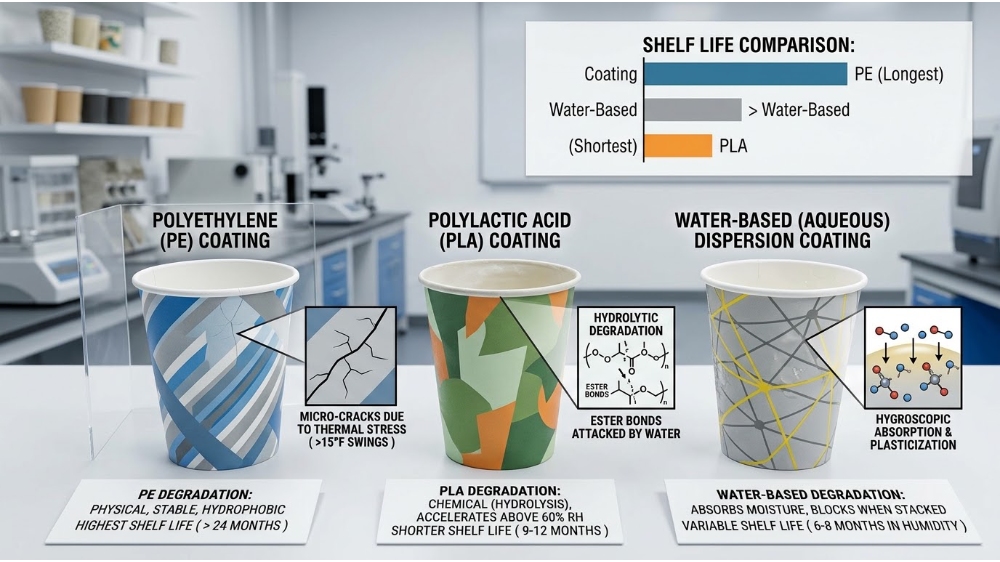
The coating is the primary barrier between the paperboard and the beverage—and it’s also the most variable component in shelf-life calculations. Three coating types dominate the market: polyethylene (PE), polylactic acid (PLA), and water-based dispersions. Each degrades by a different mechanism.
PE-coated cups are the industry standard. PE is chemically stable and hydrophobic, meaning it does not absorb water. Its degradation is primarily physical—thermal expansion and contraction cause micro-cracks over time, especially if stored in environments with temperature swings exceeding 15°F. However, PE is generally inert, which gives PE-coated cups the longest practical shelf life, often exceeding 24 months under proper storage.
PLA-coated cups are compostable but inherently less stable. PLA is a polyester that undergoes hydrolytic degradation—water molecules attack the ester bonds in the polymer chain, breaking it down into lactic acid. This process accelerates dramatically above 60% relative humidity. Research shared by BioPak indicates that PLA-coated cups stored at 80°F and 70% RH can lose up to 40% of their coating integrity within 12 months, leading to seal failure and leakage. For PLA cups, the practical shelf life is often 9–12 months, even in moderate conditions.
Water-based (aqueous) coatings offer a repulpable alternative, but they are more hygroscopic—they absorb moisture directly from the air. This plasticizes the coating, making it softer and more prone to blocking (sticking together) when cups are stacked. In humid conditions, water-based coatings can begin to fail within 6–8 months. The shelf-life hierarchy is clear: PE > Water-based > PLA, with PE offering the widest operational window for bulk purchasing.
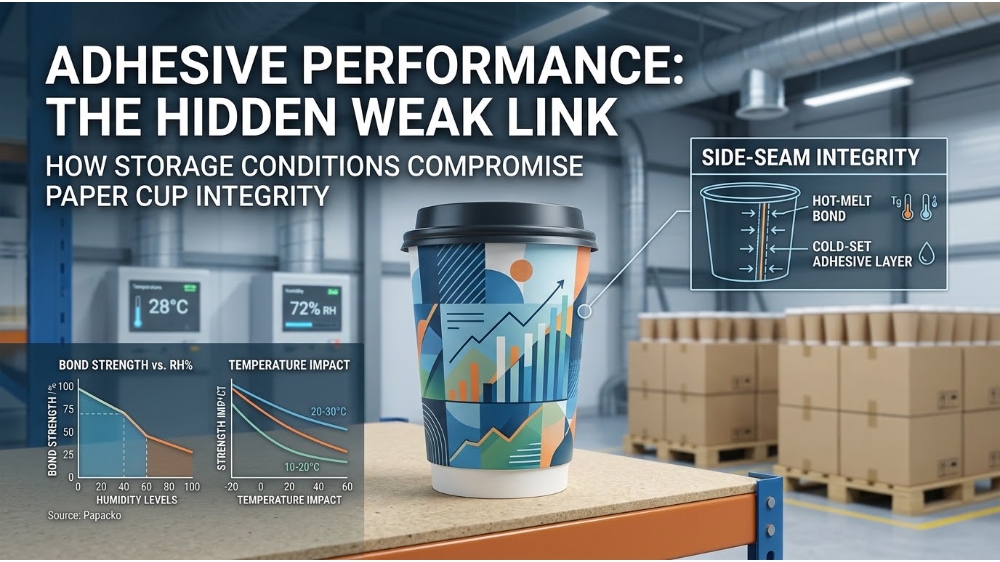
The side seam of a paper cup is held together by adhesive—either hot-melt or cold-set. While the paperboard and coating provide structural integrity, the adhesive is responsible for maintaining the cup’s cylindrical shape and preventing side-seam blowouts under heat and pressure.
Hot-melt adhesives (ethylene-vinyl acetate or polyolefin-based) are thermoplastic. They have a glass transition temperature (Tg) typically between -10°C and 10°C. When stored below Tg, the adhesive becomes brittle and can crack when the cup is handled. Conversely, when stored above 40°C, the adhesive softens, allowing the seam to slip under the weight of stacked cups. This is particularly problematic for warehouses in tropical climates without air conditioning.
Cold-set adhesives (water-based acrylics) are more sensitive to humidity. They absorb moisture, which re-emulsifies the adhesive and reduces bond strength over time. According to a technical brief from Papacko, side-seam bond strength in cold-set cups decreases by roughly 15% for every 10% increase in ambient RH above 50%, effectively setting a shelf-life clock that runs faster in humid environments. For B2B buyers, choosing the right adhesive system based on your regional climate and expected storage duration is a critical but often overlooked decision.
Relative Humidity and Moisture Exposure
Humidity is the single most aggressive enemy of paper cup shelf life. Paperboard is naturally hygroscopic—it gains moisture when ambient RH exceeds 50% and loses moisture when RH drops below 40%. This moisture exchange causes dimensional changes in the paperboard, leading to a phenomenon called “curling” at the cup’s rim and bottom curl, which compromises the seal.
When paperboard absorbs moisture, the fibers swell transversely (in width) much more than longitudinally (in length). This creates internal stress that can delaminate the board or cause the cup to become oval, rendering it unusable in automated dispensers. Data from G Lam Paper Lid indicates that storing bulk paper cups in environments exceeding 65% RH for more than 90 consecutive days can reduce the functional shelf life by up to 40%, primarily due to rim curl deformation that prevents a tight lid fit.
Conversely, extremely dry conditions (below 30% RH) can cause the paperboard to become excessively brittle, leading to cracking during the cup-forming process or when the cup is filled with hot liquid. The ideal storage relative humidity for paper cups is a narrow band between 40% and 50%. Warehouses that maintain this range effectively can expect their cups to perform reliably for the full manufacturer-recommended shelf-life window.
Temperature Extremes and Thermal Cycling
Temperature affects everything—the paperboard’s fiber strength, the coating’s flexibility, and the adhesive’s viscosity. The Arrhenius equation governs the rate of chemical degradation: for every 10°C increase in temperature, the rate of paperboard aging roughly doubles. A cup stored at 35°C (95°F) will experience fiber degradation at twice the speed of a cup stored at 25°C (77°F).
Thermal cycling is even more destructive than constant high temperature. Warehouses that experience daily temperature swings of 15°C or more (e.g., uninsulated metal buildings) cause repeated expansion and contraction of the paperboard and coating. This mechanical fatigue creates micro-fractures in the PE or PLA layer, compromising the moisture barrier. Over six months of significant thermal cycling, a cup can lose 50% of its initial burst strength, even if the average temperature remains moderate.
Shipping containers present a particularly harsh environment. During maritime transport, interior container temperatures can exceed 60°C (140°F) in direct sunlight. A single ocean voyage can accelerate paper cup degradation by the equivalent of 6–8 months of warehouse storage. B2B buyers sourcing cups internationally must account for this “transit aging” in their shelf-life calculations, especially for PLA-coated products.
Ultraviolet radiation is the most visually obvious agent of degradation—it fades printing and yellowes paperboard. But UV also does chemical damage. UV photons carry enough energy to break the carbon-carbon bonds in both the paperboard’s lignin and the polymer chains in PE and PLA coatings, a process known as photo-oxidation.
Photo-oxidation introduces carbonyl groups into the polymer backbone, which makes the coating brittle and discolored. For printed cups, UV exposure degrades the ink pigments and binders, causing the print to flake or rub off during handling. The damage is cumulative; even indirect sunlight through a warehouse window can cause measurable UV degradation over 12–18 months.
The practical rule is simple: keep paper cup cartons in opaque packaging or dark storage areas. UV exposure of even 100–200 hours (about 2–3 hours of direct sunlight per day over a few months) is sufficient to produce visible yellowing of the board and a noticeable reduction in coating flexibility, shortening the effective shelf life by approximately 15–20%. This is why reputable packaging suppliers store bulk inventory in dark, climate-controlled warehouses and why buyers should inspect incoming shipments for signs of UV damage before accepting delivery.
Warehouse Storage, FIFO, and Bulk Purchasing
Beyond the raw material science, operational discipline in the warehouse determines whether paper cups survive their intended shelf life. This is where B2B buyers differentiate themselves from casual consumers.
Stacking height and palletization are critical. Paper cup cartons are corrugated, but they are not load-bearing structures. Stacking pallets more than five cartons high compresses the cups at the bottom, distorting the cup rims permanently. This “compression set” causes cups to fail in vending machines and automated dispensers. Industry standards recommend a maximum stack height of 1.5 meters for bulk storage, with slip sheets between layers to distribute the load evenly.
FIFO (First In, First Out) inventory rotation is non-negotiable for cups with coating or adhesive systems that degrade on a defined timeline. Without FIFO, seasonal printed cups stored for 14 months may be pushed to the back of the warehouse and discovered only when they are already past their functional prime. Implementing a clear FIFO system—with date stamps on each pallet—ensures that older inventory is used first, minimizing write-offs.
Bulk purchasing and MOQ risk create a strategic tension. Ordering large quantities (e.g., a full container load of 200,000 cups) lowers the per-unit cost but increases the financial exposure if storage conditions are suboptimal. For PLA cups with a 12-month shelf life, buying a 24-month supply guarantees a significant percentage of unusable inventory. B2B buyers should match their purchase quantities to their actual consumption velocity, factoring in a safety margin, and work with suppliers who offer flexible MOQ to reduce long-term inventory risk.
Seasonal printed cups add another layer of complexity. Holiday-themed cups ordered in January for the following December will spend 11 months in storage. If those cups are PLA-coated and stored in a humid environment, they may fail before the holiday season arrives. For seasonal runs, PE-coated board is strongly preferred, and accelerated aging tests (e.g., storing a sample batch in a warm, humid chamber) should be conducted to verify that the print, coating, and adhesive will survive the intended storage period.
Cross-climate shipping between regions—for example, shipping from a dry manufacturing region to a humid coastal distribution center—requires careful management. The cups will absorb moisture during transit and storage, so the effective shelf life starts not when they are manufactured, but when they arrive at the final storage location. Buyers in humid climates should demand PE-coated cups with a proven moisture barrier and should consider storing cups in climate-controlled rooms with dehumidifiers to extend the usable window.
A practical guideline for warehouse operations is to maintain environmental logs and perform monthly spot checks on cup performance—specifically, testing rim curl and side-seam integrity on a sample of 10–20 cups from different pallets. This early warning system allows operators to rotate problem batches out of circulation before they become a quality complaint from the end customer.
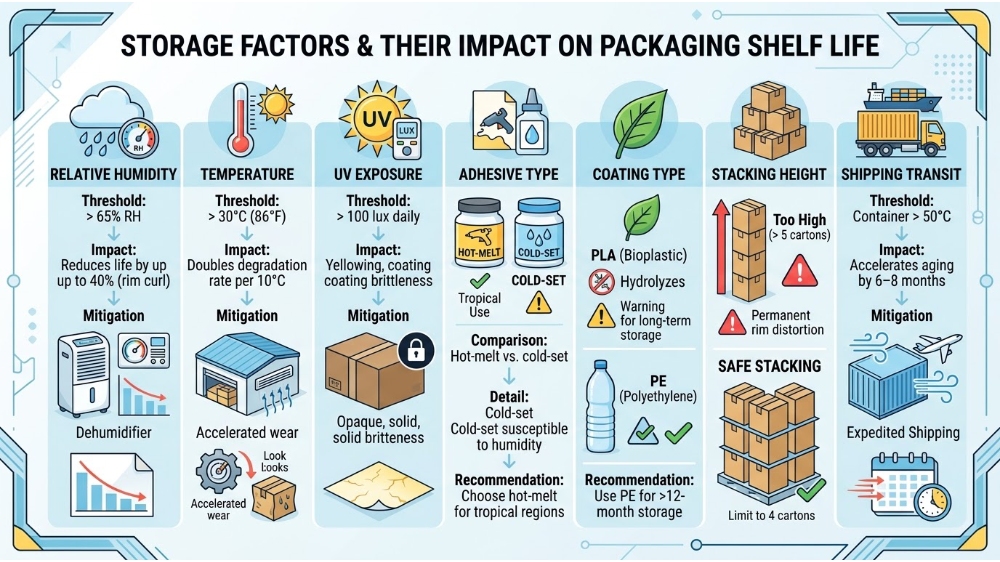
Storage Factor
Threshold
Impact on Shelf Life
Mitigation
Relative Humidity
> 65% RH
Reduces life by up to 40% (rim curl)
Climate control & dehumidifiers
Temperature
> 30°C (86°F)
Doubles degradation rate per 10°C
Insulated warehouse, air conditioning
UV Exposure
> 100 lux daily
Yellowing, coating brittleness
Opaque cartons, dark storage
Adhesive Type
Hot-melt vs. cold-set
Cold-set susceptible to humidity
Choose hot-melt for tropical regions
Coating Type
PLA vs. PE
PLA hydrolyzes; PE remains stable
Use PE for >12-month storage
Stacking Height
> 5 cartons high
Permanent rim distortion
Slip sheets, limit to 4 cartons
Shipping Transit
Container > 50°C
Accelerates aging by 6–8 months
Insulated containers, expedited shipping
B2B shelf-life rule of thumb:
PE-coated cups: 24+ months in climate-controlled storage (40–50% RH, 15–25°C)
PLA-coated cups: 9–12 months, shorter in humid climates
Water-based coated cups: 6–8 months—use for short-run promotions only
Always implement FIFO and test a sample batch before seasonal rollouts
Frequently Asked Questions
Do paper cups actually expire with a hard date?
Paper cups do not have a regulatory expiry date, but they have a functional performance window. After that window, the coating, adhesive, or paperboard may fail, causing leaks or dispensing issues. The manufacturer’s “best by” date is a guide based on lab testing under ideal conditions.
Can I use paper cups stored for 3 years if they look fine?
Visually fine does not mean functionally fine. Paperboard fibers weaken, coatings become brittle, and adhesives can fail under heat. A 3-year-old cup may hold cold water but split when filled with 90°C coffee. Always perform a hot water fill test on aged samples before committing to bulk usage.
What’s the best coating for long-term bulk storage?
PE (polyethylene) coating is the most robust for long-term storage, offering excellent moisture resistance and thermal stability. PLA is compostable but degrades via hydrolysis, making it unsuitable for inventory held longer than 12 months in most real-world warehouse environments.
How does FIFO work for paper cup inventory across multiple locations?
FIFO requires labeling each pallet with the manufacturing date and the warehouse receiving date. When a location requests stock, the warehouse management system must pull the oldest batch first. For multi-location distribution, centralizing inventory in one climate-controlled warehouse and distributing smaller, frequent batches reduces the risk of aging inventory at the point of use.
Worried About Cup Shelf Life Wasting Your Inventory Investment?
Let our packaging specialists review your current cup stock, storage conditions, and consumption velocity. We’ll help you select the right coating (PE vs. PLA) for your specific climate and menu, implement FIFO systems, and optimize bulk order quantities to minimize waste and financial risk.