Paper Cup Coatings Explained: 3 Common Lining Options and How They Affect Performance
Paper Cup Coatings: PE vs PLA vs Water-Based – Performance & Sustainability
Foodservice Packaging Guide
Paper Cup Coatings Explained: 3 Common Lining Options and How They Affect Performance
Not all paper cups are created equal. The invisible layer inside your cup determines whether it leaks, withstands boiling water, survives a 30‑minute iced latte, or ends up in a landfill instead of a recycling bin. Here is the clear, performance‑based breakdown of PE, PLA, and water‑based coatings.
A paper cup is only as good as its lining. The coating determines whether your hot coffee stays inside, whether your iced soda keeps its fizz, and whether the cup can be recycled or composted after use. Three dominant options exist today: polyethylene (PE), polylactic acid (PLA), and water‑based (aqueous) dispersions. Each offers a different balance of moisture resistance, thermal tolerance, end‑of‑life options, and cost – and choosing the wrong one can damage both your product quality and your sustainability claims.
This guide strips away the marketing fluff and compares these three coatings on the metrics that actually matter: water resistance, heat stability, cold‑drink performance, compostability, recyclability, and cost per cup. By the end, you will know exactly which lining fits your menu, your delivery radius, and your environmental commitments.
Tip: If you want to know about paper cups from beginning, besides coatings, you could read Paper Cup Manufacturing Process Guide to learn it in detail.
Why paper cups need a coating at all
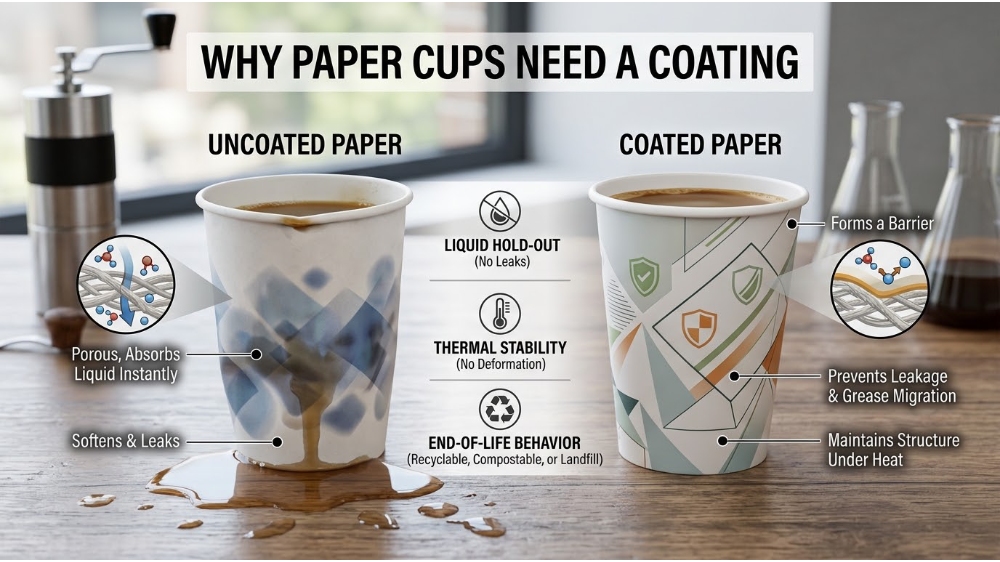
Uncoated paper is porous – it absorbs water instantly, turns soft, and leaks within seconds. The role of any cup coating is to create a barrier between the liquid (hot or cold) and the paper fibres. Without it, the cup cannot hold a beverage for more than a few seconds. Coatings also prevent grease migration from fatty drinks like hot chocolate or coffee with cream, and they contribute to the cup’s structural integrity under thermal stress.
The choice of coating material dictates three critical performance axes: liquid hold‑out (no leaks), thermal stability (no deformation or delamination at serving temperatures), and end‑of‑life behaviour (whether the cup can be recycled, composted, or must go to landfill). Each coating type excels on some of these axes and compromises on others.
PE coating: the industry standard for performance and cost
Polyethylene (PE) – typically low‑density PE (LDPE) – has been the workhorse of paper cup manufacturing for decades. It is applied as a thin film (15–25 g/m²) onto the paperboard via extrusion coating. PE offers excellent water resistance, good grease resistance, and reliable heat sealing during cup forming. It performs reliably with hot liquids up to 95°C (203°F) and cold drinks without issue.
Hot drinks: PE holds its integrity at standard coffee serving temperatures (75–85°C). It does not soften or release off‑tastes. However, at temperatures above 90°C, PE can begin to lose mechanical strength, though this is rarely a problem for typical beverage service. Click to explore PE coating paper cup for hot drinks
Cold drinks: PE is completely impermeable to water and resists condensation‑related softening. Iced beverages, sodas, and juice stay contained for hours without leakage.
Recycling and compostability: PE‑lined cups are not recyclable in standard paper mills because the PE film cannot be separated from the paper fibre in the repulping process. They contaminate the paper stream. They are also not compostable (PE is a fossil‑based plastic that does not biodegrade). Most PE‑lined cups end up in landfill or incineration, unless they go to specialised mixed‑waste facilities.
Cost: PE is the least expensive coating, adding roughly $0.005–$0.01 per cup at scale. It is the default choice for volume‑driven foodservice operators who prioritise cost and performance above all else. Read Paper Cup Cost Guide to learn more about paper cup prices.
PE coating at a glance:
Water resistance: Excellent – zero absorption
Heat resistance: Good up to ~95°C
Cold drinks: Fully compatible
Recyclability: Not recyclable in standard paper streams
Compostability: None (fossil‑based)
Cost: Lowest of the three
PLA coating: biobased but not a drop‑in replacement
Polylactic acid (PLA) is a bioplastic derived from fermented plant starch (usually corn or sugarcane). As a coating, PLA is applied via extrusion, similar to PE. It offers a similar level of water resistance and heat‑seal ability, but with a critical difference: PLA is compostable under industrial conditions, and it is derived from renewable resources.
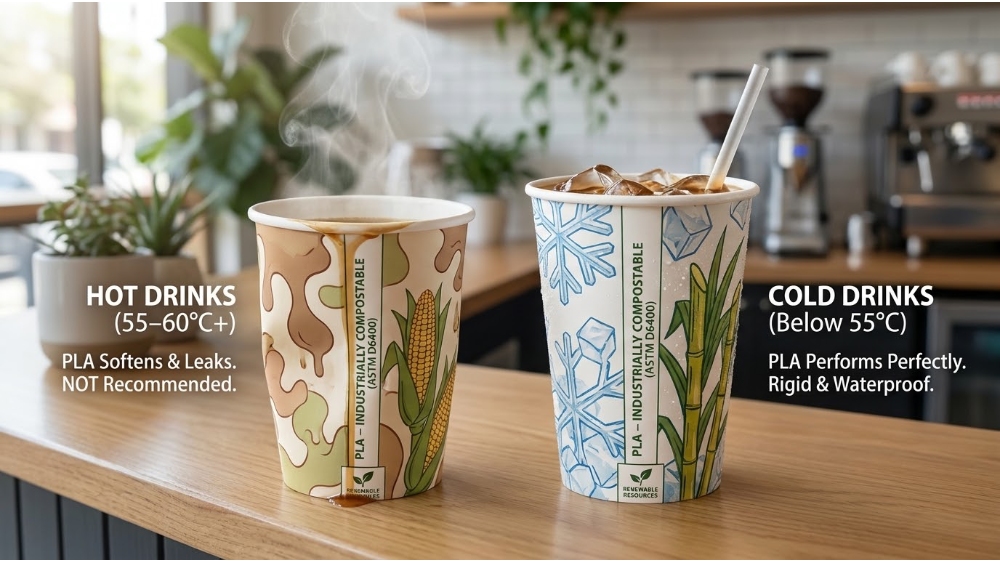
Hot drinks: This is PLA’s Achilles’ heel. PLA has a glass transition temperature of about 55–60°C. Above that, it begins to soften and lose structural integrity. At typical coffee serving temperatures (75–85°C), PLA‑lined cups can deform, delaminate, or even leak. Some suppliers add heat‑stabilising additives to raise the threshold to ~80°C, but the performance is still inferior to PE. For hot tea, coffee, or hot chocolate, PLA is generally not recommended unless the beverage is consumed quickly and at lower temperatures.
Cold drinks: PLA performs perfectly for cold beverages – iced coffee, soft drinks, juice. It remains rigid and waterproof at ambient and chilled temperatures.
Compostability and recycling: PLA is industrially compostable (ASTM D6400) but only in commercial composting facilities that maintain high heat (55–60°C) and controlled humidity for 90–180 days. It will not break down in home compost or in the environment. PLA is not recyclable in standard plastic recycling streams, and it can contaminate PET recycling. Some specialised recyclers accept PLA, but infrastructure is extremely limited.
Cost: PLA is 20–30% more expensive than PE due to feedstock costs and limited production scale. For operators prioritising a renewable feedstock and industrial compostability, PLA is the go‑to, but only if their service temperature is low enough.
PLA coating at a glance:
Water resistance: Excellent
Heat resistance: Limited – softens above ~60°C
Cold drinks: Excellent
Recyclability: Not recyclable in mainstream systems
Compostability: Industrial only (not home)
Cost: 20–30% higher than PE
Water‑based coating: the recyclable alternative with trade‑offs
Aqueous or water‑based coatings are dispersions of polymers (often modified starches, acrylics, or polyesters) that are applied to the paperboard as a liquid and then dried to form a thin barrier. Unlike extrusion coatings, they penetrate the paper fibres slightly, creating a surface that repels water and grease while remaining repulpable. This makes them the only option that allows the finished cup to be recycled in standard paper mills, because the coating can be washed off during the repulping process.
Hot drinks: Water‑based coatings can withstand temperatures up to ~85°C, depending on the formulation. Advanced formulations (e.g., Michelman’s Michem® Coat 9250) are designed for hot cup applications and pass standard heat‑seal tests. However, they are generally less heat‑resistant than PE and may show slight softening at very high temperatures. They also have lower grease resistance than PE or PLA, so they are less suitable for oily beverages or extended hold times.
Cold drinks: Water‑based coatings work well for cold beverages, though their water resistance is slightly lower than that of PE or PLA. Over long periods (30+ minutes), some condensation may penetrate, but for typical service windows, they perform adequately.
Recyclability and compostability: The key advantage is recyclability – cups with aqueous coatings can be repulped in standard paper recycling facilities, provided the coating is designed to be water‑dispersible. They are not compostable (they are plastic‑based, even if water‑borne), but they avoid the contamination issues of PE and PLA in paper recycling streams. Some formulations are also repulpable certified.
Cost: Water‑based coatings are typically 10–20% more expensive than PE, but cheaper than PLA. Their cost is driven by the application process (requires drying ovens) and the higher raw material cost of specialised polymers.
Water‑based coating at a glance:
Water resistance: Good – slightly less than PE/PLA
Heat resistance: Moderate – up to ~85°C with advanced formulas
Cold drinks: Good for typical hold times
Recyclability: Yes – repulpable in standard paper mills
Compostability: No (plastic‑based)
Cost: Mid‑range (above PE, below PLA)
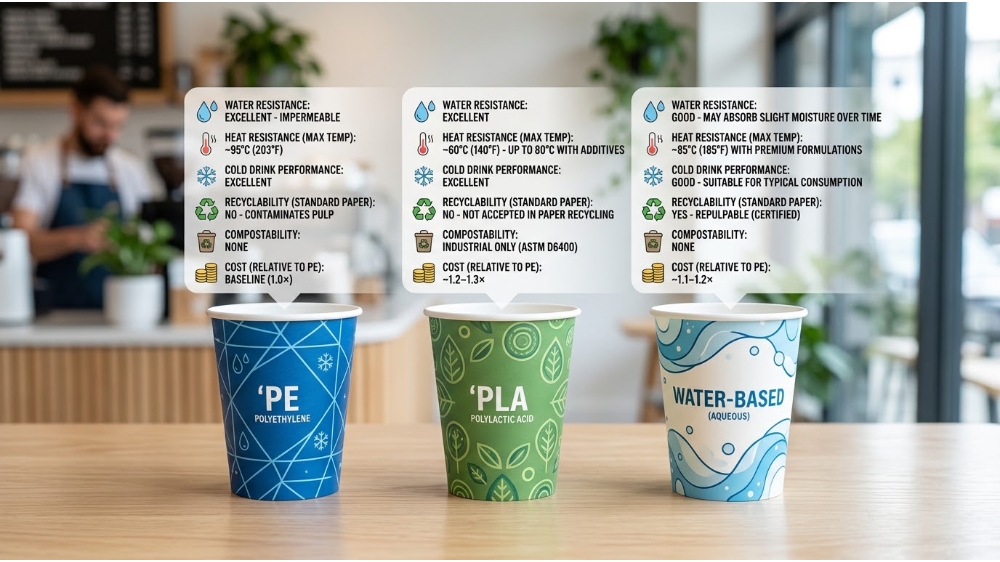
Side‑by‑side comparison table
Property
PE (Polyethylene)
PLA (Polylactic acid)
Water‑based (Aqueous)
Water resistance
Excellent – impermeable
Excellent
Good – may absorb slight moisture over time
Heat resistance (max temp)
~95°C (203°F)
~60°C (140°F) – up to 80°C with additives
~85°C (185°F) with premium formulations
Cold drink performance
Excellent
Excellent
Good – suitable for typical consumption
Recyclability (standard paper)
No – contaminates pulp
No – not accepted in paper recycling
Yes – repulpable (certified)
Compostability
None
Industrial only (ASTM D6400)
None
Cost (relative to PE)
Baseline (1.0×)
~1.2–1.3×
~1.1–1.2×
How to choose the right coating for your business
Selecting the optimal cup coating is a decision that balances service temperature, hold time, sustainability goals, and local waste infrastructure. There is no single “best” option – only the best fit for your specific use case.
Choose PE if: your primary concern is cost and performance. You serve hot coffee and tea at standard temperatures, you need reliable leak‑proof cups for both hot and cold drinks, and you operate in regions where recycling infrastructure for coated cups does not exist (or you accept landfill disposal). PE is the safe, predictable choice.
Choose PLA if: you serve only cold beverages (or lukewarm drinks below 60°C) and your business has access to an industrial composting facility. PLA is also a strong option if you want to market a “plant‑based” story, but be transparent with customers that it requires commercial composting and is not home‑compostable.
Choose water‑based if: your priority is recyclability. If your municipality accepts paper cups with aqueous coatings, this allows you to make a genuine circular‑economy claim without sacrificing too much performance. This is especially relevant in regions with advanced paper recycling (e.g., Europe, parts of North America). However, test the cup with your specific hot beverage – some aqueous cups may soften or leak with very hot or oily drinks.
For operations with diverse menus, consider using different cups for hot and cold lines. Also, factor in the actual hold time – a cup that survives 5 minutes at the counter may fail at 20 minutes in a delivery bag. Always conduct real‑world trials with your actual beverage at the temperature you serve it.
Need the right paper cup coating for your menu?
Get a one‑stop packaging consultation tailored to your beverage temperature, hold times, and sustainability goals. Request samples and technical data sheets from Maibao’s packaging experts.
What is your typical hold time (counter vs. delivery)?
Does your local waste management accept PLA compostable cups?
Are paper recycling facilities in your area equipped to handle water‑based coated cups?
What is your budget per cup – can you absorb a 10–30% premium for a more sustainable option?
Frequently asked questions
Are PE‑lined paper cups recyclable?
No. The polyethylene film cannot be separated from the paper during standard repulping, so these cups contaminate paper recycling streams and must go to landfill or incineration.
Can PLA‑lined cups go in home compost?
No. PLA requires industrial composting conditions with sustained heat (55–60°C) and moisture for 90–180 days. It will not break down in a backyard compost pile.
Do water‑based coatings work for hot coffee?
Yes, but only with advanced formulations designed for high‑heat applications. Standard water‑based coatings may soften above 70°C. Always verify the supplier’s temperature rating and test with your actual beverage.
Which coating is the most environmentally friendly?
It depends on your local infrastructure. If your area has industrial composting, PLA can be a good choice. If paper recycling is available, water‑based is better. PE is the least sustainable due to its non‑recyclable, non‑compostable nature. The “greenest” option is the one that actually gets processed, not the one with the best marketing.
Post time:
Sep-01-2026
For inquiries about our products or pricelist, please leave your email to us and we will be in touch within 24 hours.