What GSM Should Paper Cups Be? A Guide to Paper Weight, Strength & Performance
Paper Cup GSM Selection Guide: Weight, Strength & Cost
Foodservice Packaging Guide
What GSM Should Paper Cups Be? A Guide to Paper Weight, Strength & Performance
Two suppliers quote the same 12 oz cup. One feels flimsy; the other is rock solid. GSM is the starting point, but thickness, fiber composition, and wall structure tell the full story. Here is the procurement playbook for cup paper weight.
Paper cup GSM is the single most quoted specification in foodservice procurement—yet it is routinely misunderstood. Buyers compare GSM numbers across suppliers and assume a direct correlation to strength, thickness, and durability. That assumption fails in practice. A 250 GSM cup from Supplier A can underperform a 210 GSM cup from Supplier B when fiber blend, bulk, and wall geometry differ.
This guide dissects GSM from every angle that matters to a purchasing professional: the relationship between paper weight, caliper, and stiffness; the impact of double-wall construction on GSM decisions; the real-world weight capacity variables; and the cost trade-offs that determine whether you overpay for performance or under-spec and suffer field failures. For a full range of custom paper cup packaging solutions, explore Maibao’s portfolio.
What Does GSM Mean for Paper Cups?
GSM stands for grams per square meter. In paper cup manufacturing, it measures the weight of one square meter of cupstock paperboard before any coating (PE, PLA, or aqueous) is applied. It is the industry’s primary density metric, but it is a weight measurement—not a thickness measurement, and certainly not a direct proxy for strength.
When a buyer specifies “250 GSM paper cup,” they are telling the mill to supply paperboard weighing 250 grams per square meter. The converter then die-cuts, forms, and seals that board into a cup. The GSM sets the baseline material cost, because paper is priced by the ton, but the actual performance of that cup depends on at least five other factors that most specifications ignore.
Recommended GSM by Cup Size and Beverage Type
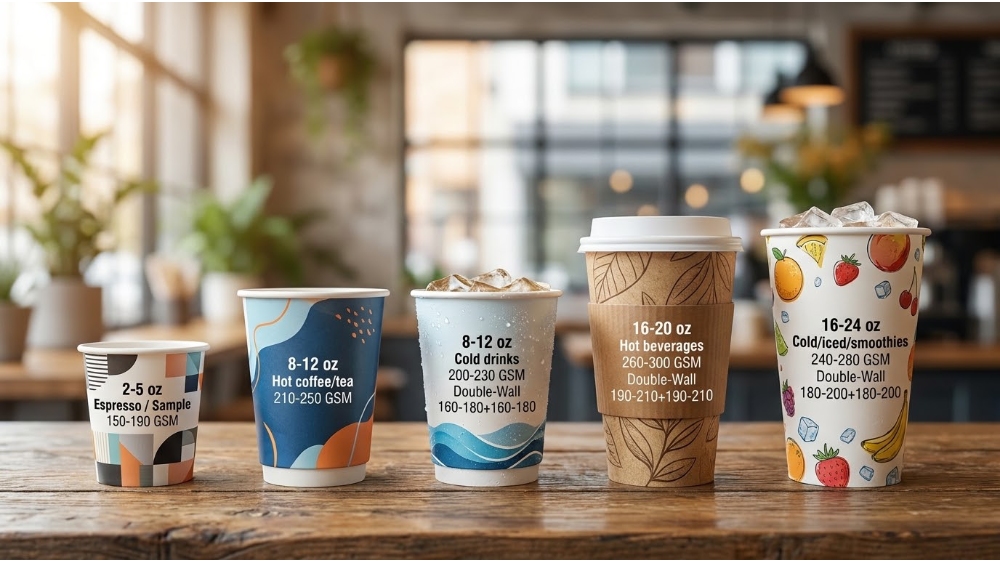
There is no universal GSM—the right number shifts with volume, temperature, and dwell time. Small espresso cups (2–5 oz) can run 150–190 GSM because the short fill height and rapid consumption reduce structural demands. Standard takeout cups (8–12 oz) typically fall into the 210–250 GSM range for hot beverages. Large 16–20 oz cold drink cups often use 260–300 GSM to resist buckling from ice weight and condensation.
Hot beverages impose the strictest requirements: near-boiling water softens paper fibers and weakens the bottom seal. A 12 oz hot cup at 230 GSM will outperform the same cup at 200 GSM under a 20-minute hold time. Cold drinks, by contrast, generate condensation on the exterior, which can weaken the sidewall through moisture wicking—so cold cups often use a heavier GSM or a specialized moisture-barrier coating.
Cup Size (oz)
Beverage Type
Single-Wall GSM Range
Double-Wall GSM Range (per layer)
2 – 5 oz
Espresso / Sample
150 – 190
N/A (usually single-wall)
8 – 12 oz
Hot coffee / tea
210 – 250
170 – 190 + 170 – 190
8 – 12 oz
Cold / iced drinks
200 – 230
160 – 180 + 160 – 180
16 – 20 oz
Hot beverages
260 – 300
190 – 210 + 190 – 210
16 – 24 oz
Cold / iced / smoothies
240 – 280
180 – 200 + 180 – 200
These ranges are industry baselines, not rigid rules. A cup with a tapered profile and a wide base can use a lower GSM than a straight-wall cup of the same volume because the geometry distributes hoop stress more efficiently. If you know less about paper cup sizes, you should learn it in detail by Paper Cup Sizes Chart: Oz to ml Dimensions Guide.
Is Higher GSM Always Better?
No. Higher GSM increases material weight, shipping cost, and environmental footprint—and it does not guarantee better field performance. A 280 GSM cup made from short-fiber recycled pulp can be weaker and more prone to seam failure than a 220 GSM cup made from long-fiber virgin kraft, because fiber length and bonding strength dominate tear resistance.
Industry research on paperboard mechanics confirms that stiffness (bending resistance) is driven more by caliper (thickness) and fiber orientation than by GSM alone. Two boards with identical GSM can have caliper differences of 10–15% depending on the refining and pressing process at the mill. That is why a cup from one supplier feels “soft” while another supplier’s cup at the same GSM feels rigid.
Overspecifying GSM also penalizes your logistics. Every 40 GSM increment adds approximately 12–15% to the base paper cost and increases shipping weight proportionally. For high-volume operators, the cumulative freight surcharge can erase any perceived quality benefit. The optimal GSM is the lowest number that consistently passes your real-world hold-time and handling tests.
GSM vs. Thickness vs. Strength: Critical Differences
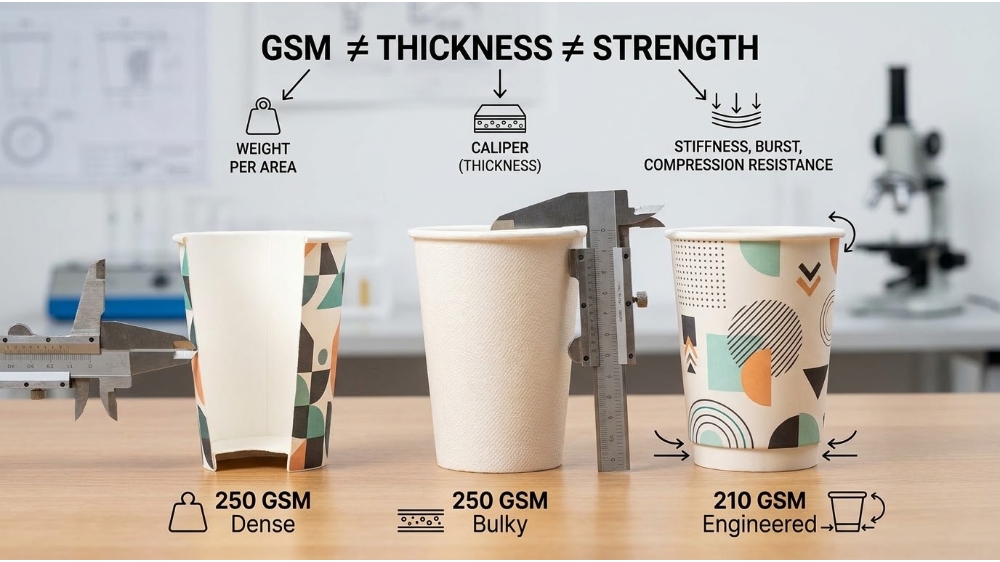
GSM ≠ thickness ≠ strength. This is the most important professional distinction in cup procurement. GSM measures weight per unit area. Thickness (caliper) measures the physical distance between the two surfaces of the paperboard, usually expressed in microns or points. Strength (stiffness, burst strength, or compression resistance) measures how the board resists deformation and fracture.
Consider two 250 GSM boards: one is heavily calendered (compressed) to a thin, dense sheet; the other is bulkier with more air volume between fibers. The bulky board has greater caliper, which generally provides higher bending stiffness—even though both weigh the same. This is why a cup made from a bulky, high-bulk fiber blend at 210 GSM can outperform a dense, highly refined 250 GSM cup in sidewall rigidity.
Cup strength is further decoupled from GSM by the geometry of the formed cup. The rim curl, bottom seam overlap, and sidewall taper all contribute to overall structural integrity. A well-engineered 210 GSM cup with a 6 mm rim curl and a double-floor bottom can withstand more compression stacking than a 250 GSM cup with a minimal curl and a flat bottom.
Key distinction for procurement teams:
GSM = weight (cost driver).
Caliper = thickness (stiffness driver).
Stiffness = resistance to bending (user experience driver).
Burst strength = resistance to puncture and seam failure.
When comparing supplier quotes, request both GSM and caliper (in microns) for the same cup size. If Supplier A quotes 250 GSM at 300 µm caliper and Supplier B quotes 240 GSM at 315 µm caliper, Supplier B’s cup will likely feel more rigid and cost less—a win-win.
Does Double-Wall Construction Change GSM Requirements?
Yes—fundamentally.Double-wall cups use two nested paper layers with an insulating air gap between them. The outer wall takes the brunt of handling and condensation, while the inner wall contains the hot liquid. Because the two layers are bonded only at the rim, the structural load is distributed across both walls. This distribution allows each layer to use a significantly lower GSM than a single-wall cup of the same overall strength.
A typical single-wall 16 oz hot cup might require 280–300 GSM to resist buckling and heat transfer. The same cup in a double-wall construction can use 190 GSM for the inner wall and 190 GSM for the outer wall—a combined weight of 380 GSM across two layers, but with far superior rigidity and insulation than a 300 GSM single-wall cup. The air gap also acts as a thermal break, reducing the need for sleeve packaging.
Double-wall construction does not simply add a second layer; it changes the mechanical physics. The outer wall bears the compression load from stacking, while the inner wall resists the hydrostatic pressure of the liquid. Because these forces are separated, each wall can be optimized independently. For cold drinks, double-wall cups often drop to 170 GSM per layer, as condensation is managed by the air gap rather than by the paper itself.
Procurement takeaway: If your specification currently mandates a 300 GSM single-wall cup, you can almost certainly switch to a double-wall cup with two 180–190 GSM layers—cutting material weight per cup while improving user comfort and structural performance.
How Much Weight Can a Paper Cup Hold?
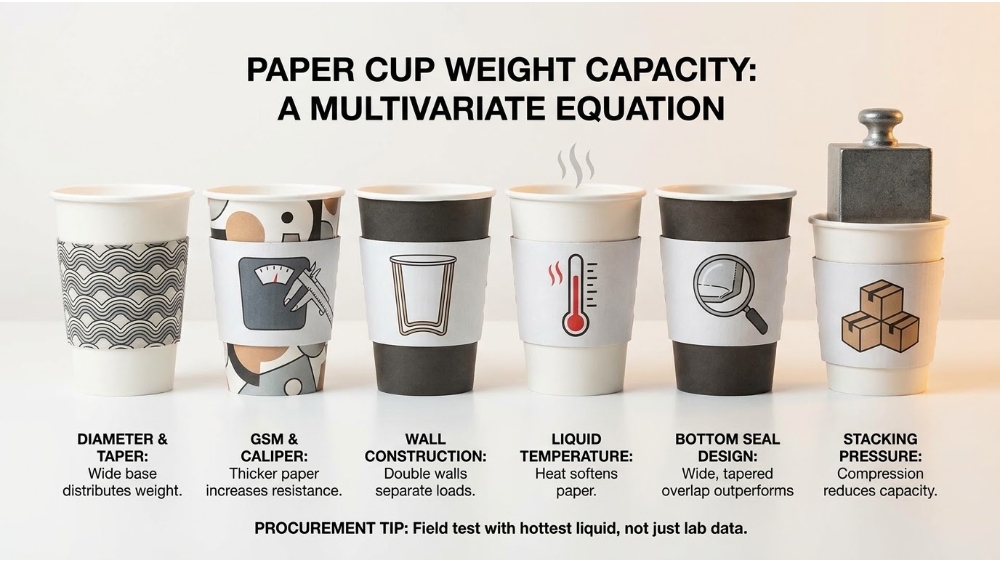
There is no single numerical answer to this question. A paper cup’s effective weight capacity is a multivariate equation. A 12 oz cup filled with hot coffee at 190°F does not “hold weight” the same way a 12 oz cup filled with iced tea does, because heat softens paper fibers and reduces the burst strength of the bottom seal by as much as 35% within the first three minutes of fill.
The variables that determine actual weight capacity include:
Cup diameter and taper: A wider base distributes liquid weight over a larger area, reducing bottom stress.
GSM and caliper: Higher GSM and greater caliper generally increase compression resistance, but the relationship is non-linear.
Wall construction: Double-wall cups separate compression and hydrostatic loads, effectively increasing capacity without raising GSM.
Liquid temperature: Hot liquids weaken the wet strength of paper coatings; a cup that holds 400 g of cold liquid may fail at 350 g of hot liquid.
Bottom seal design: A 10 mm sealed overlap with a tapered bottom outperforms a 6 mm straight overlap under identical fill weights.
Stacking pressure: Cups stored in a delivery bag under a 2 kg load experience sidewall compression that reduces effective capacity.
Rather than chasing an absolute “X pounds” rating, procurement teams should conduct a simple field test: fill the candidate cup with the hottest beverage in your menu at the maximum fill line, seal it in your delivery bag, and measure failure at 5, 15, and 30 minutes. A passing cup does not leak, buckle, or feel dangerously soft at the bottom seam. That test result is more reliable than any lab-sheet GSM specification.
How GSM Affects Cup Cost and Shipping
Paper is a commodity priced by the metric ton. Every gram of GSM represents material mass. A jump from 230 GSM to 270 GSM on a 12 oz cup adds roughly 17% more fiber to every cup. At scale—say, 5 million cups annually—that difference translates to hundreds of thousands of dollars in raw material spend.
The cost impact compounds through logistics. Heavier cups increase the pallet weight, reducing the number of units per shipping container. A container of 230 GSM cups might hold 480,000 units, while the same container with 270 GSM cups holds only 410,000 units—driving freight cost per cup up by 15–18%. For importers paying international shipping rates, the total landed cost differential between GSM tiers can approach 25–30%.
However, the real cost of under-specifying GSM is brand damage. A cup that leaks, buckles, or transfers excessive heat to the consumer’s hand generates negative reviews, return requests, and lost repeat business. The correct GSM is the one that balances unit cost against field reliability. In practice, operators serving short dwell times (under 10 minutes) can reduce GSM by 20–30 points relative to those with 20+ minute delivery windows.
Start with your actual use case—not the supplier’s standard recommendation. Document your average hold time from fill to consumption, your beverage temperature range, and your delivery bag configuration. If fries go out in a sealed thermal bag, the cup will experience higher humidity and temperature retention, accelerating fiber softening.
Test systematically. Order samples from three suppliers at three GSM tiers (e.g., 210, 240, and 270) for your largest cup size. Fill each with your hottest beverage, cap it, place it in your delivery bag, and evaluate at 10, 20, and 30 minutes. Record sidewall firmness, bottom seam integrity, and rim curl deformation. This data-driven approach eliminates guesswork and reveals the lowest GSM that passes your threshold.
Consider wall construction as a lever. If your test results show that 260 GSM single-wall cups just barely pass at 20 minutes, test a double-wall cup with two 190 GSM layers. The double-wall option may pass with better comfort and a lower combined material cost (380 GSM total vs 260 GSM single-wall—wait, careful: 190+190=380 GSM total material, but it actually uses more paper weight. However, because the layers are thinner individually, they can be made from lower-cost, lower-refined fiber, and the insulating air gap adds perceived quality. The cost comparison must be calculated per cup, not per GSM. In many cases, double-wall cups are priced higher per unit but justify the premium with sleeve elimination and superior customer experience.
Real-world procurement experience:
A fast-casual chain approached Maibao with complaints about sidewall collapse in their 16 oz iced coffee cups. Their existing 280 GSM single-wall cup from a competitor felt rigid at the sample stage but buckled consistently in summer heat due to condensation softening. We transitioned them to a double-wall cup with 180 GSM inner and 190 GSM outer layers, both coated with a moisture-resistant aqueous barrier. The new cup eliminated collapse complaints, reduced sleeve usage by 60%, and lowered the total cost per served unit by 11% after factoring in sleeve savings and reduced waste. The lesson: GSM is a starting point, not the final word. The wall architecture and coating system often matter more than a 20–30 point GSM delta.
Finally, verify your supplier’s quality control. Reputable converters measure GSM and caliper on every production run. Ask for the QC report for your batch—if they cannot produce it, they are not controlling the variables that matter.
Need cup packaging engineered for your hold time and volume?
Work with Maibao’s packaging specialists to match GSM, wall construction, and coating to your specific menu and delivery radius.
Most 12 oz hot cups use 210–250 GSM. The exact number depends on hold time, beverage temperature, and whether the cup is single-wall or double-wall. Cold 12 oz cups typically use 200–230 GSM.
Does a double-wall cup need higher or lower GSM?
Double-wall cups typically use lower GSM per layer (170–210 GSM each) because the two layers share the structural load. The combined system outperforms a single-wall cup of much higher GSM while providing insulation.
Why do two cups with the same GSM feel different?
GSM measures weight, not thickness or stiffness. Differences in fiber blend, refining, caliper (bulk), and forming geometry cause one cup to feel rigid while another feels flimsy at the same GSM.
How much does GSM increase cup cost?
A 40 GSM increase adds roughly 12–15% to the base paper cost and increases freight weight proportionally. The total landed cost difference between a 210 GSM and 250 GSM cup can exceed 20% for international shipments.
Post time:
Sep-02-2026
For inquiries about our products or pricelist, please leave your email to us and we will be in touch within 24 hours.