
A Reddit user once asked: “Are all paper cups lined with plastic? What’s the point of making paper cups if they’re lined with plastic?” It’s a fair question. The answer lies in material physics—paper provides structure, while plastic provides a barrier. Neither material is automatically superior; each serves a distinct function in the cup’s construction. This guide walks through the engineering, sustainability trade-offs, and purchasing criteria for commercial paper cup sourcing.
Paper Cups vs Plastic Cups: 9 Facts About Plastic Linings
Foodservice Packaging Guide
Why Do Paper Cups Have Plastic Linings? Are They Really Better Than Plastic Cups?
Every paper cup you hold contains a hidden plastic layer. This deep-dive explains the science behind the lining, compares paper vs. plastic cup performance, and gives B2B buyers a framework for smarter sourcing decisions.
Why Would a Paper Cup Need Plastic in the First Place?
Untreated paper is naturally porous and highly absorbent. Pour a hot coffee into an unlined paper cup, and the liquid penetrates the fiber matrix within seconds. The paperboard loses its structural integrity as the fibers swell, leading to rapid softening, leakage, and eventual collapse. The plastic lining—typically polyethylene (PE) or polylactic acid (PLA)—acts as a continuous, non-porous barrier that isolates the liquid from the paper fibers.
The paper and the lining perform entirely different jobs. The paperboard provides structure, rigidity, and a printable surface for branding. The lining provides the liquid barrier, heat sealability, and protection against moisture vapor transmission. Industry data confirms that without a barrier coating, paperboard absorbs up to 25% of its weight in water within 60 seconds, rendering it useless for hot or cold beverages. The plastic layer, by contrast, is typically less than 5% of the cup’s total weight but handles 100% of the liquid containment function.
What Would Happen If Paper Cups Had No Lining?
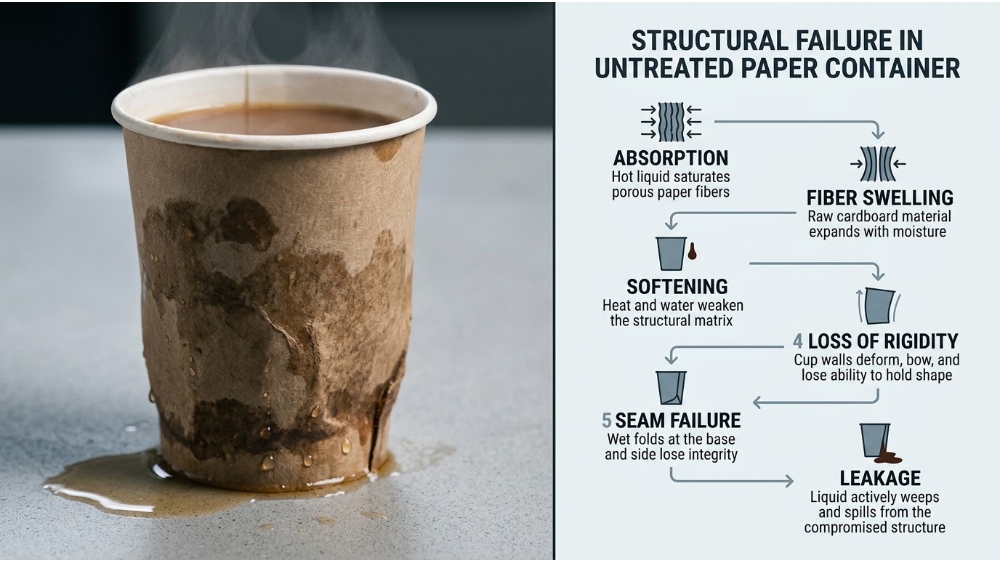
Imagine a 100% untreated paper cup—no coating, no wax, no plastic. The moment a beverage is poured in, a cascade of physical failures begins. First, liquid absorption starts at the cup’s interior surface. Next, the paper fibers swell as they take on moisture, expanding unevenly. This swelling leads to softening of the paperboard, which immediately loses its bending stiffness. The cup walls begin to bow outward under the weight of the liquid, and within two to three minutes, the bottom seam—which is held together by mechanical folding rather than adhesive sealing—begins to weep or leak outright.
This is the exact reason why the paper cup was not commercially viable until the invention of the waterproof lining in the early 20th century. The failure sequence is deterministic: absorption → fiber swelling → softening → loss of rigidity → seam failure → leakage. A plastic lining interrupts this chain at the very first step. Without it, the cup simply cannot hold liquid for longer than a few minutes, regardless of how thick or dense the paperboard is. The barrier is not optional—it’s foundational to the product’s existence.
Tip: Know more about paper cups soggy issues by Why Don’t Paper Cups Get Soggy? Leak-Proof Barrier Science.
Why Use Paper Instead of Making the Entire Cup From Plastic?
If a plastic lining is required, why not skip the paper and make the entire cup out of plastic? The answer lies in the distinct material advantages of paperboard beyond cost. Paperboard provides exceptional structural rigidity at a fraction of the weight of solid plastic. A paper cup with a thin plastic coating uses significantly less polymer material than an all-plastic cup of the same capacity—often 80% to 90% less plastic by weight.
Paper also offers superior printability for high-resolution graphics, a warmer tactile feel that consumers associate with quality, and significantly better insulation when designed with air pockets or corrugated walls. The paperboard substrate also allows for easier stacking and storage, as paper cups nest more reliably than plastic cups without sticking. Critically, the paper component is derived from a renewable resource, whereas plastic is fossil-fuel based. Neither material is automatically better in every application. For hot beverages requiring insulation and brand presentation, a paper-based structure with a thin plastic barrier often outperforms a solid plastic cup. For cold drinks requiring maximum moisture resistance and clarity, solid plastic may still be preferred. The choice depends entirely on the use case. Click to learn if paper cup safe for hot drinks
How Much Plastic Is Actually in a Paper Cup?
The plastic lining in a standard paper cup is remarkably thin—typically between 15 and 25 grams per square meter (gsm) of coating weight. By comparison, the paperboard substrate ranges from 200 to 350 gsm. This means the plastic layer represents roughly 5% to 8% of the cup’s total material weight. For a standard 12 oz cup weighing about 12 grams, the plastic lining weighs approximately 0.6 to 1.0 grams.
This is a critical distinction: “paper cup” does not mean “100% paper.” The bulk of the material is renewable fiber, while the functional barrier is a thin polymer film. In many markets, this product is legally classified as a paper-based composite rather than as a plastic item. The thinness of the lining is precisely why paper cups cannot simply be recycled in standard paper mills—the plastic layer must be separated from the fiber in a hydropulping process, which is expensive and not widely available. The physical fact that the lining is “thin” does not make it negligible; it’s thin but functionally decisive.
What Types of Plastic Linings Are Used in Paper Cups?
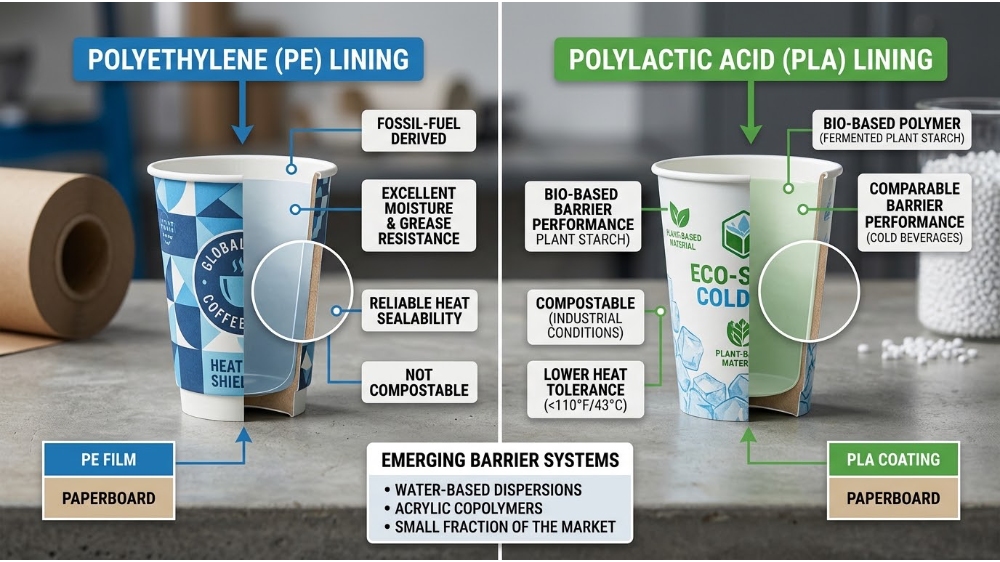
The vast majority of paper cups use one of two primary lining materials. Polyethylene (PE) is the industry standard—it is extruded or laminated onto the paperboard as a continuous film. PE offers excellent moisture and grease resistance, reliable heat sealability for seam formation, and relatively low cost. However, PE is derived from fossil fuels and is not compostable in typical commercial systems.
Polylactic acid (PLA) is a bio-based polymer derived from fermented plant starch (usually corn). PLA provides comparable barrier performance for cold beverages and is marketed as compostable under industrial conditions. However, PLA has a lower heat tolerance (softening around 110°F) and is not suitable for hot beverages without additional engineering. Other emerging barrier systems include water-based dispersions and acrylic copolymers, though these represent a small fraction of the market. Manufacturers choose between PE, PLA, and other systems based on the required temperature resistance, end-of-life goals (recyclable vs. compostable), and cost constraints.
Tip: Learn paper cup coating types in detail by Paper Cup Coatings: PE vs PLA vs Water-Based – Performance & Sustainability.
Does a Plastic Lining Make Paper Cups Less Sustainable?
Sustainability is a systems-level property, not a single-material attribute. A paper cup with a plastic lining uses significantly less plastic than a solid plastic cup, but the presence of that lining complicates traditional paper recycling. In regions with dedicated cup recycling infrastructure (using hydropulping separation), PE-lined cups can be recycled into new paper products. In areas without such facilities, the cups typically end up in landfill or incineration.
If a cup is sent to landfill, the paper component may biodegrade and release methane while the PE layer persists as a microplastic fragment. If it is sent to a modern waste-to-energy facility, both the paper and the plastic contribute to energy recovery. PLA-lined cups require specialized industrial composting—they do not break down in home compost or marine environments. The environmental performance depends on the entire packaging system: the source of the fiber, the type of plastic, the manufacturing energy, transport distance, and the actual end-of-life pathway available to the consumer. No single cup material is universally “greener.” For B2B buyers, the most sustainable choice is the one that matches the local waste infrastructure and the specific operational needs of their business.
Why Can’t We Just Make Paper Cups Completely Plastic-Free?
Eliminating the plastic lining entirely is a significant technical challenge. The barrier must withstand liquid water, water vapor (steam), oils, and mechanical stress from heat sealing. Current plastic-free alternatives include aqueous coatings (water-based acrylic or styrene-acrylic dispersions), which provide some resistance but typically fail in high-heat, high-humidity conditions above 160°F. Wax-coated cups were historically used but are no longer common due to cost and poor heat resistance.
Some advanced fiber-based barriers use biodegradable polymers blended with mineral fillers, but these often require thicker coating layers (up to 40 gsm) to match the performance of a 20 gsm PE layer, increasing material consumption. The key performance gap is heat-sealability—most non-plastic coatings cannot form the tight, leak-proof seam required for the cup’s sidewall joint. Until alternative coatings can match PE’s combination of liquid holdout, heat-seal strength, and cost-effectiveness, the plastic lining remains the industry standard. The market is moving toward fiber-based and aqueous solutions, but they are not yet a universal drop-in replacement.
Does a Paper Cup With a Lining Still Have Advantages Over a Plastic Cup?
Yes—in several measurable dimensions. A paper cup with a thin plastic lining is significantly lighter than an equivalent solid plastic cup (often 20-30% less weight), reducing transport emissions and cost. The paperboard structure provides natural insulation that keeps hot beverages warmer for longer than thin-walled plastic cups. Double-wall paper cups offer even greater insulation without any foam core.
Paper cups also have superior brand presentation; they take high-quality offset and flexographic printing with vibrant colors and sharp text, whereas plastic cups require more expensive screen printing or labeling. From a user perception standpoint, paper cups are overwhelmingly preferred by consumers who associate paper with natural origins and higher perceived food safety. In regulated markets, paper cups are also easier to market as “plant-based” or “renewable” because the dominant material is wood fiber. These advantages do not make paper cups automatically “better,” but they make them distinctly suitable for specific applications—especially hot beverages, dine-in service, and branded grab-and-go concepts.
Paper Cup vs Plastic Cup: Which Is Better for Businesses?
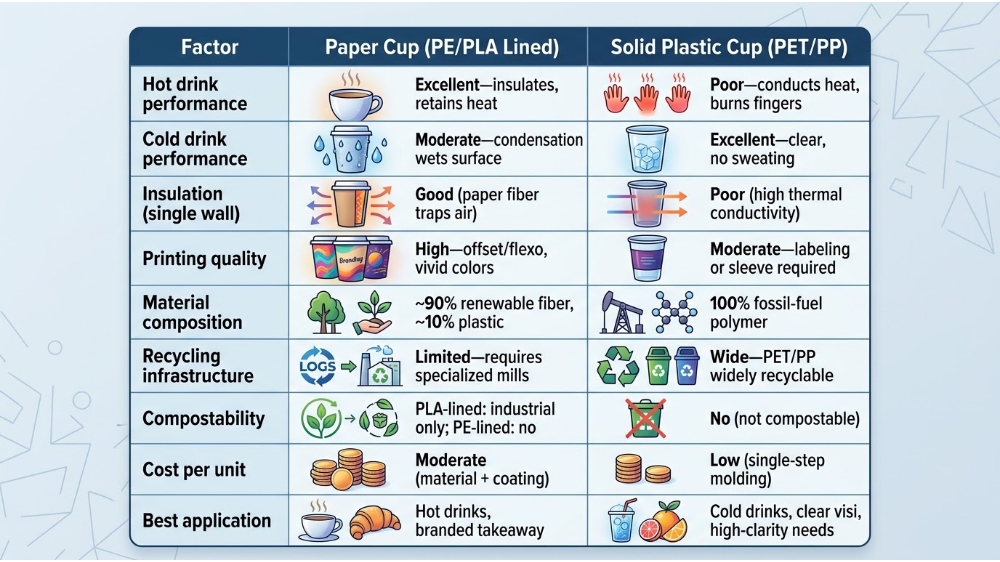
The answer depends entirely on your operational context. For businesses serving hot coffee, tea, or soups, a paper cup with a PE or PLA lining is almost always the better choice—it provides insulation, heat retention, and a comfortable rim temperature. For cold beverages like iced coffee, smoothies, and fountain drinks where condensation and clarity matter, a clear PET or PP plastic cup offers superior visual appeal and moisture control.
| Factor | Paper Cup (PE/PLA Lined) | Solid Plastic Cup (PET/PP) |
|---|---|---|
| Hot drink performance | Excellent—insulates, retains heat | Poor—conducts heat, burns fingers |
| Cold drink performance | Moderate—condensation wets surface | Excellent—clear, no sweating |
| Insulation (single wall) | Good (paper fiber traps air) | Poor (high thermal conductivity) |
| Printing quality | High—offset/flexo, vivid colors | Moderate—labeling or sleeve required |
| Material composition | ~90% renewable fiber, ~10% plastic | 100% fossil-fuel polymer |
| Recycling infrastructure | Limited—requires specialized mills | Wide—PET/PP widely recyclable |
| Compostability | PLA-lined: industrial only; PE-lined: no | No (not compostable) |
| Cost per unit | Moderate (material + coating) | Low (single-step molding) |
| Best application | Hot drinks, branded takeaway | Cold drinks, clear visibility, high-clarity needs |
This comparison demonstrates that a paper-based cup with a thin plastic lining is not a “compromise”—it is a specific engineering solution optimized for hot beverage service. Solid plastic cups are optimized for cold, transparent, and high-durability applications. The smart business decision is to match the cup material to the beverage temperature, holding time, and brand experience you intend to deliver.
Tip: If you’re interested in paper cup other comparison, you could read Paper vs Styrofoam Cups Thermal Performance Guide.
What Should Buyers Look for When Choosing Paper Cups?
Commercial buyers should evaluate paper cups across five essential criteria. First, application temperature: hot drinks require PE linings rated for temperatures above 190°F, while cold drinks can use PLA or thin PE. Second, barrier coating: confirm whether the cup uses PE, PLA, or an aqueous coating, and verify the coating weight (gsm) from the supplier spec sheet.
Third, wall construction: single-wall cups are cost-effective for short holds (under 10 minutes), while double-wall or corrugated cups improve insulation for delivery and longer service times. Fourth, end-of-life requirements: if your business promotes recyclability, ensure the cup is compatible with local paper mills or use a certified compostable PLA cup if industrial composting is available in your region. Finally, regulatory compliance: check that the cup meets FDA (or your local equivalent) food-contact regulations and that the paperboard is sourced from certified sustainable forestry (e.g., FSC).
Most importantly, request physical samples and test them with your actual beverage at your holding temperature. A cup that looks perfect on paper may fail when filled with 200°F coffee and held under a heat lamp for 20 minutes. Work with a packaging supplier who provides full technical specifications and is transparent about coating type, recycled content, and recycling compatibility.
Quick buyer’s checklist:
- Beverage temperature (hot vs. cold) — determines PE vs. PLA vs. aqueous
- Hold time (counter service vs. delivery) — single-wall vs. double-wall
- Local recycling/composting infrastructure — choose PE (recyclable) or PLA (compostable) accordingly
- Printing requirements — evaluate CMYK vs. spot color and registration accuracy
- Supplier certifications — FSC, FDA, ISO, and coating spec sheets
For businesses scaling beverage packaging across multiple outlets, consistency in cup performance is non-negotiable. A reliable supplier should offer documented quality control procedures, batch traceability, and stable lead times. Sourcing from a single partner who can provide matching lids, sleeves, and carriers further simplifies logistics and reduces packaging variability.
Need beverage packaging that matches your operational needs?
Talk to a packaging specialist about cup coatings, temperature ratings, and end-of-life options tailored to your menu and delivery model.
Frequently Asked Questions
Can paper cups with plastic linings be recycled?
Yes, but only at specialized recycling facilities that use hydropulping to separate the plastic from the paper fiber. Most standard curbside recycling programs cannot process them, and the cups should be checked against local recycling guidelines.
Do paper cups with PE linings release microplastics?
Recent research from the University of Queensland has shown that both PE- and PLA-lined cups can release microplastic and nanoplastic particles into hot beverages, though the levels are within current safety thresholds established by food safety authorities.
Are PLA-lined cups better for the environment than PE-lined cups?
PLA is bio-based and can be industrially composted, but it is not home-compostable and does not biodegrade in landfills. PE is fossil-fuel based but more widely compatible with existing recycling infrastructure. Neither is universally “better”—the optimal choice depends on local waste management systems.
Why don’t manufacturers use 100% paperboard with no coating at all?
Untreated paperboard lacks the necessary barrier properties to hold liquids, maintain seam integrity, and withstand the heat of hot beverages. The plastic lining is a functional necessity, not a design choice—without it, the cup would leak and collapse within minutes.
Post time: Sep-04-2026