How to Buy Paper Cups for a Small Business: 7 Things to Consider Before Ordering
How to Buy Paper Cups for a Small Business: 7 Key Factors
Foodservice Packaging Guide
How to Buy Paper Cups for a Small Business: 7 Things to Consider Before Ordering
Paper cups seem simple — until you price out custom printing, realize your 12oz lid doesn’t fit the 16oz cup, or get hit with a shipping bill that doubles your unit cost. For small businesses, every decision matters. This guide walks through the seven critical factors that determine whether your cup order saves money or wastes it.
A coffee shop owner once ordered 20,000 custom cups with her logo, only to discover the 90mm lids she already owned didn’t snap onto the 90mm rim of the new cups. The variance was less than a millimeter — but every cup leaked. That’s the kind of costly mistake this guide helps you avoid.
Paper cups are among the most frequently ordered packaging items for small foodservice businesses, yet they’re also among the most misunderstood. Between sizing, wall construction, printing, minimums, shipping, and lid compatibility, there are at least seven distinct decisions to get right. This guide breaks down each one with real numbers, material science, and practical advice for small-batch buyers.
What size paper cups should I order for my drink menu?
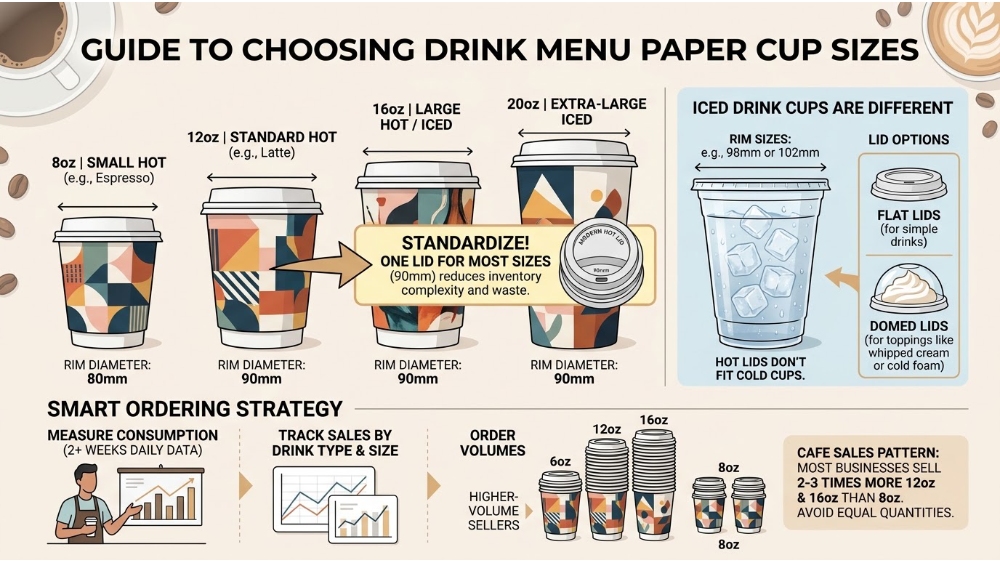
Start with your actual beverage sizes, not what you think customers want. Most cafes settle on four core sizes: 8oz (small hot drinks), 12oz (standard hot), 16oz (large hot / iced), and 20oz (extra-large iced). But size isn’t just about capacity — it’s about rim diameter, which determines which lids fit.
Standard hot cup rims are typically 80mm for 8oz and 90mm for 12oz, but 16oz and 20oz often share the same 90mm rim. This is critical: if you standardize around a 90mm rim across all your hot cups above 12oz, you only need one lid size for most of your menu, reducing inventory complexity and waste.
For cold drinks, the game changes. Iced cups use different rim profiles (typically 98mm or 102mm) and require flat or domed lids depending on whether you add whipped cream or cold foam. Do not assume your hot cup lids fit cold cups — they don’t. Measure daily consumption by drink type for at least two weeks before ordering. Track which sizes sell most, then order those sizes in greater volume. A common mistake is ordering equal quantities of each size — most businesses sell 2-3 times more 12oz and 16oz than 8oz.
Single-wall or double-wall — which is better for my business?
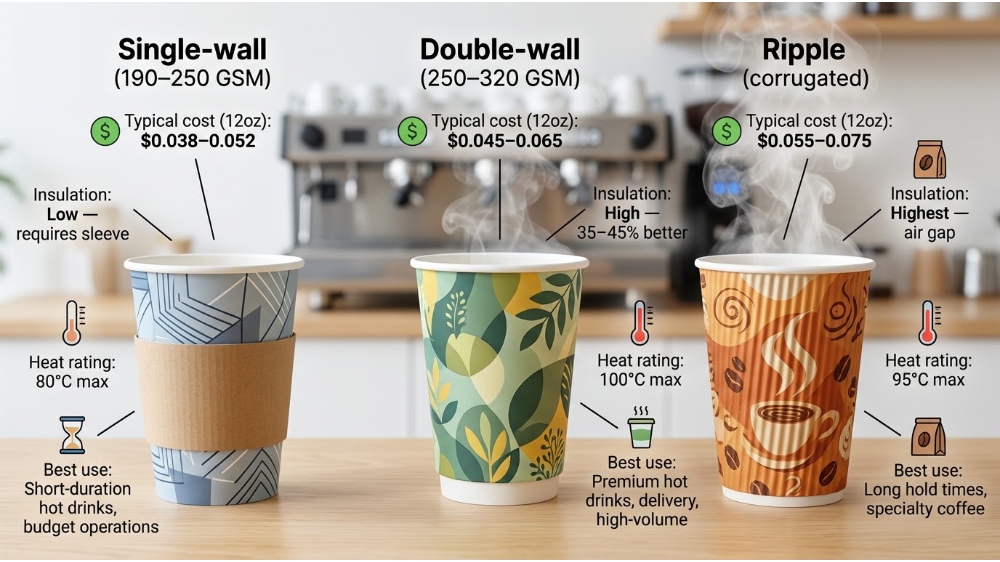
Single-wall cups are made from a single layer of paperboard, typically 190–320 GSM. They’re cheaper, lighter, and sufficient for short-duration hot drinks — but they transfer heat quickly, making them uncomfortable to hold without a sleeve. Double-wall cups use two layers of paperboard with an air gap in between, providing 35–45% better heat retention and keeping the exterior cool to the touch.
The cost difference is significant. In 2025, single-wall cups range from $0.038–0.052 per unit (plus sleeve) for a 12oz, while double-wall cups run $0.045–0.065 per unit — 20–60% more. But here’s the math that changes: a single-wall cup plus a sleeve costs roughly the same as a double-wall cup alone, and double-wall eliminates the sleeve inventory, the extra packaging step, and the customer annoyance of a slipping cardboard sleeve. For high-volume cafes, double-wall cups often win on operational efficiency despite the higher unit cost.
For operators serving extra-hot drinks (above 80°C), single-wall cups can become flimsy and lose structural integrity — double-wall cups are rated for up to 100°C and maintain their rigidity. If you’re serving pour-over or tea at near-boiling temperatures, double-wall is the safer choice for both customer comfort and cup performance.
Tip: Learn more about difference between single wall and double wall paper cups by reading their comparison guide.
What’s the minimum order quantity (MOQ) and can I negotiate it?
MOQ depends entirely on whether you’re buying stock cups or custom-printed cups. Stock cups (plain white or kraft with no custom branding) have MOQs as low as 50–200 units — you can order a few sleeves at a time from restaurant supply stores. Custom-printed cups, on the other hand, typically require 10,000–50,000 units per size when ordered directly from Asian manufacturers, with some larger suppliers requiring 100,000+ for four-color printing.
Here’s the negotiation tactic most small business owners don’t know: you can ask for a tiered MOQ structure. Some suppliers will print 3,000–5,000 units at a higher per-unit price as a “sample run” or “soft launch” order. The per-unit cost will be higher (sometimes 2–3x the bulk rate), but you’re paying for the flexibility. Another approach: split your order across multiple suppliers — order stock cups for immediate needs while working with a custom supplier for the long-term branded cups.
Wholesale bulk purchases can save 20–30% compared to small-batch orders, but only if you have the storage space and the cash flow to hold inventory. For a new business, starting with stock cups and transitioning to custom after 3–6 months of sales data is a lower-risk strategy that avoids thousands of dollars in unused inventory.
Should I buy stock cups or invest in custom printing?
Stock cups are plain white or kraft, sold off-the-shelf with no branding. They cost less, ship immediately, and have low MOQs. Custom cups display your logo, brand colors, and possibly a tagline or design. They cost more upfront (tooling + setup fees + higher per-unit cost) and take 3–8 weeks for delivery, but they turn every cup into a billboard for your brand.
The decision comes down to volume: if you sell fewer than 500 cups per day, custom printing is hard to justify — the branding benefit is real, but the cost per impression is high. Most small businesses should start with stock cups, apply custom stickers or branded sleeves for branding, and transition to custom-printed cups once monthly volume exceeds 5,000–10,000 units per size. At that scale, the per-unit markup for custom printing drops to $0.005–0.015 per cup, making the brand value worthwhile.
One underrated factor: custom cups signal professionalism and build customer trust. A plain white cup from a local cafe feels temporary; a custom-branded cup feels like a deliberate brand experience. If your business competes on experience (not just price), custom cups are a relatively inexpensive way to elevate perception. But order samples first — colors print differently on paperboard than on screen, and a poorly executed print job looks worse than a plain cup.
How much storage space do bulk cups need?
This is the hidden cost that sinks small businesses. A standard pallet of 12oz cups holds approximately 6,000–7,500 units depending on the cup construction (double-wall cups take slightly more space due to the thicker material). If you order 50,000 cups, you’re looking at 7–8 pallets — roughly 70–80 cubic feet of storage. That’s a significant chunk of a small cafe’s back-of-house space.
Storage conditions matter as much as space. Paper cups are moisture-sensitive — humidity above 60% can cause cups to warp, lose rigidity, or fail to seal properly. Store cups off the floor (on pallets), away from exterior walls, and in climate-controlled environments if possible. Cups left in a humid garage or warehouse can degrade in 2–3 weeks. Shelf life is typically 1–2 years under proper conditions, but high-humidity environments can cut that to 4–6 months.
Calculate your monthly consumption before ordering bulk. If you use 1,200 cups per week (about 5,200 per month), a 50,000-unit order covers nearly 10 months — which is fine if you have the space and the cash flow. But if your storage area is limited to a single 4×4-foot shelf, you’re limited to about 2,000–3,000 cups. Measure your storage footprint before you order, not after.
Unit price vs landed cost — what’s the real cost per cup?
This is where most buyers get burned. The FOB (Free On Board) price — the cost per cup at the supplier’s factory — is not the cost to your door. For international orders, landed cost can be 35–50% higher than the FOB price once you add shipping, insurance, customs duties (typically 3–6% for paper products entering the US), port fees, and inland freight.
Let’s run the numbers. A 12oz double-wall cup might cost $0.050 FOB. Add ocean freight ($0.008–0.015 per cup), customs duty (4% = $0.002), and domestic freight from port to your warehouse ($0.003–0.005), and your landed cost is roughly $0.065–0.072 per cup — a 30–44% increase over the quoted unit price. Industry data shows landed cost consistently adds 35–50% to FOB pricing, so factor that into your budgeting.
For domestic suppliers, the gap is smaller — shipping is typically $0.005–0.010 per cup, and no duties apply. But domestic per-unit prices are often 20–40% higher than Asian suppliers to begin with. The trade-off is speed, lower MOQs, and no customs risk. Price both options, not just the FOB number. A $0.055 domestic cup might actually be cheaper after shipping than a $0.045 imported cup that adds $0.020 in freight and fees.
Lid compatibility is the single most common failure point in cup ordering. The problem: two cups with the same stated rim diameter (e.g., 90mm) can have different rim profiles — one might have a rolled lip, another a straight-wall rim, and a third might have a slight taper. Lids are engineered to snap onto a specific rim geometry, not just a diameter. Even a 0.5mm variance can cause leaks, poor seals, or lids that pop off.
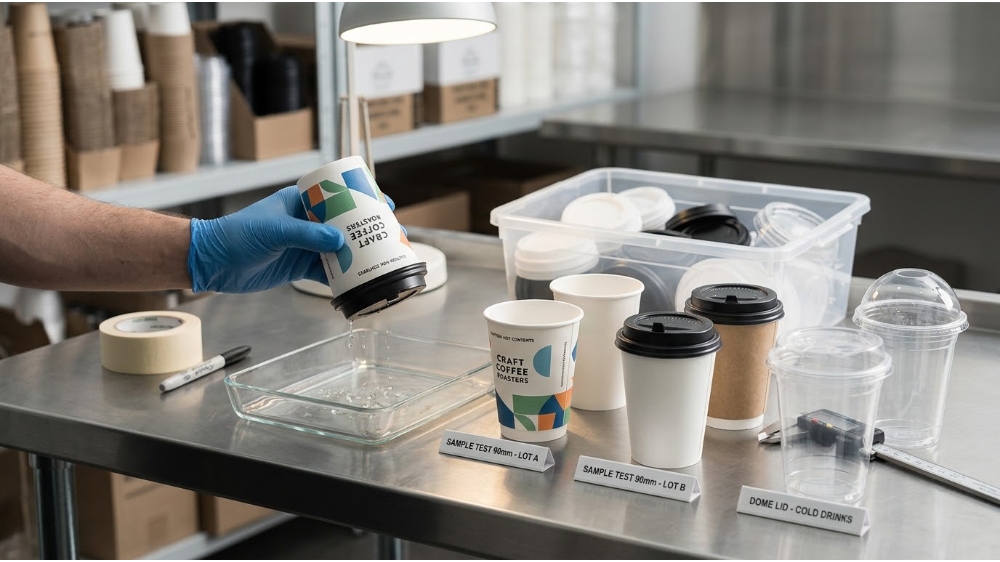
The fix is simple but often ignored: order sample lids and sample cups from the same supplier and test them together before committing to bulk. Fill a cup with hot water, snap on the lid, turn it upside down, and shake gently. If it leaks, reject the combination. Suppliers that promise “snap-fit” compatibility but can’t provide test samples are not worth the risk.
Also consider lid type: flat lids for hot drinks (sipping spout), domed lids for iced or blended drinks (clear plastic, raised center for whipped cream), and sip-through lids that allow drinking without removing the lid. Each lid type has different fit specifications. If you’re serving both hot and cold drinks, you’ll need at least two lid SKUs — don’t try to use a flat lid on an iced cup or a domed lid on a hot cup.
Cup type comparison: single-wall, double-wall, and ripple
Each cup construction type serves a different use case. The table below compares the three most common variants across cost, insulation, structural integrity, and best-fit application.
Cup type
Typical cost (12oz)
Insulation
Heat rating
Best use
Single-wall (190–250 GSM)
$0.038–0.052
Low — requires sleeve
80°C max
Short-duration hot drinks, budget operations
Double-wall (250–320 GSM)
$0.045–0.065
High — 35–45% better
100°C max
Premium hot drinks, delivery, high-volume
Ripple (corrugated)
$0.055–0.075
Highest — air gap
95°C max
Long hold times, specialty coffee
Ripple cups (sometimes called corrugated cups) combine a single-wall interior with a corrugated exterior layer, creating an air gap that insulates better than double-wall. They cost more but provide exceptional heat retention and a distinctive textured feel. For delivery-focused operations or customers who nurse their drinks slowly, ripple cups are the premium choice.
Lead time and shipping — when will my cups arrive?
Lead time varies wildly by supplier type. Domestic suppliers typically deliver in 2–7 business days for stock cups and 2–4 weeks for custom printing. International suppliers (primarily from Asia) take 30–60 days for sea freight plus 2–4 weeks for production — total lead time of 6–12 weeks from order to delivery. Plan your order at least 3 months before you need the cups if you’re going overseas.
Shipping method is the lever you can pull to adjust speed. Air freight cuts transit time from 30 days to 3–5 days but can cost 3–5x more than sea freight, wiping out the savings of an international supplier. For urgent needs, a split strategy works: order a small batch via air to cover immediate demand while sea freight carries the main order.
Don’t forget to account for port delays, customs clearance, and inland freight — these can add 1–3 weeks to the total lead time, especially during peak seasons (September–December). Building a buffer of 2–4 weeks of extra inventory is a prudent practice for any business relying on international supply chains.
Building a cup-buying strategy for your small business
Buying paper cups isn’t a one-size-fits-all decision. The seven factors above — size, wall type, MOQ, stock vs custom, storage, landed cost, and lids — all interact. A change in one cascades through the rest. The lowest FOB price often leads to the highest landed cost. The smallest MOQ usually means the highest per-unit price. The fastest shipping usually means the highest freight cost.
The winning strategy: test small, order medium, scale when verified. Start with stock cups from a domestic supplier for 1–2 weeks of inventory. Test your drink sizes, lid fit, and customer response. Once you’ve validated your sizing and volume, place a custom order with an international supplier at a larger MOQ — but build in the 6-12 week lead time and the 35-50% landed cost buffer.
For operators managing multiple locations or scaling rapidly, consistency across all seven factors is more important than any single variable. A cup that works for your flagship store should work for all stores — same rim profile, same lid, same supplier, same specification. Changing suppliers mid-stream introduces the risk of mismatched lids, changed rim profiles, or inconsistent quality.
Need paper cups optimized for your menu and delivery radius?
Get a sourcing consultation that matches cup specifications, printing options, and shipping logistics to your actual volumes and storage constraints.
Can I order custom cups with a low MOQ (under 5,000)?
Yes — some digital printers offer low-MOQ runs of 1,000–3,000 cups using digital or flexographic printing, but per-unit costs are 2–3x higher than bulk offset printing. Expect to pay $0.12–0.20 per cup for small-run custom orders, with lead times of 2–3 weeks.
How long do paper cups last in storage?
Properly stored (cool, dry, off-floor), paper cups have a shelf life of 1–2 years. In humid environments, shelf life drops to 4–6 months as cups absorb moisture, warp, and lose structural integrity. Always store in original packaging and away from moisture sources.
Can I use one lid size across multiple cup sizes?
Only if the rim diameters match. Many 12oz, 16oz, and 20oz hot cups share a 90mm rim, allowing one lid to cover all three sizes. But never assume — always verify rim diameter and profile with samples from your supplier before ordering.
What’s the best cup for iced coffee and cold drinks?
For cold drinks, use PET or PLA clear cups with a 98mm or 102mm rim (depending on the cup size) and flat or domed lids. Paper cups are not ideal for iced drinks because condensation weakens paperboard, causing cups to become flimsy after 15–20 minutes. Use double-wall paper for iced only if the drink is consumed quickly.
Post time:
Sep-02-2026
For inquiries about our products or pricelist, please leave your email to us and we will be in touch within 24 hours.