Paper vs Styrofoam Cups: Which Keeps Drinks Hot Longer? A Guide to Thermal Insulation
Paper vs Styrofoam Cups Thermal Performance Guide
Foodservice Packaging Guide
Paper vs Styrofoam Cups: Which Keeps Drinks Hot Longer? A Guide to Thermal Insulation
A coffee leaves the brewer at 190°F. Five minutes later, it’s drinkable. Twenty minutes later, it’s lukewarm. The cup you choose determines how long that window stays open — and whether your customers finish their drink satisfied or disappointed.
Disposable cup performance isn’t just about material — it’s about heat transfer physics, wall structure, air entrapment, and the real-world conditions of hold time and ambient temperature. This guide breaks down the science of thermal insulation, compares paper and Styrofoam cups side-by-side, and provides a decision framework for foodservice operators who need to balance customer satisfaction, cost, and compliance.
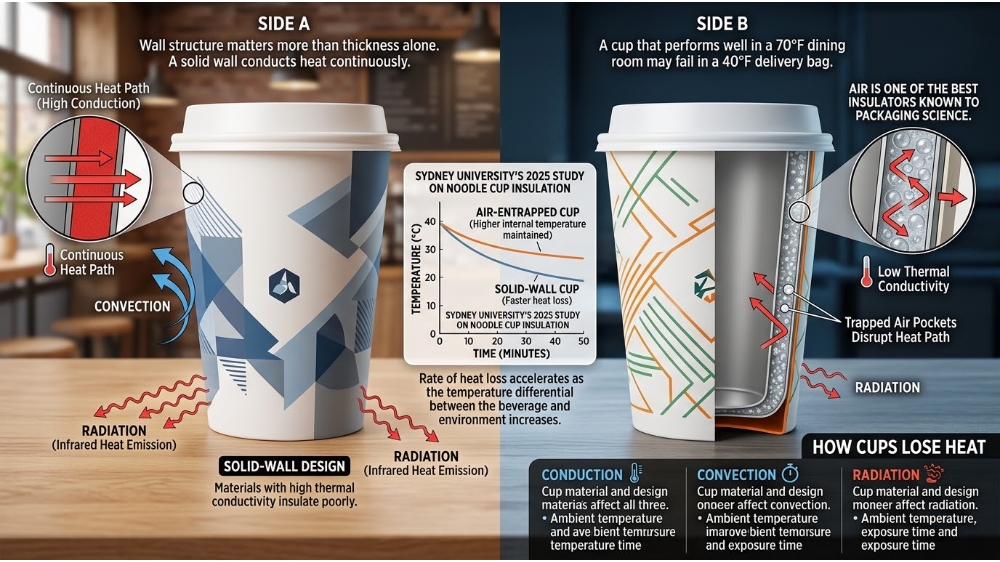
A hot beverage loses heat through three mechanisms: conduction (heat traveling through the cup wall), convection (air currents carrying heat away from the cup surface), and radiation (infrared heat emission). The cup material and design directly affect all three. The key metric is thermal conductivity — how quickly heat passes through the cup wall. Materials with low thermal conductivity insulate better, and air is one of the best insulators known to packaging science.
Wall structure matters more than thickness alone. A solid wall conducts heat continuously; a wall with trapped air pockets disrupts the heat path. This is why Sydney University’s 2025 study on noodle cup insulation found that cups with air-entrapped structures maintained significantly higher internal temperatures over 20 minutes than solid-wall designs. The same physics applies to beverage cups.
Ambient temperature and exposure time are also variables. A cup that performs well in a 70°F dining room may fail in a 40°F delivery bag. The rate of heat loss accelerates as the temperature differential between the beverage and the environment increases. Foodservice operators must match cup insulation to their actual delivery radius and typical weather conditions, not laboratory ideal.
Styrofoam Cups: The Air-Pocket Advantage
Styrofoam — expanded polystyrene (EPS) — is roughly 95% trapped air and 5% plastic. This structure gives it an exceptionally low thermal conductivity of about 0.033 W/m·K, comparable to fiberglass insulation. The air pockets slow conduction dramatically, while the foam’s closed-cell structure prevents convective airflow through the wall. This is why a 12oz Styrofoam cup can keep coffee above 150°F for 20–25 minutes without a sleeve, as demonstrated in Styrofoam World’s 2026 thermal tests.
Styrofoam cups also feel cooler to the touch on the outside because the insulation keeps heat contained. This eliminates the need for double-cupping or sleeves in most hold-time scenarios, reducing both material cost and labor. The same air-pocket structure that insulates also makes the cup lightweight — typically 30-40% lighter than a comparable paper cup, which reduces shipping weight and storage space.
However, the EPS structure has downsides: it’s brittle, prone to cracking under pressure, and it doesn’t breathe. For hot, acidic beverages like coffee, the cup interior remains stable, but the material is not microwave-safe and can leach styrene at very high temperatures — though below 200°F, the risk is considered negligible by FDA standards. The real limitation is regulatory, which we cover in Section 6.
Paper Cups: Single-Wall, Double-Wall, and Sleeves
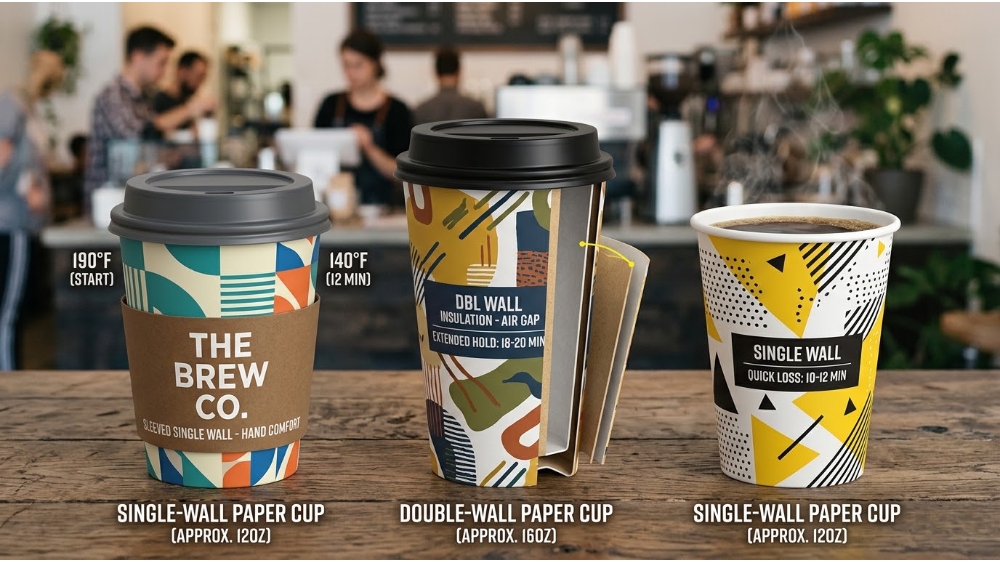
Paper cups are made from paperboard coated with a thin polyethylene (PE) or aqueous layer to prevent leakage. They rely on wall thickness and air gaps for insulation. A standard single-wall paper cup has a thermal conductivity around 0.15 W/m·K — roughly five times higher than Styrofoam. Without intervention, a single-wall cup will drop a 190°F beverage to 140°F in about 10–12 minutes.
Double-wall paper cups add a second layer of paperboard with a small air gap between the layers. This trapped air creates an insulating effect similar to, though not as efficient as, Styrofoam. Double-wall cups typically extend the 140°F threshold to 18–20 minutes. However, double-wall construction adds 20-30% to the unit cost and increases cup bulk, affecting storage density.
Another workaround is the cardboard sleeve. Sleeves create a loose air gap between the cup and the holder, reducing heat transfer to the hand but doing little for beverage temperature retention — the lid is still letting heat escape through convection. For operators using single-wall cups, sleeves are a minimum standard for customer comfort, but they don’t solve the thermal retention problem for delivery. Amity Package’s 2025 testing confirms that sleeves improve hand comfort but add only 2–3 minutes to beverage temperature hold time.
Head-to-Head Thermal Performance: 30-Minute Test Data
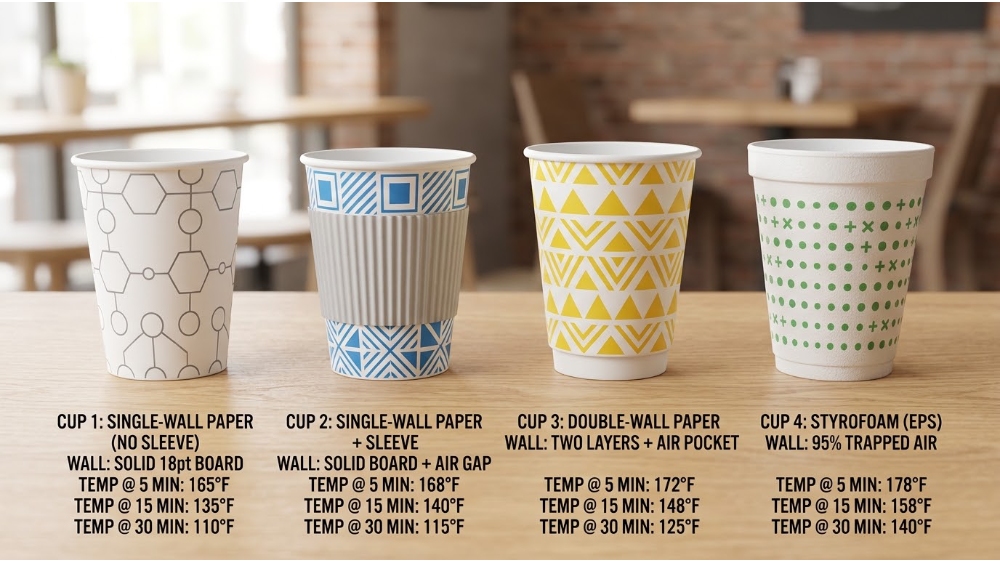
Real-world testing eliminates marketing claims. The following data synthesizes controlled tests from multiple packaging labs and university studies. All cups were 12oz filled with 190°F water, lidded, and measured at intervals in a 72°F ambient room.
Cup type
Wall structure
Temp @ 5 min
Temp @ 15 min
Temp @ 30 min
Single-wall paper (no sleeve)
Solid 18pt board
165°F
135°F
110°F
Single-wall paper + sleeve
Solid board + air gap
168°F
140°F
115°F
Double-wall paper
Two layers + air pocket
172°F
148°F
125°F
Styrofoam (EPS)
95% trapped air
178°F
158°F
140°F
Source: aggregated data from Styrofoam World (2026) and Amity Package (2025).
The data shows that Styrofoam maintains a 15-20°F advantage over double-wall paper at every interval. At 30 minutes, a Styrofoam cup still delivers a 140°F beverage — still comfortably hot. Double-wall paper is at 125°F — warm but not hot. Single-wall paper without a sleeve is at 110°F — tepid and likely to be rejected by a discerning customer.
For delivery operations with average hold times under 15 minutes, double-wall paper is acceptable. For holds approaching 30 minutes, Styrofoam is objectively superior. The trade-off is regulatory risk and consumer perception.
Cost Analysis: Unit Price, Sleeves, Labor, and Waste Fees
Unit price is only the first line of cost. A standard 12oz Styrofoam cup typically costs $0.04–0.06. A single-wall paper cup costs $0.07–0.09. Double-wall paper cups run $0.11–0.15. On the surface, Styrofoam is cheaper. But the total cost of ownership (TCO) includes sleeves, labor, storage, shipping weight, and waste disposal fees.
Sleeves add $0.02–0.04 per cup. If you’re using single-wall paper, sleeves are essentially mandatory for hot beverages. That brings the effective cost of single-wall paper to $0.09–0.13 — very close to double-wall paper, which often eliminates the sleeve. Double-wall paper can be a cost-neutral upgrade from single-wall with sleeve, while delivering better temperature performance.
Labor and storage: Styrofoam cups are lighter and nest more tightly than double-wall paper, so you can fit 20–25% more cups per storage shelf. They also take less time to handle — no sleeves to grab or fit. For a high-volume operation, this translates to real labor minutes saved per shift. NSP Distribution’s 2025 logistics analysis estimates foam cups reduce handling labor by 8–12% compared to sleeved paper cups.
Waste and environmental fees: This is the variable that can tip the scale. In jurisdictions with foam bans (see Section 6), Styrofoam may be unavailable or subject to disposal penalties. Paper cups, particularly those with aqueous coatings, are more likely to be accepted in recycling streams — though the PE-coated variety still faces challenges. Some municipalities charge commercial waste fees based on volume or material type, and foam, being bulky and non-recyclable in most regions, often incurs higher disposal costs. When these fees are factored in, the per-cup cost of foam can rise to $0.08–0.12, narrowing or eliminating the paper vs foam price gap.
Regulatory Landscape: Bans, Fees, and Consumer Perception
As of 2026, more than a dozen U.S. states and hundreds of municipalities have restricted or banned expanded polystyrene foodservice containers. New Jersey, New York, Maine, Maryland, Vermont, and California have statewide bans. Virginia Beach recently enacted its own ban, effective 2026, as documented on the Virginia Beach government website. These bans apply to cups, clamshells, and trays. Any foodservice operator shipping into or operating within these jurisdictions cannot use Styrofoam cups, regardless of their thermal performance. Click to explore eco-friendly paper packaging to be your alternative
Beyond bans, consumer perception is shifting. The Two Sides 2025 Trend Tracker found that 62% of consumers say they prefer paper packaging over plastic or foam, and 73% are willing to pay a small premium for more sustainable options. This sentiment is strongest among 18–35 year olds, who represent a disproportionate share of takeout and delivery orders. For brands positioning themselves as eco-conscious, paper cups — especially those with clear sustainability labeling — can command higher customer loyalty and justify a higher menu price.
Regulatory risk is the wildcard. Even if Styrofoam is cheaper and more insulating today, a ban in your state or a major delivery market could force a sudden, costly transition. Many operators are proactively switching to double-wall paper or lined molded fiber cups to future-proof their supply chain, absorbing the modest cost increase in exchange for stability and brand alignment.
How to Choose the Right Cup for Your Business
There is no universal “best” cup — only the best cup for your specific mix of delivery distance, beverage type, brand positioning, and regulatory environment. Use this decision matrix:
Delivery under 10 minutes, cost-sensitive: Single-wall paper with sleeve is acceptable, but foam is cheaper and hotter. If legal, choose foam.
Delivery 10–20 minutes, balanced approach: Double-wall paper eliminates sleeve labor and delivers solid hold times. Cost premium is offset by sleeve savings.
Delivery over 20 minutes, premium brand: Styrofoam is the clear performance winner, but you must assess regulatory risk. Alternatively, double-wall paper with a lid and a thermal delivery bag can match foam performance at higher system cost.
Eco-focused brand, any hold time: Choose double-wall paper with aqueous coating (recyclable) and clearly communicate your sustainability story. Customers will accept a slightly warmer-not-hottest beverage for the environmental trade-off.
Multi-state operator: Standardize on double-wall paper to avoid SKU proliferation and regulatory whiplash. Consistency across markets beats hyper-optimization per location.
Test before committing. Order samples of each cup type, fill them with your actual beverage (coffee, tea, or soup), and measure temperatures at 10, 20, and 30 minutes in your actual delivery bags. Let your own data guide the final decision, not vendor claims.
Need cups and packaging matched to your delivery radius and brand?
Get custom recommendations on materials, wall structures, and sourcing volumes from packaging specialists who understand the full cost-thermal-compliance trade-off.
Which keeps drinks hot longer: paper or Styrofoam?
Styrofoam cups consistently keep beverages hotter for 30–45 minutes due to their trapped-air structure. Double-wall paper cups come closer but still lag by 15–20°F at the 20-minute mark.
Are paper cups cheaper than Styrofoam cups overall?
Unit price is lower for Styrofoam, but when you factor in sleeves (for single-wall paper), storage density, and waste disposal fees, the total cost gap narrows significantly. In jurisdictions with foam bans, paper is the only option.
Do double-wall paper cups eliminate the need for sleeves?
Yes — double-wall paper cups have an insulating air gap that keeps the exterior cool enough to hold comfortably, eliminating sleeve labor and cost. They perform well up to 15–20 minutes of hold time.
Can you microwave Styrofoam cups?
No. Styrofoam cups are not microwave-safe — heat can cause the foam to break down or leach styrene. Paper cups with aqueous or PE coatings are also not recommended for microwaving; transfer hot beverages to a ceramic mug for reheating.
Post time:
Sep-04-2026
For inquiries about our products or pricelist, please leave your email to us and we will be in touch within 24 hours.