

A paper cup looks harmless — just paper and a thin lining. But when you pour a 90°C coffee or an iced soda, that lining interacts with the liquid, the temperature, and the clock. Are paper cups safe for hot drinks? And for cold drinks? The answer depends on seven interdependent factors, from coating chemistry to contact time. This guide synthesizes peer-reviewed research, regulatory frameworks, and material science to give you a clear, actionable answer.
Are Paper Cups Safe for Hot and Cold Drinks? 7 Safety Factors
Food Contact Safety Guide
Are Paper Cups Safe for Hot and Cold Drinks? 7 Factors That Affect Food Contact Safety
From morning coffee to iced soda, paper cups are everywhere. But do they leach microplastics into your hot tea? Do cold cups collapse from condensation? This guide breaks down the 7 critical safety factors — coating integrity, temperature thresholds, contact time, and more — so you can choose the right cup with confidence.
Coating type: PE, PLA, or wax — which is safest?
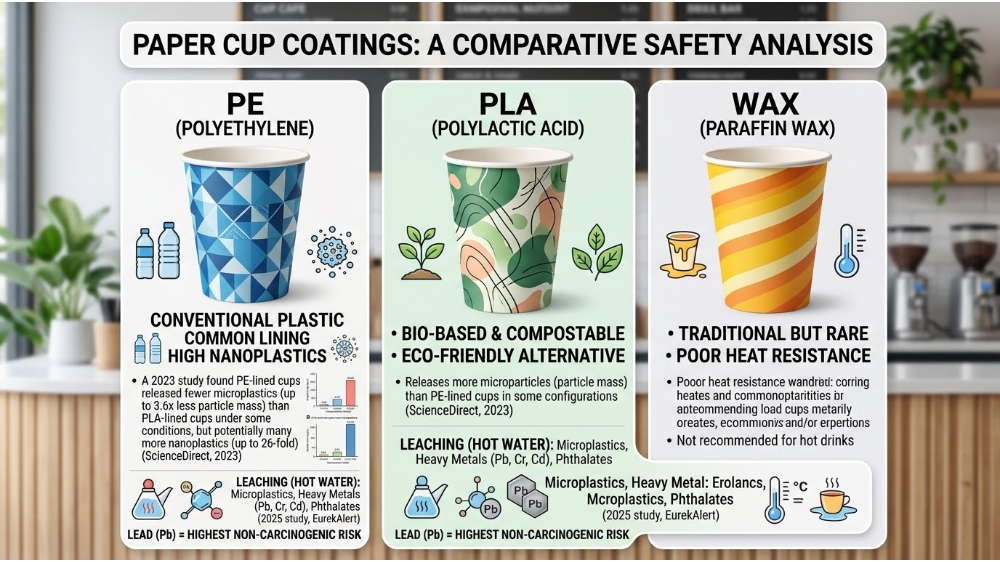
Most paper cups are not pure paper — they are coated with a waterproof layer. The coating is the primary barrier between the beverage and the paperboard, and its material dictates safety. Three common types dominate the market:
- Polyethylene (PE) — the most widespread, a conventional plastic lining.
- Polylactic acid (PLA) — a bio‑based, compostable alternative.
- Wax — traditional but increasingly rare due to poor heat resistance.
Which releases fewer microparticles? A 2023 study in ScienceDirect found that PE‑lined cups release significantly fewer microplastics than PLA‑lined cups under identical conditions — PLA released roughly 3.6 times more particle mass. However, a 2025 study published on EurekAlert revealed that both PE and PLA cups leach microplastics, heavy metals (Pb, Cr, Cd), and phthalates when exposed to hot water, with lead posing the greatest non‑carcinogenic risk. Interestingly, PE‑lined cups have been shown to release up to 26‑fold more nanoplastics than PLA‑lined cups in some configurations (ScienceDirect, 2023). So there is no universally “safe” coating — the choice depends on the beverage temperature and contact time, which we cover next.
Coating safety at a glance:
- PE: Low microparticle release, high nanoplastic variability — stable up to ~100°C
- PLA: Higher microparticle release, lower nanoplastics — degrades at >60°C
- Wax: Melts at ~60°C — only suitable for cold drinks
Hot beverage temperature: when does heat trigger leaching?
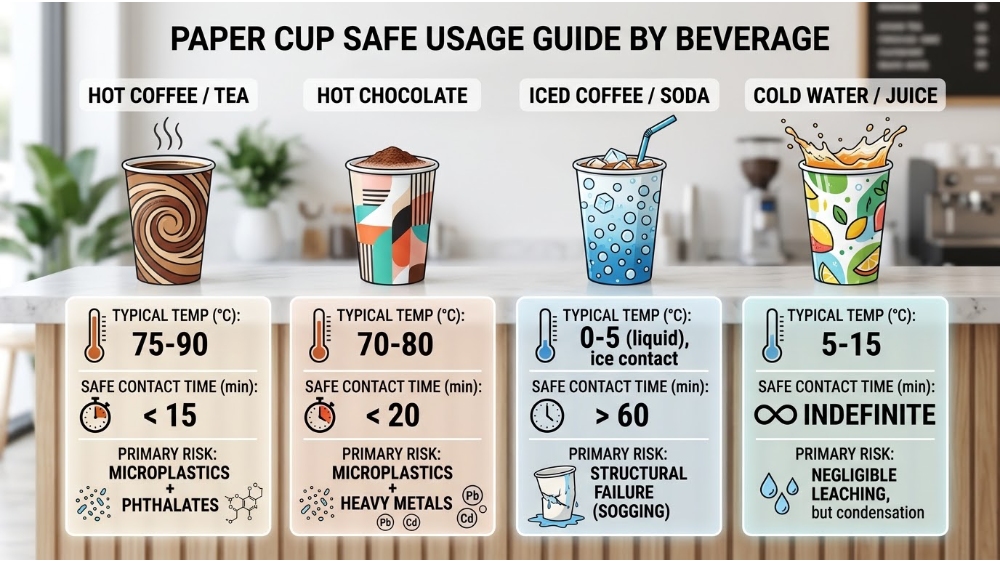
Hot drinks — coffee, tea, hot chocolate — are typically served at 65–90°C. This range is well above the glass transition temperature of many coatings. A 2020 study on ScienceDirect demonstrated that within 15 minutes of contact with hot water (85°C), disposable paper cups release roughly 25,000 micron‑sized microplastic particles per 100 ml. The same study also detected leaching of heavy metals, including lead, chromium, and cadmium, into the water. The 2025 EurekAlert‑covered research confirmed that phthalates — endocrine‑disrupting plasticizers — migrate into hot beverages at a rate that accelerates with temperature. So, is it safe to drink hot tea in paper cups? For a single cup consumed within 10–15 minutes, the risk is considered low by regulatory standards (PubMed, 2025), but habitual consumption of multiple hot cups daily may accumulate. For coffee, the same principles apply — the hotter the liquid and the longer it stays, the more migration occurs.
| Beverage | Typical temp (°C) | Safe contact time (min) | Primary risk |
|---|---|---|---|
| Hot coffee / tea | 75–90 | < 15 | Microplastics + phthalates |
| Hot chocolate | 70–80 | < 20 | Microplastics + heavy metals |
| Iced coffee / soda | 0–5 (liquid), ice contact | > 60 | Structural failure (sogging) |
| Cold water / juice | 5–15 | Indefinite | Negligible leaching, but condensation |
Cold drinks & condensation: why exterior moisture matters
Cold beverages present a different challenge: condensation. When a cold drink is poured into a paper cup, moisture from the air condenses on the cup’s exterior. This water soaks into the paperboard, weakening its structural integrity. Unlike hot drinks, cold drinks do not trigger significant microplastic leaching from the coating because the polymer chains remain stable at low temperatures. However, the coating must still withstand prolonged contact with liquid and ice. Standard hot‑use cups often have a thinner PE layer; cold‑use cups may use a thicker coating or a wax blend to resist moisture absorption. If you use a hot‑cup for a cold drink, the exterior will become soggy and collapse within 30–60 minutes. Conversely, cold‑cups used for hot drinks will fail due to coating degradation. So, can paper cups be used for cold drinks? Yes — provided they are cold‑rated. The safety concern is not chemical leaching but physical failure and the potential for the consumer to be scalded (if the cup collapses with hot liquid) or get wet hands (annoying but not toxic).
Contact time: the 15‑minute rule
Contact time is the single most under‑discussed factor in paper cup safety. Research from a 2023 ScienceDirect paper on nanoplastics release showed that microplastic release increases exponentially with time — the first 10 minutes account for the majority of migration. Another 2025 study monitoring heavy metal migration in Turkish market cups found that zinc (394.54 ppb) and chloride (17.49 ppm) levels spiked after 15 minutes of hot water contact (ScienceDirect, 2025). The consensus: if you drink your coffee or tea within 10–15 minutes, the amount of leached substances is well below established safety thresholds. If you sip slowly over an hour, the cumulative exposure rises. For cold drinks, contact time matters less for chemical leaching but more for structural integrity — a cup that holds ice water for 2 hours may become soggy, but the coating does not degrade. Therefore, the practical advice is: consume hot beverages promptly and do not leave them in paper cups for extended periods. For businesses serving delivery or take‑out, this is a critical quality and safety consideration.
Coating integrity: scratches, cracks, and aging
Even the best coating is only as good as its physical condition. Microscopic scratches or cracks — caused during manufacturing, stacking, or handling — can expose the paperboard directly to the beverage. The paperboard itself may contain residual lignin, optical brighteners, or heavy metals from recycled pulp. A 2025 PubMed study highlighted that damaged coatings significantly increase the migration of lead and other toxic elements compared to intact coatings. Storage conditions also matter: high humidity can degrade the coating over time, and old stock may have compromised barrier properties. For foodservice operators, this means that fresh, undamaged cups from reputable suppliers are always safer than discounted, aged inventory. Always inspect for visible scratches, delamination, or warping before use.
Food‑contact compliance: FDA, EU, and global standards
In the United States, paper cups are regulated under the FDA’s “housewares exemption” (21 CFR 176.170), which means they do not require pre‑market approval as long as the coatings comply with indirect food additive regulations. As PackagingLaw (2014) clarifies, manufacturers are responsible for ensuring their materials meet the specifications for temperature and food type. In the European Union, the Framework Regulation (EC) 1935/2004 requires all food‑contact materials to be safe and inert, with specific migration limits (SMLs) for individual substances. Both frameworks set limits on heavy metals and overall migration (OM). However, these limits are generally based on short‑contact (≤ 15 min) scenarios. For extended contact (e.g., a traveler’s coffee that sits for an hour), the migration may exceed the SML, even though the cup itself is “compliant.” Therefore, compliance is not a binary “safe/unsafe” — it depends on actual use conditions, which is why contact time and temperature are so important.
Paperboard quality: from virgin pulp to recycled fiber
The base paperboard is not inert. Virgin pulp is generally free from heavy metals and dioxins, but recycled paperboard can contain mineral oils, phthalates, and residual inks. A 2020 ScienceDirect paper warned that recycled fibers may introduce more chemical migrants than virgin fibers, even through the coating. High‑quality food‑grade paperboard uses virgin or well‑purified recycled fibers with a barrier coating that is thick enough to prevent migration. Some cups use a double‑wall construction for insulation, which adds an extra air gap that also reduces heat transfer and slows coating degradation. For hot drinks, choose cups labeled “hot cup” or “double‑wall” from a supplier that can provide test data on overall migration. For cold drinks, a standard single‑wall cold cup with a good PE coating is sufficient, but always verify that the coating is PE‑extruded rather than solvent‑coated, as the latter is more prone to pinholes.
Need food‑safe paper cups for your hot or cold beverage line?
Talk to a packaging specialist about coating options, temperature ratings, and compliance certifications for your specific menu and hold times.
Frequently asked questions
Are paper cups safe for hot drinks like coffee and tea?
Yes, when consumed within 10–15 minutes. Studies show microplastic and heavy metal migration increases with time, but within that window, levels remain below safety thresholds. Choose PE‑coated cups for hot beverages.
Can you put hot drinks in paper cups without health risks?
Short‑term use is considered low‑risk by FDA and EU standards. However, habitual daily consumption of multiple hot drinks from paper cups may lead to cumulative exposure — consider using ceramic or glass for regular use.
Are paper cups safe for cold drinks and iced beverages?
Chemically, yes — cold temperatures do not cause significant leaching. The main risk is structural: condensation can weaken the cup, causing it to leak or collapse. Always use cold‑rated cups with a thicker coating.
What is the difference between hot and cold paper cups?
Hot cups use a PE or PLA lining designed to withstand high temperatures without degrading, while cold cups often use a thinner coating or wax that resists moisture penetration from condensation. Hot cups are typically thicker and may have a double‑wall construction.
Post time: Aug-27-2026