Plastic vs. Paper Coffee Cups and Lids: Which Packaging Is Better for Your Coffee Business?
Plastic vs. Paper Coffee Cups and Lids: Which Packaging Is Better for Your Coffee Business?
Foodservice Packaging Guide
Plastic vs. Paper Coffee Cups and Lids: Which Packaging Is Better for Your Coffee Business?
Neither material wins outright — the cup that’s “better” depends on whether your bottleneck is cost, hot-fill performance, brand story, or what your customers’ bins actually accept. Here’s how to make the call with the trade-offs laid out honestly, not the marketing version.
Ask ten coffee shop owners whether plastic or paper cups are “better” and you’ll get ten confident, contradictory answers — because most of them are answering a different question than the one they think they’re answering. Cost, hot-fill performance, recyclability, and brand perception don’t all point the same direction, and a cup that wins on one axis often loses on another.
This guide separates those axes out deliberately: what plastic and paper cups and lids are actually made of, how each performs on the counter and in the customer’s hand, what happens to each after disposal, and which combination fits which kind of coffee business. For the certification and lining detail behind a compostable or recyclable claim specifically, this site’s guide to whether paper coffee cups are actually recyclable goes deeper on the end-of-life question than this article does; here, the focus is the head-to-head decision between materials.
What’s Actually Different Between Plastic and Paper Coffee Cups?
A plastic cup is a single, uniform material — usually PET, PP, or foamed polystyrene — while a “paper” cup is really a composite: paperboard laminated with a thin plastic or bioplastic film. That one structural fact explains almost every other difference between them, from cost to recyclability to why a paper cup still contains plastic even when the label doesn’t mention it.
Plastic cups are molded or thermoformed from a single resin in one manufacturing pass, which is why they’re cheap to produce at scale, perfectly transparent when clarity matters for cold drinks, and mechanically simple to recycle — a recycling facility only has to identify and sort one material, not separate two bonded layers. Paper cups start from kraft or bleached paperboard, which is inherently recyclable and biodegradable on its own, but that paperboard would turn to pulp within minutes of contact with a hot or cold beverage without a waterproofing layer. That layer is almost always polyethylene (PE), polylactic acid (PLA), or a newer water-based dispersion coating, and it’s this hidden second material — not the visible paper — that determines whether a “paper” cup can actually be recycled or composted at all.
The practical result: plastic cups are a recyclability story built around material purity, and paper cups are a recyclability story built around how successfully the coating can be separated from, or matched to, the fiber underneath. Neither structural approach is automatically superior — each creates a different failure mode, which the sections below walk through one at a time.
Plastic vs. Paper Cups: Cost, Performance, and Durability Compared
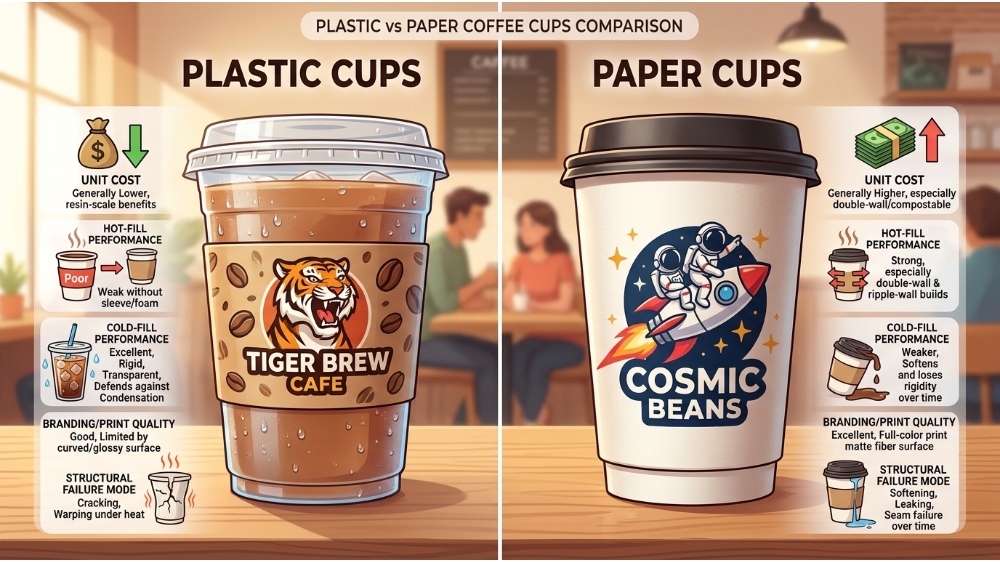
Plastic cups cost less to produce, hold cold drinks without sweating through, and show off drink color and layering; paper cups insulate heat better, feel more premium to hold, and print more vividly for branding. The choice usually comes down to which failure a business can least afford — a soggy hot cup or a sweating cold one.
On raw production economics, plastic has the edge: a single-resin cup requires less energy and roughly 42% less water to manufacture than an equivalent paper cup, according to one widely cited life-cycle comparison of the two production processes, and that manufacturing efficiency generally translates into a lower per-unit wholesale price for plastic. Paper cups close some of that gap through print quality — the fibrous surface takes full-color branding and logo work more cleanly than the smoother, often curved surface of a molded plastic cup, which is a real factor for any café using the cup itself as a marketing surface rather than just a container.
Heat and cold performance
For hot beverages, paper’s insulating structure — especially in double-wall or ripple-wall construction — genuinely outperforms plastic, which conducts heat quickly enough to burn a bare hand unless it’s foamed polystyrene or fitted with a sleeve. For cold beverages, the relationship flips: plastic is dimensionally rigid enough to resist the softening that paperboard experiences under prolonged condensation, and its transparency lets customers see ice, color, and layering in iced coffee, cold brew, or blended drinks — a visual cue paper cups simply can’t offer. This is why most multi-format coffee businesses don’t pick one material company-wide; they pair paper for hot service with plastic or a clear PET cup for cold service, which is the same logic reflected in how operators interviewed about their cup strategy describe choosing materials primarily by drink menu rather than by a single blanket policy.
Durability under real conditions
Paper cups are more vulnerable to structural failure from the inside out — a lid that doesn’t seal perfectly, a cup filled too close to the rim, or an extended hold time can all lead to the paperboard weakening and eventually leaking, especially in single-wall constructions without a sleeve. Plastic cups fail differently: they crack under impact or excessive cold (particularly thinner PS cups), and they can warp or partially melt if exposed to a hot beverage they weren’t rated for, which is a genuine risk when a barista or drive-thru worker grabs the wrong cup size under pressure. Neither material is more “durable” in the abstract — they’re durable against different threats, which is why standardizing cup and drink pairings in staff training matters more than picking a universally tougher material. If you prefer paper cups, but you’re concerning about environment protection, you should read How to Choose Eco-Friendly Paper Cups for Coffee Shops and Takeaway Brands?
Factor
Plastic cups
Paper cups
Unit cost
Generally lower, benefits from resin-scale manufacturing
Generally higher, especially double-wall or certified-compostable versions
Hot-fill performance
Poor without a sleeve or foam construction
Strong, especially double-wall and ripple-wall builds
Excellent, full-color print on matte fiber surface
Structural failure mode
Cracking, warping under heat
Softening, leaking, seam failure over time
Plastic vs. Paper Lids: Which Seals Better, Which Recycles Better?
Plastic lids (typically PP or PS) give the tightest, most consistent seal and the smoothest sip feel, while paper and fiber lids reduce plastic weight per drink but are more sensitive to heat, dwell time, and rough handling. The lid decision is smaller than the cup decision but carries disproportionate weight in how “eco-friendly” a drink actually feels in the customer’s hand.
Plastic lids mold precisely to a cup’s rim, which is why they remain the default for to-go and drive-thru service where a spill during transit is a worse outcome than the plastic itself — a point echoed by operator guidance noting that plastic lids deliver consistent fit and sip feel for busy commuter and mobile trade, while paper and fiber lids need a more forgiving use case. Paper lids are more sensitive to three specific conditions: very hot drinks held for a long time, rough handling during transit, and repeated opening and closing of a sip hole — any one of which can cause a paper lid to soften, tear at the drink opening, or lose its seal faster than a molded plastic equivalent would. Some manufacturers address the weakest point — the sip opening — with a small embedded plastic or bioplastic plug at the drinking edge, which is a hybrid compromise rather than a fully single-material solution.
End-of-life for lids specifically
Lids often have a cleaner recycling story than the cup they sit on, precisely because most plastic lids are a single resin (commonly PP) rather than a paper-plastic composite — which means a rinsed, uncontaminated plastic lid can, in principle, go through standard plastics recycling in a way a laminated paper cup cannot. In practice, lid recycling rates remain low for the same reason cup recycling rates are low: small, lightweight items are frequently missed by mechanical sorting equipment at material recovery facilities regardless of what resin they’re made from. Paper lids sidestep that sorting problem only if they contain no embedded plastic sip plug — the moment a hybrid design is used, the lid inherits the same separation problem as a laminated paper cup.
Which One Is Actually Greener — Plastic or Paper?
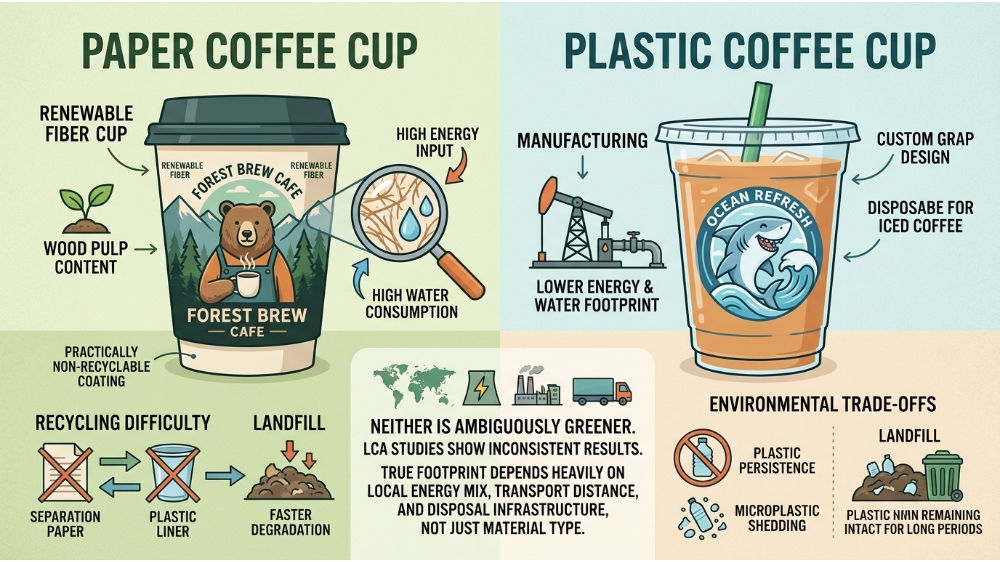
Neither is unambiguously greener: plastic cups generally have a lower manufacturing carbon and water footprint, while paper cups degrade faster if they end up in a landfill and avoid long-term microplastic shedding. Whichever answer sounds more surprising is usually the one being left out of a supplier’s marketing copy.
A peer-reviewed life-cycle assessment comparing disposable cup types found that existing LCA studies on disposable cups show inconsistent and sometimes conflicting results because of differences in the underlying data sets and crediting assumptions used for recycling — which is a meaningful finding on its own: there is no single settled number for “the carbon footprint of a paper cup” or “the carbon footprint of a plastic cup” that applies everywhere, because the answer depends heavily on local energy mix, transport distance, and what actually happens to the cup after disposal, not just what it’s made from.
What the research does agree on more consistently is the shape of the trade-off. Because paper cup production draws on wood pulp, water, and bleaching chemicals rather than petroleum refining, it tends to carry a higher manufacturing energy and water cost per unit than a plastic cup — but a paper cup’s outer fiber layer breaks down over a matter of years in a landfill, while the polyethylene or other plastic components in both cup types persist far longer and can shed microplastic particles as they slowly fragment. An EU-funded research project examining global paper cup consumption found that paper cups lined with plastic coatings are almost impossible to recycle because separating the paper from the waterproof liner isn’t economically or mechanically practical at scale — meaning most paper cups still end up in landfill or incineration despite being made primarily from a renewable material, which undercuts the “paper equals recyclable” assumption most customers bring to the counter.
The honest summary for a business owner: if your metric is production-phase emissions and water use, plastic edges ahead; if your metric is landfill persistence and microplastic shedding once a cup is actually discarded, paper edges ahead; if your metric is “does this cup get recycled in practice,” both materials underperform their own marketing, for different structural reasons. A sustainability claim on either material only holds up if it specifies which part of the lifecycle it’s actually describing.
Does the Right Material Change Between Hot Drinks and Cold Drinks?
Yes — hot drinks favor paper for insulation and burn-risk reduction, while cold drinks favor plastic for rigidity, condensation resistance, and visual clarity. Most multi-format coffee businesses end up running two cup materials in parallel rather than forcing one material to serve both use cases.
Espresso-based drinks, drip coffee, and tea are almost universally served in paper cups — usually double-wall or ripple-wall for anything larger than a small size — because plastic conducts heat too readily to hold safely without a sleeve, and adding a sleeve introduces a second SKU and packaging step that many operators would rather avoid. Iced coffee, cold brew, smoothies, and layered drinks lean plastic or clear PET for the opposite reason: customers expect to see the drink, ice level, and any visual layering, which a paper cup obscures entirely, and plastic’s rigidity holds up far better against hours of condensation during a hot commute or long counter sit.
The businesses that get this wrong in either direction tend to over-index on a single “eco” material across the entire menu for brand-consistency reasons, then discover the mismatch shows up as customer complaints — a paper cold cup going soft in a cupholder, or a plastic hot cup that’s too hot to hold without a sleeve nobody stocked enough of. Matching material to drink temperature first, and worrying about brand consistency in the print and color palette rather than the substrate, avoids that failure mode.
How to Decide: Matching Cup and Lid Material to Your Business Model
The right material follows your sales channel, your margin tolerance, and your customers’ actual waste infrastructure — not whichever material photographs better on social media. A drive-thru, a sit-down café, and an event caterer are answering three different versions of this question even when they’re all selling the same cup of coffee.
High-volume, cost-sensitive operations — drive-thru chains, convenience counters, large-format QSR — generally do best standardizing on one or two SKUs across their whole menu to simplify ordering and staff training, which usually means a reliable PE-coated paper cup for hot service paired with a rigid plastic cup for cold, rather than chasing a compostable claim the operation can’t back up with in-store composting infrastructure anyway. Independent cafés and specialty roasters, by contrast, have the operational control to make a compostable or recyclable claim actually mean something — pairing a PLA-lined compostable cup with an in-store composting bin the owner manages directly closes the loop between the marketing claim and what actually happens to the cup, in a way a decentralized chain usually can’t guarantee across every location.
Before locking in a cup-and-lid material decision, check:
What share of your menu is hot vs. cold, since that alone often settles the plastic-vs-paper question per drink type
Whether your location has real access to industrial composting or curbside plastics recycling — not just whether the cup is labeled compostable or recyclable
Whether your lid needs to survive drive-thru transit and dwell time, which still favors molded plastic over paper in most cases
Whether your margin can absorb paper’s typical cost premium, or whether standardizing on plastic for cost-sensitive SKUs makes more sense
Events, campuses, and municipal programs sit in a middle position: they can justify paper’s premium and a compostable lining because the disposal environment is controlled and short-lived — a stadium or campus dining hall can place composting bins directly next to every point of sale, closing the same loop an independent café can. Businesses evaluating a full range rather than a single SKU can compare custom-branded hot and cold cup packaging options side by side before committing to a production run, since a mismatched material choice is far more expensive to correct after a bulk order ships than before one is placed. We advice you to contact with Maibao Packaging expert to help your businesses.
Frequently Asked Questions
Are paper cups always more eco-friendly than plastic cups?
No — plastic cups typically have a lower manufacturing carbon and water footprint, while paper cups degrade faster in a landfill but are harder to recycle because of their plastic lining. Which one is “better” depends on which part of the lifecycle, and which local disposal infrastructure, you’re measuring against.
Why do paper coffee cups still contain plastic?
Unlined paperboard would dissolve within minutes of contact with a hot or cold drink, so nearly all paper cups are laminated with a thin polyethylene, PLA, or water-based coating to make them waterproof. That coating is what makes most paper cups hard to recycle through standard paper mills.
Should a coffee shop use the same material for hot and cold cups?
Not usually — paper insulates better for hot drinks, while rigid, transparent plastic resists condensation and shows drink color better for cold and iced beverages. Most multi-format coffee businesses run both materials rather than forcing one to cover the whole menu.
Are plastic lids or paper lids better for drive-thru and delivery?
Plastic lids generally seal more consistently and hold up better over long transit and dwell times, which is why most drive-thru and delivery-heavy operations still default to them. Paper and fiber lids work best for shorter, lower-risk, in-store or walk-up service.
Still weighing plastic, paper, or a hybrid cup strategy?
Talk to a packaging specialist about matching cup and lid material, wall construction, and certification to your actual drink menu, sales channel, and waste-stream access.