Plastic Cup Sizes Explained: A Complete Guide to PET and PP Cup Dimensions
Plastic Cup Sizes Explained: PET & PP Dimensions Guide
Plastic Packaging Guide
Plastic Cup Sizes Explained: A Complete Guide to PET and PP Cup Dimensions
From a 2 oz sampling shot to a 32 oz jumbo takeaway — how diameter, wall thickness, resin choice, and cooler-shelf logistics decide the cup size that actually works at the counter.
A standard plastic cup runs from a 2 oz sampling shot up to a 32 oz jumbo fountain cup, with the 12 oz to 16 oz band covering most café, quick-service, and convenience-store counters. The right pick depends less on a single ounce number and more on the resin the cup is molded from, the rim diameter that has to match an existing lid and dispenser, and where the cup has to sit next — in a countertop dispenser tube, a cold-case door pocket, or a vending machine chute.
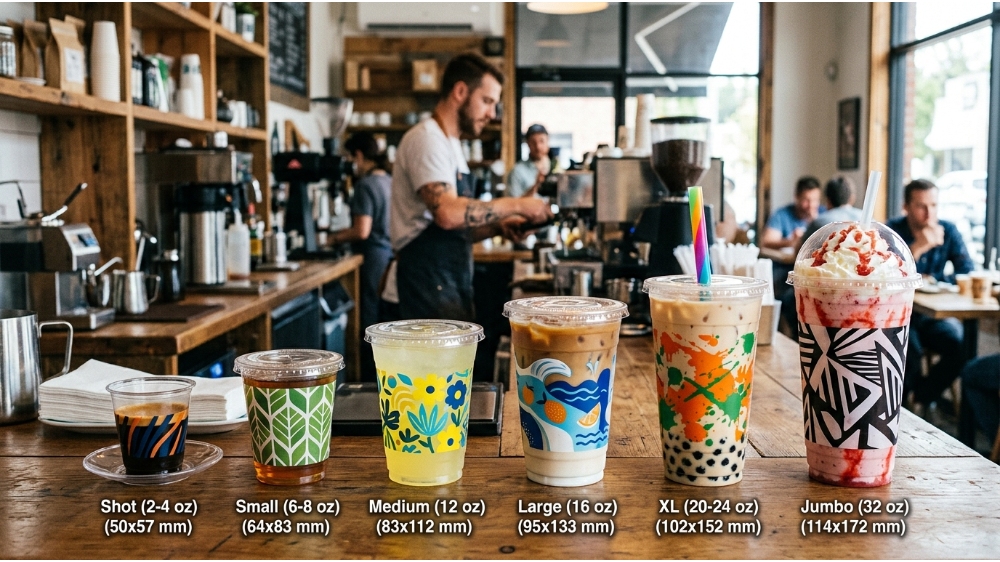
This guide lines up every commonly used plastic cup size in ounces, milliliters, and millimeters, then goes further than a typical size chart by explaining why PET and PP cups of the same stated ounce count aren’t actually interchangeable, and why coffee counters, grocery chains, and bars converge on different size ladders even when the cups look similar on a shelf. For a full range of ready-to-order clear and printed cups, see this plastic cup packaging overview.
What Counts as a “Standard” Plastic Cup Size?
A plastic cup‘s labeled size is a fluid-ounce or milliliter capacity, but that number alone doesn’t tell you whether a cup will actually fit your lid, your dispenser, or your cooler shelf. Two “16 oz” cups from two different molds can differ by several millimeters in rim diameter, which is the dimension that actually determines lid compatibility.
Unlike paper cups, which are usually sold under a single foodservice sizing convention, plastic cups split into at least three separate sizing logics depending on who’s buying. A café or bar buyer cares about fluid ounces matched to a pour recipe. A packaging buyer specifying a custom mold cares about rim diameter, base diameter, and overall height in millimeters, because those three numbers determine whether an existing lid, sleeve, or case-pack tooling can be reused. A grocery or convenience-store buyer mostly cares about how many cups fit upright in a door-mounted cold-case dispenser without the stack jamming or tipping. None of these audiences are well served by a chart that only lists “medium cup: 16 oz,” which is why lid mismatches and cooler-fit problems are such common reorder headaches. Learn more about paper cup by reading paper cup sizes guide.
Demand for plastic cups is large enough that sizing decisions play out at real production scale. Fortune Business Insights values the global disposable cup market at USD 18.26 billion in 2025, projecting growth to USD 25.47 billion by 2034, a pace that reflects quick-service chains and convenience retailers standardizing cup ladders at volume rather than adjusting a handful of SKUs. Within the plastic segment specifically, capacity data breaks the market into four bands — under 10 oz, 10 to 15 oz, 16 to 20 oz, and 21 to 25 oz — with the 10 to 15 oz band alone accounting for roughly a quarter of end-use demand, which lines up with the “one core size, two flanking sizes” pattern most foodservice operators actually stock.
Plastic Cup Size Chart: Oz, ML, and Dimensions Compared
Cup capacity and cup footprint are two different specifications, and treating them as interchangeable is the most common reason a “16 oz” reorder arrives with the wrong lid or won’t stand upright in an existing dispenser rack. The table below lines up nominal size class, typical rim diameter and height, metric conversion, and the use case each class is generally matched to.
These brackets track closely with what buying guides across the industry converge on: WebstaurantStore’s sizing guide identifies 12 oz as the single most-ordered plastic cup size in foodservice, since it balances perceived customer value against ice and syrup cost while still fitting standard straw and lid tooling — the same “one dominant middle size, flanked by a small and a large” pattern shown in the coffee-counter section below. Fill logic matters as much as the printed ounce number: the same source notes operators plan around a “practical fill” level that leaves headspace below the rim, rather than a “flush fill” to the brim, because flush-filled cups spill during lid application and transport far more often than the capacity number alone would suggest.
PET vs. PP: How Resin Choice Changes the Size Math
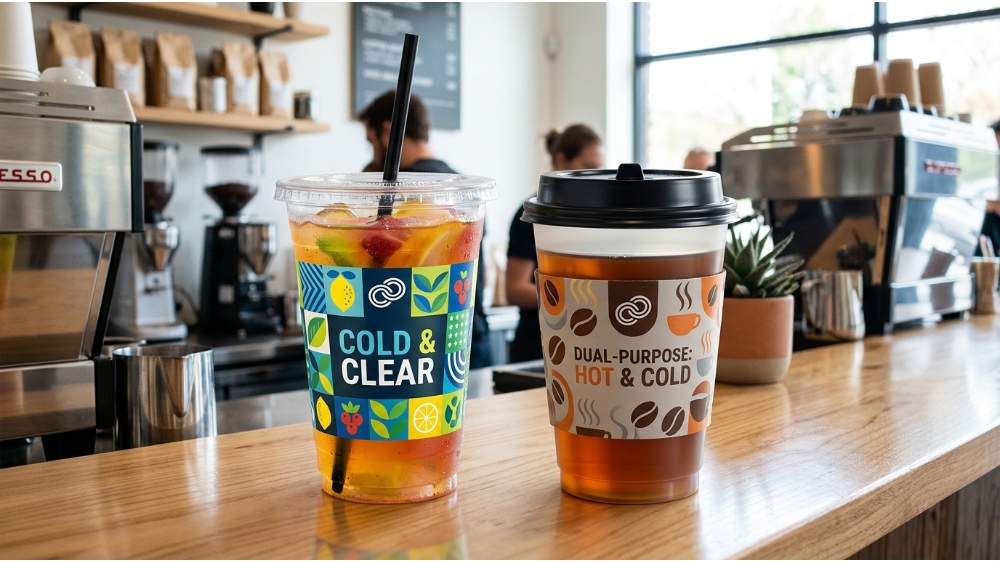
PET (polyethylene terephthalate) cups run crystal clear and hold their exact molded dimensions tightly, making them the default for cold-only drink programs; PP (polypropylene) cups flex slightly, tolerate hot fill, and are the practical choice when one cup size has to serve both hot and cold menu items. Choosing between them changes which dimensions actually matter for your reorder.
PET’s rigidity and optical clarity are why it dominates cold-beverage cups at every size band — from 2 oz tasting shots up to 32 oz party cups — since the resin doesn’t warp or cloud even in a nested stack sitting in a countertop dispenser for a full shift. Because PET holds its molded shape precisely, rim diameter tolerances are tight enough that a lid sourced from one supplier will almost always seat correctly on a same-spec cup from another, which is the main reason PET buying guides can publish a single confident diameter number per ounce size rather than a range.
PP behaves differently at the same nominal capacity. Because polypropylene has a lower melting point tolerance and slightly more flex in the sidewall, PP cups are the material of choice anywhere a single cup size needs to survive both a hot-fill pour and a cold-fill pour without cracking or deforming — bubble tea shops serving both hot and iced menus from one cup ladder, for instance, or QSR counters that fill the same cup size with hot coffee in the morning and iced tea in the afternoon. The tradeoff is a slightly less glass-like clarity and marginally looser dimensional tolerance across production runs, so buyers switching an existing PET-sized reorder to PP should re-check lid fit rather than assuming the ounce label alone guarantees compatibility.
Before finalizing a PET or PP cup order, confirm:
Whether the cup needs to survive hot fill, cold fill, or both — this decides resin, not just size
Rim diameter against your existing lid tooling, not just the printed ounce count
Wall thickness against carry distance — thin-wall cold cups can buckle on longer delivery routes
Whether printed branding needs a straight or tapered sidewall for full-bleed graphics
What Size Cups Do Coffee Shops and Fast-Food Counters Use?
Coffee counters and quick-service kitchens rarely size a cup to a specific drink recipe — they size it to an order-value tier that every barista and register can grab without thinking, which is why the same three or four sizes keep showing up across unrelated chains. A single espresso or drip coffee rides in the smallest cup on the ladder; a combo-meal soda needs a cup tall enough to nest a straw and lid without tipping in a cup holder; a large or “size-up” order needs enough sidewall surface for branding and enough diameter to fit standard drive-thru cup-holder cutouts.
That order-tier logic maps onto a fairly narrow band across the industry. Coffee counters typically anchor their core ladder around 8 oz for a short or single-shot drink, 12 oz as the standard mid-tier pour, and 16 oz as the upsized option — almost exactly the small-medium-large progression industry capacity guides describe as the most common PET cold-drink range, with 6–8 oz reserved for single-serving hot pours and 12 oz established as the standard cold-drink size for iced coffee, tea, and milkshake-style orders. Quick-service drive-thru counters extend that same ladder one step further, adding a 20–24 oz fountain size for large orders and self-serve refill stations, since a wider fountain-fill nozzle needs a correspondingly wider cup mouth to avoid splash-back during a fast pour.
Counter logistics add a constraint a size chart alone won’t show: cups are almost always stored pre-nested in a nose-down dispenser tube mounted under or beside the register or espresso machine, and that tube has a fixed bore diameter. A cup that’s even a few millimeters wider than the tube bore won’t nest cleanly and will jam the stack mid-rush — which is the practical reason most counter-service operations standardize on two or three sizes with closely related rim diameters rather than mixing cup families from different suppliers on the same dispenser.
Counter type
Core size ladder
Why
Espresso / specialty coffee bar
8 oz, 12 oz, 16 oz
Matches short, standard, and upsized pour without extra tooling
Quick-service drive-thru
12 oz, 16 oz, 20–24 oz
Fountain-fill nozzle needs a wider mouth at the top of the ladder
Wide-mouth profile needed for dome lids and wide-bore straws
Grocery and Convenience-Store Cooler Sizing
Grocery and convenience-store cold cases don’t size cups to a drink recipe at all — they size the cup pack to fit a fixed door-pocket or shelf-facing dimension, because a case that runs thousands of doors across a chain has a direct cost incentive to standardize on one cup footprint per category rather than restocking a different shape per SKU. That’s the opposite constraint from a coffee counter, where the drink comes first and the cup follows.
Reach-in and door-mounted cold cases in grocery and c-store formats are generally built around shelf depths in the 22–26 inch range with door-pocket or facing heights tuned to single-serve bottle and cup formats, which is why pre-filled iced coffee, smoothie, and bubble-tea cups sold refrigerated in grocery almost always land in the 12–16 oz band rather than the 24–32 oz jumbo sizes common at a self-serve fountain station — a taller or wider cup simply won’t face correctly on a standard door shelf without wasted vertical space above it. Multipack cup trays follow the same logic: case-ready trays are engineered to a fixed footprint so a stocker can slide a full tray onto a shelf in one motion rather than hand-facing individual cups, which puts real pressure on packaging buyers to keep new SKUs within an existing tray mold rather than requesting a bespoke diameter.
The category itself is growing fast enough that this shelf-fit discipline increasingly shapes new product launches rather than following them. Future Market Insights projects the global PET cup market reaching USD 1.10 billion by 2036, with the 10–15 oz capacity band expected to lead demand at roughly 27% share and food service accounting for the largest end-use segment — a strong signal that the mid-size, single-serve cup format is the one grocery and convenience retailers are most actively expanding, rather than the party-size end of the ladder.
Before finalizing a grocery or convenience-store cup order, check:
Door-pocket or shelf-facing height against your tallest filled cup, including the lid dome
Whether one 12–16 oz size covers most of the category, or a second size is genuinely needed
Tray or case-pack footprint against existing shelf tooling before commissioning a new mold
Cold-chain condensation resistance — labels and sleeves need to stay legible at refrigerated temperatures
Bar, Event, and Vending Cup Sizes
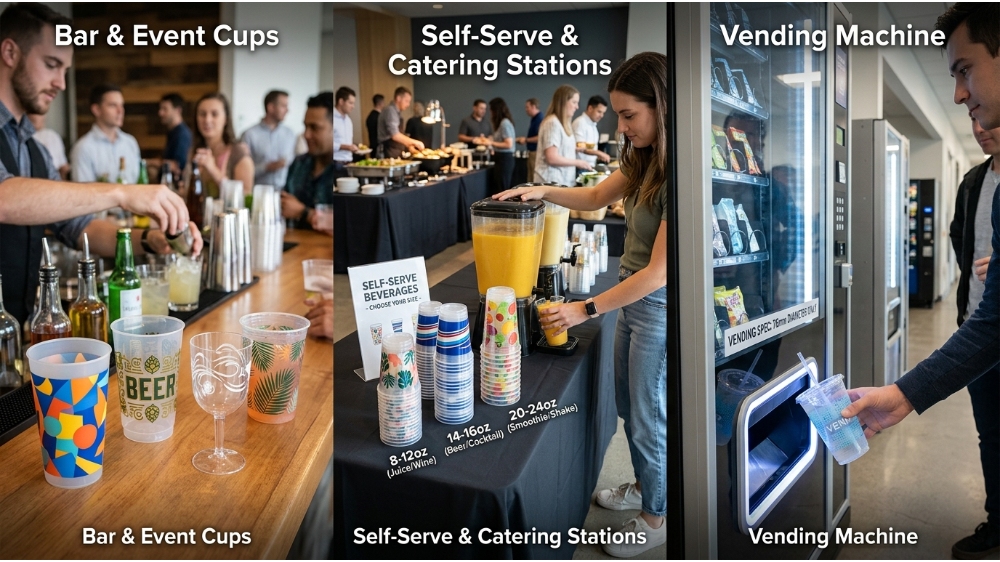
Bar and event cups follow a looser ladder than foodservice or grocery cups, mostly because pour recipes rather than fixed equipment drive the size decision — a wine pour, a beer pour, and a mixed cocktail each want a different cup profile even at similar capacities. Vending machines sit at the opposite extreme, with a chute-width constraint as rigid as any grocery cooler.
For self-serve stations and catered events, sizing generally follows the beverage rather than a fixed operational tier: an 8–12 oz cup handles water, juice, or wine service without excess headspace, a 14–16 oz cup is the practical minimum for beer or a full cocktail pour, and a 20–24 oz cup is standard for smoothies or milkshakes where thicker consistency needs a wider mouth to scoop or sip comfortably. Large self-serve events with multiple drink stations often stock two sizes rather than one specifically to avoid the mismatch of pouring a thin mixer into an oversized cup or a thick shake into an undersized one.
Vending and self-serve fountain machines impose a hard mechanical limit that overrides drink-type preference: the drop chute and cup-sensor mechanism are built to a fixed diameter tolerance, so a cup that’s a few millimeters outside spec either jams the dispense mechanism or drops crooked and spills on landing. Machine operators sourcing replacement cups should treat the machine manufacturer’s diameter spec as a hard constraint to check first, before ounce capacity or branding space, since a cup that doesn’t physically clear the chute is unusable regardless of how well it matches the rest of the size ladder.
How to Choose the Right Plastic Cup Size for Your Situation
The “right” standard size changes depending on who’s buying — a café or coffee counter optimizing for dispenser-tube fit, a QSR chain standardizing across thousands of drive-thru lanes, a grocery or c-store chain packing a fixed door-pocket footprint, a bar or event planner matching pour type, or a packaging buyer specifying a custom mold. Matching the buyer’s situation to a size — rather than defaulting to whatever ounce count sounds safely “medium” — avoids both lid mismatches and wasted packaging spend.
Who’s choosing
Recommended size
Why
Espresso / specialty coffee bar
8 oz core, 12 oz and 16 oz flanking
Matches short-pour to upsized drink without extra dispenser tooling
QSR / drive-thru chain
12 oz, 16 oz, 20–24 oz fixed ladder
Wider mouth at the top size accommodates fountain-fill nozzles
Bubble tea / boba shop
16 oz core, 24–32 oz for large orders
Wide-mouth profile needed for dome lids and wide straws
Grocery / convenience cooler
12–16 oz as the default
Fits standard 22–26″ door-pocket depth without wasted shelf space
Bar / catered event
8–12 oz for wine/water, 16 oz for beer/cocktails
Matches pour type rather than a single fixed operational tier
Businesses evaluating a full lineup rather than a single size can review ready-made options such as custom clear PET cups with lids or fully bespoke PP tooling by resin, rim diameter, and case-pack footprint before committing to a production run. Whatever the segment, the same rule applies: check rim diameter against your existing lid and dispenser before finalizing a size — the ounce number printed on a spec sheet is only the starting point. Here we present a packaging businesses expert, Maibao Packaging for you.
Not sure which size fits your menu or cooler?
Talk to a packaging specialist about matching plastic cup size, resin, and dispenser or cold-case logistics to your actual order volume.
What is the most common plastic cup size in foodservice?
12 oz is the single most-ordered size, since it balances customer perceived value against ice and syrup cost while still fitting standard straw and lid tooling. Most operators stock it as the core size, flanked by an 8 oz small and a 16–24 oz large.
What’s the real difference between a PET and a PP plastic cup?
PET is rigid, crystal clear, and holds tight dimensional tolerances, making it the default for cold-only drink programs. PP flexes slightly and tolerates hot fill, making it the practical choice when one cup size has to serve both hot and cold menu items.
Why won’t my new cup order fit my existing lids?
Two cups with the same printed ounce count can still differ in rim diameter by several millimeters if they come from different molds or resins. Always check rim diameter against your current lid spec rather than assuming the ounce label guarantees a fit.
What size cup should I stock for a grocery cold case?
Most refrigerated single-serve cups land in the 12–16 oz range because standard door-pocket and shelf-facing depths are built around that footprint. Jumbo 24–32 oz sizes generally don’t face correctly on a standard cooler shelf and are better suited to self-serve fountain stations.
Post time:
Jul-21-2026
For inquiries about our products or pricelist, please leave your email to us and we will be in touch within 24 hours.