How to Choose Eco-Friendly Paper Cups for Coffee Shops and Takeaway Brands?
How to Choose Eco-Friendly Paper Cups | Buyer Guide
Sustainable Packaging Guide
How to Choose Eco-Friendly Paper Cups for Coffee Shops and Takeaway Brands
Lining material, certification, and lid compatibility decide whether a “green” cup actually composts, actually recycles, or just costs more without doing either — here’s how to pick the one that fits your menu, your waste stream, and your reorder budget.
Most “eco-friendly paper cup” listings compare price per case and stop there, which is exactly how a café ends up with cups that are certified compostable on the label but land in a landfill anyway because no local facility accepts them. The material questions that actually determine whether a cup performs — and whether its sustainability claim survives contact with a real waste stream — sit one layer below the marketing copy: what’s the inner coating made of, which certification backs the compostable claim, and does your city’s composting or recycling infrastructure actually take it.
This guide works through paper cup sustainability the way a packaging buyer has to: lining chemistry first, waste-stream reality second, certification paperwork third, and only then the size, wall structure, and branding decisions that most buying guides lead with. For the full range of ready-stock and custom coffee paper cup options, see this paper cup packaging overview, and for capacity and dimension planning once you’ve settled on a material, this paper cup sizes guide lines up oz, ml, and rim diameters across the standard ladder.
What Makes a Paper Cup Actually “Eco-Friendly”?
An eco-friendly paper cup is judged by three things together — its inner lining material, whether that lining is certified compostable or recyclable, and whether the buyer’s local waste infrastructure actually processes it — not by the word “eco” printed on the sleeve. A cup can fail on any one of the three and still be marketed as sustainable.
The paperboard shell of a cup is never the problem. Kraft, white, or bamboo-fiber paperboard is inherently recyclable and often FSC-certified at the pulp stage. The sustainability question lives entirely in the thin polymer film laminated to the inside of the cup, because unlined paperboard would dissolve the moment a hot or cold drink touched it. That inner film is what makes a standard paper cup functionally a paper-plastic composite rather than a pure paper product — and composites are exactly what most municipal recycling facilities are built to reject, because their sorting equipment can’t separate a bonded plastic film from the fiber it’s laminated to.
This is also why cup sustainability claims split into two entirely separate value propositions that buyers routinely conflate. A cup can be engineered to compost completely, coating included, in an industrial facility — which solves the landfill problem but only works if the buyer’s city runs industrial composting and the customer actually sorts the cup correctly. Or a cup can be engineered for mechanical recyclability, using a coating thin or chemically similar enough to paper fiber that standard paper mills can process it — which solves the “goes in the blue bin” problem but doesn’t necessarily mean it breaks down quickly if it ends up in a landfill instead. Neither claim is “more eco-friendly” in the abstract; each is correct for a different disposal environment, which is the single biggest source of confusion in sourcing conversations.
PE-Lined vs. PLA-Lined vs. Water-Based Coated Cups
Conventional PE-lined cups are the cheapest and most heat-stable option but aren’t compostable or easily recyclable; PLA-lined cups are compostable in industrial facilities but require hot-composting infrastructure to actually break down; water-based coated cups skip plastic film entirely and are built to recycle alongside ordinary paper. The choice between them should follow your waste stream, not your marketing copy.
PE-lined (polyethylene) cups
Standard disposable cups use a thin polyethylene film bonded to the paperboard, which is what makes them cheap, widely available, and reliably leak-proof across hot and cold fill. The tradeoff is that PE doesn’t biodegrade on any practical timeline and can’t be separated from the paper fiber by a standard recycling mill, so PE-lined cups overwhelmingly end up in landfill even when a customer drops one in a recycling bin with good intentions. Buyers still choose PE for high-volume, cost-sensitive programs where supply stability and hot-fill performance outweigh the disposal story — but pairing a PE cup with “eco-friendly” branding is the fastest way to draw a greenwashing complaint.
PLA-lined (polylactic acid) cups
PLA is a bioplastic derived from plant starch — usually corn — and is the lining behind most cups marketed as compostable. Properly certified PLA-coated cups can genuinely disintegrate and biodegrade in an industrial composting facility, which runs at sustained temperatures of roughly 50–60°C with managed moisture and active microbial activity — conditions a backyard compost pile or a landfill essentially never reaches. That’s the catch buyers most often miss: a PLA cup thrown in general trash behaves almost exactly like a PE cup, because it needs industrial heat to break down, not just time. Before committing to PLA, a coffee shop or takeaway brand should confirm that municipal or third-party industrial composting is actually available and accepts foodservice packaging in their service area — otherwise the “compostable” claim never gets exercised.
Water-based coated (dispersion-coated) cups
Newer water-based or dispersion coatings replace the plastic film with a barrier applied more like a paint layer, using far less polymer per cup and, in the better formulations, thin enough that paper mills can pulp the cup alongside ordinary recycled paper. This is the category gaining the fastest ground with brands trying to solve the “goes in the recycling bin and actually gets recycled” problem rather than the composting problem, since it doesn’t depend on the customer having access to industrial composting at all — only on standard paper recycling, which is far more widely available. The tradeoff is typically a slightly shorter hot-hold window and a narrower supplier base than PE or PLA, since dispersion coating lines are a newer capital investment for manufacturers.
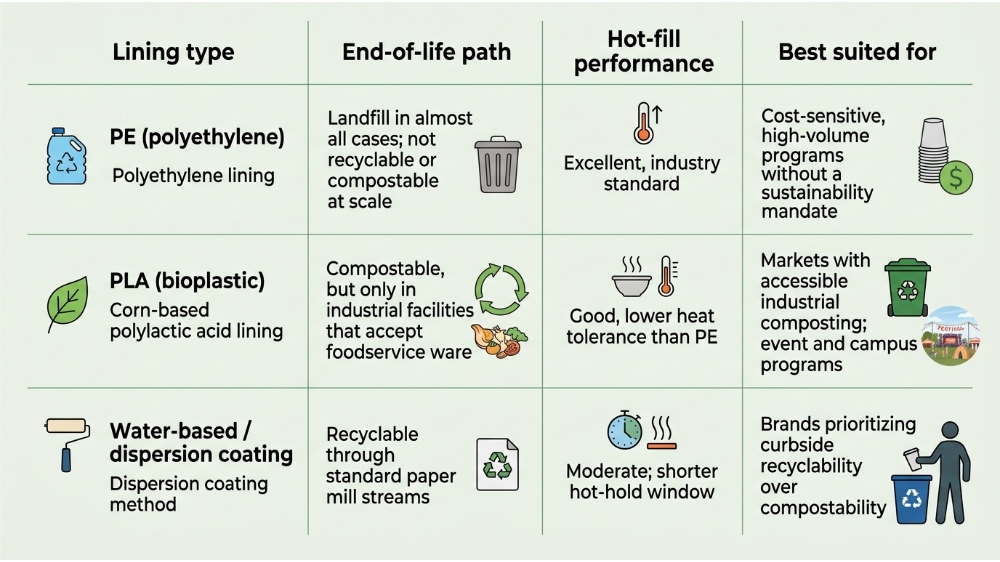
Lining type
End-of-life path
Hot-fill performance
Best suited for
PE (polyethylene)
Landfill in almost all cases; not recyclable or compostable at scale
Excellent, industry standard
Cost-sensitive, high-volume programs without a sustainability mandate
PLA (bioplastic)
Compostable, but only in industrial facilities that accept foodservice ware
Good, lower heat tolerance than PE
Markets with accessible industrial composting; event and campus programs
Water-based / dispersion coating
Recyclable through standard paper mill streams
Moderate; shorter hot-hold window
Brands prioritizing curbside recyclability over compostability
Compostable, Biodegradable, or Recyclable — What’s the Real Difference?
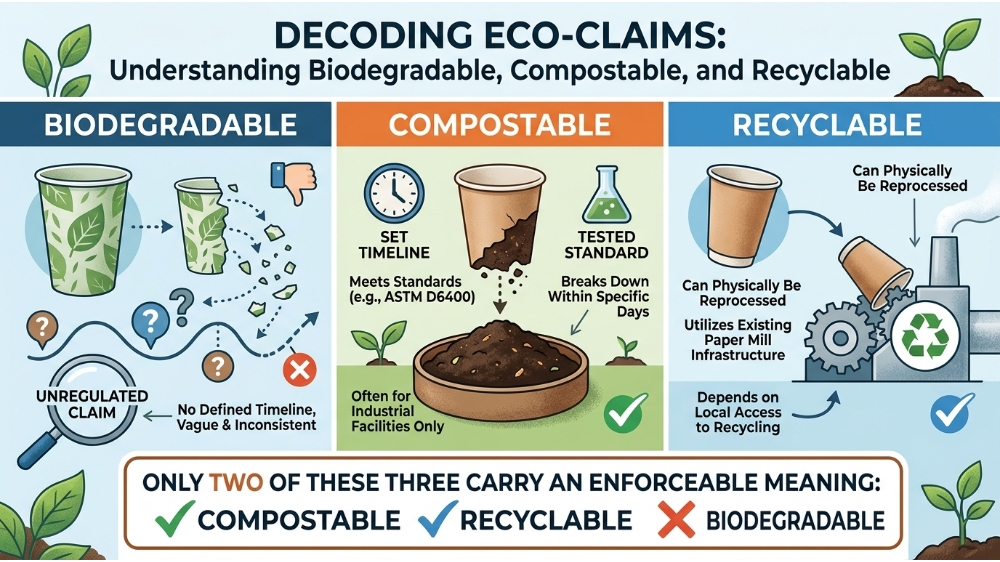
“Biodegradable” is an unregulated claim with no defined timeline, “compostable” means a product meets a tested standard for breaking down within a set number of days under specific conditions, and “recyclable” means the cup can physically be reprocessed by existing paper mill infrastructure. Only two of the three carry any enforceable meaning. Learn more about recyclable by reading Are Paper Coffee Cups Recyclable? What Coffee Shops Need to Know About Sustainable Cup Packaging.
Biodegradable is the loosest term in cup marketing precisely because almost anything biodegrades eventually — the question a buyer actually needs answered is how long, and under what conditions, and biodegradable alone answers neither. A cup lining can be marketed as biodegradable while taking years to break down in a landfill, with no third-party test backing the claim at all. This is the gap regulators have started closing: a growing number of U.S. states now restrict unsubstantiated compostability and biodegradability claims outright, which is pushing serious suppliers toward certified language and away from biodegradable as a standalone marketing term.
Compostable is the stricter, testable claim, and it comes in exactly two flavors that map to the linings above: a fully plastic or bioplastic component is tested against one standard, while a paper-fiber product with a compostable coating or lining is tested against a related but distinct standard. Recyclable is the third and mechanically simplest path — a cup with no plastic film, or a coating thin and compatible enough with fiber recycling, can be pulped by a standard paper mill the same way any cardboard box can, which is why water-based coated cups are marketed on recyclability rather than compostability. The practical takeaway for a coffee shop or takeaway brand: match the claim to the disposal infrastructure your actual customers have access to, rather than picking whichever word sounds greenest on a supplier’s spec sheet.
Single Wall, Double Wall, and Ripple Wall: Which Insulation Fits?
Single-wall cups are the lightest and cheapest but need a sleeve for hot drinks; double-wall cups trap an insulating air gap between two paper layers and skip the sleeve entirely; ripple wall cups use a corrugated inner layer for grip and insulation at a lighter material weight than true double wall. The choice affects both material use and per-cup cost, which is its own sustainability tradeoff.
Single-wall cups use the least paperboard per unit and are the default for cold drinks or any hot beverage served with a separate cardboard sleeve, since the sleeve — not the cup wall — does the insulating work. This keeps material use low, but it also means a hot-drink program has to stock and dispense a second SKU, which adds its own packaging and inventory overhead that a sustainability-minded buyer should weigh against the material saved on the cup itself. Double-wall cups solve the sleeve problem by sandwiching an air pocket between an inner and outer paperboard layer, which insulates almost as well as a sleeved single-wall cup while cutting the SKU count to one — at the cost of noticeably more paperboard per cup and a higher unit price. Ripple wall sits between the two: a corrugated middle layer gives grip and some insulation using less total fiber than a full double-wall construction, making it a common middle-ground choice for chains trying to cut sleeve waste without fully absorbing double-wall’s material cost.
Reading the Certifications: BPI, ASTM, EN 13432, FSC
BPI certification (used across North America) and the EN 13432 seedling mark (used across the EU) are the two labels that actually confirm a compostable claim was independently tested; FSC certifies the paperboard fiber’s sourcing, not the cup’s end-of-life behavior. A cup can carry one, some, or none of these, and buyers should know which gap each one fills.
In the U.S., BPI certification is built on two ASTM test standards — D6400 for products made entirely of compostable plastic, and D6868 for paper-fiber products coated or laminated with a compostable film, which is exactly the category most PLA-lined paper cups fall into. Because a PLA-coated paper cup combines a fiber substrate with a bioplastic lining, D6868 rather than D6400 is the standard that actually applies to it, and buyers verifying a supplier’s compostability claim should ask specifically which of the two certificates the cup holds rather than accepting “ASTM certified” as a blanket answer. In the EU, EN 13432 plays the equivalent role and is backed by the visually distinct seedling logo, and it’s effectively mandatory for any cup sold as compostable in most European retail or foodservice channels.
FSC (Forest Stewardship Council) certification is a different axis entirely — it verifies that the paperboard pulp came from responsibly managed forestry, which matters for a brand’s sourcing story but says nothing about whether the finished cup composts or recycles. A cup can be FSC-certified on the fiber and still use a conventional PE lining that sends it straight to landfill, which is why a genuinely sustainable sourcing spec needs to check fiber certification and end-of-life certification as two separate line items, not one.
Before signing off on an “eco-friendly” cup order, confirm:
Which specific ASTM standard (D6400 or D6868) backs the compostable claim, and whether the certificate is current
Whether your city or region actually operates industrial composting that accepts foodservice packaging
Whether the lining is PE, PLA, or water-based — printed “eco” branding alone doesn’t answer this
Whether the paperboard carries FSC (or equivalent) fiber-sourcing certification separately from any compostability mark
How Coffee Shops, QSR Chains, and Grocery Programs Source Differently
Independent coffee shops generally prioritize a compostable story their customers can see and trust; large QSR chains prioritize supply stability and cost predictability across thousands of locations; grocery and convenience programs prioritize whichever material their existing recycling or composting partnerships already accept. The same cup rarely serves all three well.
A single-location or small-chain coffee shop has the most latitude to make a compostability claim genuinely mean something, because it can pair a PLA-lined cup with in-store signage and a composting bin the owner controls directly — closing the loop between the certification and the actual disposal outcome in a way a national chain usually can’t standardize across every franchise location. This is a large part of why specialty coffee brands lean into PLA and compostable branding as a customer-facing story, while large QSR operators more often default to either conventional PE for cost stability or water-based coated cups where curbside recyclability doesn’t depend on a composting bin being present at every single drive-thru.
The market backdrop makes clear this isn’t a niche shift: the global paper cup market is projected to grow from roughly USD 11.73 billion in 2026 to USD 13.98 billion by 2034, with coffee-related applications accounting for a significant share of that growth and Asia Pacific emerging as the fastest-growing region. That scale is exactly why sourcing decisions increasingly get locked in at the supplier-tooling level rather than adjusted order-by-order — a chain that standardizes on one lining and one certification across its supply chain avoids the reorder chaos of mixing PE, PLA, and water-based coated cups across different regional distributors.
Grocery and convenience retail programs sit closer to QSR in practice: pre-filled cold-brew or iced-coffee cups sold refrigerated are chosen based on shelf-stability and whatever recycling stream the retailer’s packaging team has already validated at scale, which more often lands on recyclable water-based coating than compostable PLA, simply because grocery customers overwhelmingly have curbside recycling access and rarely have industrial composting access.
How to Choose the Right Eco Cup for Your Brand
The right material depends on which disposal infrastructure your actual customers use, how much cost premium your margin can absorb, and whether your sustainability claim needs to survive public scrutiny — not on which cup “sounds” greenest on a spec sheet.
Who’s choosing
Recommended material
Why
Independent café with in-store composting
PLA-lined, BPI/D6868 certified
Owner can close the loop between claim and actual disposal
QSR / drive-thru chain
Water-based coated or conventional PE
Cost and supply stability across thousands of locations
Grocery / convenience cold-case program
Water-based coated, recyclable
Matches existing curbside recycling access, not composting
Events, campuses, and municipal programs
PLA-lined, paired with on-site composting bins
Controlled disposal environment makes the compostable claim meaningful
Brand prioritizing lowest per-cup cost
Conventional PE-lined, FSC fiber
Responsible fiber sourcing without the compostable cost premium
Businesses evaluating a full lineup rather than a single SKU can review ready-made single-wall, double-wall, and compostable options by lining type, wall construction, and certification before committing to a production run. Whatever the segment, the rule holds: verify the lining, verify the certificate number, and verify that your customers’ bins actually accept it — the word “eco-friendly” on the case alone confirms none of the three. If you need any packaging solution, try to contact Maibao Packging, your eco-friendly partner.
Not sure which lining or certification fits your menu?
Talk to a packaging specialist about matching paper cup material, wall construction, and compostable or recyclable certification to your actual waste-stream access.
Are PLA-lined paper cups actually better for the environment than PE-lined cups?
Only if they reach an industrial composting facility — otherwise a PLA cup in general trash behaves close to a PE cup, since both need conditions a landfill doesn’t provide. PLA is the better choice specifically where industrial composting is genuinely accessible to the end customer.
Can paper cups with a plastic lining be recycled curbside?
Conventional PE-lined cups generally cannot be separated from the fiber by standard paper mills and are rejected by most curbside programs. Water-based dispersion-coated cups are the category specifically engineered to avoid this problem.
What’s the difference between BPI certified and FSC certified paper cups?
BPI certification confirms the cup’s compostability was independently tested against ASTM standards, covering end-of-life behavior. FSC certification confirms the paperboard’s forestry sourcing, which is a separate claim about where the fiber came from, not how the cup breaks down.
Is “biodegradable” the same claim as “compostable” on a paper cup?
No — biodegradable has no standardized timeline or testing requirement behind it, while compostable requires meeting a specific ASTM or EN standard within a defined number of days. A cup can be labeled biodegradable without any third-party verification at all.
Post time:
Jul-22-2026
For inquiries about our products or pricelist, please leave your email to us and we will be in touch within 24 hours.