Are Paper Coffee Cups Recyclable? What Coffee Shops Need to Know About Sustainable Cup Packaging
Are Paper Coffee Cups Recyclable? Full Guide for Cafés
Sustainable Packaging Guide
Are Paper Coffee Cups Recyclable? What Coffee Shops Need to Know About Sustainable Cup Packaging
Most paper cups leaving a café counter today aren’t recyclable in the bin they’ll end up in — not because the paper is the problem, but because of a coating most customers never think about. Here’s what that coating actually does, and how a coffee shop can fix the mismatch without wrecking its cup budget.
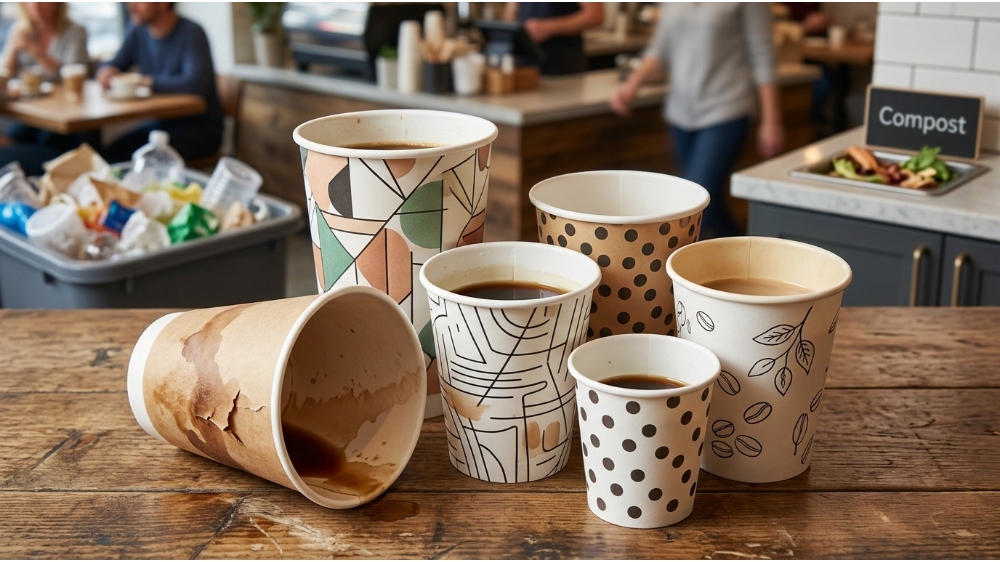
Paper coffee cups are recyclable in theory, but almost never in the recycling bin sitting next to your register. The paperboard body is genuinely valuable fiber — the problem is the thin coating bonded to it, which is what lets the cup hold a hot latte without going soggy, and which is exactly what a standard paper mill can’t process.
That gap between “technically recyclable” and “actually recycled” is where most of the confusion — and most of the greenwashing complaints — comes from. This guide breaks down what the lining is actually made of, why a chasing-arrows symbol on a cup doesn’t mean your city will take it, and what a coffee shop can realistically do about it, from lining choice to lid and sleeve handling to customer-facing take-back programs. For a working set of sustainable cup and lid options already built around these constraints, see this paper cup packaging range.
Are Paper Coffee Cups Actually Recyclable?
Yes, but only at a small number of specialized paper mills — not in the household or storefront recycling bin most customers and most coffee shops actually use. A standard paper coffee cup is roughly 90–95% wood-based fiber, which on its own recycles as easily as any cardboard box. What breaks the process is the remaining 5–10%: a thin waterproofing layer bonded directly to the fiber, which almost no municipal recycling facility is equipped to strip off.
This is the single most misunderstood fact in disp osable foodservice packaging, and it’s why “recyclable” and “recycled in practice” are two different claims. According to the American Forest & Paper Association’s 2025 industry update, roughly 40 specialized mills across North America are currently equipped to re-pulp polyethylene-lined paper cups by separating the plastic film from the fiber during processing — a real and growing capability, but a small, geographically uneven one compared to the thousands of standard mixed-paper facilities that simply reject cups on sight.
The practical consequence for a coffee shop is this: putting “recyclable” on a cup sleeve is not the same as guaranteeing the cup gets recycled. Unless your shop is inside a city with a dedicated cup collection program, or you’ve set up a direct take-back relationship with a specialty mill or hauler, the overwhelming majority of your cups are going into general waste the moment a customer drops them in whatever bin is nearest the door.
Why the Plastic or PLA Lining Changes Everything
A paper cup needs a barrier layer because raw paperboard absorbs liquid, softens, and fails within minutes — the lining is what lets a cup hold a 12 oz coffee for the twenty minutes it takes to drink it. But that same lining is a fused, two-material laminate, and fused laminates are exactly what recycling and composting infrastructure is worst at handling.
Most paper cups on the market are lined with polyethylene (PE), a petroleum-based plastic chosen because it’s cheap, heat-stable, and easy to extrude onto paperboard at high speed. The tradeoff is that PE doesn’t biodegrade or compost, and it can’t be separated from the fiber by a standard paper mill’s pulping equipment, which relies on plain water agitation rather than the chemical and mechanical de-lamination steps a specialty cup-recycling mill uses.
A smaller but fast-growing share of cups use a PLA (polylactic acid) lining instead — a corn-starch-derived bioplastic that’s compostable rather than recyclable. PLA sounds like the obvious upgrade, but it only breaks down inside an industrial composting facility running at sustained temperatures around 55–70°C for 90 to 180 days; dropped in a home compost bin or a landfill, it behaves almost exactly like ordinary plastic and can persist for years. Worse, if a PLA cup lands in a standard recycling stream, it contaminates the PET plastic bale, since the two materials aren’t compatible in reprocessing.
PE-Lined vs. PLA-Lined vs. Recyclable-Ready Cups: What’s the Difference?
Not every “eco” cup solves the same problem, and picking the wrong one for your local waste infrastructure can leave a shop paying a premium for a cup that ends up in the same landfill bag as the cheap version. The table below lines up the three cup families a shop is likely to be choosing between.
Cup lining type
End-of-life path
Hot-liquid ready?
Cost vs. standard PE cup
Best fit
PE-lined paper
Landfill, unless routed to 1 of ~40 specialty mills
Yes, industry default
Lowest
Shops with no local specialty collection; cost-sensitive counters
PLA-lined paper
Industrial compost only; landfill if no facility nearby
Limited — softens above ~85–90°C
Moderate
Shops near a commercial composter, or cold/iced drink programs
Recyclable-ready / uncoated fiber
Standard mixed-paper recycling stream
Varies by coating chemistry
Moderate to higher
Shops in cities with strong curbside paper recycling and sustainability marketing goals
Molded fiber (no liner)
Compostable and often curbside-paper compatible
Cold drinks and short-hold hot drinks
Higher
Cold cups, bowls, and takeaway food where full compostability is the selling point
Recyclable-ready cups are the newest category and worth watching closely: they replace the continuous plastic film with a water-based dispersion coating engineered to pass standard mixed-paper mill repulping tests, meaning the cup can travel through the same recycling stream as an ordinary cardboard box rather than requiring a dedicated specialty mill. They’re not yet universal — acceptance depends on your specific municipal recycler’s equipment — but they close the gap between “labeled recyclable” and “actually accepted” better than either PE or PLA cups do on their own.
Before switching cup lining types, confirm:
Whether your city’s residential or commercial recycling stream accepts any lined paper cups at all
Whether a commercial composting facility actually operates within economical hauling distance, if you’re considering PLA
Whether the new lining tolerates your hottest menu item without softening or leaking
Whether your lid, straw, and sleeve materials match the same end-of-life path as the cup, or you’re just solving one-third of the problem
Why Can’t Paper Cups Go in a Normal Recycling Bin?
Curbside and in-store single-stream recycling is built around plain paper, plain plastic, and plain metal moving through a mechanical sorting line — and a laminated cup doesn’t sort cleanly into any of those categories. The plastic film that makes the cup usable is precisely what makes standard sorting equipment misread and mishandle it.
At a material recovery facility, optical scanners and mechanical screens are calibrated to separate paper from plastic based on how each material behaves — paper stays relatively flat and rigid, plastic film is bendable and light. A cup does both at once, so it frequently gets misrouted, and if it lands in the paper bale, the embedded plastic layer degrades the quality of the recycled pulp that bale produces. Contaminated bales are exactly what buyers on the other end of the recycling chain reject or discount, which is a direct cost problem for the recycler, not just an abstract sustainability one.
This is also why a coffee shop can’t simply trust the chasing-arrows symbol printed on a cup. Earth911′s recycling breakdown estimates that roughly 60 billion paper cups are discarded in the U.S. every year, and that coffee chains recycle less than 1 percent of their own cups internally — a gap that has far less to do with customer intent than with the fact that almost no local recycling stream is actually built to take a lined cup.
The accessories tell a more encouraging story. A plastic lid stamped #1–7 is usually acceptable in standard non-bottle plastic recycling, and a plain cardboard sleeve recycles exactly like any other corrugated packaging. It’s specifically the fused cup body — paper welded to plastic — that breaks the system, which is why cup-specific take-back programs exist as a separate collection stream rather than folding into either paper or plastic recycling.
What Actually Happens to a Cup After It’s Thrown Away?
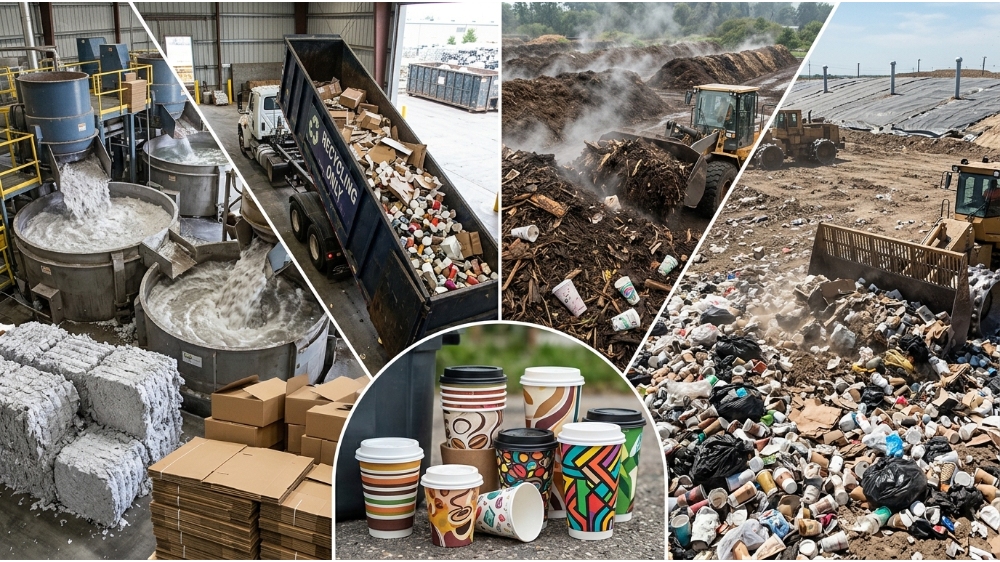
A used coffee cup has three realistic destinations once it leaves the counter, and only one of them recovers any material value: a specialty mill that reclaims the fiber, an industrial composting facility that breaks down a PLA lining, or a landfill where neither the paper nor the plastic component fully decomposes for decades. Which one a given cup reaches depends almost entirely on infrastructure your shop doesn’t control directly — collection logistics, not the cup’s label.
Where a cup does reach one of the ~40 specialty repulping mills, the process works: pulpers agitate the cup in water until the fiber separates from the plastic film, the reclaimed fiber goes on to become new packaging, tissue, or paperboard, and the separated plastic is typically diverted to energy recovery rather than reused directly. That’s a genuinely closed loop, but it depends on a hauler routing cups to that specific mill rather than a general mixed-waste stream — which is exactly the weak link most shops are missing.
Where a cup ends up in ordinary landfill instead, the outcome is far less encouraging. Buried in an oxygen-poor landfill environment, the paper fraction breaks down slowly and the plastic fraction essentially doesn’t break down at all within any commercially relevant timeframe, and anaerobic decomposition of the fiber releases methane along the way. A cup that looks completely biodegradable at a glance can sit in a landfill for a very long time before either component meaningfully disappears.
How Coffee Shops Can Build a Genuinely Sustainable Cup Program
The highest-leverage move for most coffee shops isn’t switching lining chemistry at all — it’s reducing how many single-use cups leave the counter in the first place, since no lining type beats a cup that never gets thrown away. Everything below that starting point is about making the cups you do use match the waste infrastructure you actually have access to, rather than the infrastructure you wish existed.
Start by auditing what your local haulers and municipal facility actually accept, not what a supplier’s marketing page claims is possible. A shop in a city with a strong commercial composting network is a good candidate for PLA-lined or molded-fiber cups; a shop without one is better served by either a standard PE-lined cup paired with an active take-back arrangement, or a recyclable-ready cup validated against the local mill’s own specifications, since a PLA cup with nowhere to compost is arguably worse than a plain PE cup handled honestly as landfill waste.
Reusable-cup incentives remain the most reliably effective lever a counter can pull directly, since a discount for bringing a personal mug reduces total cup consumption rather than shifting the same volume of waste from one material to another. Pairing that with clearly labeled front-of-house bins — a separate stream for cups going to a specialty mill or composter, distinct from general trash — closes the gap between what a cup is capable of and what actually happens to it after a customer walks away from the counter.
A realistic sustainable cup checklist for a coffee shop:
Confirm what your waste hauler or municipal facility will actually accept before switching cup type
Offer a visible discount or loyalty incentive for reusable cups, since reduction beats any recycling or composting path
Match lid and sleeve materials to the same end-of-life stream as the cup body
Label front-of-house bins clearly if you run a cup-specific take-back or composting stream
Re-audit annually — recyclable-ready and PLA infrastructure is expanding fast enough that last year’s answer may be outdated
Choosing the Right Cup for Your Situation
The right coffee packaging solution depends less on which lining sounds greenest on a spec sheet and more on the waste infrastructure actually available where your shop operates — a specialty mill relationship, a commercial composter, a strong curbside paper stream, or none of the above.
Your situation
Recommended cup
Why
No specialty mill or composter nearby
Standard PE-lined cup, honestly marketed
Avoids paying a premium for a material with no local end-of-life path
City with a commercial composting network
PLA-lined or molded-fiber cup
Lining fully breaks down within the 90–180 day industrial cycle
Strong municipal mixed-paper recycling
Recyclable-ready / uncoated cup
Passes through the same stream as ordinary cardboard, no specialty routing needed
High-volume QSR or drive-thru
PE-lined cup + active take-back with a hauler
Keeps per-cup cost low while still recovering fiber at scale
Sustainability-forward specialty café
Reusable-cup discount program first, compostable cup second
Reduces total cup volume before optimizing the material of what’s left
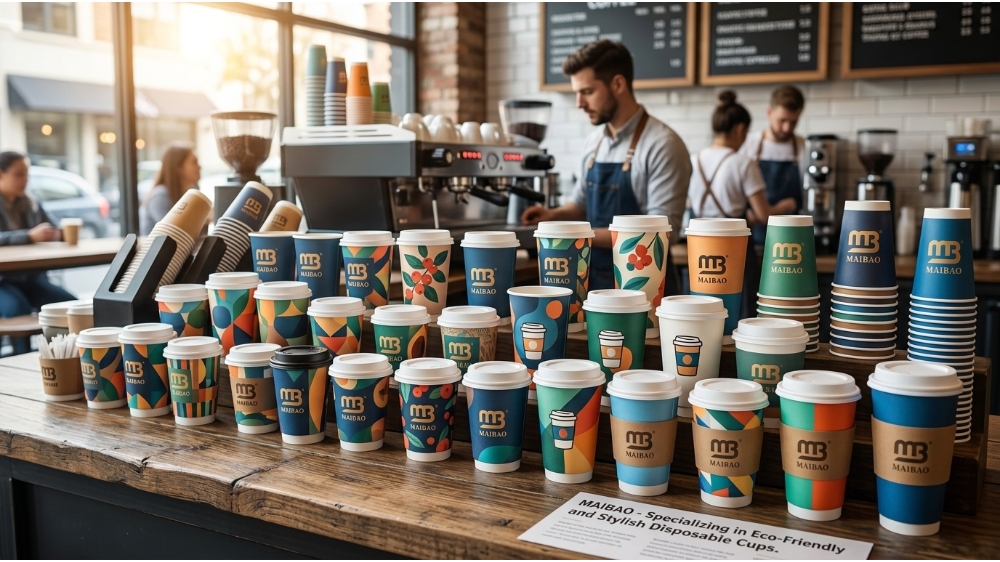
Shops weighing a full lineup rather than a single SKU can review ready-made options across PE-lined, PLA-lined, and recyclable-ready cup formats before committing to a print run and a waste-stream commitment at the same time. Maibao Packaging works with coffee shops and roasters on exactly this pairing of cup material to real-world collection capability.
Not sure which cup lining fits your city’s recycling reality?
Talk to a packaging specialist about matching cup material, lid, and sleeve choices to the waste and composting infrastructure your shop can actually access.
Can I put a paper coffee cup in my curbside recycling bin?
In most cities, no — the plastic or PLA lining fused to the paper isn’t something standard recycling equipment can separate. Check your municipal program directly, since a small but growing number of cities now accept lined cups.
Are compostable PLA coffee cups actually better than plastic-lined ones?
Only if a commercial composting facility is actually available to your shop, since PLA requires industrial heat and time to break down. Without one, a PLA cup behaves like ordinary plastic in a landfill rather than compostable material.
What should I do with the lid and sleeve if the cup itself isn’t recyclable?
Plastic lids marked #1–7 are usually acceptable in standard non-bottle plastic recycling, and plain cardboard sleeves recycle with ordinary corrugated packaging. It’s specifically the fused cup body that most facilities reject, not the accessories.
What’s the single most effective change a small coffee shop can make?
Offering a real discount for reusable cups reduces total cup volume, which outperforms any lining switch since it avoids the recycling and composting question entirely. Pair that with matching your remaining disposable cup to whatever waste stream is genuinely available locally.
Post time:
Jul-22-2026
For inquiries about our products or pricelist, please leave your email to us and we will be in touch within 24 hours.