Coffee Packaging Materials Explained: Paper, Plastic, Compostable, and Kraft Options
Coffee Packaging Materials Explained: Paper, Plastic, Compostable, and Kraft Options
Foodservice Packaging Guide
Coffee Packaging Materials Explained: Paper, Plastic, Compostable, and Kraft Options
Every material claim on a coffee packaging spec sheet — recyclable, compostable, biodegradable, food-safe — means something specific and legally distinct. Here’s what each material actually does, what “compostable” requires to be true, and which one fits your product, your budget, and the regulation you’re actually subject to.
“Eco-friendly” is not a material. Neither is “sustainable.” Paper, plastic, kraft, and compostable are four different answers to four different engineering problems — moisture, grease, heat, and end-of-life — and a buyer who treats them as interchangeable sustainability tiers ends up with a spec sheet that looks responsible and fails on the loading dock, in a compost facility that won’t accept it, or in front of a regulator who defines “compostable” a lot more narrowly than the supplier’s product page does.
This guide breaks each material down by what it’s actually made of, what barrier performance it can and can’t deliver, what certification a compostability claim legally requires, and which EU rule set now governs the claim regardless of what a supplier’s marketing copy says. For the cup format decision like cup lids, that usually comes right after the material decision, see coffee cup lid guide, and for a full range of ready-stock material options, see this overview.
What “Coffee Packaging Material” Actually Covers
“Coffee packaging” is not one material decision — it’s five separate ones made about five different products that behave nothing alike: bean bags, hot and cold cups, lids, straws, and wraps or carriers. Most sourcing content collapses all five into a single “paper vs. plastic” question, which is why so much of it reads as generic advice that doesn’t actually help a buyer choose anything.
The reason the five categories need separate answers is that each one is judged on a different failure mode. A bean bag is packed once and needs to hold an oxygen and moisture barrier for months on a shelf. A hot cup is handled for minutes and needs heat resistance and grip, not long-term barrier performance. A cold cup needs clarity and rigidity a fibrous material can’t provide on its own. A straw is the only packaging component that enters a customer’s mouth, which is why straw material carries the tightest regulatory scrutiny of anything on this list. Treating all five as one “packaging material” question is the root cause of most mismatched specs — a bag-grade compostable film has no business being specified for a cup, and a cup-grade PE-lined kraft has no business being marketed as a compostable bean bag.
This guide works through the four materials that actually appear across those five product categories — paper/kraft, plastic, compostable bioplastics, and fiber-based compostables like bagasse — and what each one is and isn’t suited for.
Paper and Kraft: The Default Material and Its Limits
Kraft paper is wood pulp processed through the kraft (sulfate) chemical pulping process, which produces a stronger, more tear-resistant sheet than mechanically pulped paper — the reason it’s the default for bags, wraps, cup exteriors, and carriers across foodservice. Unbleached kraft’s brown color is the natural pulp tone, not a coating, which is part of why it reads as the “sustainable” default even before any certification is checked.
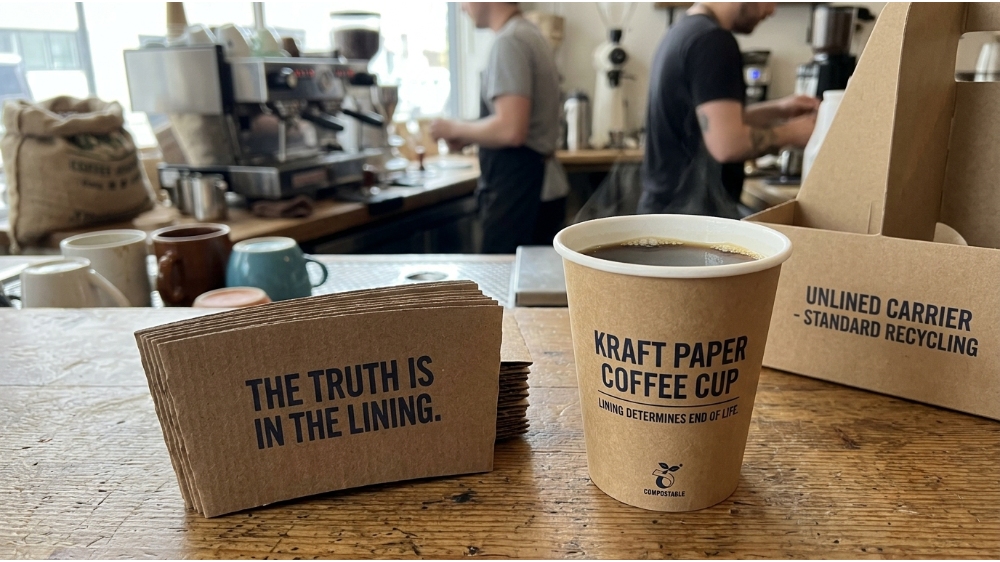
The limitation that every kraft spec eventually runs into is barrier performance. Pure, uncoated kraft has almost no resistance to grease, moisture, or oxygen, which is fine for a dry bag or a carrier but is not fine for anything that touches a hot or wet drink directly. That’s why virtually every kraft coffee cup on the market is lined — with a thin PE (polyethylene) coating for conventional cups, or a PLA coating for compostable ones — and why an unlined kraft claim on a hot cup product should be treated as a red flag rather than a selling point. The lining, not the kraft itself, is what actually determines whether the finished product is recyclable, compostable, or neither, which is the single most misunderstood fact in coffee packaging sourcing.
This lining detail also determines what happens to the material at end of life. A paper cup with a PE lining is technically recyclable only where a facility has the specialized pulping equipment to separate the plastic film from the fiber — most curbside programs don’t — while a kraft carrier or sleeve with no lining at all recycles in a completely standard paper stream. A kraft cup sleeve is a useful example of unlined kraft doing exactly the job it’s suited for: insulation and grip, with no coating to complicate its recyclability.
Plastic: PE, PP, PET, and Why It Hasn’t Disappeared
Plastic packaging in coffee service isn’t one material — it’s three distinct polymers doing three distinct jobs, and none of them is going away as fast as “avoid plastic” advice implies, because none of them has a fiber-based substitute that matches its performance yet. Polyethylene (PE) is the thin film lining most hot paper cups and many bean bags, chosen because it’s the cheapest reliable moisture and grease barrier available. Polypropylene (PP) shows up in cold cups, lids, and — where local rules still permit it — straws, valued for its clarity, rigidity, and resistance to cracking under cold and pressure. PET (polyethylene terephthalate) is the material behind most clear cold cups and clamshells, chosen specifically because no paper or bioplastic option currently matches its transparency and structural strength at a comparable price.
The honest case for plastic in this category is that it remains the highest-barrier, lowest-cost option for jobs that genuinely need clarity, rigidity, or long-term moisture resistance — a fact that gets lost in guides that treat “plastic” as a single villain material rather than three polymers with different recyclability profiles. PET is among the most widely recycled plastics in municipal programs; PP recycling access varies far more by region; PE film, because it’s usually bonded to paper rather than free-standing, is the hardest of the three to actually recover. A buyer choosing between them on sustainability grounds should be comparing local recycling access for that specific resin, not treating “plastic” as a single yes/no decision.
Compostable Materials: PLA, Bagasse, and What the Claim Requires
“Compostable” is a certified technical claim with a defined breakdown timeframe under specific conditions — not a synonym for “eco-friendly,” and not something a supplier gets to assert without third-party testing behind it. The distinction matters because, as recent guidance on compostable food-packaging certification explains, a “compostable” label and a “biodegradable” label solve two entirely different problems, and treating them as interchangeable is one of the most consequential and common mistakes a buyer can make.
PLA (polylactic acid)
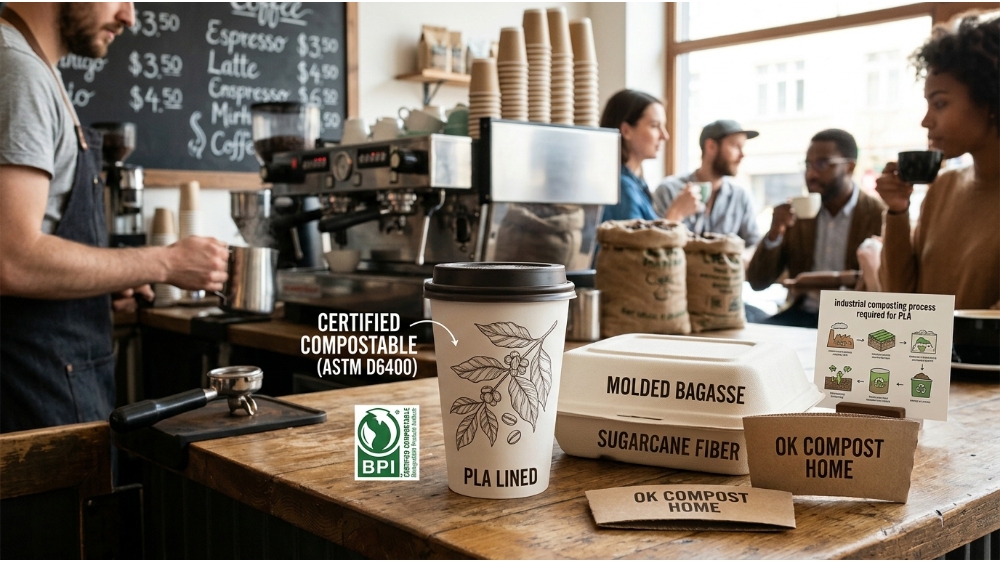
PLA is a bioplastic derived from renewable starches — typically corn, though sometimes sugarcane — and is the most common compostable lining and straw material on the market. Its structural weakness is the same one that makes it compostable at all: PLA needs the sustained heat and microbial activity of an industrial composting facility to break down within a defined window, and it is not accepted by most home compost systems or standard municipal recycling streams, where it behaves essentially like contamination.
Bagasse and molded fiber
Bagasse is the fibrous byproduct left over from sugarcane processing, molded into clamshells, trays, and hot food containers where its natural breathability helps manage steam and moisture — a genuine functional advantage over a sealed plastic container for hot, moist food. Bagasse composts more readily than PLA in some certified structures and can, depending on the specific product and coating, qualify for both industrial and home composting claims, but the same rule applies: the certificate has to cover the finished product, including any coating, ink, or glue, not just the raw fiber.
For any material claiming compostability, the only reliable verification is checking that finished-product certification against a recognized standard — ASTM D6400 for compostable plastics, ASTM D6868 for fiber-based products with a compostable coating, or their EU equivalent — rather than accepting an unverified “compostable” label at face value.
Biodegradable vs. Compostable vs. Recyclable
These three words get used interchangeably in packaging marketing and mean three legally and functionally different things, which is the single biggest gap in most existing sourcing content on this topic. Getting the distinction right is the difference between a defensible sustainability claim and a liability. Learn more detail by reading Compostable VS Biodegradable Packaging: What’s the Difference?
Biodegradable has no standardized timeframe or testing requirement attached to it in most markets — a claim that a material “will break down eventually” is technically true of almost everything given enough time, which is exactly why regulators increasingly treat an unqualified “biodegradable” label as a potentially misleading environmental claim. Compostable is the narrower, certified version of that claim: a defined breakdown window, under defined conditions (industrial or home), verified by third-party testing against a named standard. Recyclable is different from both — it describes whether a material is physically capable of being processed by an existing local collection and reprocessing stream, which means a technically recyclable material can still be functionally non-recyclable in a region without the infrastructure to accept it.
The rule that resolves most labeling disputes: a material is only as “compostable” or “recyclable” as the specific, local infrastructure that receives it. A PLA-lined cup that’s certified compostable is still functionally trash in a city with no industrial composting program, in exactly the same way a technically-recyclable PET clamshell is still functionally trash in a region that doesn’t collect it. The certificate proves the material’s capability; it doesn’t guarantee the outcome.
Matching Material to Product Type
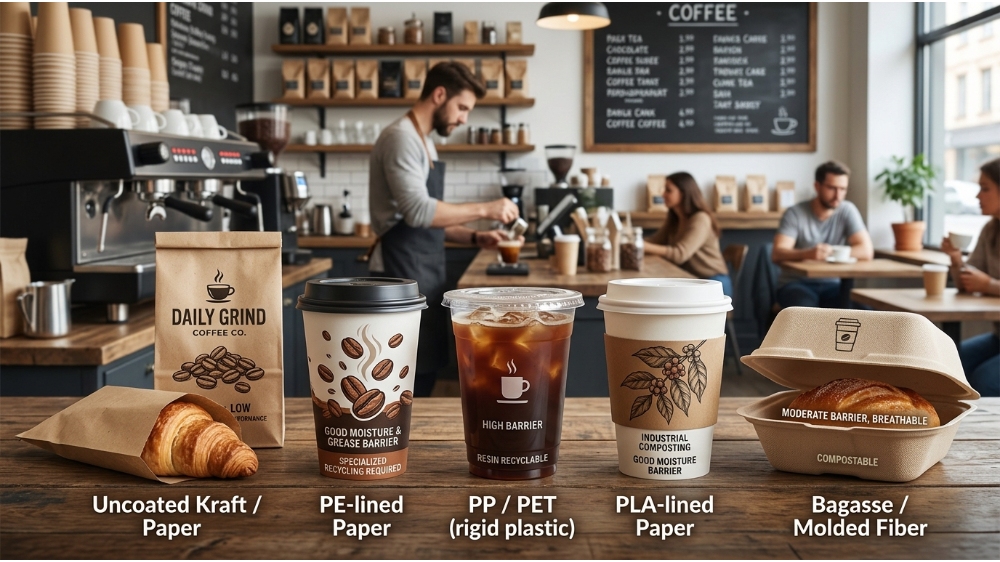
No single material wins across every coffee packaging product, because no single material can satisfy grease resistance, heat tolerance, clarity, and compostability at once — each one is a trade-off, and the right choice depends on which property the specific product actually needs.
Material
Barrier performance
End-of-life
Best fit
Relative cost
Uncoated kraft / paper
Low — no grease or moisture resistance alone
Standard paper recycling
Bags, wraps, carriers, sleeves
Lowest
PE-lined paper
Good moisture and grease barrier
Recyclable only at specialized facilities
Conventional hot cups, lined bean bags
Low-moderate
PP / PET (rigid plastic)
High — clarity, rigidity, moisture resistance
Recyclable where local streams accept the resin
Cold cups, clamshells, clear lids
Moderate
PLA-lined paper
Good moisture barrier, weaker heat tolerance than PE
Industrial composting only
Compostable hot cups, straws
Higher
Bagasse / molded fiber
Moderate — breathable, manages steam well
Industrial, sometimes home composting
Hot food containers, clamshells, trays
Higher
A single wall paper cup paired with a separate kraft sleeve is a useful illustration of the matching principle in practice: the cup handles moisture with a thin PE or PLA lining while the sleeve, left completely uncoated, handles heat insulation and grip without needing any barrier properties at all — two products, two materials, each chosen for the one job it actually does.
The Real Cost Comparison: Material Price vs. Total Cost
Comparing coffee packaging materials on raw unit price is the same mistake as comparing accessory formats on unit price — it ignores everything the sticker doesn’t show. A kraft cup blank is cheap; a kraft cup blank that needs a PE or PLA lining applied to be usable for a hot drink is a different product with a different cost basis, and quoting the two side by side as if they’re comparable is how budgets go wrong before an order even ships.
Compostable materials carry a real, consistent cost premium over conventional plastic-lined equivalents, driven by lower production volumes, more expensive feedstock, and — for anything claiming a certified compostable status — the cost of maintaining that certification through testing and documentation. That premium is often defensible for a brand whose customer base actively values it, but it should be budgeted as a deliberate brand decision, not accepted as a hidden line item because a supplier’s “eco” SKU wasn’t clearly price-differentiated from its conventional equivalent at the quoting stage.
The other cost that rarely makes it into a comparison is functional failure. A compostable straw or lining that underperforms in the field — softening early, cracking under heat it wasn’t rated for — generates refunds, reorders, and complaints that erase any per-unit savings several times over. The material that’s marginally more expensive but actually performs for the full length of the drink is, in almost every case, the cheaper choice once failure cost is counted rather than ignored.
The Regulatory Landscape: PPWR and Beyond
Most existing coffee packaging guides still frame European regulation around the 2021 Single-Use Plastics Directive and stop there — which is now out of date. That directive has been superseded by the far broader EU Packaging and Packaging Waste Regulation (PPWR), which applies generally from 12 August 2026 and governs recyclability, compostability claims, and restricted substances across essentially all packaging placed on the EU market, not just straws and cutlery.
Two provisions matter most for a coffee packaging buyer specifically. First, the PPWR requires that all packaging placed on the EU market be recyclable by design starting 12 August 2026, which puts pressure on PE-lined paper formats that current facilities can’t easily separate. Second, the regulation restricts per- and polyfluoroalkyl substances (PFAS) in food-contact packaging from the same date — a rule that applies regardless of whether the base material is plastic, kraft, or a certified compostable fiber, since PFAS has historically been used as a grease-resistant coating on some fiber-based foodware. A “compostable” or “kraft” claim no longer implies PFAS-free by default; that now has to be verified separately, and a growing number of jurisdictions outside the EU are moving toward comparable fiber foodware PFAS restrictions on their own timelines.
For a business buying across regions, the practical takeaway is that a material spec that was compliant under the old EU straw-and-cutlery ban framework is not automatically compliant under PPWR, and a spec built only around US state rules won’t necessarily clear EU requirements either — regional compliance now has to be checked per market, per material, rather than assumed from a single prior ruling.
How to Build a Compliant Material Lineup
The right material lineup pairs each product category — bags, hot cups, cold cups, straws, wraps — with the material that actually matches its barrier requirement, then verifies the compostable or recyclable claim on anything marketed that way before it’s placed on a menu or a packing slip.
Verification checklist before a bulk material order:
Confirm any “compostable” claim is backed by finished-product certification (ASTM D6400/D6868 or EU equivalent), not just a raw-material claim
Check whether the lining — PE, PLA, or none — matches the barrier need of the specific product, not the marketing tier of the material
Verify PFAS-free status separately from compostability status; the two are not the same claim
Match the compostable or recyclable claim to the infrastructure that actually exists in your operating market before printing it on the product
Price compostable and conventional material options on total landed cost, including lining and certification, not raw unit price alone
For businesses building a material lineup across cups, carriers, and sleeves at once, reviewing kraft, PE-lined, and compostable options side by side against the same order profile — rather than sourcing each product category from a different supplier with a different “eco” definition — is what keeps the claims on the final packaging consistent and defensible. A kraft cup carrier is a straightforward starting point for that comparison, since it’s typically available in both standard and certified compostable kraft. If you need a packaging partner to verify certification documentation and match materials to your specific markets, contact Maibao Packaging.
Not sure which material actually fits your product and market?
Talk to a packaging specialist about matching kraft, plastic, and compostable options to your barrier needs, budget, and the regulations you’re actually subject to.
Not automatically. Uncoated kraft is generally recyclable and biodegradable, but a kraft cup or bag with a plastic lining only qualifies as compostable if the finished product — coating included — carries third-party certification against a recognized standard.
What’s the actual difference between biodegradable and compostable packaging?
Biodegradable is an unregulated claim with no defined timeframe or testing requirement in most markets. Compostable is a certified claim with a defined breakdown window under specific conditions, verified against a standard like ASTM D6400 or D6868.
Is plastic packaging still allowed in coffee service?
Yes, in most markets and most product categories — plastic remains the highest-barrier, most widely recyclable option for cold cups, lids, and clamshells. Restrictions have targeted specific formats like single-use straws and cutlery far more than plastic packaging broadly.
Does a “compostable” material guarantee it will actually compost?
No. A certified compostable material will only break down as claimed in the specific composting environment — industrial or home — that its certification covers, and it needs access to that infrastructure locally. Without it, a certified compostable product typically ends up in a landfill like any other packaging.
Post time:
Jul-27-2026
For inquiries about our products or pricelist, please leave your email to us and we will be in touch within 24 hours.