

Food trucks operate in a unique paradox: high-volume sales with micro-kitchen storage, premium price points with razor-thin margins, and custom-branded expectations with limited shelf space. The packaging you choose is the single most repeated physical touchpoint with your customer—and if it fails, it fails in full view of your business. Mobile foodservice packaging must be four things simultaneously: storage-dense, service-speed-ready, structurally reliable, and brand-consistent. This guide walks through every variable that matters.
Food Truck Packaging Guide: Size, Durability & Cost
Mobile Kitchen Packaging Guide
How to Choose Food Packaging for Food Trucks: Size, Durability, Cost & Customer Convenience
A food truck kitchen is a masterclass in constraint—every inch of storage, every second of service, and every gram of cost matters. The right packaging doesn’t just hold your food; it streamlines your workflow, protects your margins, and turns every takeout order into a mobile brand statement. This guide breaks down the engineering behind food truck packaging, from fry boxes to burger clamshells, so you can choose containers that survive the heat, fit the space, and delight the customer.
Why Food Truck Packaging Demands a Different Playbook
Unlike a static restaurant kitchen, a food truck is a mobile, space-constrained environment where every square foot of storage competes with cooking equipment, refrigeration, and prep surfaces. Traditional restaurant packaging—designed for back-of-house storage rooms—is often too bulky for a truck’s overhead compartments or under-counter cabinets.
Food trucks also face accelerated service speeds. During a lunch rush, a truck may serve 80 to 100 customers per hour, meaning packaging assembly time directly impacts throughput. Industry operational data indicates that switching from tuck-end to auto-erect designs boxes saves between five and ten seconds per order. Over a 100-order service period, that translates to nearly 15 minutes—time that can be reallocated to cooking, prep, or simply managing a shorter queue. Additionally, mobility means packaging must withstand vibration, shifting loads, and temperature swings during transport to and from commissary kitchens, a stress test that stationary restaurants rarely encounter.
How to Select Packaging by Food Type: Burgers, Fries, Bowls & More
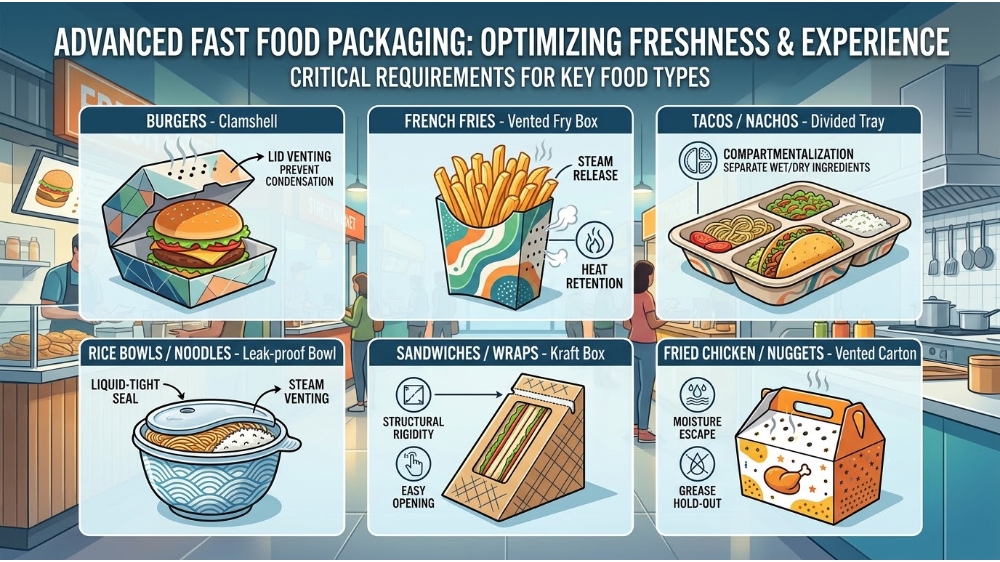
Different menu items exert different physical demands on their containers. A cheeseburger exudes grease and moisture that can compromise uncoated paperboard within minutes, while crispy fries demand ventilation to prevent steam-induced sogginess. Rice bowls and noodles demand leak-proof seals, while tacos need compartmentalization to prevent shell breakage.
Selecting the right match between food physics and packaging material is non-negotiable. The table below maps common food truck menu categories to the optimal packaging format, material, and performance attributes.
| Food Type | Primary Packaging | Key Material | Critical Requirement |
|---|---|---|---|
| Burgers | Clamshell / Hinged Box | PE-coated or Aqueous-coated paperboard | Grease barrier + lid venting to prevent bun condensation |
| French Fries | Vented Fry Box (side/back perforations) | Kraft or PE-coated board | Steam release (2-4% open area) + heat retention balance |
| Tacos / Nachos | Divided takeout tray or box with insert | Molded fiber or coated board | Compartmentalization to separate wet/dry ingredients |
| Rice Bowls / Noodles | Leak-proof bowl with tight-fitting lid | PLA-lined paper or molded fiber with coating | Liquid-tight seal, steam venting |
| Sandwiches / Wraps | Kraft sandwich wedge or sub box | Uncoated or lightly coated kraft | Structural rigidity + easy tear-away opening |
| Fried Chicken / Nuggets | Vented carton or foldable box | Grease-resistant coated board | Moisture escape + grease hold-out |
This matching exercise is the starting point for any packaging specification. Once the food type is locked to a format, you can move to sizing, durability, and branding variables.
Right-Sizing: Portion Control, Headspace, and Storage Efficiency
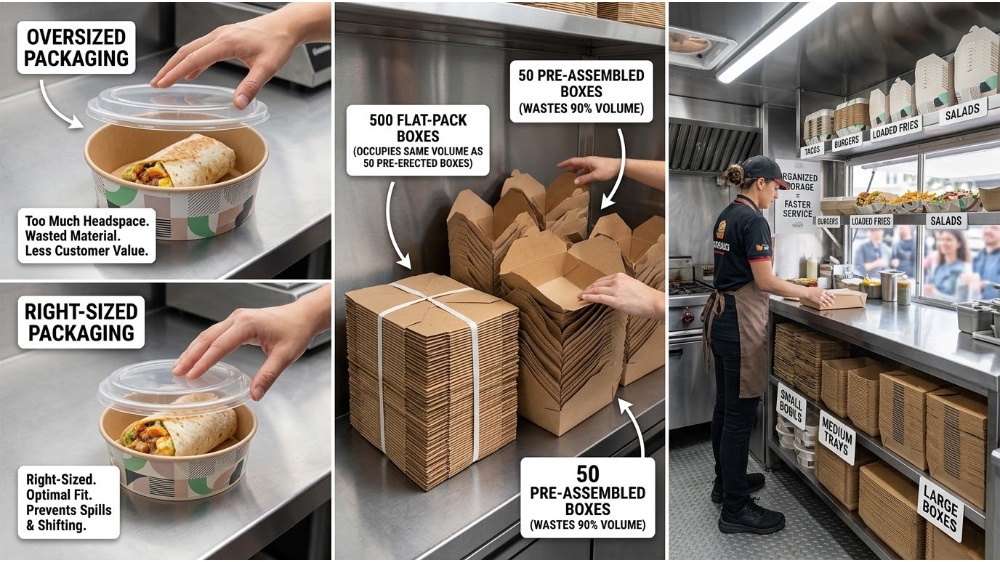
Oversized packaging is a silent profit killer. It wastes material, increases storage footprint, and makes customers feel like they’re paying for air. Undersized packaging, on the other hand, leads to spillage, messy eating, and negative reviews. The sweet spot is portion-matched sizing with minimal headspace—just enough room to close the lid without compressing the food.
For food trucks, sizing has an extra dimension: storage efficiency. Packaging that ships and stores flat—commonly referred to as flat-pack or knock-down (KD) format—can reduce storage volume by up to 90% compared to pre-erected containers. For example, a case of 500 flat-packed burger boxes occupies roughly the same space as a case of 50 pre-assembled boxes. That difference is the difference between restocking daily versus restocking hourly. Flat-pack containers also allow for more flexible stacking inside truck cabinets, enabling operators to organize by portion size or menu item without wasting vertical space.
Pro tip: Select the right size in detail by reading Takeout Box Paperboard Thickness Guide: GSM, Caliper & Strength.
Space-saving packaging principles for food trucks:
- Flat-pack (KD) over pre-erected — 90% less storage volume
- Stackable lids and bases that nest together
- Multi-size cases that share the same footprint for modular storage
- Use headspace strategically: 5-10% above food height for ventilation and lid clearance
Durability Under Fire: Grease, Heat, and Transit Resistance
A food truck’s packaging endures a gauntlet of physical stresses: hot grease from fried items, steam from freshly cooked proteins, moisture from sauces, and the constant vibration of a moving vehicle. Durability is not a luxury; it is a baseline requirement.
Grease resistance is the first line of defense. Uncoated kraft paperboard absorbs oil rapidly, weakening its fiber structure and leading to structural collapse. Research indicates that untreated paper can lose up to 70% of its wet tensile strength when saturated with oil or moisture. PE-coated and aqueous-coated boards provide a barrier that prevents oil from wicking into the fiber, maintaining box integrity for delivery times of 15 to 30 minutes. For exceptionally greasy items like loaded fries or smash burgers, double-wall construction or an absorbent base layer is recommended.
Heat and moisture management are equally critical. A container that traps steam turns crispy foods into soggy disappointments. Vented designs—such as perforated side panels in fry boxes or steam-release holes in clamshell lids—allow moisture to escape while preserving internal temperature. This balance is achieved through precise hole sizing (typically 3-6 mm) and placement, ensuring steam exits before it condenses on the food. For hot soups or chili, fully leak-proof bowls with lock-tab lids are mandatory; a single spill inside a truck cab or in a customer’s car can destroy goodwill instantly.
Transit durability is often overlooked. Food trucks drive over potholes, brake suddenly, and navigate uneven surfaces. Packaging must hold its shape under lateral movement. This means tight-fitting lids, secure locking mechanisms (like tuck tabs or snap-locks), and board thickness of at least 18 pt to 24 pt for main containers. Thinner materials may reduce cost but increase the risk of collapse during delivery, leading to product loss and refunds.
Customer Convenience: Open, Carry, and Eat with Zero Friction
Convenience is the invisible currency of food truck success. A container that is difficult to open, awkward to hold, or prone to leaking forces the customer to focus on the package instead of the food. Good packaging design anticipates the entire eating journey—from pick-up to the first bite to the final napkin.
Ease of opening matters more than most operators realize. Tear tabs, perforated openings, and easy-lift lid tabs eliminate the struggle of peeling stubborn corners. When customers fumble with packaging, it signals low quality, regardless of the food’s actual taste. Similarly, carry ergonomics—whether the box fits comfortably in one hand, whether the bag handles are wide enough, whether the container sits securely in a cup carrier—directly affect customer satisfaction scores.
Leak-proofing is non-negotiable. Sauces, dressings, and juices must stay inside the package. This requires containers with fold-lock corners that are mechanically sealed (not just folded) and lids that click firmly into place. For multi-item orders, compartmentalized trays or containers with separate sauce cup inserts prevent cross-contamination and ensure that a crispy taco shell doesn’t become a soggy mess before the customer reaches their table.
Mobile Branding: Making Your Logo Work on the Move
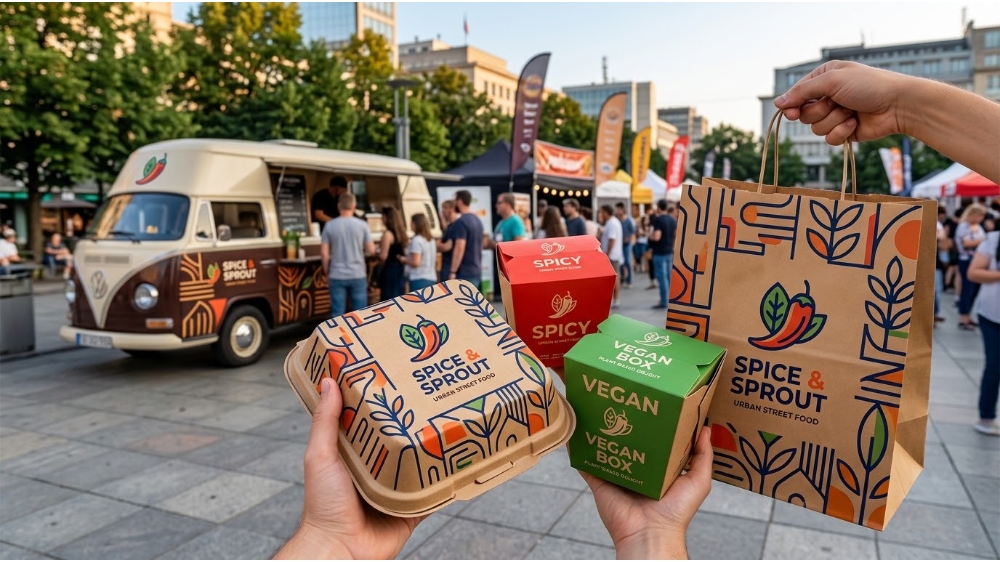
For a food truck, the packaging is a rolling billboard. Every container handed to a customer is a visual impression that extends far beyond the physical location of the truck. Branded packaging reinforces recall, justifies premium pricing, and turns a one-time buyer into a social media sharer.
Effective branding on packaging starts with printing technology. Flexographic printing remains the most cost-effective method for high-volume runs, while digital printing allows for lower minimum order quantities and faster turnaround for seasonal menus. The key is contrast and legibility—dark logos on light board or vibrant, saturated colors that pop against kraft backgrounds. Custom printing also enables functional branding: using color-coded boxes to distinguish menu categories (red for spicy, green for vegan) speeds up order assembly and reduces errors.
However, branding must coexist with practicality. Full-bleed printing can be expensive and may interfere with recyclability if the inks are not compostable. Many food truck operators opt for a balanced approach: a prominent front-panel logo with the rest of the box left uncoated to enhance sustainability cues. The decision ultimately depends on your volume and budget, but the baseline is simple: your packaging should be instantly recognizable as yours, even from across the street.
Pro tip: Learn more about how to print your logo on food packaging by 5 Ways to Print Your Logo on Food Boxes.
The Real Cost of Packaging: Unit Price vs. Total Ownership
The most common mistake in food truck packaging procurement is focusing exclusively on unit price. A box that costs $0.10 less per unit seems attractive until you factor in higher assembly time, increased leakage rates, larger storage volume, and missed branding opportunities. The true cost of packaging is a Total Cost of Ownership (TCO) model that includes five variables.
First is the unit cost—the base price per container. Second is storage cost: flat-pack boxes save space, allowing you to buy in larger quantities without renting external storage, thereby reducing per-unit logistics overhead. Third is assembly time: if a pre-assembled box costs two cents more but saves four seconds per order, that time saving, at an average food truck labor rate of $18/hour, pays back the cost within 200 orders. Fourth is failure rate: boxes that leak or collapse lead to re-makes, refunds, and wasted food—a hidden cost that can easily reach 3-5% of total food revenue. Fifth is brand consistency: generic, unbranded packaging erodes the perceived value of a $14 gourmet burger, potentially reducing repeat purchase rates by as much as 20% over six months. Learn about food paper box costs in detail by Paper Food Container Cost: 8 Wholesale Pricing Factors.
Food truck packaging TCO checklist:
- Unit price + shipping and duty fees
- Warehousing cost per unit (cubic volume)
- Average assembly time per order (minutes x hourly wage)
- Historical failure rate (leaks, collapses, customer complaints)
- Brand lift: repeat order uplift from custom branding vs. plain packaging
Sustainability: Paper, Recyclable, and Compostable Trade-offs
Sustainability in food truck packaging is no longer a differentiator—it is an expectation. Consumer sentiment data reveals that over 90% of diners consider sustainability important when choosing a food vendor, and a growing segment is willing to pay a premium for compostable or recyclable containers.
However, sustainability is not a single attribute; it exists on a spectrum. Recyclable paperboard (uncoated or aqueous-coated) is the most straightforward solution, as it can be processed in standard municipal paper recycling streams. The caveat is that it offers minimal grease resistance, making it unsuitable for high-fat items without an internal barrier. Compostable containers made from molded fiber, sugarcane bagasse, or bamboo are increasingly popular; they are renewable, backyard-compostable, and offer good structural integrity. Yet they tend to have higher unit costs and require specific composting conditions (often commercial facilities). Many compostable containers also rely on PLA (polylactic acid) linings, which do not fully break down in home compost but are certified for industrial composting under standards like EN13432. Click to learn more about food paper box sustainability by reading Are Paper Food Containers Recyclable? Facts & Guide for Foodservice.
The practical food truck operator should match sustainability claims to local infrastructure. If your city has commercial composting, invest in certified compostable containers. If not, opt for highly recyclable mono-material paperboard and educate customers on proper disposal. Avoiding PFAS (per- and polyfluoroalkyl substances) —often used for greaseproofing—is increasingly critical, as health and environmental regulations are tightening around these chemicals globally.
Frequently Asked Questions
What packaging type saves the most storage space inside a food truck?
Flat-pack (knock-down) paperboard boxes are the absolute space-savers, reducing storage volume by up to 90% compared to pre-erected containers. They allow operators to stack hundreds of units in overhead cabinets without taking up valuable counter space.
What is the most durable packaging material for greasy food truck items?
PE-coated or aqueous-coated paperboard offers the best balance between grease hold-out and structural strength for greasy items like smash burgers and fried chicken. These coatings prevent oil wicking into the fibers, maintaining box integrity for 20+ minutes.
Are sustainable packaging options more expensive for food trucks?
Generally, compostable molded fiber containers cost 15-30% more than standard kraft boxes. However, when factoring in the marketing value and potential for higher customer willingness to pay, many operators find the premium pays for itself through increased repeat sales and positive reviews.
How can a small food truck get custom-branded packaging without massive MOQs?
Digital printing enables custom runs as low as 500 to 1,000 units, though per-unit costs are higher. Another approach is using custom-branded stickers or wraps on plain kraft boxes, allowing for small-batch branding without the need for large print runs.
Need Food Truck Packaging That Fits Your Space, Speed, and Budget?
Talk to a packaging specialist about custom sizing, durable materials, branding options, and cost-effective solutions for your mobile kitchen. Get packaging that works as hard as you do.
Post time: Aug-24-2026