How Much Do Paper Food Containers Cost? 8 Factors That Affect Wholesale Pricing
Paper Food Container Cost: 8 Wholesale Pricing Factors
Foodservice Packaging Sourcing Guide
How Much Do Paper Food Containers Cost? 8 Factors That Affect Wholesale Pricing
Whether you are a restaurant chain, a catering business, or a food truck operator, understanding the true cost of paper food containers is essential to protecting your margins. Wholesale pricing is not a single number—it is the sum of material choices, structural engineering, print complexity, and logistical trade-offs. This guide breaks down the eight factors that determine what you actually pay, and more importantly, how to avoid the hidden costs that inflate your packaging budget.
In the world of foodservice packaging, the cheapest quoted price per unit is often a trap. The actual cost of a paper food container extends far beyond the factory floor—it includes material performance, print fidelity, supply chain reliability, and the operational losses caused by failed packaging. This guide covers every variable, from GSM to coating chemistry, and provides a framework for calculating total cost of ownership (TCO) so you can make procurement decisions that are genuinely cost-effective.
We analyze the eight core factors that drive wholesale pricing: material grade, paper thickness, box dimensions, printing methods, coating applications, minimum order quantities, custom tooling, and shipping logistics. By the end, you will understand why a $0.12 container can cost you $0.30 in the long run, and why a $0.18 container might be the most profitable choice you make.
What Are the Main Factors That Determine Paper Food Container Wholesale Pricing?
Wholesale pricing for paper food containers is determined by a cascade of production inputs, each interacting with the next. The eight primary factors are: material type (kraft, SBS, or recycled board), paper weight (GSM), box dimensions and structural design, print colors and coverage, coating and lamination, minimum order quantity (MOQ), custom die-cutting or tooling, and shipping and warehousing. According to industry sourcing data, these variables can shift per-unit costs by as much as 200% between a basic takeout box and a premium branded container.
Operational context matters just as much as material specs. A container optimized for a 10-minute dine-in experience requires a different cost structure than one designed for 45-minute delivery. The most successful buyers prioritize a cost-performance model rather than chasing the lowest quoted price. The sections below unpack each factor in detail, providing specific cost triggers and decision-making criteria for each.
How Does Material Choice Affect Paper Food Container Cost?
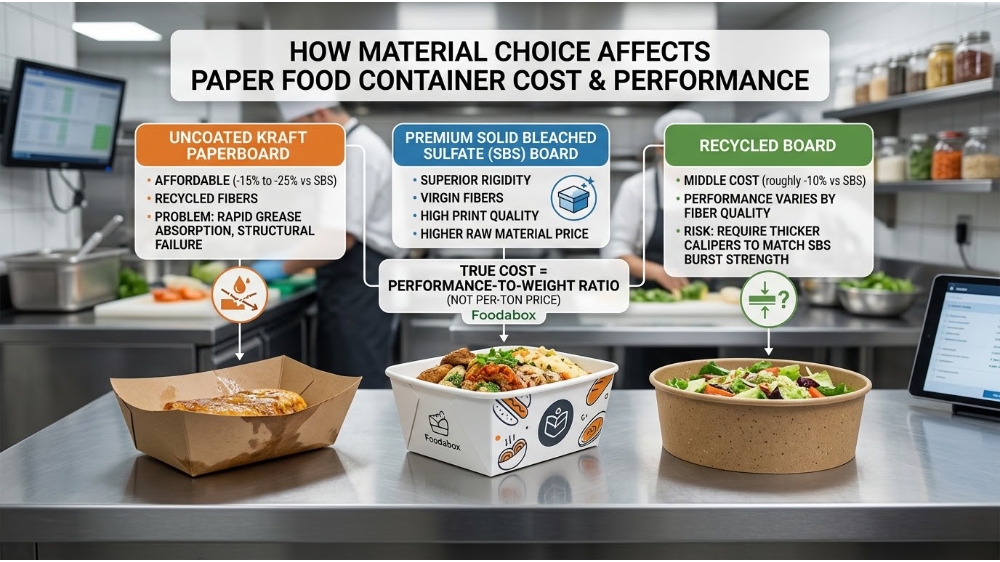
Material selection is the single largest cost driver. Uncoated kraft paperboard—made from recycled fibers—is the most affordable option, typically costing 15–25% less than premium solid bleached sulfate (SBS) board. However, as documented in foodservice packaging analyses, uncoated kraft absorbs grease rapidly, leading to structural failure and customer complaints in high-moisture applications. SBS board, by contrast, offers a bright, smooth printing surface and superior rigidity, but its virgin-fiber composition commands a higher raw material price.
Recycled board sits between these two extremes in cost, but its performance varies significantly based on the quality of the recovered fiber. A 2025 packaging industry report highlights that while recycled board reduces material costs by roughly 10%, it often requires thicker calipers to achieve the same burst strength as virgin SBS, which can offset the savings. Foodabox’s breakdown of material economics underscores that the true cost of a material is not its per-ton price, but its performance-to-weight ratio in the end-use environment.
Why Does Paper Thickness (GSM) Change the Price?
GSM—grams per square meter—directly correlates with material consumption. A standard takeout box uses paperboard ranging from 250 GSM to 400 GSM. Every 50 GSM increase adds approximately 8–12% to the raw material cost of the container, as confirmed by multiple packaging cost models. Thicker board provides better insulation, structural resistance to hot grease, and a premium tactile feel, but it also increases shipping weight, which inflates freight costs.
The optimal GSM depends on the food type. For a dry pastry or a cold sandwich, 250–300 GSM is sufficient and cost-effective. For a loaded burrito bowl or a heavy pasta dish, 350–400 GSM is required to prevent sagging. Hallpack’s cost analysis notes that many buyers over-specify GSM “just to be safe,” adding 15% to their packaging budget unnecessarily. The rule of thumb: select the lowest GSM that passes your structural integrity test at the maximum expected hold time, then validate with a trial run.
How Do Box Size and Structural Complexity Influence Pricing?
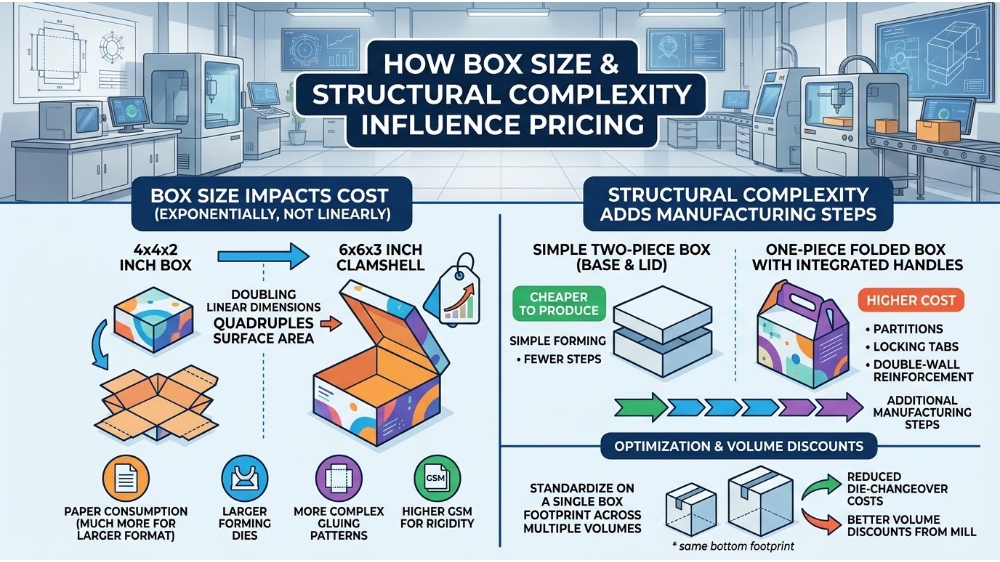
Box size affects cost exponentially, not linearly. Doubling the linear dimensions of a container quadruples the surface area, which in turn quadruples the paper consumption. A 4x4x2 inch box uses significantly less board than a 6x6x3 inch clamshell, yet the price difference is rarely proportional to the volume. This is because larger formats require larger forming dies, more complex gluing patterns, and often higher GSM to maintain rigidity over a greater span.
Structural complexity—such as partitions, locking tabs, or double-wall reinforcement—adds additional manufacturing steps. A simple two-piece box (base and lid) is cheaper to produce than a one-piece folded box with integrated handles. Foodabox’s engineering guide advises buyers to standardize on a single box footprint across multiple volume sizes to reduce die-changeover costs and achieve better volume discounts from the paper mill.
What’s the Cost Difference Between Spot Color and Full-Color Printing?
Printing cost is driven by both the number of colors and the total coverage area. Spot color printing (using 1–2 Pantone inks) is the most economical, adding roughly 5–10% to the base container cost. Full-color CMYK printing, especially with edge-to-edge coverage, can add 25–40% to the unit price because it requires higher-resolution plates, more ink consumption, and rigorous quality control on the press.
However, the choice is not purely financial. Full-color printing drives brand recognition and premium positioning, which can justify a higher menu price. A 2026 market observation from packaging sourcing experts highlights that operators who print bold, full-color graphics on their boxes report a 15% higher perceived food value among customers. Hallpack’s production data suggests that the most cost-effective approach is full-color printing on the lid (the primary visual element) combined with 1-color spot printing on the base, balancing visual impact with material economics.
Do Coatings and Special Finishes Justify the Extra Cost?
Coatings are the second-largest cost differentiator after base material. PE (polyethylene) coating is the industry standard for grease and moisture resistance, adding 8–15% to the cost of an uncoated board. PLA (polylactic acid) coatings—compostable but derived from plant starches—typically add 15–25% due to higher raw material costs and more complex application requirements. Aqueous coatings, which are water-based and repulpable, fall in between, adding roughly 12%.
Special finishes—like matte lamination, soft-touch coating, or metallic foil stamping—are discretionary. They can double the per-unit cost of a basic box, but they are reserved for high-end retail or event catering where unboxing experience directly drives repeat business. YBJ Packing’s buyer guide emphasizes that for standard food delivery, a PE-coated board with a matte aqueous overprint is the “sweet spot” of cost and functionality, providing grease holdout and a pleasant tactile finish without the premium of a full lamination.
How Does Minimum Order Quantity (MOQ) Affect Per-Unit Cost?
MOQ is perhaps the most misunderstood factor in wholesale pricing. A factory has fixed setup costs—die-making, plate-making, press calibration, and batch changeover—that are independent of order size. These costs are amortized across the units produced. For a run of 5,000 boxes, setup costs might add $0.06 per unit; for a run of 50,000 boxes, that same setup cost drops to $0.006 per unit. This is why per-unit prices can fall by 30–50% as order quantities scale from 5,000 to 100,000.
However, pushing order volume purely to chase a lower unit price is risky. It ties up cash flow, consumes warehouse space, and can lead to obsolete inventory if your packaging design changes. Alibaba’s global sourcing data indicates that the optimal MOQ sweet spot for most restaurant chains is between 20,000 and 40,000 units—enough to hit the second or third tier of volume discounts without overextending inventory carrying costs.
What Are the Hidden Costs Beyond Unit Price?
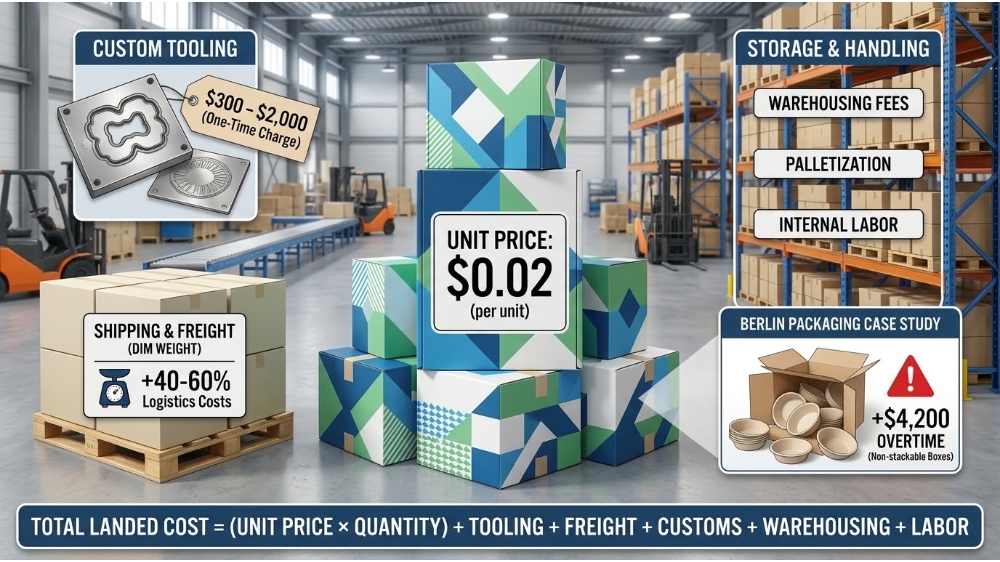
The quoted unit price excludes a range of ancillary costs that can dramatically alter your packaging budget. Custom tooling (die-cutting molds) is a one-time charge that ranges from $300 to $2,000 per design, depending on complexity. Shipping and freight are non-negotiable; because paper containers are bulky but lightweight, you pay for dimensional weight (DIM weight), not actual weight, which increases logistics costs by 40–60% compared to dense products.
Storage and handling are equally significant. If you order a full container load (FCL) to maximize volume discounts, you must factor in warehousing fees, palletization, and internal labor for inventory management. Berlin Packaging’s case study reveals a client who saved $0.02 per unit on paper bowls but incurred $4,200 in additional warehouse overtime due to non-stackable box shapes. The hidden cost erased the per-unit savings entirely. Always calculate total landed cost: (Unit Price × Quantity) + Tooling + Freight + Customs + Warehousing + Labor.
China Factory vs. Distributor: Which Is Cheaper Overall?
Direct sourcing from a China-based paper container factory typically offers a 18–25% lower base price compared to buying from a regional distributor or a domestic wholesale supplier. This is due to lower labor costs, vertically integrated pulp and paper production, and massive economies of scale in the Chinese packaging ecosystem. However, this price advantage is attenuated by longer lead times (40–60 days vs. 7–10 days), higher freight costs, and the requirement for larger MOQs (often 50,000+ units).
Distributors, by contrast, provide warehousing, split-LTL (less-than-truckload) shipping, and the ability to order multiple product types in mixed quantities. You pay a premium for this flexibility. Alibaba’s strategic sourcing guide suggests that for operators ordering fewer than 30,000 total units per year, a distributor is often cheaper in total cost despite the higher per-unit price, because you avoid heavy freight, customs brokerage fees, and the risk of inventory spoilage.
Why Isn’t the Lowest Unit Price Always the Lowest Total Cost?
This is the central paradox of packaging procurement. The supplier with the lowest unit price often achieves that price by using thinner board, less robust coatings, or simpler structural designs. While the upfront cost is lower, the field failure rate—leaking, tearing, or sogging—generates operational losses that dwarf the initial savings.
Consider a real-world example: a 50-store burger chain tested three 6-inch paper bowl suppliers. Supplier A offered a $0.12 bowl (uncoated kraft, 250 GSM). Supplier B offered a $0.18 bowl (PE-coated, 300 GSM). Supplier C offered a $0.22 bowl (PLA-coated, 350 GSM with a rolled rim). Over a six-month trial, Supplier A’s bowls had a 14% failure rate (leaks and collapses), leading to 1,400 replacement meals at an average cost of $8.50 each—an operational loss of $11,900. Supplier B had a 2% failure rate, costing $1,700 in replacements. Supplier C had a 0.5% failure rate, costing $425.
Vendor
Unit Price
Failure Rate
Replacement Cost (50 stores, 6 mo)
Total Actual Cost (Packaging + Losses)
Supplier A (Cheapest)
$0.12
14%
$11,900
$18,700
Supplier B (Mid-tier)
$0.18
2%
$1,700
$11,900
Supplier C (Premium)
$0.22
0.5%
$425
$12,425
As the table demonstrates, Supplier B delivered the lowest total cost—not the lowest unit price. The $0.18 bowl saved the chain $6,800 compared to the $0.12 bowl when factoring in operational losses. Berlin Packaging’s cost-controller analysis and StickerGiant’s procurement guide both emphasize this principle: the total cost of packaging is the unit price plus the cost of failure. A successful sourcing strategy identifies the minimum quality threshold for your specific food application and then negotiates aggressively only above that threshold. Do not anchor on price per piece. Anchor on total cost per customer served.
Total Cost of Ownership (TCO) Checklist for Paper Containers:
What’s the typical price range for wholesale paper food containers?
Basic uncoated kraft boxes start at $0.08–$0.15 per unit at high volumes (50,000+). Coated, printed, and structurally engineered containers range from $0.18 to $0.45 per unit, depending on size and complexity.
Does a higher GSM always mean better quality?
Not necessarily. Higher GSM improves rigidity and insulation, but it also increases weight and cost. The best quality is the GSM that delivers structural integrity for your specific hold time—over-specifying is wasteful, under-specifying is expensive in returns.
What’s the most cost-effective coating for hot food?
PE (polyethylene) coating offers the best balance of grease resistance, moisture holdout, and cost—typically adding 10–12% to the base price. For compostable requirements, PLA is viable but adds 15–25%.
How many units should I order to get the best per-unit price?
The steepest discount curve typically flattens after 30,000–50,000 units. Ordering beyond this point yields marginal per-unit savings while increasing warehousing and working capital costs. Calculate your annual usage and order 3–4 times per year to balance price and inventory risk.
Need a packaging quote that accounts for total cost, not just unit price?
Let’s discuss your menu, average delivery time, and annual volume. We’ll recommend the material, coating, and structural design that gives you the lowest total cost of ownership—not just the cheapest box.