How Thick Should Food Takeout Boxes Be? Paperboard GSM, Strength & Box Performance Explained
A takeout box that collapses under a heavy meal or turns soggy from steam isn’t just a packaging failure—it’s a brand failure. This guide breaks down paperboard GSM, caliper, folding strength, and compression resistance so you can match box thickness to your menu, delivery distance, and food weight.
A takeout box is a structural system under load. It must hold hot food, resist grease and moisture, survive stacking in a delivery bag, and arrive at the customer’s door without buckling or leaking. The single most important specification that determines whether a box performs or fails is its thickness—but thickness alone tells only part of the story.
This guide explains the relationship between paperboard GSM (grams per square meter), caliper (physical thickness), folding strength, and compression resistance. It provides a framework for selecting the right box thickness for your specific menu items, delivery distances, and operational conditions.
What is GSM in paperboard packaging?
GSM stands for grams per square meter. It measures the weight of a single sheet of paperboard that is one meter wide and one meter long. A 300 GSM board means one square meter of that board weighs 300 grams. GSM is the global standard for specifying paperboard density and is the primary metric used by packaging suppliers to communicate material weight.
Higher GSM generally means a denser, heavier board, but GSM is not the same as thickness. Two boards with identical GSM can have different physical thicknesses depending on how densely the wood fibers are pressed during manufacturing. A “high-bulk” board uses less compression, resulting in a thicker sheet at the same GSM, which can provide better rigidity and insulation with less fiber weight.
For foodservice packaging, typical GSM ranges from 250 GSM for lightweight items to 450+ GSM for heavy-duty takeout boxes. The most common range for takeout boxes is 300–400 GSM, which balances rigidity, print quality, and cost.
GSM at a glance:
250–300 GSM — Lightweight boxes for dry snacks, pastries, and salads
300–350 GSM — Standard takeout boxes for burgers, fries, and sandwiches
350–400 GSM — Heavy-duty boxes for loaded meals, family-size portions, and delivery
400+ GSM — Premium or rigid boxes for high-end presentation and heavy loads
Paperboard thickness: caliper, points, and microns explained
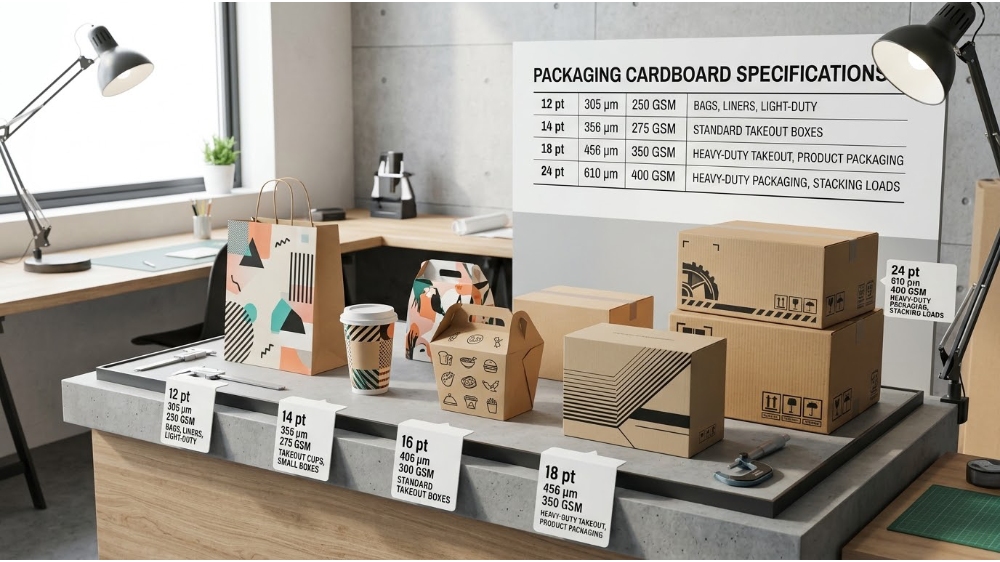
While GSM measures weight, caliper measures physical thickness. In the United States, caliper is expressed in points (pt), where 1 point = 0.001 inch. In metric markets, thickness is measured in microns (µm) or millimeters. A 16 pt board is 0.016 inches thick—approximately 406 microns.
Typical takeout boxes range from 14 pt to 24 pt (approximately 356–610 microns). A 14 pt board (275 GSM) is suitable for lightweight items like small cups or single-serve snacks. A 16 pt board (300 GSM) is the workhorse for standard takeout boxes. For heavy-duty applications—family meals, multiple entrées, or long delivery distances—18 pt (350 GSM) to 24 pt (400 GSM) provides the necessary structural integrity.
It’s important to understand that GSM and caliper are correlated but not directly convertible. The relationship depends on the board’s bulk—the ratio of thickness to weight. A high-bulk board can achieve the same caliper as a lower-bulk board with less GSM, reducing material cost and weight while maintaining stiffness.
Caliper (pt)
Thickness (microns)
Approx. GSM
Common use
12 pt
305 µm
250 GSM
Bags, liners, light-duty
14 pt
356 µm
275 GSM
Takeout cups, small boxes
16 pt
406 µm
300 GSM
Standard takeout boxes
18 pt
456 µm
350 GSM
Heavy-duty takeout, product packaging
24 pt
610 µm
400 GSM
Heavy-duty packaging, stacking loads
Folding strength and compression resistance: why thickness isn’t everything
A thick box isn’t necessarily a strong box. Folding strength (also called bending stiffness) and compression resistance are determined by the interplay of caliper, fiber quality, and board construction—not GSM alone. Research published in Wiley Online Library (2022) demonstrated that printing a PLA-based grid on box panels improved compression performance by 29% under standard conditions and 60% in humid conditions—without changing the board thickness. This shows that structural design and reinforcements can dramatically affect box strength independent of GSM.
In foodservice packaging, the most critical structural property is vertical compression resistance—the ability of a box to support the weight of boxes stacked above it during delivery. A box with adequate caliper but poor folding strength will buckle at the score lines (the creases where the box folds). This is why paperboard grade matters as much as thickness: virgin fiber boards like SBS and CUK have longer, stronger fibers than recycled boards, providing superior fold strength at the same caliper.
For operators stacking multiple boxes in a delivery bag, the bottom box must support the weight of all boxes above it. A 16 pt box that performs well for a single order may collapse under the weight of three stacked meals. In these scenarios, upgrading to 18 pt or 24 pt board—or using a corrugated structure—is essential.
Paperboard grades: SBS, CUK, CRB, and recycled board compared
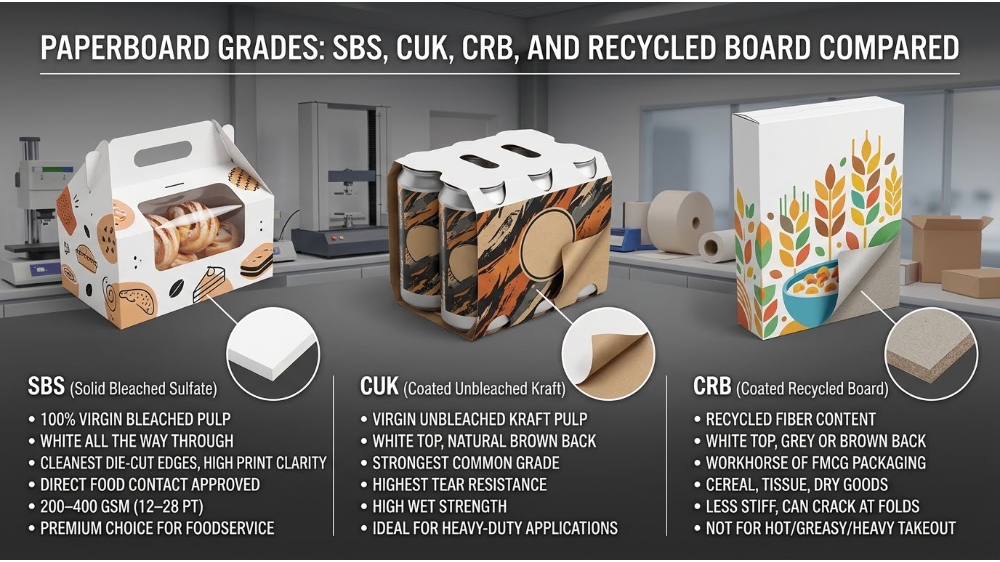
Not all paperboard is created equal. The three primary grades used in folding cartons—SBS (Solid Bleached Sulfate), CUK (Coated Unbleached Kraft), and CRB (Coated Recycled Board)—have distinctly different strength, print, and cost profiles.
SBS is made from 100% virgin bleached wood pulp and is white all the way through. It offers the cleanest die-cut edges, highest print clarity, and is the grade most commonly approved for direct food contact. SBS typically ranges from 200–400 GSM (12–28 pt). It is the premium choice for foodservice packaging where presentation and food safety are paramount.
CUK is made from unbleached virgin kraft pulp with a white clay-coated top surface and a natural brown back. It is the strongest common paperboard grade, with the highest tear resistance and wet strength. CUK is ideal for heavy-duty applications like beverage carriers, frozen food, and large takeout boxes that must survive rough handling.
CRB is made from recycled fiber with a white top layer and a grey or brown back. It is less stiff than virgin boards and can crack at folds if not scored perfectly. CRB is the workhorse of FMCG packaging—cereal boxes, tissue boxes, and dry goods—but is generally not recommended for hot, greasy, or heavy takeout applications.
Quick grade selector:
SBS — Premium food contact, high print quality, foodservice boxes
CUK — Maximum strength, tear resistance, heavy-duty takeout
CRB — Cost-effective recycled option for dry, lightweight goods
Matching thickness to food weight and box size
The weight of the food inside the box is the most direct determinant of required thickness. A light meal—a salad, a pastry, or a single sandwich—can be safely packaged in a 14–16 pt (275–300 GSM) box. A standard meal—a burger and fries, a loaded burrito, or a pasta dish—requires 16–18 pt (300–350 GSM) to prevent sagging and maintain structural integrity. A heavy meal—family-size portions, multiple entrées, or a whole roasted chicken—demands 18–24 pt (350–400+ GSM) or a corrugated structure.
Box size also matters. A larger box has longer spans between fold lines and is more prone to sagging under load. A 9×9 inch box holding a heavy meal needs more caliper than a 5×5 inch box holding the same weight because the larger panel has less inherent stiffness. For large-format takeout boxes (e.g., family meal boxes, pizza boxes), corrugated board (B-flute or E-flute) is often a better choice than solid paperboard because the fluted structure provides excellent strength-to-weight ratio.
Practical rule: For every 500g (about 1.1 lb) of food weight, increase your baseline caliper by approximately 2 pt. A 1 kg meal needs at least 18 pt; a 1.5 kg meal needs 20–22 pt or corrugated.
Hot food, grease, and moisture: barrier coatings matter
Thickness alone cannot prevent grease stains or moisture damage. Hot, greasy foods like fried chicken, burgers, and loaded fries release oils and steam that can compromise an uncoated box within minutes. Barrier coatings—typically polyethylene (PE) or aqueous (water-based) coatings—are essential for hot, moist, or greasy applications.
A PE-coated board provides an excellent grease and moisture barrier while still allowing some vapor to escape through uncoated areas (like vent holes). PE coating is the standard for premium takeout boxes designed for delivery holds of 15–25 minutes. Aqueous coatings are a newer, repulpable alternative that provides good grease resistance and moderate moisture protection, making them a strong choice for eco-conscious brands.
For operators using uncoated kraft boxes, the board absorbs grease directly into the fiber, leading to stains and structural softening over time. This is acceptable for very short holds (under 10 minutes) but is a liability for delivery. When specifying thickness, always consider whether the board will be coated—a coated 300 GSM board will outperform an uncoated 350 GSM board in greasy applications because the coating prevents oil from weakening the fiber structure.
Practical note: A board with a grease barrier can often use 10–20% less GSM than an uncoated board while achieving the same functional performance, because the coating protects the fiber from degradation.
Stacking and shipping: compression testing for delivery
In a delivery environment, takeout boxes are rarely treated gently. They are stacked in bags, jostled in cars, and handed off to customers who may carry them for blocks. Compression resistance—the ability of a box to withstand vertical pressure without collapsing—is the single most important performance metric for delivery packaging.
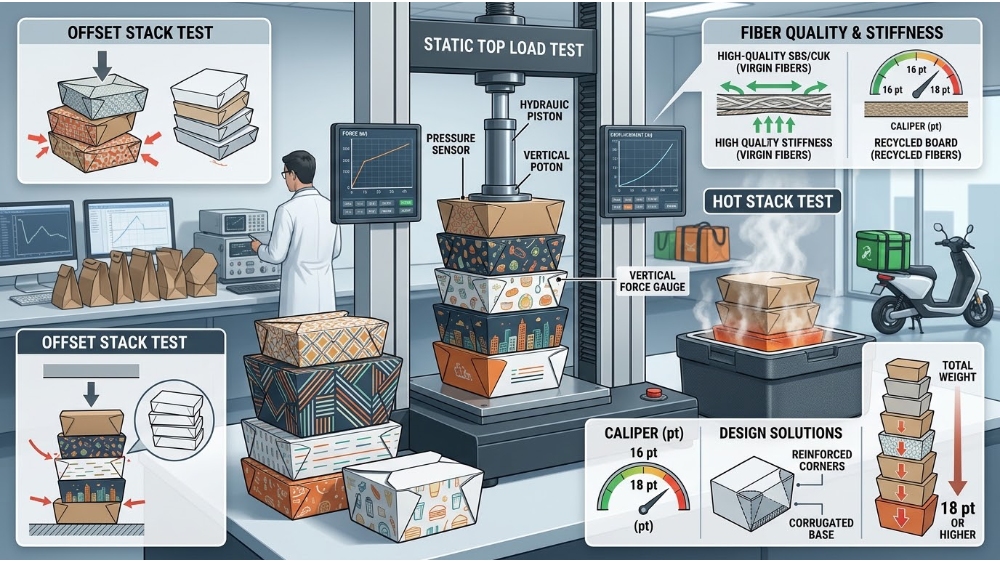
Industry-standard compression tests simulate real-world stacking conditions. A static top load test applies a defined weight to the box for a set time; failure is indicated by lid collapse or wall buckling. A hot stack test fills boxes with hot food and stacks them immediately to simulate delivery conditions. An offset stack test stacks boxes with slight misalignment to test corner strength.
Research on folding board boxes has shown that vertical compression behavior depends primarily on bending stiffness, which is a function of both caliper and fiber quality. A box made from high-quality SBS or CUK at 16 pt will typically outperform a recycled board at 18 pt because the virgin fibers provide greater stiffness per unit of thickness.
For operators shipping multiple boxes per order: The bottom box must support the weight of all boxes above it. If you routinely stack three or more boxes, specify 18 pt or higher and consider reinforced corner designs or corrugated bases.
How to choose the right takeout box thickness for your business
Selecting the right box thickness comes down to four variables: food weight, hold time, grease level, and delivery distance. Start by measuring your actual hold time—from kitchen to customer—not your ideal one. If the average delivery takes 25 minutes, design for 30.
Then evaluate your menu. A light, dry item (pastry, cookie, cold sandwich) can use 14–16 pt (275–300 GSM) uncoated board. A standard hot meal (burger, fries, pasta) needs 16–18 pt (300–350 GSM) with a PE or aqueous coating. A heavy or greasy meal (fried chicken, loaded burrito, family meal) demands 18–24 pt (350–400+ GSM) with a robust grease barrier.
Test with your actual product. Pack a fresh meal in the box, seal it in a delivery bag, and check for sagging, grease spots, and structural integrity at 10, 20, and 30 minutes. If the box sags or leaks at 20 minutes, increase caliper or upgrade the coating. If the box is rigid but cold, you may have over-specified—reduce GSM or explore lightweighting options.
For businesses scaling delivery across multiple locations, packaging consistency is as important as food quality. Working with a packaging supplier who can provide consistent, tested box formats across your full menu eliminates the most common variable in packaging complaints: a box that wasn’t designed for the food it’s holding.
The best GSM depends on your food. Light items (salads, pastries) work with 250–300 GSM. Standard hot meals (burgers, fries) need 300–350 GSM. Heavy or greasy meals require 350–400+ GSM. Always match GSM to food weight, moisture, and delivery distance.
What is the difference between GSM and caliper?
GSM measures weight per square meter; caliper measures physical thickness in points or microns. Two boards can have the same GSM but different thicknesses depending on fiber density and manufacturing. Caliper is the more direct predictor of structural stiffness.
How thick should a takeout box be for delivery?
For standard delivery (15–25 minutes), use at least 16 pt (300 GSM) coated board. For longer holds or stacked orders, upgrade to 18–24 pt (350–400+ GSM). Corrugated board (B-flute or E-flute) is recommended for large or heavy family meals.
Does thicker paperboard mean better grease resistance?
Not directly. Grease resistance comes from barrier coatings (PE or aqueous), not thickness. A coated 300 GSM board outperforms an uncoated 400 GSM board for greasy foods because the coating prevents oil from penetrating and weakening the fiber.
Post time:
Aug-21-2026
For inquiries about our products or pricelist, please leave your email to us and we will be in touch within 24 hours.