
The global shift away from single-use plastics has pushed paper food packaging to the forefront. Yet the paper industry faces a fundamental paradox: a container made of 100% virgin fiber is highly recyclable, but the moment you add a grease barrier, a heat-seal coating, or a poly lining, it often becomes a contaminant in the recycling stream. Understanding the nuances of paper recycling—from fiber length to local material recovery facilities (MRFs)—is essential for any foodservice operator navigating sustainability claims.
Are Paper Food Containers Recyclable? Facts & Guide for Foodservice
Foodservice Packaging Guide
Are Paper Food Containers Recyclable? A Complete Guide to Coatings, Food Residue & Recycling
A paper food container feels sustainable. But toss it in the recycling bin, and it might end up in a landfill anyway. Between plastic coatings, grease stains, and local sorting rules, the answer is rarely a simple “yes.” This guide breaks down exactly what makes a paper container recyclable—and how to choose packaging that matches your end-of-life goals.
What Makes a Paper Food Container Recyclable?
For a paper container to be truly recyclable, it must meet three criteria at a standard paper mill. First, the fiber content must be recoverable—meaning it can be repulped with water and mechanical action without damaging the equipment. Second, any coating or additive must be removable during the pulping process, either by dissolving, screening, or floating away. Third, the final recycled pulp must yield fibers clean enough to form new paper products. According to Technical Association of the Pulp and Paper Industry (TAPPI) guidelines, recyclable paper packaging must achieve a repulpability rate above 80% in standard laboratory tests.
Recycling paper is not a closed loop forever. Each cycle shortens the cellulose fibers. Virgin paper fibers average around 3-4 millimeters in length; after just one recycling pass, they can shrink to under 1.5 millimeters. After 5 to 7 cycles, they become too short to bond, rendering them unusable for new paper products—which is why recycled content is often blended with virgin pulp. This physical limitation means even “recyclable” paper containers eventually exit the system as waste, typically ending up as sludge in a landfill or incinerator.
Uncoated vs. Coated Paperboard: The Core Difference
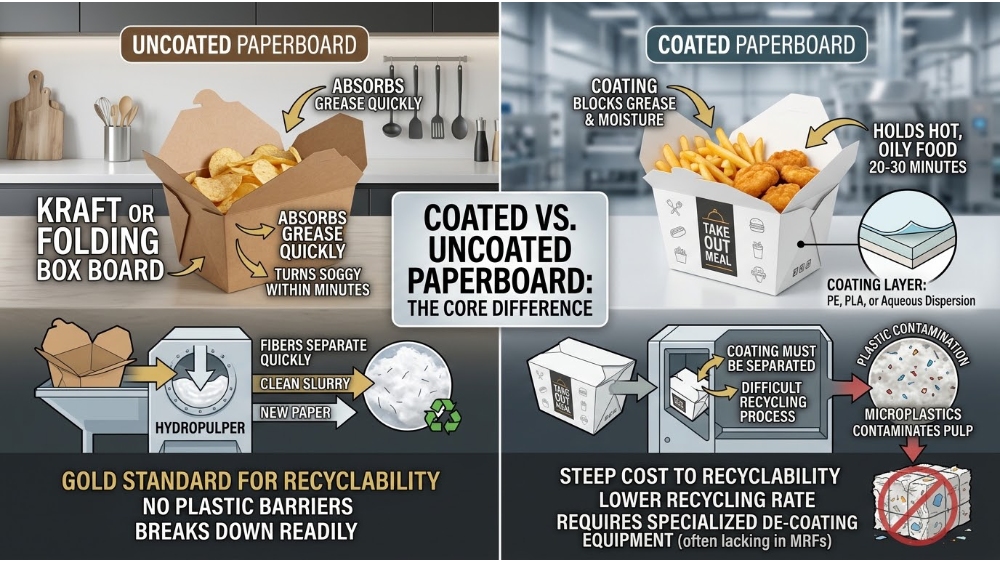
Uncoated paperboard—like standard kraft or folding box board—is the gold standard for recyclability. It contains no plastic barriers, so it breaks down readily in a hydropulper. The fibers separate quickly, and the resulting slurry can be screened, cleaned, and pressed into new paper. However, uncoated board absorbs grease and moisture rapidly. For french fries or saucy noodles, it turns into a soggy, stained mess within minutes, making it impractical for most takeout applications beyond short holds.
Coated paperboard introduces a functional layer—often polyethylene (PE), polylactic acid (PLA), or an aqueous dispersion—to block grease and moisture. These coatings allow the container to hold hot, oily food for 20-30 minutes. But they come at a steep cost to recyclability. The coating must be separated from the fiber during recycling. If the coating is not water-soluble or if it fragments into microplastics, it contaminates the pulp, forcing the mill to reject the bale entirely. The recycling rate for coated paperboard is significantly lower than for uncoated because most municipal MRFs lack the de-coating equipment found at specialized mills. Click to explore coated paperboard Chinese food paper box
PE, PLA, and Aqueous Barriers: Which One Recycles?
Polyethylene (PE) lining
PE-coated paper is the most common barrier in hot cups and fry boxes. The coating provides excellent grease and moisture holdout. However, PE is a thermoplastic that does not dissolve in water. In recycling, it must be mechanically separated using heat and centrifugal force—a process called “polycracking” or “delamination.” Most standard paper mills cannot perform this. Consequently, PE-lined paper is widely considered non-recyclable in curbside systems and is usually directed to waste-to-energy incineration. The hydrophobic nature of PE also means it breaks into persistent microplastics if it accidentally enters composting streams. Click to explore PE lined paper box for food packaging
Polylactic acid (PLA) lining
PLA is a bioplastic derived from corn starch. It is industrially compostable but not recyclable in standard paper streams. When PLA-lined paper enters a conventional recycling mill, the PLA behaves as a heat-sensitive contaminant that melts and clogs screens, or it fails to separate from the fiber, weakening the final recycled sheet. A 2025 study published in ACS Sustainable Chemistry & Engineering confirmed that PLA-coated paper is nonrecyclable under TAPPI recycling conditions because PLA cannot be effectively separated from paper fibers using existing hydropulping technology. Click to explore PLA lined food paper box
Aqueous coatings (water-based barriers)
Aqueous coatings are dispersions of acrylics, styrene-butadiene, or bio-based polymers applied to paperboard. Unlike extruded PE, aqueous coatings are designed to be repulpable. When exposed to water and mild alkaline conditions, they break down into fine particles that are easily removed during screening and cleaning steps. Advanced all-cellulose bilayer barriers have demonstrated over 98% fiber recovery rates, representing a step-change in sustainable packaging. Aqueous-coated board offers excellent grease resistance (often exceeding PE at lower coat weights) while remaining compatible with standard recycling infrastructure, making it the preferred choice for operators with clear end-of-life goals.
Coating recyclability at a glance:
- PE coating: Non-recyclable in curbside; incineration or landfill.
- PLA coating: Non-recyclable; only industrial compostable (not home compost).
- Aqueous coating: Recyclable (repulpable) with proper screening; retains fiber integrity.
How Grease and Food Residue Affect Recyclability
Even a perfectly uncoated paper container is useless to a recycler if it is saturated with grease or leftover food. The issue is physical contamination. During pulping, the entire bale—container plus contents—is submerged in water. Oil and grease coalesce into sticky agglomerates called “stickies.” These stickies coat screens, clog piping, and create dark spots or weak patches in the new paper, rendering it unfit for printing or food-contact use.
Most recycling facilities operate a “tolerance threshold.” For loose, dry residue like a few crumbs or a light dusting of salt, the bale is usually accepted. However, for heavily greasy pizza boxes or oily french fry boxes, the accepted wisdom is clear: when in doubt, throw it out. Some advanced MRFs have optical sorters and air classifiers that can remove some food-contaminated paper, but the majority do not. The Waste Management journal (2024) reported that phthalates and long-chain fatty acids from food residues are among the most commonly detected contaminants in recycled paperboard, directly compromising safety and quality for secondary food-grade uses.
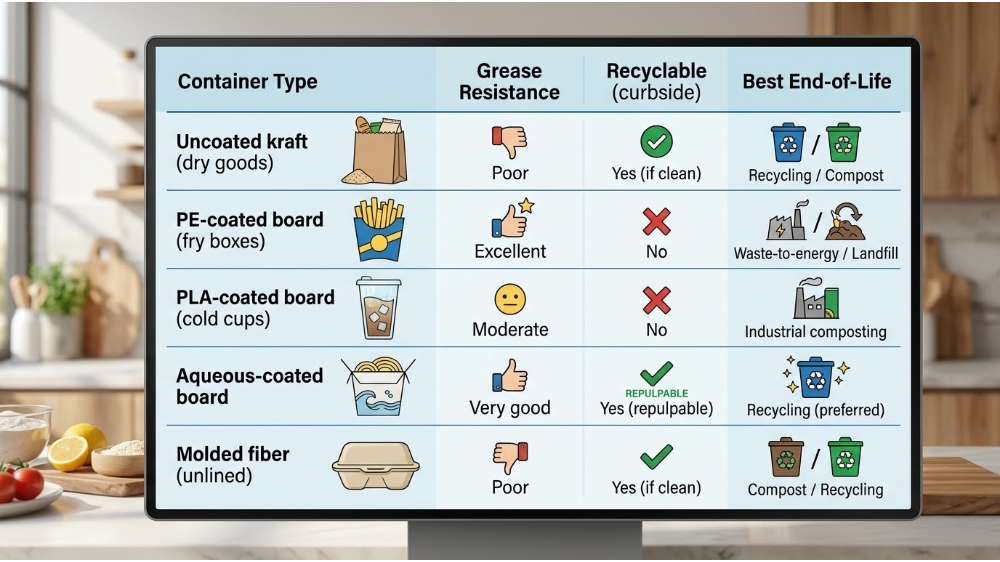
| Container Type | Grease Resistance | Recyclable (curbside) | Best End-of-Life |
|---|---|---|---|
| Uncoated kraft (dry goods) | Poor | Yes (if clean) | Recycling / Compost |
| PE-coated board (fry boxes) | Excellent | No | Waste-to-energy / Landfill |
| PLA-coated board (cold cups) | Moderate | No | Industrial composting |
| Aqueous-coated board | Very good | Yes (repulpable) | Recycling (preferred) |
| Molded fiber (unlined) | Poor | Yes (if clean) | Compost / Recycling |
Recyclable vs. Compostable: Know the Difference
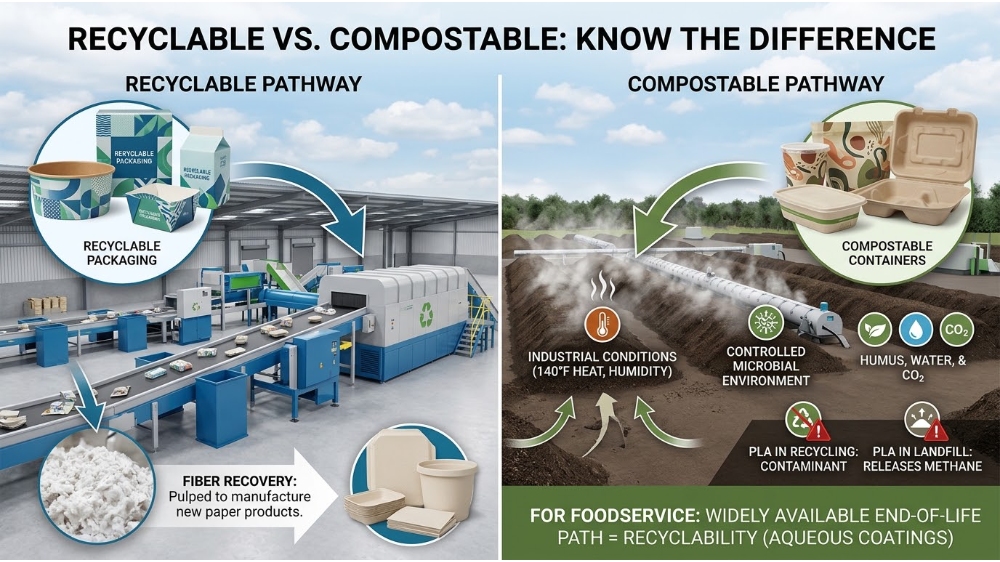
Recyclable and compostable are not interchangeable end-of-life pathways. Recycling recovers raw material (fiber) for manufacturing new paper products. Composting converts organic matter (including bio-based plastics like PLA) into humus, water, and carbon dioxide through biological digestion. They require entirely different infrastructure.
Many operators assume “compostable” is the greener choice. But industrial composting facilities are scarce compared to recycling plants. A PLA-coated paper cup will not break down in a backyard bin; it requires 140°F heat, high humidity, and a controlled microbial environment for 45-60 days. If it ends up in a recycling stream, it is a contaminant. If it ends up in a landfill, it releases methane. For foodservice businesses, the most practical and widely available end-of-life path remains recyclability—specifically, using aqueous coatings that align with existing MRF capabilities. Click to find more compostable food paper boxes
Why “Paper” Does Not Automatically Mean Recyclable
Greenwashing is pervasive. A box labeled “100% paper” can contain up to 15% plastic by weight once you factor in extrusion coatings, adhesive laminates, and wet-strength additives. Wet-strength resins—often used in cold cup walls—are synthetic polymers that cross-link the fiber network to resist liquid penetration. These resins are deliberately engineered to not break down in water, meaning they survive the pulping process as shives or plastic flecks, contaminating the final product.
Additionally, many paper containers are treated with per- and polyfluoroalkyl substances (PFAS) to provide oil and grease resistance. PFAS are “forever chemicals” that are classified as persistent organic pollutants. A 2023 study in Environmental Science & Technology highlighted that polyethylene laminates (often blended with PFAS) are neither compostable nor recyclable, and they pose significant ecotoxicity risks. Thus, “paper” is just the structural carrier—the additives, coatings, and chemical treatments dictate the actual recyclability.
How Local Recycling Rules Differ by Facility
Recycling is local. A container that is accepted in San Francisco’s highly automated single-stream system may be rejected in rural Alabama. The difference comes down to MRF technology. High-investment facilities use near-infrared (NIR) optical sorters, eddy-current separators, and ballistic separators to distinguish between fiber grades. They can sort PE-lined cups from uncoated paper and direct them to specialized mills. However, fewer than 15% of U.S. MRFs have de-inking and de-coating capabilities.
Most communities rely on “dual-stream” or manual sorting, where the presence of any coating or food residue triggers automatic rejection. The recycler sends contaminated bales to the landfill rather than risk damaging the pulping equipment. Operators must check with their local waste management authority to understand specific acceptance criteria for paper food service ware. As a rule of thumb: if the container leaves a visible grease stain on your hand, it will probably stain the recycling batch.
What Food Businesses Should Ask Packaging Suppliers
Purchasing sustainable packaging requires due diligence. Foodservice operators should move beyond surface-level “eco” labels and demand specific, verifiable data. Key questions to ask:
- “Is this container repulpable per TAPPI standard T-275?” TAPPI T-275 is the benchmark for repulping performance. A “yes” means it has been lab-tested for fiber recovery.
- “What is the coating chemistry? Is it PE, PLA, or aqueous?” Request a technical data sheet or a material safety data sheet (MSDS) specifying the barrier type.
- “Are there any PFAS added intentionally?” Many states (e.g., Maine, New York) are banning PFAS in food packaging. Compliance with local regulations is non-negotiable.
- “Do you have a letter of certification or a test report from a third-party lab (e.g., Western Michigan University, PTS, or KCL)?” Lab reports provide evidence of recyclability and grease resistance.
- “What is the minimum recycled content percentage?” Using post-consumer recycled (PCR) fiber reduces reliance on virgin wood but may require thicker caliper board to maintain strength.
How to Choose a Paper Box Based on End-of-Life Goals
Choosing the right paper box starts with defining your waste destination. For operators in cities with mature recycling infrastructure (e.g., Portland, Seattle, parts of Europe), aqueous-coated paperboard is the best investment. It offers the grease holdout required for hot sandwiches and fried items while maintaining repulpability. It closes the loop without compromising functional performance.
For operators in regions where composting is the dominant organic stream—and where industrial digesters exist—PLA-lined board may be appropriate, provided you have clear educational signage to guide customers to the correct bin. However, if the end-of-life path is uncertain, uncoated kraft with a separate greaseproof wrap or insert is the safest default for recyclability, even if it sacrifices some holding time.
Decision framework for operators:
- Hold time < 10 min: Uncoated kraft or molded fiber — fully recyclable/compostable.
- Hold time 10–25 min: Aqueous-coated board — best balance of performance and recyclability.
- Hold time > 25 min / heavy sauces: PE-coated board — but accept that it is non-recyclable; consider waste-to-energy.
- Eco-premium / circular model: Aqueous-coated board + 100% PCR content + clear “Recycle Me” instructions.
Frequently Asked Questions
Can I recycle a greasy paper food container?
Generally, no. Heavy grease and food residue contaminate the pulp, causing stickies and weak spots. A small, dry crumb is acceptable, but if the paper is stained or saturated, it belongs in the trash or compost (if certified).
Are PLA-coated paper cups recyclable?
No. PLA is not recyclable in standard paper recycling systems. It acts as a contaminant that clogs screens and degrades fiber quality. PLA cups should go to industrial composting facilities only.
What does “compostable” mean for paper containers?
Compostable means the container will biodegrade under specific industrial conditions within a defined timeframe (usually 90 days). It does not mean it breaks down in a backyard pile or a recycling bin. BPI certification is a reliable third-party standard.
How do I know if my paper box is recyclable?
Check for the “recyclable” claim verified by a third party (e.g., How2Recycle label). Ask your supplier for a TAPPI T-275 repulpability test report. If it is coated, confirm whether the coating is aqueous (good) or PE/PLA (bad for recycling).
Need packaging that meets your sustainability goals without sacrificing performance?
Talk to a packaging specialist about matching board type, coatings, and fiber sourcing to your menu, hold times, and local waste infrastructure.
Post time: Aug-18-2026