

A standard paper cup runs from a 2–3oz sampling or espresso cup up to a 32oz fountain-drink giant, with the 8oz–16oz band covering nearly every café counter, quick-service order, and office break room in between. The label on the sleeve — “small,” “medium,” “12oz,” “grande” — is really shorthand for three separate specs: the fluid-ounce fill volume, the millimeter rim diameter that decides which lid fits, and the wall construction that decides how much of that labeled volume you actually get to drink.
This guide lines up every commonly stocked paper cup size in ounces, milliliters, and millimeters, then goes further than a typical size chart by explaining why rim diameter — not ounce count — is the spec that actually determines lid, sleeve, and vending-machine compatibility, and why coffee chains, quick-service counters, and office vending operators converge on different size ladders even when the cups look identical in a photo. For a full range of ready-to-order cups, see this paper cup packaging overview.
What Is a “Standard” Paper Cup Size?
A paper cup’s labeled size is a fluid-ounce fill rating, but the number that actually decides compatibility with lids, sleeves, and dispensing equipment is the millimeter rim diameter — not the ounce count printed on the sleeve. Two cups can both say “12oz” and take completely different lids if one has a 90mm rim and the other has an 80mm rim.
Unlike paper bags, which inherited the SOS/barrel-fraction numbering system from bulk dry-goods shipping, paper cups never developed an industry-wide capacity code. Instead, the fluid ounce (US) or milliliter (everywhere else) became the default label, with 1 fluid ounce equal to approximately 29.57 ml. That single conversion factor is the only truly universal constant in paper cup sizing — everything else, including what counts as “small,” “medium,” or “large,” is set independently by each manufacturer, each café chain, and each vending machine brand, which is exactly why the same ounce number can mean a different cup depending on who poured it. Besides, if you’re interested in paper bag sizes, you could read paper bag sizes guide.
Demand for that labeling flexibility is scaling fast. Fortune Business Insights projects the global paper cups market growing from $11.73 billion in 2026 to $13.98 billion by 2034, with North America holding roughly half of global share — a pace driven less by any single new cup size than by quick-service chains, coffee shops, and offices replacing foam and plastic cups at volume across every size tier they already stock. That volume is also why rim-diameter mismatches are such a common ordering mistake: a buyer who reorders “the same 16oz cup” from a new supplier without checking the rim spec can end up with a pallet of cups that no lid in their current inventory actually fits.
Paper Cup Size Chart: Oz, ml, mm, and Typical Uses
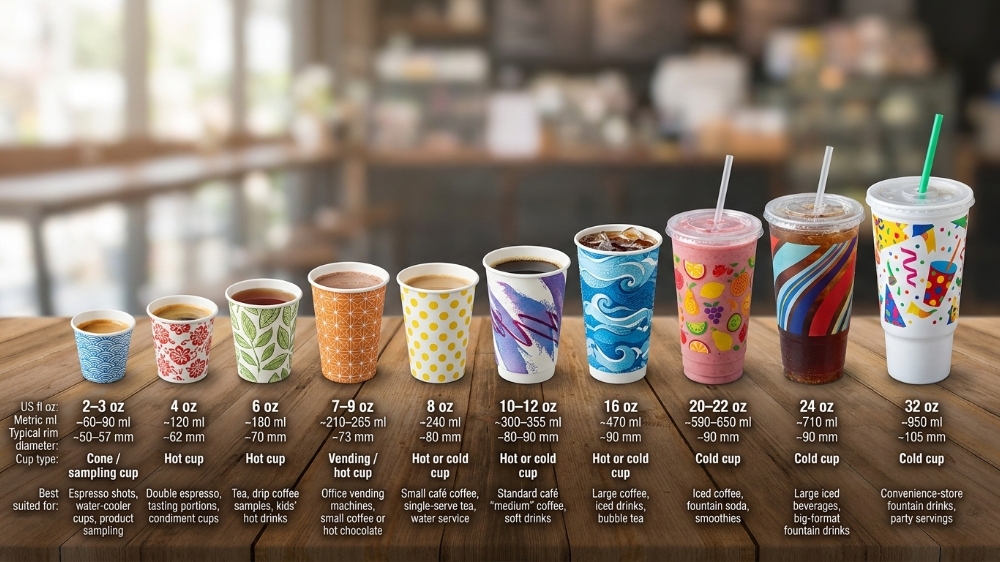
Paper cups run in roughly a dozen standard capacities from 2oz (60 ml) up to 32oz (950 ml), and each capacity clusters around one of a handful of standard rim diameters — commonly 62mm, 73mm, 80mm, 90mm, or 105mm. The chart below lines up nominal size, metric conversion, typical rim diameter, and the use case each size is generally stocked for.
| Size (US fl oz) | Metric (ml) | Typical rim diameter | Cup type | Best suited for |
|---|---|---|---|---|
| 2–3 oz | ~60–90 ml | ~50–57 mm | Cone / sampling cup | Espresso shots, water-cooler cups, product sampling |
| 4 oz | ~120 ml | ~62 mm | Hot cup | Double espresso, tasting portions, condiment cups |
| 6 oz | ~180 ml | ~70 mm | Hot cup | Tea, drip coffee samples, kids’ hot drinks |
| 7–9 oz | ~210–265 ml | ~73 mm | Vending / hot cup | Office vending machines, small coffee or hot chocolate |
| 8 oz | ~240 ml | ~80 mm | Hot or cold cup | Small café coffee, single-serve tea, water service |
| 10–12 oz | ~300–355 ml | ~80–90 mm | Hot or cold cup | Standard café “medium” coffee, soft drinks |
| 16 oz | ~470 ml | ~90 mm | Hot or cold cup | Large coffee, iced drinks, bubble tea |
| 20–22 oz | ~590–650 ml | ~90 mm | Cold cup | Iced coffee, fountain soda, smoothies |
| 24 oz | ~710 ml | ~90 mm | Cold cup | Large iced beverages, big-format fountain drinks |
| 32 oz | ~950 ml | ~105 mm | Cold cup | Convenience-store fountain drinks, party servings |
These brackets track closely with the same ladder most manufacturers describe when comparing paper cup dimensions across capacities, and the reason 90mm shows up across four separate ounce sizes is not a coincidence — it’s a deliberate design choice, covered in the next section, that lets a single lid SKU serve multiple cup volumes. Capacities listed above are brim-full ratings; practical, spill-free serving is generally 85–90% of that number to leave room for foam, ice, or a securely seated lid.
Rim Diameter and Lid Fit: The Number That Matters More Than Volume
Two cups of the same ounce rating can require two different lids if their rim diameters differ, while cups of very different ounce ratings can share a single lid if their rims match. That’s why packaging buyers who only track “8oz, 12oz, 16oz” on a spec sheet — and never record the millimeter rim number — routinely discover a lid mismatch the moment they switch suppliers.
In practice, the industry has converged on a small number of rim diameters rather than a continuous range: roughly 62mm and 73mm for small hot and vending cups, 80mm as the traditional standard for 4–12oz cups, and 90mm for cups from about 10oz up through 24oz. Because one 90mm lid can seal a 10oz, 12oz, 16oz, or 20oz cup interchangeably, operators who standardize their whole hot-drink line on a single rim diameter can cut their lid SKU count dramatically compared to stocking a different lid for every ounce size — a real cost and inventory-complexity saving that shows up on the purchasing side long before it shows up on the menu.
Wall construction changes the math again. A double-wall cup adds an inner liner and an outer shell with an insulating air gap between them, which narrows the usable interior slightly compared to a single-wall cup rated at the same nominal ounce count — a difference that is barely noticeable at 8–12oz but becomes more relevant at 20oz and above, where a “20oz” double-wall cup may hold a touch less liquid than a “20oz” single-wall cup from a different line. Hot cups and cold cups also diverge structurally even at matching rim diameters: hot cups are almost always paper-only with a thin PE or PLA lining designed to survive near-boiling liquid, while cold cups are frequently made in clear PET or PP specifically so branding and ice remain visible, and their rims are cut with a different curl profile to seat a snap-on dome or flat sipper lid rather than a pinch-fold paper lid.
Before finalizing a cup order, confirm:
- The rim diameter in millimeters, not just the ounce count, especially when switching suppliers
- Whether the lid you already stock is rated for that rim diameter and cup type (dome, flat, sip-through)
- Single-wall vs. double-wall construction, and whether a sleeve is still needed on hot cups
- Whether the cup is rated for hot fill, cold fill, or both — PE-lined paper cups are not all interchangeable with PP or PET cold cups
What Size Cups Do Coffee Shops and Fast-Food Chains Use?
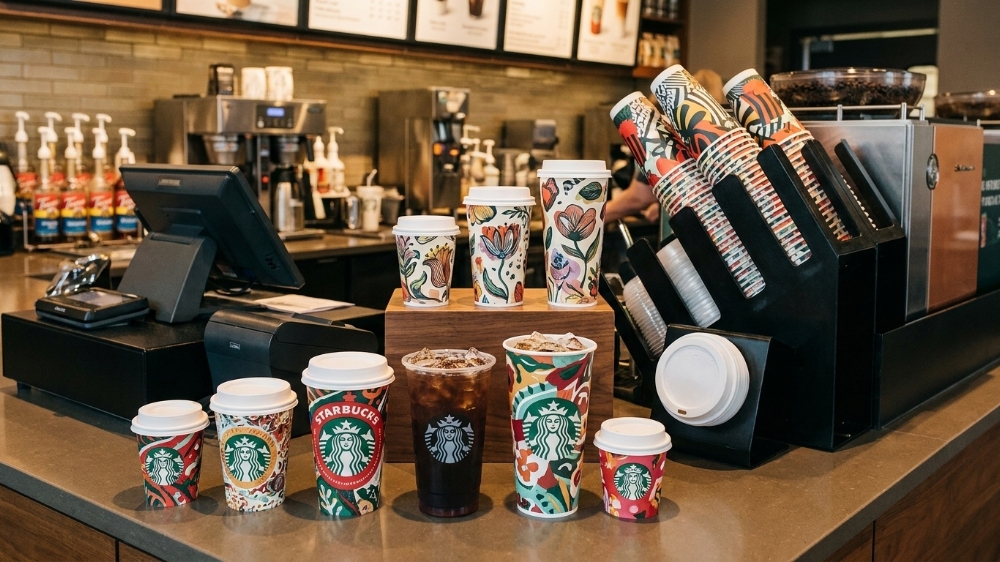
Coffee counters and quick-service chains size cups to an order-value tier rather than to a specific drink recipe, which is why most chains settle on two or three core sizes instead of a cup for every menu item. A small tier covers a single espresso-based drink, a medium tier covers the most popular “regular” order, and a large tier covers iced or combo-scale drinks — a three-step ladder that shows up under different names at almost every chain.
Starbucks is the clearest public example of this logic, and also the source of most customer confusion about it. The chain’s core sizes are Tall (12oz), Grande (16oz), and Venti — 20oz hot or 24oz for iced drinks, since cold orders need extra headspace for ice, with a smaller 8oz Short and a largest 30–31oz Trenta available for cold drinks only. The venti’s two different volumes for hot versus iced is a useful illustration of a rule that applies well beyond one chain: cold-cup capacity planning has to budget headspace for ice on top of the liquid pour, so a cold cup and a hot cup carrying the same ounce label are not delivering the same amount of drinkable liquid.
Independent cafés generally don’t need five sizes to replicate that logic — most settle on 8oz, 12oz, and 16oz as their three core sizes, which covers the vast majority of orders without crowding counter storage or confusing new staff on a busy morning.
Quick-service and drive-thru chains apply the same order-tier thinking but optimize harder for register and drive-thru speed. A cup dispenser rack mounted at the drink station holds a fixed number of pre-sleeved cup stacks, and every extra size variant is another rack slot and another chance for a runner to grab the wrong stack during a rush — the same fixed-SKU pressure that pushes chains toward standardizing lids on a single rim diameter across their whole cold-cup range. That’s also why many quick-service counters lean on 16oz, 20oz, and 24oz for fountain drinks specifically: a wider mouth and taller cup let the fountain nozzle fill quickly without foam overflow, while the cup still fits the same cup-holder cutout in a drive-thru bag or car console.
Vending Machines, Water Coolers, and Office Cup Sizing
Vending machine cups are sized less by drink type and more by the physical dispensing mechanism, which means rim diameter compatibility — not ounce capacity — is the deciding spec for anyone restocking a machine. The most common vending cup sizes are 6.5–7oz and 9oz, generally built around a 70–73mm rim, with a 12oz option on an 80mm rim for larger drink menus.
That narrow rim range exists because vending cup dispensers rely on a solenoid or gravity chute calibrated to a specific rim diameter and stacking taper — a mismatch of even a couple of millimeters can cause the machine to drop two cups at once, drop a cup sideways, or jam the chute entirely, which is a service call that a slightly-off cup order can trigger even when the ounce label matches perfectly. Because of that tight tolerance, office and break-room buyers restocking a machine from a new supplier should always request a physical sample cup to test in the actual dispenser before committing to a bulk order, rather than assuming a “9oz cup” from any vendor will drop cleanly.
Water coolers and standalone water dispensers use an even simpler format: a small 4–5oz cone cup with no flat bottom and no gusseted body, designed to sit in a cone-cup dispenser rather than stand upright on a counter. Office coffee stations, by contrast, usually stock two sizes rather than one — a compact office coffee cup around 8oz for a quick espresso-machine pour, and a 12oz option for drip coffee — which mirrors the small-medium tiering used at retail cafés, just without a branded name attached to either size.
Bulk, Catering, and Event Cup Sizing
Catering and event planning generally works off a two-size system — a small cup for tastings, samples, or water service, and a larger cup for the main beverage — rather than trying to match cup size to every drink on offer. Sizing beyond that adds storage bulk and staff confusion without meaningfully improving the guest experience.
A 2–4oz cup is the standard for wine tastings, sampling stations, and condiment or sauce servings, since the goal is a small, controlled portion rather than a full drink. Water service at conferences and events typically runs 5–7oz, matching the “suitable for water” range most manufacturers quote, while the main beverage service — coffee, soda, or a mixed drink — moves up to the 10–16oz band that covers most adult portion expectations without excessive material cost per guest. Large-format events with self-serve stations sometimes stock a 20–24oz option specifically for iced tea or lemonade dispensers, where guests are expected to refill less often over a multi-hour event.
For beverage brands and bubble tea or smoothie operators building an SKU line rather than a one-off event order, the sizing logic shifts again: capacity needs to scale with add-ins like tapioca pearls, whipped cream, or fruit purée, which is why bubble tea cup lines commonly start at 16oz rather than the 8–12oz range typical of straight coffee service — the extra headroom is functional, not just a bigger portion for its own sake.
How to Choose the Right Paper Cup Size for Your Situation
The “right” standard size changes depending on who’s buying — an independent café optimizing for counter speed, a QSR chain standardizing across thousands of drive-thru lanes, a vending or office operator matched to a specific dispenser, or an event caterer planning a fixed guest count. Matching the buyer’s situation to a size, and to its rim diameter, avoids both under-filled drinks and mismatched lids on reorder.
| Who’s choosing | Recommended size | Why |
|---|---|---|
| Independent café / coffee counter | 8oz, 12oz, and 16oz on a shared 90mm rim | Covers small, regular, and large orders while cutting lid inventory to one diameter |
| QSR / drive-thru chain | 16oz–24oz cold cups, 12oz–20oz hot cups | Matches order-value tiers and fits fixed dispenser rack slots at speed |
| Office / vending operator | 7oz or 9oz on a 73mm rim, 12oz for drip stations | Rim diameter must match the dispenser mechanism exactly to avoid jams |
| Convenience store / fountain drink counter | 20oz–32oz on a 90–105mm rim | Wide mouth speeds fountain fill; large format suits self-serve refills |
| Caterer / event planner | 5oz for water, 10oz–16oz for the main drink | Two-size system keeps staff bagging and setup simple at scale |
| Hotel / hospitality buyer | 6oz–8oz in-room, 12oz for lobby or breakfast service | Smaller in-room cups reduce waste; food-grade lidding matters for room service |
Businesses evaluating a full lineup rather than a single size can review ready-made options such as double-wall coffee cups with lids or cold cup formats by rim diameter and fill weight before committing to a production run. Whatever the segment, the same rule applies: confirm the rim diameter and lid fit alongside the ounce number before finalizing an order — the ounce printed on the sleeve is only the starting point. Need a professional paper cup supplier? Maibao Packaging expert is here for you!
Not sure which size fits your menu or machine?
Talk to a packaging specialist about matching cup size, rim diameter, and lid compatibility to your actual order volume.
Frequently Asked Questions
Why do two 12oz cups from different suppliers take different lids?
Because ounce capacity and rim diameter are separate specs — one supplier’s 12oz cup may use an 80mm rim while another uses 90mm. Always confirm the millimeter rim diameter, not just the ounce label, before ordering lids.
What size paper cup does a typical coffee shop use most?
Most independent cafés and chains report the medium tier — commonly 12oz — as their highest-volume size, sitting between an 8oz small and a 16oz large. It’s the size most customers picture by default when they order without specifying.
Why is a Starbucks Venti two different sizes?
A hot Venti is 20oz, while an iced Venti is 24oz, because cold drinks need extra headspace for ice on top of the liquid pour. The same logic applies industry-wide: a cold cup and hot cup with the same ounce label rarely hold the same amount of drinkable liquid.
Can I use the same cup size in a vending machine as at a counter?
Not automatically — vending machines are calibrated to a specific rim diameter and stacking taper, typically 70–80mm, and a cup that’s off by even a few millimeters can jam the dispenser. Always test a sample cup in the machine before ordering in bulk.