Single Wall vs Double Wall Coffee Cups: Which One Should Your Business Choose?
Single Wall vs Double Wall Coffee Cups: Which One Should Your Business Choose?
Foodservice Packaging Guide
Single Wall vs Double Wall Coffee Cups: Which One Should Your Business Choose?
One cup costs less per sleeve. The other costs less per complaint. Here’s the layer-by-layer math on insulation, sleeves, spill rate, and recyclability that actually decides which wall count belongs on your counter.
Most “single wall vs double wall” comparisons stop at one sentence — double wall is thicker, so it’s warmer — and never get to the number that actually decides a purchase order: what a sleeve costs you per cup versus what the extra paperboard costs you per cup, run against your actual hold time. That’s the gap this guide closes.
The decision looks simple from the outside: two layers feel more premium than one, so double wall must be the “better” cup. But a shop serving flat whites that are gone in four minutes is paying for insulation nobody uses, while a shop serving 20-ounce drive-thru drip in a single wall cup with no sleeve is one scalded hand away from a review that costs more than a year of upgraded cups. This guide works through the decision the way a packaging buyer has to — construction first, real insulation performance second, the sleeve-versus-double-wall cost math third, and only then the branding and sustainability angles most articles lead with. For the plastic side of the same buying decision, see this plastic vs. paper coffee cup comparison, and for the full catalog of ready-stock and custom paper cups by wall type, see this coated paper cup lineup.
Why Wall Count Matters More Than Price Per Sleeve
A cup’s wall count decides three things at once: how long it protects a hand, how much it costs before and after sleeves, and how it gets sorted in a recycling stream. Comparing single wall and double wall cups on unit price alone, without running that math against your actual drink temperatures and hold times, is how a shop ends up either over-engineering a cold-brew menu or under-protecting a drive-thru one.
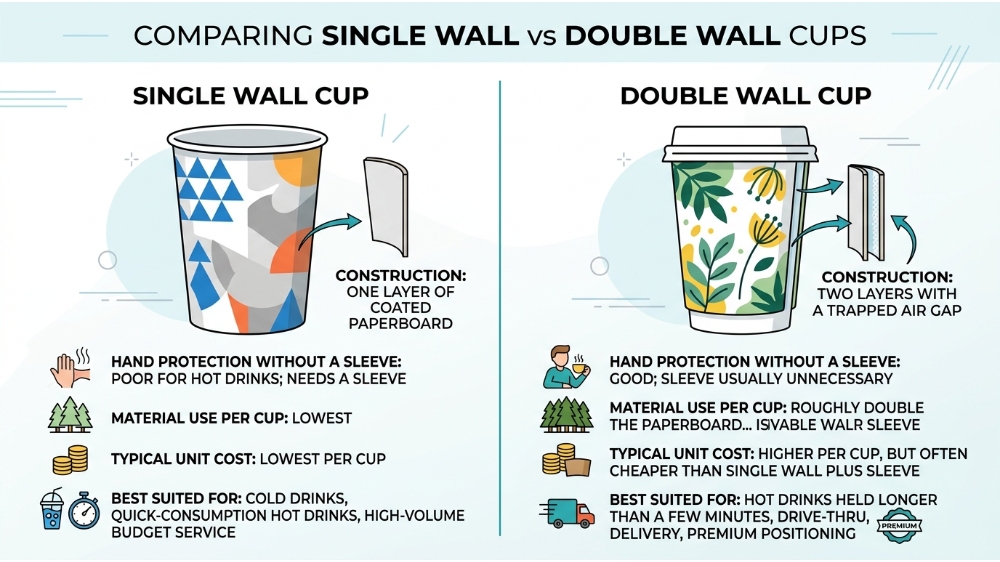
Single wall cups are one layer of coated paperboard. Double wall cups are two layers with a trapped air gap that slows heat transfer to the outer surface. That structural difference is the entire story — everything else, from comfort to cost to compostability, follows from whether there’s an air pocket between the drink and the customer’s hand. A single wall cup filled with a near-boiling pour-over will transfer heat to the outer wall almost immediately, which is why single wall service has historically depended on a paper sleeve as a mandatory second component rather than an optional upsell.
The mistake that costs money in both directions is treating this as a single global decision instead of a per-drink one. A shop that standardizes on double wall for every size, including 8-ounce espresso-based drinks that are consumed within minutes, is paying an insulation premium that never gets used. A shop that standardizes on single wall for everything, including 16-ounce drip coffee held for a 20-minute commute, is either burning through sleeve inventory or fielding burned-hand complaints. The right answer is almost always both cups, assigned by drink category — not one cup chosen for the whole menu.
Single Wall vs Double Wall: How They’re Actually Built
A single wall cup is one sheet of PE- or PLA-coated paperboard rolled into a cone; a double wall cup is two of those sheets nested together with air trapped between them, sometimes with a textured or ripple outer layer for grip. The coating on the inside is what makes either version liquid-proof — the wall count only governs what happens to heat after it passes through that inner layer.
Single wall construction
A single wall cup starts as flat paperboard, typically food-grade stock with a thin polyethylene or PLA film laminated to the inside to stop the paper from soaking through. That single sheet is die-cut, rolled, and seamed into the familiar cone-and-base shape. Because there’s only one layer, the wall is thin — usually well under a millimeter of combined paper and coating — which keeps the cup light and inexpensive to produce, ship, and store, but also means heat from the drink reaches the outer surface with almost nothing slowing it down.
Double wall construction
A double wall cup takes that same single wall cup and nests it inside a second, slightly larger paperboard sleeve, sealed at the rim and base so a thin layer of air is trapped between the two. That air gap is the entire mechanism — air is a poor conductor of heat, so the outer layer stays noticeably cooler than the inner layer even while the inner layer is in direct contact with a hot drink. Some double wall cups replace the smooth outer layer with a corrugated or “ripple” one, which increases surface area for grip and airflow but is technically a different sub-category, covered in its own section below.
Feature
Single wall
Double wall
Construction
One layer of coated paperboard
Two layers with a trapped air gap
Hand protection without a sleeve
Poor for hot drinks; needs a sleeve
Good; sleeve usually unnecessary
Material use per cup
Lowest
Roughly double the paperboard of a single wall cup this size, before any sleeve is added
Typical unit cost
Lowest per cup
Higher per cup, but often cheaper than single wall plus a sleeve combined
Best suited for
Cold drinks, quick-consumption hot drinks, high-volume budget service
Hot drinks held longer than a few minutes, drive-thru, delivery, premium positioning
The Real Insulation Difference: How Much Longer Does Double Wall Stay Hot?
Double wall paperboard keeps a hot drink noticeably warmer for longer than a single wall cup of the same size, largely because the trapped air gap slows heat loss to the outside air rather than trapping it inside the drink. The more immediately useful number for a buyer isn’t how much longer the coffee itself stays hot — it’s how much cooler the outer wall stays, since that’s what determines whether the cup is comfortable to hold bare-handed.
Industry testing on standard 8-ounce paper cups has found that double wall construction keeps drinks measurably warmer than single wall for a comparable period, which is consistent with what most cafés observe operationally: a single wall cup filled with near-boiling drip coffee becomes uncomfortable to hold within roughly a minute or two, while a double wall cup filled with the same drink can typically be held bare-handed for the full length of a walk to a car or a commute onto a train. That gap is exactly why industry comparisons of takeaway cup construction treat single wall cups as a short-drink format — suited to espresso, macchiatos, and anything consumed at the counter — rather than a general-purpose hot cup.
What this means practically is that “insulation” isn’t a single fixed property of a cup, it’s a function of wall count and drink temperature together. A single wall cup holding a 60°C oat-milk latte behaves very differently from the same cup holding a 90°C black Americano — the insulation gap between single and double wall widens as the drink gets hotter, which is why the wall-count decision should be made per drink temperature, not per cup size alone.
Sleeves vs Double Wall: The Cost Math Most Buyers Skip
A single wall cup plus a corrugated sleeve is not automatically cheaper than a double wall cup — once you add the sleeve’s unit cost, the labor time to apply it, and the SKU it adds to your inventory, the two options often land within a fraction of a cent of each other. The buyer error is comparing the cup-only price of single wall against the all-in price of double wall, which stacks the comparison against the more convenient option before the math even starts.
Run the comparison correctly and there are four line items on the single wall side: the cup, the sleeve, the seconds of labor per drink to slide the sleeve on during a rush, and the warehouse or back-of-counter space for a second SKU that has to be reordered, tracked, and never run out independently of the cup itself. Double wall collapses all four into one SKU and one unit cost. For a high-volume counter doing several hundred hot drinks a day, the labor time alone — a barista fumbling a sleeve during a queue — is a real, if unmeasured, cost that a straight cup-price comparison never captures.
Where single wall plus a sleeve still wins on pure economics is lower-volume, mixed hot-and-cold operations that don’t want to hold two separate hot cup SKUs, or brands that use the sleeve itself as a second branding surface — a printed sleeve is often cheaper to customize in small runs than a printed double wall cup, since it’s a flat blank rather than a formed cup. The honest framing for a buyer: run the four-line-item math against your own drink mix and hold times before assuming either option is cheaper, because the answer flips depending on volume and labor cost, not on a general rule either format’s marketing repeats.
Before choosing between a sleeve and a double wall cup, calculate:
All-in cost per hot drink: cup + sleeve + labor seconds, compared against the double wall cup price alone
Average hold time for your hottest drink category — a 3-minute counter pour needs less insulation than a 20-minute delivery order
Whether your team can reliably apply a sleeve correctly during a rush without slowing the line
Whether the sleeve doubles as printable branding real estate you’d otherwise have to buy on the cup itself
Ripple Wall: The Third Option Nobody Mentions Until It’s Too Late
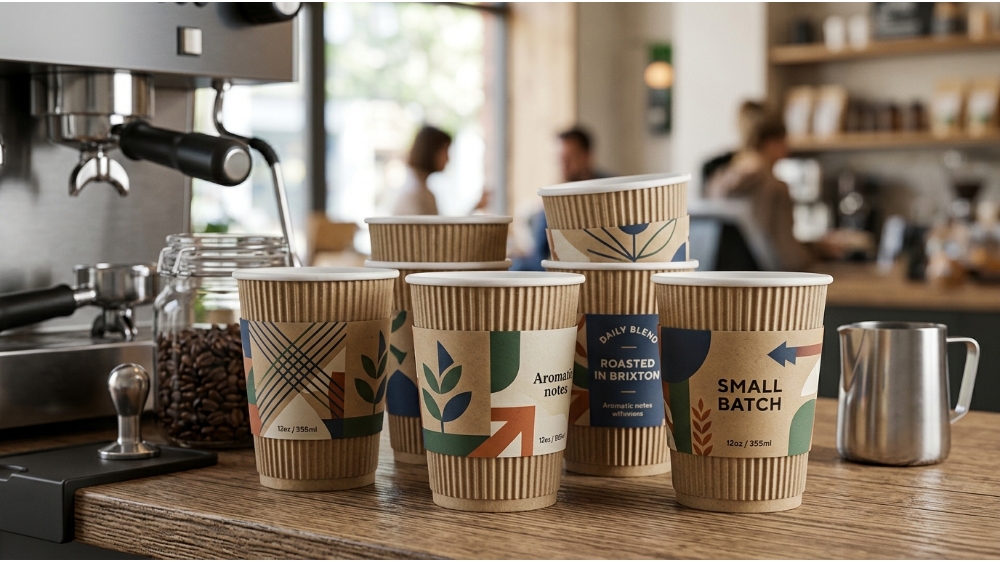
Ripple wall cups are a single wall cup wrapped in a corrugated outer layer instead of a second smooth layer, giving similar insulation and grip to double wall at a construction cost that depends on printing complexity rather than a fixed rule that one is always cheaper than the other. Buyers who only compare “single vs double” often miss this format entirely, then discover it mid-negotiation when a supplier quotes it as an upsell.
The corrugated ridge on a ripple wall cup increases surface area between the hand and the hot drink, which slows heat transfer in a similar way to double wall’s air gap, while also giving the cup a textured, tactile grip that some premium and specialty coffee brands use deliberately as a design signal. The tradeoff is manufacturing complexity: applying and die-cutting a corrugated outer wrap is a more involved production step than nesting two smooth layers, which is part of why ripple wall pricing tends to sit close to, and sometimes above, double wall rather than reliably below it. Click to explore more ripple wall cups.
For a business deciding between the two, the practical distinction isn’t insulation performance — both formats solve the heat-transfer problem adequately for most hot drink service — it’s branding surface and mouthfeel. Double wall gives a smoother, fuller surface for edge-to-edge full-wrap printing; ripple wall trades some of that print real estate for a grip and texture that reads as artisanal on a shelf or in a customer’s hand. Neither is a mistake; they’re solving slightly different brand problems that happen to share the same thermal benefit.
Recyclability: Which Wall Type Is Actually the Greener Claim?
Wall count itself doesn’t determine recyclability — the inner coating does — but double wall cups use roughly double the paperboard of a single wall cup the same size, which is the honest sustainability tradeoff a “greener because it’s paper” claim usually skips. A cup’s recyclability comes down to whether its coating is a standard polyethylene laminate, which most municipal paper streams still reject at scale, or a compostable or water-based barrier, which is increasingly accepted in industrial composting and some paper-recycling programs.
This is where the single-vs-double comparison gets more nuanced than most sourcing guides admit. A single wall cup with a PE lining and a disposable paper sleeve produces two separate pieces of waste per drink, both of which typically need to go through the same limited recycling or composting pathway as a lined double wall cup — so the “single wall is greener because it uses less material” argument only holds if the sleeve is being counted out of the waste stream entirely, which in real-world service it rarely is. A double wall cup eliminates the second component, but at the cost of roughly twice the base paperboard per cup compared to single wall.
The defensible position for a business making a sustainability claim is specific, not comparative: state the coating type (PE, PLA, or water-based barrier) and whether your region’s facilities actually process it, rather than asserting that fewer layers or fewer components automatically means a lower footprint. Neither wall count is inherently the sustainable choice — the lining chemistry and your local waste infrastructure decide that, the same way they do on the plastic side of a cup lineup. Learn more about coating type by reading Are PLA Cups really Eco-friendly the Truth behind Compostable Packaging Claims.
Matching Wall Type to Drink, Size, and Service Style
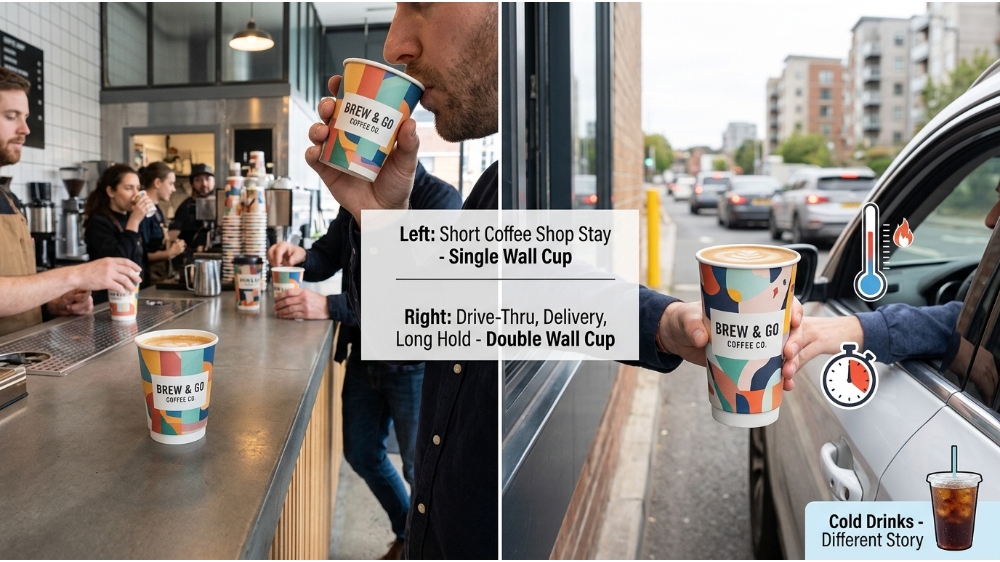
Short, quickly consumed hot drinks in smaller sizes are the strongest case for single wall; anything hot, large, or held for more than a few minutes — drive-thru, delivery, and long commutes — is the strongest case for double wall. Size and temperature interact: a small single wall cup of scalding espresso is manageable because the volume of hot liquid and the surface area in contact with the hand are both small, while a large single wall cup of the same temperature drink multiplies both.
Espresso-based short drinks — macchiatos, cortados, straight espresso — are consumed at or near the counter in most service formats, which is exactly the profile comparisons of 8-ounce hot cup formats point to when noting that double wall construction extends comfortable hold time well beyond what a quick counter drink actually needs. Drip coffee, large lattes, and anything sold through a drive-thru window or a delivery app sit at the opposite end: longer hold times, larger volumes, and — critically — a customer who often can’t set the cup down to let it cool, because they’re driving or walking. That’s the segment where a single wall cup without a sleeve produces the complaint pattern most shops actually experience: hot-to-the-touch cups, spilled lids from a rushed hand-off, and reviews that mention discomfort rather than the coffee itself.
Cold drinks are a different conversation entirely
Wall count is a hot-drink decision. For iced coffee, cold brew, and other cold service, insulation against heat transfer is irrelevant — the wall-count question there is really about condensation and rigidity, which is why most cold cup sourcing decisions run through resin choice rather than paperboard layers. If your menu is cold-drink-heavy, that’s a separate sourcing question covered in this plastic cold cup and lid lineup rather than the single-vs-double-wall paper decision. Learn more about plastic cups by reading Best Plastic Cups for Coffee Shops: How to Choose the Right Cup Material, Size, and Style.
How to Choose the Right Wall Count for Your Business
The right wall count depends on your drink’s temperature, its typical hold time before consumption, your service format, and whether the sleeve-versus-double-wall cost math actually favors the cheaper-looking option once labor and inventory are counted — not on which cup looks more premium on a shelf.
Who’s choosing
Recommended wall type
Why
Espresso bar, counter-service short drinks
Single wall, no sleeve
Hold time is short enough that insulation adds cost without adding comfort
Café with mixed short and long hot drinks
Single wall for espresso sizes; double wall for 12oz+ drip and lattes
Matches insulation to actual hold time per drink category, not one cup for the whole menu
Drive-thru or delivery-heavy operation
Double wall across all hot sizes
Customers can’t set the cup down to cool; comfort and spill risk matter more than unit cost
Premium or specialty brand
Double wall or ripple wall with full-wrap print
Both formats support edge-to-edge branding and a heavier, more substantial feel
Events, sampling, low-volume pours
Single wall with sleeve on hand as needed
Avoids paying for a dedicated hot-cup SKU when volume doesn’t justify it
Shops evaluating a full hot-cup lineup rather than a single SKU can review ready-made single wall, double wall, and custom-printed options side by side before committing to a production run, and for the branding side of that decision, this custom coffee cup packaging overview covers print and finish options across both wall types. Whatever the segment, the rule holds: match wall count to hold time and drink temperature first, then layer branding and sustainability claims on top of that decision rather than in place of it. If you need a packaging partner to run the sleeve-versus-double-wall math for your specific menu, try to contact Maibao Packaging, your cup sourcing partner.
Not sure which wall type fits your hot drink menu?
Talk to a packaging specialist about matching single wall, double wall, or ripple wall construction to your actual drink temperatures, hold times, and service format.
Is double wall always better than single wall for hot coffee?
Not always — for espresso-based drinks consumed within a minute or two at the counter, the extra insulation of double wall often goes unused. It becomes clearly worthwhile once hold time stretches past a few minutes, as with drive-thru, delivery, or large drip coffee.
Is a single wall cup with a sleeve cheaper than a double wall cup?
Not necessarily — once you add the sleeve’s unit cost, the seconds of labor to apply it during a rush, and the extra SKU it adds to inventory, the two options often land close in total cost per drink. Run the comparison against your own volume and labor cost rather than assuming either wins by default.
Are double wall cups recyclable if single wall cups aren’t?
Recyclability comes down to the inner coating, not the wall count — a PE-lined cup of either type typically faces the same limited acceptance in municipal paper streams. A double wall cup does remove the need for a separate paper sleeve, which is one fewer component in the waste stream per drink.
What’s the difference between double wall and ripple wall cups?
Double wall uses two smooth paperboard layers with a trapped air gap; ripple wall uses a single inner cup wrapped in a corrugated outer layer for grip and airflow. Insulation performance is broadly similar between the two — the real difference is branding surface, texture, and manufacturing cost.
Post time:
Jul-24-2026
For inquiries about our products or pricelist, please leave your email to us and we will be in touch within 24 hours.