Coffee Cup Lid Guide: Types, Sizes, and How to Choose the Right Lid
Coffee Cup Lid Guide: Types, Sizes, and How to Choose the Right Lid
Foodservice Packaging Guide
Coffee Cup Lid Guide: Types, Sizes, and How to Choose the Right Lid
A lid gets picked last in most packaging orders and blamed first when a drink leaks. Here’s how to read lid type, diameter, and material as one fit decision instead of three separate line items.
Buyers spend most of a packaging conversation on the cup — wall count, coating, print run — and treat the lid as whichever option the supplier lists next to it. That ordering gets the failure point backwards. The cup is what a customer sees; the lid is what a customer trusts not to fail between the counter and the first sip. A lid that’s the wrong diameter, the wrong type for the drink, or the wrong material for the heat pops, leaks, or collapses, and the complaint that follows never mentions the cup at all.
This guide treats the lid as its own sourcing decision: how the four main lid types actually differ, why diameter — not a vague “fits most cups” claim — is the number that prevents leaks, what the common lid plastics trade off against each other, and where a 2024 EU rule already narrows the field for any business shipping into the European market. For carriers, straws, and sleeves, see the guide to coffee cup accessoies, and for the lids, see this overview.
Why the Lid Is the Last Point of Failure in a Cup Order
A lid is the only packaging component under continuous physical stress from the moment it’s snapped on until the cup is empty — pressure from heat, weight from ice, tilt from walking, and the direct force of a mouth against it. Get everything else in an order right and get the lid wrong, and the failure still shows up as a burn, a spill, or a one-star review about “bad packaging.”
Most lid problems trace back to one of three mismatches, not to a defective lid. A diameter mismatch — a lid rated for one cup line pressed onto a slightly different rim — creates a seal that looks fine on the counter and fails the first time the cup tips in a bag or a cupholder. A type mismatch — a flat lid with no vent used on a very hot, freshly steamed drink — builds steam pressure with nowhere to go, which is the mechanism behind a lid popping off rather than leaking slowly. And a material mismatch — a lid designed for cold, rigid holding used on a drink hot enough to soften it — deforms exactly when the seal needs to hold tightest.
The buying pattern that avoids all three is the same one that governs the rest of a packaging order: spec the lid against the drink and the cup it actually sits on, not against the lowest price per thousand for a generic “universal fit” SKU. A lid that’s a fraction of a cent cheaper but doesn’t seal on your actual cup line isn’t a savings — it’s a spill waiting for a customer to absorb.
Lid Types: Flat, Dome, Sip, and Reclosable Explained
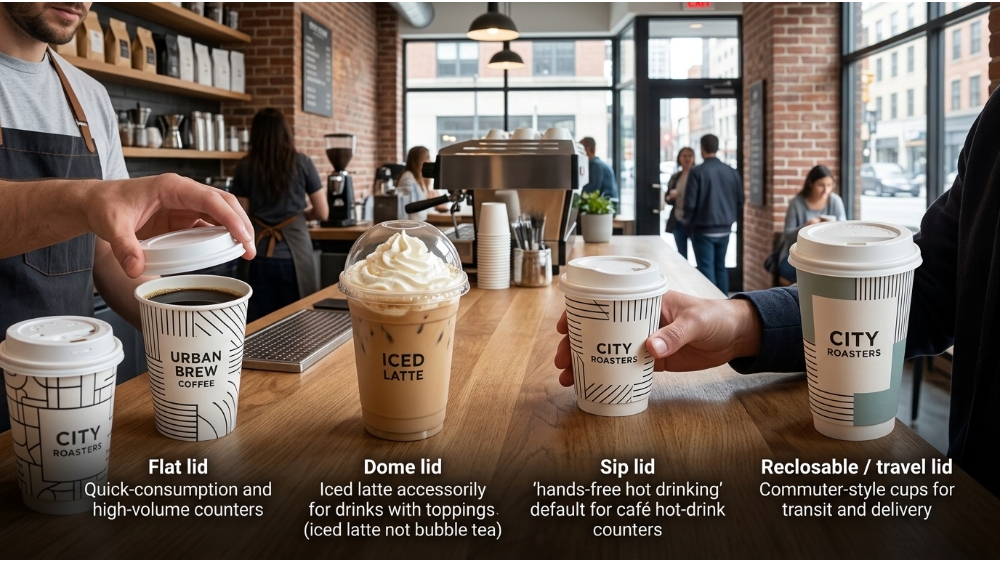
Flat lids sit low and suit fast hot-drink service; dome lids add headspace for toppings and cold drinks; sip lids raise a mug-like spout for hands-free hot drinking; reclosable lids trade a little speed for a seal that survives a bag. Each format solves one drink-handling problem and creates a different failure mode when it’s used on the wrong beverage.
Flat lids
A flat lid lays close to the cup rim with a small sip hole or straw slot near the edge, which keeps the stack height low for storage and the assembly time short at the counter. It’s the default for straightforward hot drinks and quick-consumption cold drinks without toppings, and its low profile is also why it’s the cheapest lid format to freight and store in bulk. The trade-off is headspace: a flat lid gives a drink almost no room to expand, which makes it a poor match for anything topped with foam, whipped cream, or a mound of ice.
Dome lids
A dome lid extends upward from the rim in a rounded shape, creating vertical clearance that a flat lid doesn’t have. That extra space is the entire point — it protects whipped cream, cold foam, and iced-drink toppings from getting crushed against the lid during transport, and it’s why dome lids dominate the frappe, iced-latte, and bubble tea segment rather than the plain hot-coffee segment. Dome lids also do double duty as a visual feature, since the clear or translucent versions show off a layered drink through the lid itself, which matters more for a menu built around photogenic cold drinks than for a black-coffee counter.
Sip lids
A sip lid is molded with a raised, mug-like spout that lets a customer drink hot coffee without tilting the cup or removing the lid, which is why it’s become the default lid on most hot-drink counters rather than a specialty option. The raised spout also does a second job: it keeps a customer’s lips away from the hottest point of the drink, which sits directly under a flat lid’s low sip hole. Sip lids are built specifically for hot service and aren’t a fit for iced or blended drinks that need a straw or a wide topping clearance.
Reclosable and travel lids
A reclosable lid adds a flip-top, slide, or tab mechanism that lets a drink be sealed shut between sips rather than left permanently open at a sip hole or straw slot. That extra seal is the strongest defense against a spill inside a bag, a car cupholder, or a backpack, which is why reclosable and premium travel lids concentrate in commuter-heavy and delivery-heavy service rather than counter pickup, where the drink is consumed shortly after purchase. The cost is speed and unit price — a reclosable mechanism takes longer to manufacture and to operate than a flat sip hole, which is a fair trade for a drive-through or delivery order and an unnecessary one for a customer drinking at a table five minutes after ordering.
Lid type
Best fit
Watch for
Flat lid
Hot coffee, quick-consumption cold drinks, high-volume counters
No headspace for foam or toppings; needs a vent for very hot drinks
Dome lid
Iced lattes, frappes, bubble tea, drinks with whipped cream
Bulkier to store; not built for scalding-hot liquid
Sip lid
Hands-free hot drinking, the default for most café hot-drink counters
Not designed for straws, ice, or thick blended drinks
Reclosable / travel lid
Commuters, delivery, car cupholders, long transit
Higher unit cost and slower to apply than a flat sip lid
Lid Sizing: How Diameter Actually Determines Fit
A lid’s fit is decided by rim diameter, not by drink size or a “universal” label, and the industry has settled on a small set of standard diameters that most cup lines are built around. Getting the diameter wrong is the single most common cause of a leaking lid, and it’s usually invisible on the counter before the cup ever tilts.
Cup and lid diameters are typically measured in millimeters across the rim, and 80mm, 90mm, and 98mm are the sizes most disposable cup lines are built to, spanning small hot cups through large cold and iced formats. A lid one size off doesn’t simply fail to fit — an 80mm lid forced onto a 90mm rim won’t seat at all, while a 90mm lid on an 80mm rim seats loosely enough to look secure on a flat counter and still fail the moment the cup is carried at an angle. A rim diameter tolerance beyond roughly half a millimeter is enough to produce frequent leaks, which is a far tighter margin than most buyers assume when they’re comparing lids across suppliers by size name alone rather than by measured diameter.
The practical risk isn’t buying the wrong size on purpose — it’s assuming that two suppliers’ “medium” or “16oz” lids are interchangeable because they’re marketed under the same label. Cup and lid dimensions aren’t standardized by law, only by informal industry convention, so a lid rated for a 16oz cup from one manufacturer can measure differently from a 16oz lid at another. The only reliable check before a bulk order is to measure the actual rim diameter of the cup in hand and match it against the lid’s stated diameter in millimeters, not against the ounce size printed on either package.
Lid fit checklist before a bulk order:
Measure your cup’s actual rim diameter in millimeters — don’t rely on the ounce size printed on the case
Confirm the lid diameter against that measurement, not against a supplier’s “universal fit” claim
Test the seal at an angle, not just flat on a counter, since most leaks only appear once a cup tilts
Request a physical sample of both cup and lid together before committing to a production run
Lid Materials: PS, PP, PET, and PLA Compared
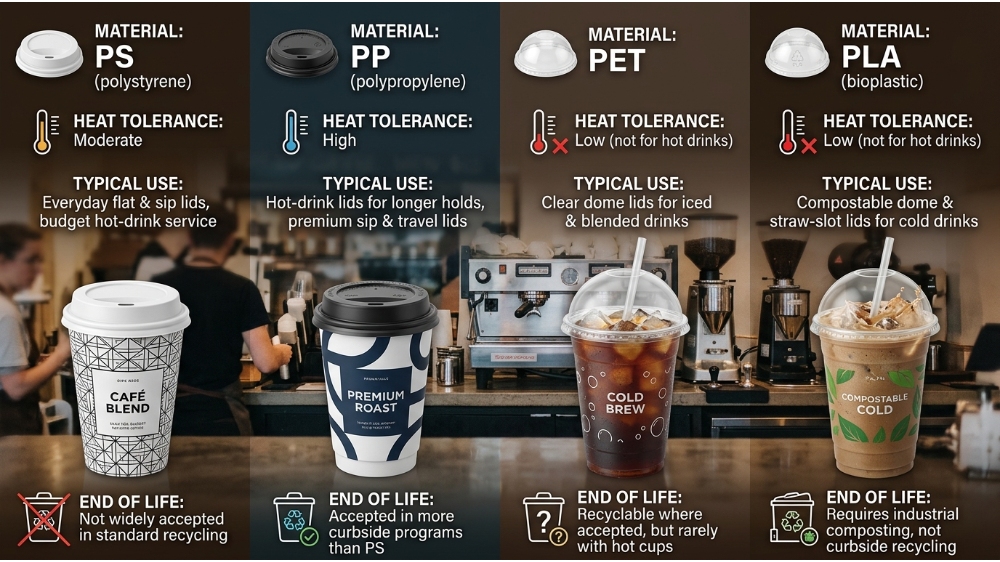
Lid material decides how a lid behaves under heat, how rigid it stays under ice, and how it exits the waste stream, and the four materials that cover most of the market perform differently enough on all three that swapping one in for another without checking is a real operational risk, not a cosmetic choice.
Polystyrene (PS) is the lowest-cost option and still common on flat and sip lids for everyday hot-drink service, though it softens at lower temperatures than the alternatives and holds up worse under repeated reheating or very hot pours. Polypropylene (PP) costs a little more but tolerates heat noticeably better, which is why it’s become the preferred plastic for lids paired with very hot drinks or drinks held for a longer commute. PET is the clear, rigid plastic behind most dome lids, prized for showing off a layered iced drink but not built for hot service, since it distorts under sustained heat in a way PS and PP resist. PLA, the compostable bioplastic, behaves close to PET at room and cold temperature but softens well before either petroleum-based plastic when exposed to hot liquid, which limits it mostly to cold-drink dome and straw-slot lids rather than hot-coffee lids — the same industrial-composting caveat that applies to PLA straws applies here: it only breaks down where a commercial composting facility exists to receive it.
Material
Heat tolerance
Typical use
End of life
PS (polystyrene)
Moderate
Everyday flat and sip lids, budget hot-drink service
Not widely accepted in standard recycling
PP (polypropylene)
High
Hot-drink lids for longer holds, premium sip and travel lids
Accepted in more curbside programs than PS
PET
Low (not for hot drinks)
Clear dome lids for iced and blended drinks
Recyclable where accepted, but rarely with hot cups
PLA (bioplastic)
Low (not for hot drinks)
Compostable dome and straw-slot lids for cold drinks
Requires industrial composting, not curbside recycling
The buying rule that avoids the most complaints mirrors the straw decision covered elsewhere in this guide’s accessory series: match material heat tolerance to the drink, not to the lowest sticker price, and treat any “eco-friendly” material claim as accurate only where the local waste infrastructure can actually process it.
Hot Lids vs Cold Lids: Why They Aren’t Interchangeable
A hot-drink lid and a cold-drink lid are solving opposite physical problems, which is why a lid built for one drink category tends to fail, not just underperform, when it’s used on the other. Heat needs somewhere to go; cold and ice need to be sealed in.
A hot beverage generates steam inside a closed cup, and a lid without any vent or pressure-release path traps that steam until it forces its own way out — usually violently, at the seam, rather than gradually through a designed opening. That’s the mechanism behind a popped lid rather than a slow leak, and it’s why hot-drink lids are built with a sip spout, vent hole, or perforated tab specifically to give pressure a controlled exit. A cold or iced drink has the opposite problem: no internal pressure to vent, but ice, condensation, and liquid volume pressing outward against a seal that has to hold through jostling, tilting, and a straw punched through the lid itself. That’s why cold lids favor a tighter cross-cut or pre-cut straw slot and a more rigid rim seal rather than a vented spout.
The failure that shows up most often in practice is a flat, unvented lid pressed onto a freshly steamed hot drink because it was the closest size on the shelf — the seal holds for a few seconds, then releases under building steam pressure, and the result is a scald risk rather than a minor spill. Stocking hot and cold lids as genuinely separate SKUs, rather than treating any lid that physically fits the cup as interchangeable, is the cheapest insurance available against that specific failure.
The EU Tethered-Lid Rule and What It Means for Sourcing
Any business shipping disposable cups into the European Union is already operating under a lid-specific rule that changes how a plastic lid can be packaged and sold, independent of which type or material is chosen. This is a compliance boundary, not a design preference, and it applies whether the lid is flat, dome, or sip.
Since July 2024, the EU requires that plastic caps and lids on single-use beverage containers up to three litres remain attached to the container during use, as part of the wider Single-Use Plastics Directive that also restricts plastic straws and cutlery. In practice, that means a separate, fully detachable snap-on plastic lid — the format most disposable cup programs have used for decades — no longer meets the requirement on its own; the lid needs a tether, hinge, or other attachment feature that keeps it connected to the cup even when it’s opened. The rule applies specifically to plastic lids on plastic-containing cups; it does not reach cups using non-plastic, molded-fiber lids or lid-free formats where the closure is built into the cup itself, which is one reason fiber-lid development has accelerated alongside it.
For a business sourcing lids for EU service, the practical takeaway is to confirm tethered-lid compliance with a supplier before a bulk order, the same way a straw order needs confirmation against the plastic-straw restriction — a lid that was fully compliant in 2021 may not be compliant today if it’s still a fully detachable snap-fit design. Businesses outside the EU should still watch for comparable rules locally, since single-use packaging regulation has generally moved in the same direction across multiple regions rather than staying unique to Europe. Start with biodegradable lid to deal with EU rule.
Matching Lids to Drink Type and Service Format
The drink decides the lid type and material; the service format decides how much seal margin to build in on top of that baseline. A specialty hot-coffee counter and a bubble tea shop selling nearly identical cup sizes need almost entirely different lid stocks.
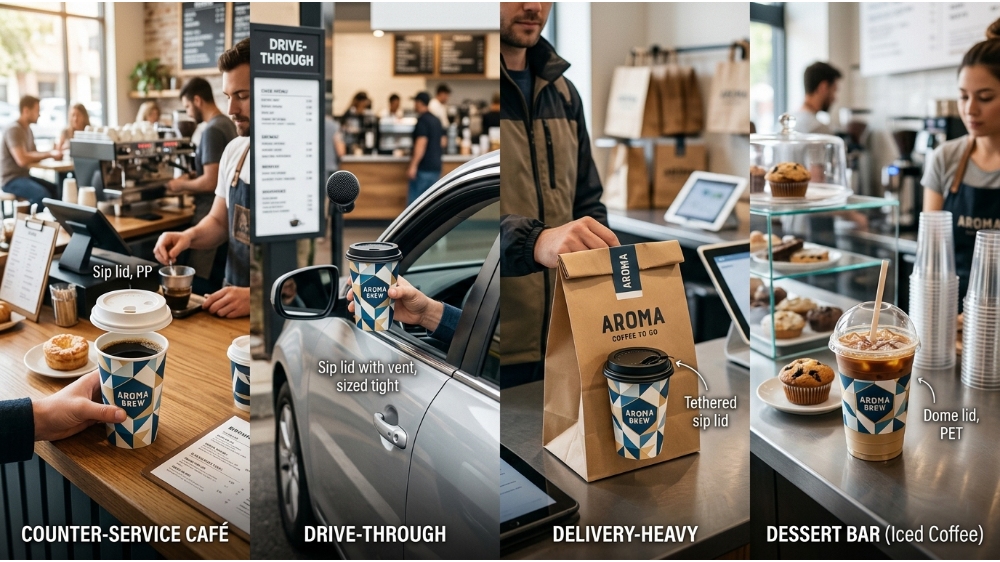
Hot-drink counters should default to sip lids in PP or PS sized to the exact rim diameter of their hot cup line, reserving flat lids for high-volume simple black coffee where speed matters more than the hands-free spout. Cold and blended drink counters should run the opposite default — dome lids in PET or PLA, pre-cut for a straw where the menu calls for one, sized generously enough to protect whatever topping the drink carries. Delivery and drive-through operations need to weight both categories toward the tighter-sealing end regardless of drink type, since a lid has to survive far more tilting and jostling in a delivery bag or a moving vehicle than it does across a five-foot handoff at a counter; reclosable and tethered lids earn their higher unit cost specifically in this format.
Service format
Hot lid default
Cold lid default
Seal priority
Counter-service café
Sip lid, PP or PS
Dome lid, PET, straw slot as needed
Standard — short hold before consumption
Drive-through
Sip lid with vent, sized tight
Dome lid with tighter cross-cut
Elevated — cup rides in a moving vehicle
Delivery-heavy
Tethered or reclosable sip lid
Dome or flat lid with reinforced seal
High — longest transit and most jostling
Bubble tea / dessert bar
Rarely applicable
Dome lid with wide straw cross-cut
Standard, with topping clearance as priority
How to Choose the Right Lid for Your Business
The right lid decision is three checks run in order, not one unit-price comparison: confirm the type matches the drink category, confirm the diameter matches the measured cup rim, and confirm the material matches the heat or cold the drink will hold at. Skipping any one of the three is how a shop ends up with a lid that fits the price sheet and fails the customer.
Start with a physical sample of the cup and lid together, seal it, tilt it, and carry it the way a customer actually would — across a counter, into a car, through a bag — before committing to a bulk order. That test catches the diameter and vent problems that a spec sheet alone won’t show, the same discipline that applies to testing carriers and sleeves before a production run. If a lid holds a menu’s hottest drink without deforming and a menu’s coldest drink without sweating through the seal, it’s earned its place in the lineup regardless of what it costs per thousand next to a lid that doesn’t. For businesses reviewing lids alongside a full cup order, ready-stock and custom-printed options across flat, dome, sip, and tethered formats can be sampled side by side before a production run, and if you need a packaging partner to size a lid lineup against your specific cup line and drink mix, contact Maibao Packaging.
Not sure which lid actually fits your cup line?
Talk to a packaging specialist about matching lid type, diameter, and material to your drinks, your cups, and your service format.
What’s the difference between a flat lid and a sip lid?
A flat lid lays close to the rim with a small sip hole and suits fast, simple hot-drink service. A sip lid has a raised, mug-like spout built specifically for hands-free hot drinking and is now the default on most café hot-drink counters.
Why do coffee cup lids leak even when they seem to fit?
Most leaks come from a small diameter mismatch that looks fine on a flat counter but fails once the cup tilts — a gap of even half a millimeter between the lid and rim is enough to cause frequent leaking. Always test a lid at an angle, not just sitting flat, before a bulk order.
Can I use a plastic lid on a coffee cup sold in the EU?
Yes, but since July 2024 any plastic cap or lid on a single-use beverage cup up to three litres must remain attached to the cup during use, so a fully detachable snap-on lid no longer meets the requirement on its own. A tethered, hinged, or non-plastic fiber lid is needed to stay compliant.
Is PLA a good material for hot coffee lids?
Not usually — PLA softens at lower temperatures than PP or PS, so it’s better suited to cold-drink dome and straw-slot lids than to hot coffee. Where a compostable hot lid is needed, check that the specific formulation is rated for hot liquid rather than assuming all PLA performs the same.
Post time:
Jul-27-2026
For inquiries about our products or pricelist, please leave your email to us and we will be in touch within 24 hours.