How Much Do Paper Cups Cost? 8 Factors That Affect Wholesale Pricing
Paper Cup Cost Guide: 8 Factors That Set Wholesale Pricing
Foodservice Packaging Pricing Guide
How Much Do Paper Cups Cost? 8 Factors That Affect Wholesale Pricing
A 12 oz paper cup can cost $0.04 or $0.18 — and the difference is not just about size. Understanding the eight factors that shape wholesale paper cup pricing saves money and prevents over-specifying. Here is the breakdown every foodservice buyer needs.
Paper cups are the workhorse of the foodservice industry — but their pricing is anything but standard. A basic 12 oz single-wall cup ordered by the truckload may cost $0.04 per unit. A custom-printed double-wall cup in small quantity can exceed $0.20. The spread exists because paper cup pricing is a function of at least eight distinct variables, each with its own cost driver.
This guide breaks down every pricing factor — size, paperboard weight, wall structure, coating, print complexity, volume, custom tooling, and shipping — so you can spec paper cups that match your budget without overpaying for features you do not need. For a full menu of paper cup options, explore Maibao’s paper cup collection.
Cup Size & Volume
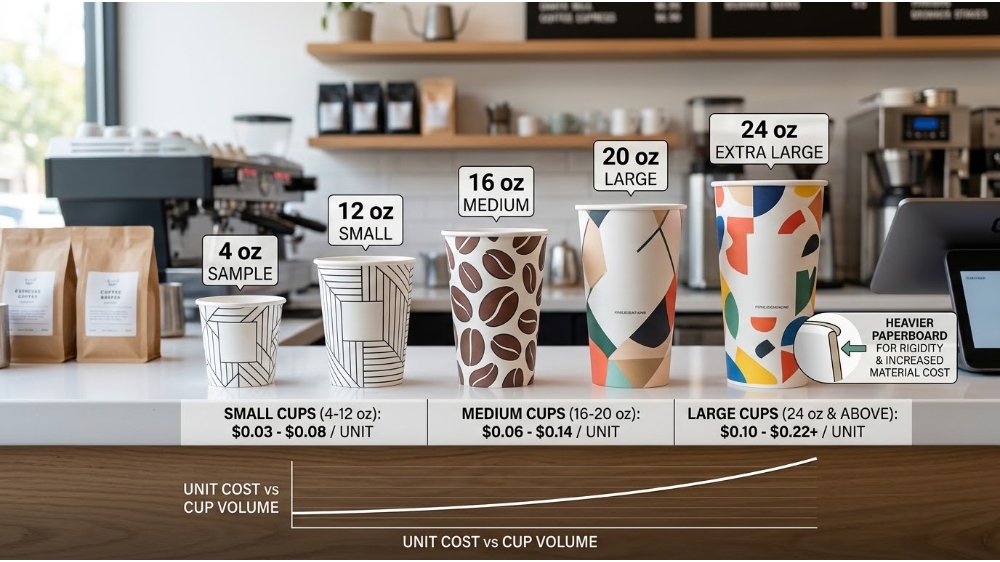
The most obvious pricing factor is also the most variable: cup volume. A 4 oz sample cup consumes less paper and requires less coating than a 24 oz large cup. But the relationship is not strictly linear; material cost scales with surface area, and larger cups often use heavier paperboard to maintain rigidity, which further increases unit cost.
In wholesale pricing, small cups (4–12 oz) typically range from $0.03–$0.08 per unit for basic single-wall configurations. Medium cups (16–20 oz) fall in the $0.06–$0.14 range, while large cups (24 oz and above) can run $0.10–$0.22 or more depending on material specification. Operators should size up only to the volume their menu actually requires — over-sizing by 4 oz adds material cost without customer benefit.
GSM — grams per square meter — measures paperboard density and thickness. Standard cup paper ranges from 170 GSM for lightweight cold cups to 300+ GSM for premium hot cups. Higher GSM means greater stiffness, better heat retention, and less risk of collapse when filled with hot liquid. But it also means more raw material per cup, raising the base cost.
In foodservice, 210–250 GSM is the sweet spot for most hot beverage cups, balancing cost and performance. Cold cups often use 170–190 GSM because they face less thermal stress. Moving from 210 GSM to 280 GSM adds roughly 15–20% to the paper cost alone. For operators serving primarily room-temperature or iced drinks, the extra GSM provides no functional benefit — it is a common area of over-specification.
Wall structure is one of the largest cost differentiators in paper cup pricing. Single-wall cups are the least expensive but offer minimal heat insulation — they are suitable for cold drinks or short-hold hot beverages. Double-wall cups incorporate an air gap between two paper layers, adding insulation and improving the tactile experience. Ripple (corrugated) cups use an external sleeve for maximum heat protection and a premium feel.
In wholesale terms, a single-wall cup might cost $0.05; the equivalent double-wall cup costs $0.09–$0.12; a ripple cup with a full sleeve can reach $0.15–$0.20. The incremental cost is driven by additional paper, the second wall, and more complex forming processes. Restaurants should match wall structure to actual customer holding time — for dine-in coffee, single-wall is adequate; for delivery, double-wall or ripple is often justified.
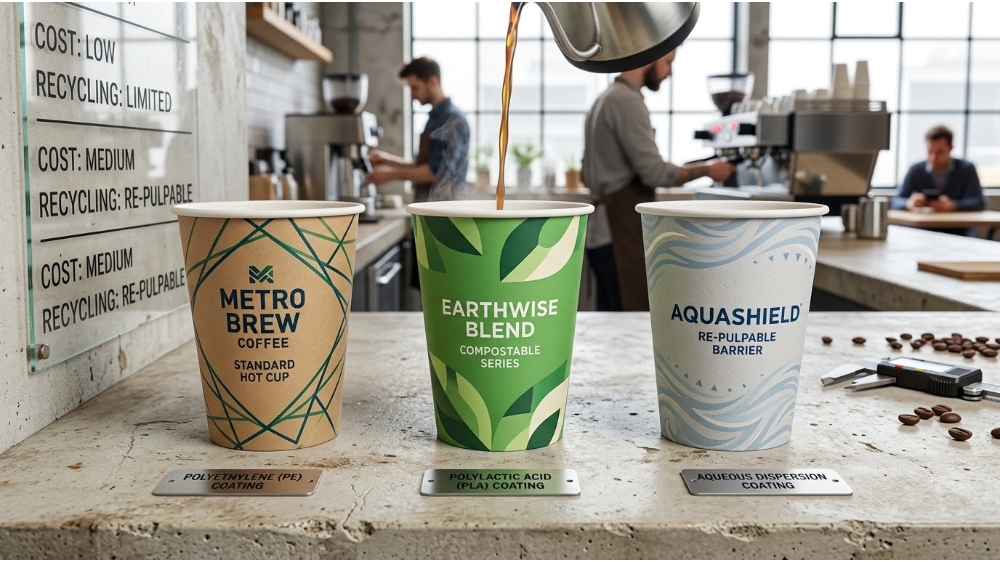
Coatings make paper cups liquid-tight. The choice of coating material has a significant cost impact and determines recyclability, compostability, and heat resistance. Polyethylene (PE) coating is the industry standard — it is reliable, low-cost, and creates an effective moisture barrier. PLA (polylactic acid) is a bio-based alternative often marketed as compostable, typically costing 20–40% more than PE. Aqueous dispersions are a newer, repulpable option falling between PE and PLA in cost.
Operators should consider total system cost, not just cup price. PLA cups require specific composting infrastructure to justify their premium; in markets without industrial composting, the higher cost delivers no environmental benefit. PE remains the most cost-effective barrier for most foodservice applications. Testing by packaging engineers confirms that PE-coated cups outperform uncoated or lightly coated alternatives in leakage prevention, directly reducing waste and spill-related refunds.
Unprinted cups are commodities — custom-printed cups are branded assets. The cost difference between a plain white cup and a full-color custom cup can be substantial. Printing costs are driven by the number of colors, the print area coverage, and the number of print stations required on the production line. A one-color logo on one panel is relatively inexpensive; full-wrap, 4-color process printing with spot colors and bleeds adds significant production time and ink cost.
In wholesale pricing, custom printing typically adds $0.01–$0.06 per cup depending on complexity. Pantone color matching and tight registration tolerances can push that higher. Some brands choose to print only on the upper third of the cup — where the customer holds it — to reduce cost while maintaining visual impact. The most expensive printing setups are full-wrap designs with metallic or specialty inks; these can double the base cup cost.
Order Quantity & Volume Discounts
Volume is the most powerful lever in paper cup pricing. Unlike the other factors — which affect per-unit material or production cost — volume affects how the fixed costs of setup, plate-making, and machine runs are amortized. A 10,000-cup order carries a much higher per-unit cost than a 500,000-cup order because the tooling and print setup costs are spread across fewer units.
Typical wholesale pricing structures show a steep curve: 5,000 cups might cost $0.12 each; 50,000 cups drops to $0.07; 500,000 cups can fall below $0.04. The inflection point is usually around 100,000 units, where material purchasing power and production efficiency converge. Operators consolidating cup orders across sizes or consolidating multiple locations into a single order capture significant savings. Packaging buyers should model total landed cost, not just per-unit price, when comparing quotes from different suppliers.
Custom Printing, Dimensions, Special Structures & Tooling
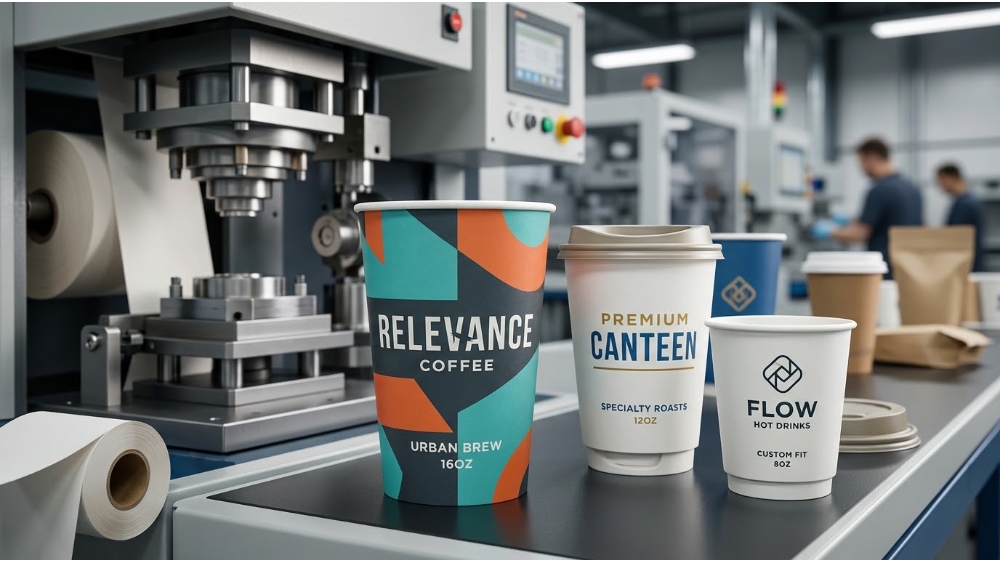
Customization extends beyond printing to include non-standard dimensions, special lid fitments, unique rim profiles, and proprietary roll-forming tooling. These specifications are often required for premium branding or to accommodate unusual beverage sizes — but they come with a cost. Custom tooling (die plates, forming mandrels, and sealing heads) can run from a few hundred to several thousand dollars, depending on complexity.
Non-standard dimensions require dedicated mandrels and changeover time on the production line, increasing per-unit cost. Special structures — like a recessed base for stackability or a rolled rim for lid compatibility — require additional forming steps. Operators should evaluate whether a custom spec is truly required or whether an existing standard size can be adapted with a custom print run. When tooling costs are amortized across the full order volume, the per-unit impact diminishes rapidly; for smaller orders, it can dominate the total price.
Tooling & custom spec cost considerations:
Standard sizes: No tooling cost — lowest per-unit price
Custom diameter/height: Tooling required — adds $0.002–$0.01/unit at scale
Special lid fitment: Custom sealing head — adds $0.003–$0.008/unit
Unique rim profile: Forming mandrel — adds $0.005–$0.015/unit
Full custom tooling set: Upfront $2,000–$5,000 tooling fee
Shipping, Packaging & Logistics
Paper cups are bulky but lightweight — shipping cost is primarily driven by volume (dimensional weight) rather than actual weight. A standard 40-foot container holds roughly 400,000 to 600,000 cups depending on size and stacking efficiency. The per-unit shipping cost can vary significantly based on origin, destination, and container utilization.
In wholesale pricing, domestic freight adds $0.002–$0.008 per cup; international freight can add $0.005–$0.02 per unit depending on ocean rates. Packaging format — bulk-packed in master cartons versus individually sleeved or poly-wrapped — also affects cost. Bulk packing reduces packaging waste and cost; sleeve-wrapped cups look more premium but add material and labor. Operators should consider the complete supply chain cost, including warehousing and last-mile delivery to individual locations, when evaluating cup pricing.
Paper Cup Cost Comparison: 8 Factors at a Glance
Cost factor
Cost range impact
Key decision trade-off
Cup size (volume)
$0.03–$0.22 per unit
Match actual serving size; avoid over-sizing
Paperboard GSM
+15–20% for +70 GSM
Higher GSM for hot; lower for cold drinks
Wall structure
+60–100% for double-wall
Single for dine-in; double for delivery
Coating type
+20–40% for PLA over PE
PE is most cost-effective barrier
Printing complexity
+$0.01–$0.06 per unit
Reduce colors or print area to cut costs
Order quantity
~50% price drop at 100,000 units
Consolidate orders for volume leverage
Custom tooling & specs
+$0.002–$0.015/unit + setup fees
Amortize tooling across large orders
Shipping & packaging
+$0.002–$0.02 per unit
Bulk pack for cost; sleeved for premium
Frequently Asked Questions
How much does a typical wholesale paper cup cost?
A standard single-wall 12 oz cup with no custom printing costs $0.04–$0.07 in wholesale quantities of 50,000+ units. Custom-printed double-wall cups in smaller volumes often exceed $0.15 per unit.
What is the most important factor in paper cup pricing?
Order volume is the most powerful pricing lever because it spreads fixed setup, tooling, and printing plate costs across more units. Moving from 10,000 to 100,000 units can reduce per-unit cost by 30–50%.
Are PLA-coated cups worth the higher price?
Only if your market has access to industrial composting facilities and your brand values compostability as a differentiator. In markets without composting infrastructure, PE coating delivers the same functional performance at a lower cost.
How can I reduce paper cup costs without sacrificing quality?
Consolidate orders across cup sizes to reach higher volume tiers, specify single-wall for cold beverages, reduce print colors to 1–2, and choose standard dimensions to avoid custom tooling fees. Each adjustment lowers cost without functional compromise.
Need paper cup pricing that fits your budget and your brand?
Get a customized quote based on your cup size, quantity, print requirements, and delivery timeline. Maibao Packaging provides transparent, factor-based pricing with no hidden fees.