Why Do French Fry Boxes Have Holes? The Packaging Design Behind Crispy Takeout Fries
Why Do French Fry Boxes Have Holes? Crispy Fry Packaging Design
Foodservice Packaging Guide
Why Do French Fry Boxes Have Holes? The Packaging Design Behind Crispy Takeout Fries
A fry leaves the fryer crisp and golden. Ten minutes in a sealed container, it’s limp, soggy, and disappointing. The holes in a french fry box aren’t a design afterthought—they’re a precision-engineered solution to the physics of steam, starch, and moisture migration. Here’s why they work and how to choose fry packaging that actually keeps fries crispy.
A french fry is one of the most structurally fragile foods in the takeout ecosystem. It’s a thin, starch-based rod with a high surface-area-to-volume ratio, fried at 350°F to achieve a crisp exterior and a fluffy interior. Once it leaves the fryer, it starts losing quality immediately—and the primary enemy is not time, but moisture.
This guide explains the food science behind fry sogginess, breaks down exactly how vent holes in fry boxes prevent steam damage, and provides a framework for choosing fry packaging that delivers crisp fries, every time. For related guidance on burger boxes, cup carriers, and full takeout packaging systems, explore the food packaging.
Why Fries Get Soggy: The Science of Starch and Steam
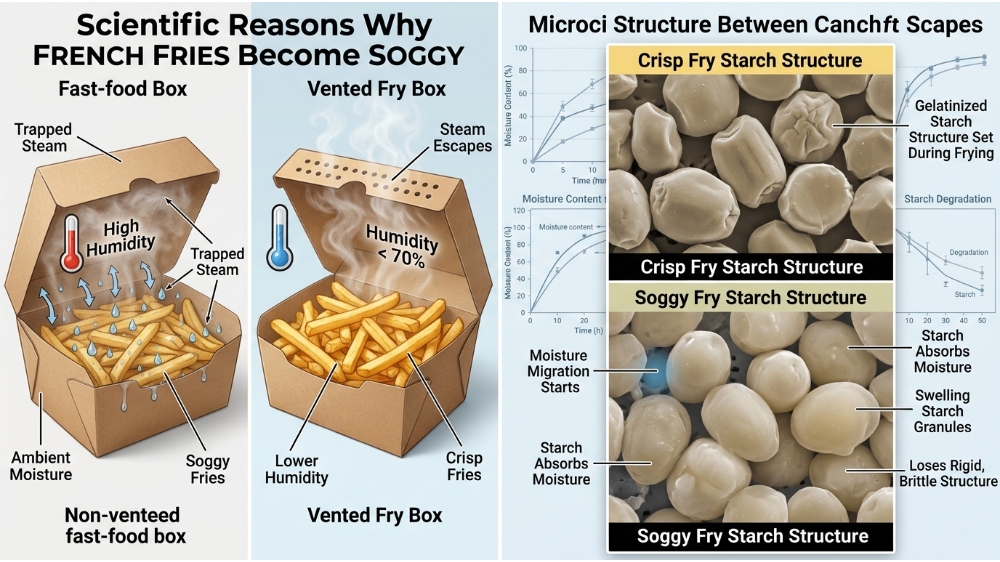
A french fry’s crispness comes from its gelatinized starch structure, which is set during frying. When the fry is exposed to humidity above roughly 70%—the exact environment inside a sealed takeout container—the starch granules begin to absorb ambient moisture through a process called moisture migration. This causes the starch to swell and lose its rigid, brittle structure, resulting in a limp, soggy texture. The USDA’s food quality research has long documented that starch-based fried foods degrade rapidly in high-humidity microclimates—precisely the condition created by a hot fry inside a closed box.
The speed of sogginess depends on three factors: how much steam is trapped, how quickly that steam can escape, and whether the fries are in direct contact with a moisture source (like condensation dripping from the lid). A sealed paper bag or solid-sided box traps steam against every fry surface, accelerating sogginess within five to eight minutes. A vented fry box, by contrast, allows steam to rise and exit while keeping the fries physically separated from pooled condensation.
What Fry Box Holes Actually Do: Ventilation Physics
The holes in a french fry box serve one primary function: steam release. As hot fries release water vapor, that vapor needs a path to escape. Without it, the vapor saturates the air inside the package, condenses on the box walls and the fries themselves, and accelerates staling. The vent holes—typically small perforations in the sides or back of the box—create a pressure-driven airflow path that allows moist air to exit and drier ambient air to enter, lowering the internal relative humidity.
This is not a passive feature; it’s a carefully considered thermodynamic design element. The size, number, and placement of holes determine the rate of airflow. Too few holes, and steam accumulates; too many, and heat escapes too quickly, leaving fries cold. The optimal design balances moisture venting with heat retention—a trade-off that food packaging engineers have studied extensively. Research published by the Institute of Food Technologists (IFT) indicates that even a small vent area—as little as 2-3% of the box surface—can reduce internal humidity by 30-40% without significantly cooling the food over a 15-20 minute delivery window.
How fry box holes work:
Allow steam to escape before it condenses on fries
Reduce internal relative humidity from ~95% to ~60%
Prevent condensation from dripping onto fries from the lid
Maintain crispness for 15-25 minutes when properly designed
Hole Size, Placement, and Quantity: The Engineering Details
Not all fry box holes are created equal. The diameter of each hole, the total open area, and the position on the box all affect performance. Most standard fry boxes use holes between 3mm and 6mm in diameter, arranged in rows along the back panel or sides. This placement is intentional: holes on the back allow steam to rise and exit without creating a direct draft that cools the fries prematurely.
Hole quantity is a function of box size and expected hold time. A small fry box (serving 1-2 people) might have 6-8 holes; a large box (serving 3-4) might have 12-16. The total open area typically ranges from 1.5% to 4% of the box’s surface area. This range has been validated in food packaging research as the sweet spot for moisture control without excessive heat loss. Boxes with holes on the bottom are less common because they can allow grease to leak; holes on the sides or back are the industry standard for a reason.
Perforation patterns also matter. Round holes are most common, but some premium boxes use slotted or elongated perforations that provide the same open area with better structural integrity. The key engineering principle is this: the holes must be large enough to allow steam to escape, but small enough to prevent fries from falling through or catching on the edges during packing.
Box Materials: Coated Board, Kraft, and Grease Resistance
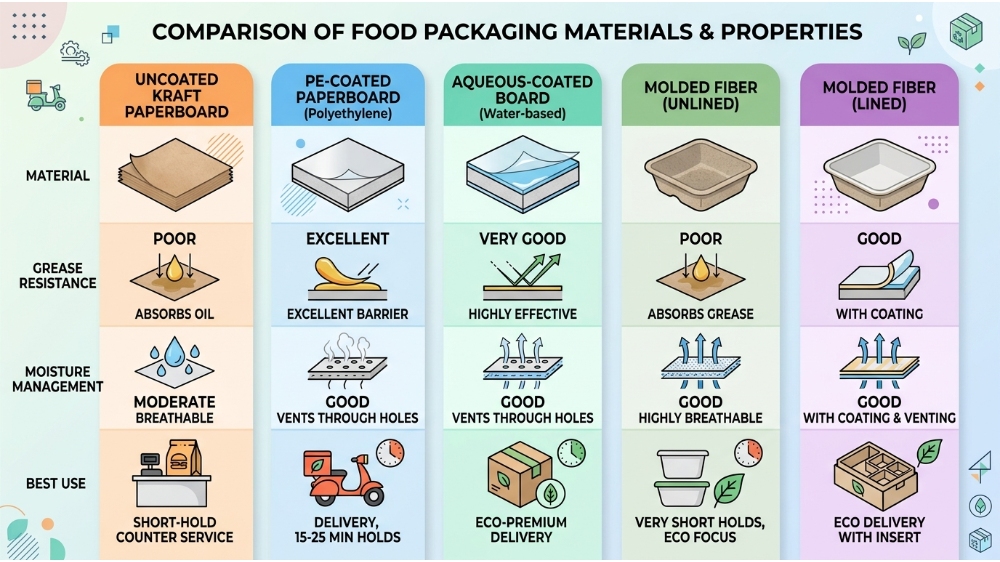
The material a fry box is made from determines not only its structural integrity but also its interaction with moisture and grease. Most fry boxes are made from paperboard—either uncoated kraft, PE-coated, or aqueous-coated board. Each has distinct trade-offs.
Uncoated kraft paperboard
Uncoated kraft is the most common and lowest-cost option. It’s breathable, which helps with moisture escape, but it absorbs grease directly into the fiber, leading to stains and structural softening over time. For short holds (under 10 minutes), uncoated kraft is acceptable. For longer delivery, it’s a liability.
PE-coated paperboard
Polyethylene-coated board offers a grease barrier that prevents oil from soaking through, while still allowing some moisture vapor to escape through the uncoated areas (like the holes). This is the standard for premium fry boxes designed for delivery holds of 15-25 minutes.
Aqueous-coated board
Aqueous coatings are a newer, repulpable alternative to PE. They provide good grease resistance and moderate moisture protection, making them a strong choice for eco-conscious brands. However, they are slightly less effective against high-heat, high-grease applications than PE coatings.
Molded fiber and compostable options
Molded fiber fry boxes are growing in popularity in markets with foam bans. They offer excellent breathability but absorb moisture and grease aggressively unless lined. Some designs incorporate a thin internal coating or a separate grease-absorbing insert to compensate. Custom-coated fry boxes and wraps designed specifically for high-grease, high-moisture applications avoid these trade-offs by combining an eco-friendly exterior with a functional barrier coating.
Material
Grease resistance
Moisture management
Best use
Uncoated kraft
Poor—absorbs oil
Moderate—breathable
Short-hold counter service
PE-coated paperboard
Excellent
Good—vents through holes
Delivery, 15-25 min holds
Aqueous-coated board
Very good
Good—vents through holes
Eco-premium delivery
Molded fiber (unlined)
Poor—absorbs grease
Good—highly breathable
Very short holds, eco focus
Molded fiber (lined)
Good—with coating
Good—with coating
Eco delivery with insert
Fry Boxes vs. Burger Boxes vs. Pizza Boxes: Venting Compared
Different foods require different venting strategies. A burger box needs headspace above the bun to prevent condensation from dripping onto the crown—hence the domed or elevated lid. A pizza box relies on the corrugated structure and small side perforations to allow steam to escape while keeping the pie warm. A fry box, by contrast, uses side and back holes because fries are loose, stackable, and have a high surface area that demands rapid moisture release.
The key difference is airflow direction. In a fry box, steam rises from the hot fries, travels upward, and exits through holes in the upper sides or back. In a burger box, steam rises to the lid, condenses, and must be channeled away from the bun—hence the headspace and vented lid designs. In a pizza box, steam escapes through the corners and small perforations in the sides, but the large surface area of the pizza means moisture is less concentrated than in a box of fries.
For operators using multiple packaging formats, consistency in venting philosophy matters. A vented, rigid carton box with a raised base works for burgers; a similarly vented fry box with side perforations works for fries. The underlying principle—controlled steam release—is the same, but the execution differs based on food geometry and hold time.
Hold Time and Temperature: Matching Packaging to Delivery
A fry box that works for a 5-minute counter hold will fail for a 25-minute delivery. The longer the hold, the more critical venting becomes—but also the more important heat retention. This is the central tension in fry packaging design.
For holds under 10 minutes—typical dine-in or quick counter service—an uncoated kraft box with moderate venting is sufficient. The fries are consumed before moisture accumulation becomes a problem. For holds between 10 and 20 minutes—standard delivery—a coated box with optimized venting (6-12 holes, 3-5mm diameter) is the baseline. For holds beyond 20 minutes, additional measures are needed: a box with a grease-absorbing insert, a separate vented sleeve, or even a two-component system where the fries are packed in a vented inner box inside an insulated outer bag.
Temperature also plays a role. Fries kept at 140°F or above release steam more rapidly, increasing the need for venting. Fries that drop below 120°F stop releasing significant steam, but by then, they’ve likely already lost crispness. The goal is to maintain temperature while allowing moisture to escape—a balance achieved through hole design, material choice, and box geometry working in concert.
Hold-time packaging guidelines for fries:
Under 10 min: Uncoated kraft box, basic venting—counter service standard
Selecting the right fry box comes down to four variables: hold time, fry volume, grease level, and delivery distance. Start by measuring your actual hold time—from fryer to customer—not your ideal one. If the average delivery takes 22 minutes, design for 30.
Then evaluate your fry type. A thin, shoestring fry has more surface area and loses crispness faster than a thick, steak-cut fry. It needs more aggressive venting. A heavily seasoned or sauced fry introduces additional moisture and may require a box with a grease-absorbing insert or a separate sauce cup.
Test with your actual product. Pack a fresh batch of fries in the box, seal it in a delivery bag, and check crispness at 10, 20, and 30 minutes. If the fries are soggy at 20 minutes, the box needs more holes, better coating, or a different material. If they’re cold but crisp, the holes are too large or too numerous—reduce open area.
For businesses scaling fry delivery across multiple locations, packaging consistency is as important as fry quality. Working with a packaging supplier who can provide consistent, tested fry box formats across your full menu eliminates the most common variable in fry quality complaints: a box that wasn’t designed for the fries it’s holding. For a sourcing consultation on fry boxes, vented wraps, and delivery-optimized packaging matched to your specific menu and hold times, contact Maibao Packaging.
Need fry packaging that keeps fries crisp through delivery?
Talk to a packaging specialist about matching box design, venting, and material to your fry menu, your hold times, and your delivery radius.
The holes allow steam to escape from the box, preventing condensation from making the fries soggy. Without venting, internal humidity reaches near 100% within minutes, accelerating starch degradation and texture loss.
Do fry box vents actually keep fries crispy?
Yes—when properly designed. Vents reduce internal humidity by 30-40% over a 15-20 minute delivery window, significantly extending crispness compared to a sealed container. However, venting must be balanced with heat retention.
Why don’t all fry boxes have holes?
Cost and perceived structural integrity. Some operators believe holes weaken the box or allow grease to leak. However, modern coated boards and precision perforation patterns eliminate these issues while delivering superior fry quality.
What’s the best fry box for delivery?
A PE-coated or aqueous-coated paperboard box with 8-12 side or back vent holes (3-5mm diameter) is the best all-around format for delivery holds of 10-25 minutes. For longer holds, add an absorbent base layer or use a two-component system.
Post time:
Aug-03-2026
For inquiries about our products or pricelist, please leave your email to us and we will be in touch within 24 hours.