Burger Wrap vs Burger Box: Which Packaging Is Better for Takeout Burgers?
Burger Wrap vs Box: Best Takeout Packaging Guide
Takeout Packaging Decision Guide
Burger Wrap vs Burger Box: Which Packaging Is Better for Takeout Burgers?
A burger wrapped in paper feels nostalgic and fast. A burger box feels premium and protective. But which one actually keeps your takeout burger fresher, crisper, and more intact—and which one hurts your margins and your reputation? The answer depends on three variables: hold time, burger construction, and delivery distance. Here’s the data-driven decision framework every restaurant operator needs.
A burger is not a single ingredient—it’s a thermodynamic system. Hot protein, moist produce, emulsified sauce, and a porous starch bun all interact inside a closed package. The choice between a burger wrap and a burger box determines whether that system produces a crisp, enjoyable meal or a soggy, disappointing one. This guide compares the two formats across moisture control, structural protection, cost, and hold-time performance—so you can match the package to your actual operations, not just your instincts.
Why Takeout Burgers Lose Their Crisp: The Sogginess Problem
The core physics are unavoidable: a freshly cooked burger patty releases water vapor continuously as it cools. That vapor saturates the air inside any closed package. When it contacts the cooler, porous surface of a bun, it condenses into liquid water and migrates directly into the starch matrix. This process, starch retrogradation and moisture migration, is well-documented in food science. The USDA’s food quality research has long established that bread texture degrades sharply in high-humidity microenvironments—exactly the conditions inside a sealed burger container.
The speed of sogginess depends on three factors: the volume of trapped steam, the path available for that steam to escape, and whether the bun is in direct contact with pooled condensation. A tight burger wrap (foil or wax paper) holds the burger together but traps steam against every surface. A burger box with a lid creates headspace, allowing vapor to rise and collect away from the bun. Understanding this physics is the foundation for any rational packaging choice.
Burger Wrap vs Burger Box: A Head-to-Head Comparison
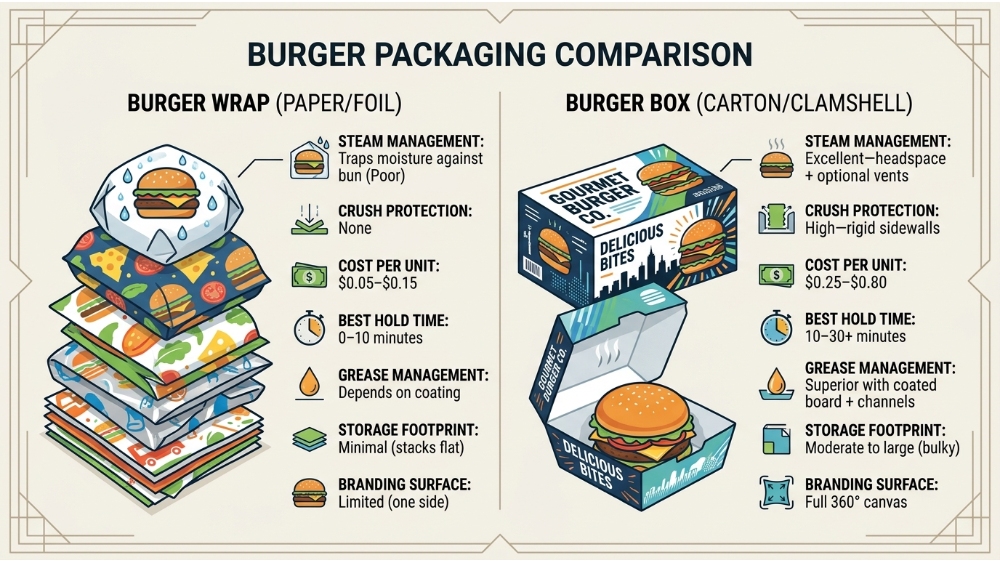
The two formats serve fundamentally different operational needs. A wrap is designed for speed, low cost, and immediate consumption. A box is designed for protection, stackability, and extended hold times. Neither is universally superior—each solves a specific set of problems.
The wrap (wax paper, butcher paper, foil-lined paper)
A burger wrap is the classic counter-service format. It’s fast to fold, cheap to buy, and takes up minimal storage space. Wraps allow a burger to be handed directly to a customer with no additional assembly. The trade-off is moisture management: a fully folded wrap creates a sealed envelope that traps steam. Wax-coated paper breathes slightly through its fibers, but foil-lined wraps are total vapor barriers that guarantee a wet bun within ten minutes. Wraps also offer zero compression protection—a burger in a delivery bag under a fries container will be flattened.
The box (carton-style, clamshell, or sleeve-and-tray)
A burger box—typically a paperboard carton with a tuck-top or locking lid—prioritizes structural integrity and moisture control. The rigid sidewalls prevent compression. The headspace above the bun allows steam to rise and condense on the lid rather than the food. Premium boxes include grease-channeling bases and venting perforations. The downside: boxes cost 3–5x more per unit than wraps, require more storage space, and take slightly longer to assemble during a rush.
Feature
Burger Wrap (Paper/Foil)
Burger Box (Carton/Clamshell)
Steam management
Poor—traps moisture against bun
Excellent—headspace + optional vents
Crush protection
None
High—rigid sidewalls
Cost per unit
$0.05–$0.15
$0.25–$0.80
Best hold time
0–10 minutes
10–30+ minutes
Grease management
Depends on coating
Superior with coated board + channels
Storage footprint
Minimal
Moderate to large
Branding surface
Limited (one side)
Full 360° canvas
The Venting Factor: How Steam Escape Changes the Game
A completely sealed package—whether a foil wrap or an airtight clamshell—turns the interior into a steam chamber. Internal relative humidity reaches nearly 100% within three minutes of closure, and bun degradation is measurable within eight minutes. This is not speculation; it’s a repeatable food physics outcome documented across Institute of Food Technologists (IFT) packaging research.
Venting is the deliberate inclusion of a steam escape path. For a burger wrap, this means leaving a corner unsealed or using paper that breathes—but this compromises heat retention and grease resistance. For a burger box, venting is designed into the structure: small perforations in the lid, a gap around the tuck closure, or a domed lid that channels condensation to the edges. A few millimeters of open area is sufficient to drop internal humidity without significantly cooling the burger over a 20-minute delivery window.
The practical rule: if your burger travels more than ten minutes from kitchen to customer, the package must include deliberate venting. A wrap without a vent gap is a counter-service solution, not a delivery solution.
Venting checklist for burger packaging:
Does the package have a clear steam escape path (perforations, unsealed flap, lid gap)?
Test humidity: place a dry piece of bread inside the closed package with a hot patty for 10 minutes—if it’s damp, venting is inadequate.
For boxes, verify that the lid doesn’t create an airtight seal; a slight gap is functional, not defective.
For wraps, never use foil for holds over 10 minutes unless paired with an absorbent interlayer.
Material Matters: Grease Resistance and Moisture Barriers
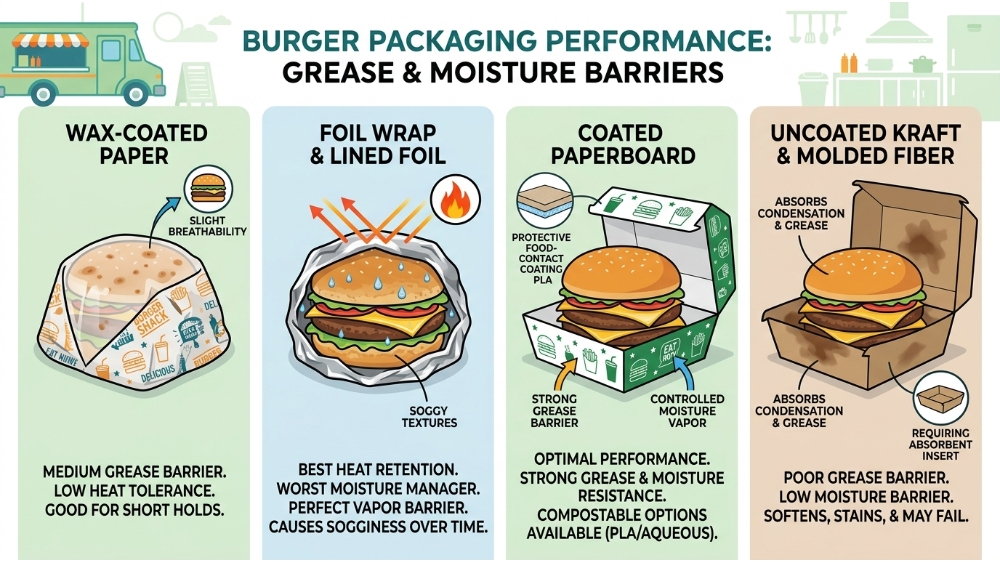
The material a package is made from determines two critical performance dimensions: grease resistance and moisture vapor transmission. A material that excels at one often fails at the other without specific engineering.
Wax-coated and butcher paper
Wax paper is the standard for takeout burger packaging in counter-service settings. The wax layer repels grease and allows slight breathability through the paper fibers, giving it a moderate advantage over foil for bun texture on short holds. The limitation is heat tolerance: wax softens under high heat, reducing its grease barrier effectiveness with a very fresh patty.
Foil and foil-lined wraps
Foil is the best heat retainer and the worst moisture manager. It reflects radiant heat and creates a perfect vapor barrier—useful for keeping a burger hot for 30+ minutes, catastrophic for bun texture over that same period. Foil is only appropriate for delivery if paired with an absorbent layer between the patty and the bun.
Coated paperboard (PE, PLA, aqueous)
Most premium burger boxes use paperboard with a food-contact coating. Polyethylene (PE) coatings offer the strongest grease and moisture barrier at the lowest cost. PLA coatings provide compostability but are more heat-sensitive. Aqueous coatings are a newer water-based option that repels grease effectively while keeping the board repulpable. For a delivery box holding a double cheeseburger for 25 minutes, a PE or high-quality aqueous coating is the baseline.
Uncoated kraft and molded fiber
Eco-friendly uncoated materials absorb both condensation and grease directly into the fiber. The result is a package that softens, stains, and can structurally fail during a long hold. The solution is a thin internal lining or a separate grease-absorbing insert. Custom-coated burger wraps and boxes designed specifically for high-grease applications avoid this trade-off entirely.
Hold Time Is Everything: Matching Packaging to Delivery Radius
Hold time is the single most important variable in the wrap vs. box decision. A package that works for a 6-minute counter hold is entirely inadequate for a 25-minute delivery route. The guidelines below are based on empirical testing of bun texture degradation under real-world conditions.
Under 10 minutes (counter service, dine-in takeaway): A burger wrap (wax paper or butcher paper) is sufficient. The burger is consumed before condensation has time to accumulate in damaging quantities. This is the most cost-effective format for high-volume, low-hold operations.
10–20 minutes (standard delivery): A vented burger box with headspace becomes the baseline. The box protects against compression and allows steam to escape. Wraps at this hold time will produce a noticeably soggy bun, especially with double patties or saucy burgers.
20–30 minutes (longer delivery routes): A vented box with an absorbent base layer and a moisture-resistant coating is required. Some operators add a separate grease pad or channeled base to extend the crisp window of the bottom bun by an additional 5–10 minutes.
30+ minutes (extended transit): Two-piece packaging is the gold standard: the burger in a vented box, and wet toppings (lettuce, tomato, sauce) in a sealed cup. The customer assembles the burger just before eating. This eliminates the dominant source of sogginess on long hauls.
0–10 min: Wrap (wax paper or butcher paper) — lowest cost, fast service
10–20 min: Vented burger box with headspace — delivery baseline
20–30 min: Vented box + absorbent base + coated board
30+ min: Two-piece: separate burger box + sealed toppings container
The Structural Advantage: Why Boxes Protect Burger Integrity
A well-designed burger box does four things that a wrap cannot: create headspace, prevent compression, separate condensation from food-contact surfaces, and channel grease away from the bun base. Each of these is a structural feature, not a material one.
Headspace is the distance between the bun crown and the lid. Without it, condensation drips directly onto the bun—the primary mechanism behind the “wet top bun” complaint. A domed lid with even 10–15mm of clearance changes the condensation dynamic entirely: droplets form on the lid and run to the edges rather than saturating the bun.
Compression protection is critical because a burger in a delivery bag is stacked under other items. A box with rigid sidewalls and a locked lid prevents the bun from being pressed flat, preserving both texture and visual appeal. Wraps offer zero compression protection.
Grease channeling is a premium design detail. A box with a ribbed or textured base allows grease to pool in channels beneath the burger rather than saturating the bottom bun. Combined with a grease-resistant coating, this design extends the crisp window of the bottom bun by 5–10 minutes—the difference between a burger that arrives intact and one that arrives as a collapsed mess.
For businesses scaling burger delivery packaging through apps where transit times routinely exceed 20 minutes, a vented, rigid carton box with a raised base is not a luxury upgrade—it’s the minimum viable packaging for a burger that arrives looking and tasting like it just left the grill.
Cost vs. Quality: The Business Decision Behind Packaging
The cost difference between a wrap and a box is significant: a wrap costs $0.05–$0.15 per unit, while a premium coated box costs $0.25–$0.80. For high-volume operations, this difference can exceed $20,000 annually. The key is to match the packaging investment to the customer experience you promise—and the price point you charge.
A $6 smash burger from a counter-service window does not need a $0.60 box. A $16 gourmet double cheeseburger with premium toppings, delivered via app, absolutely does. The calculation changes further when factoring in replacement orders and negative reviews. A single refund for a soggy, collapsed burger can erase the cost savings of using wraps for an entire week.
For restaurants sourcing burger packaging wholesale, the volume discount often makes boxes more competitive at scale. Many burger packaging suppliers offer tiered pricing that brings coated boxes into a reasonable cost range for delivery-focused operations. The operational win is consistency: a box standardizes the presentation and reduces the skill required to wrap burgers quickly, which can improve throughput during peaks.
The bottom line: don’t choose packaging based solely on unit cost. Calculate the total cost of ownership—including storage, assembly time, customer satisfaction, and repeat order rates—to determine the true value of each format.
How to Choose the Right Packaging for Your Restaurant
The decision between a burger wrap and a burger box comes down to four diagnostic checks: measure your real hold time, assess your burger’s moisture output, test the package with your actual menu item, and factor in your delivery radius. Here’s how to apply the framework.
Step 1: Measure your actual hold time. Don’t use your ideal time—measure the longest delivery in your radius. If the average is 22 minutes, design for 30. Then work backward: a 30-minute hold points to a vented carton box with a coated board and absorbent base. A 6-minute hold points to a wax wrap.
Step 2: Assess your burger. A double-stacked cheeseburger with special sauce and fresh lettuce releases more steam and grease than a simple single-patty smash burger with ketchup. The packaging that works for one may fail for the other. The rigid carton format is particularly well-suited for stacked, high-moisture burgers.
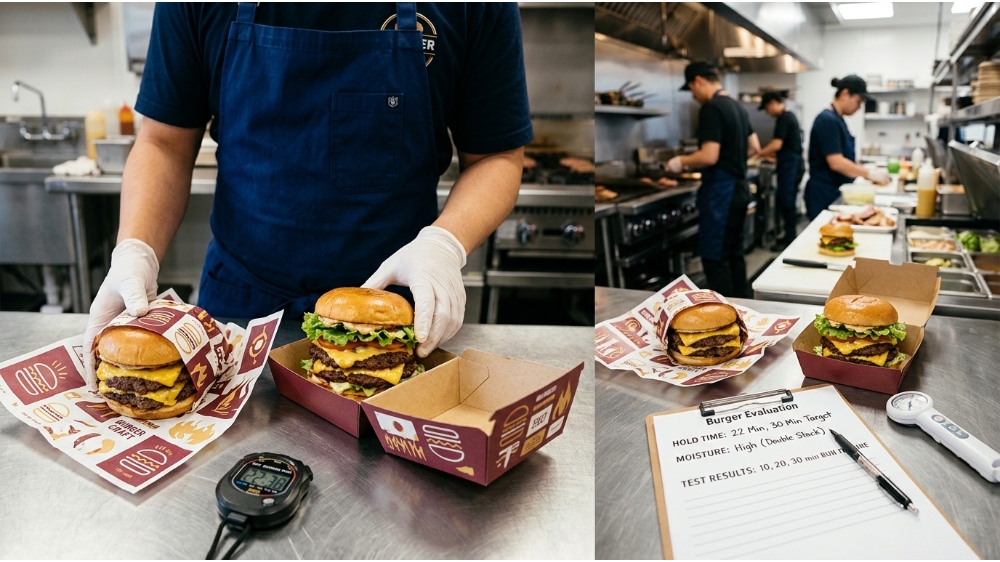
Step 3: Test with your actual burger. Seal a burger in the package, place it in a delivery bag, and check bun texture at 10, 20, and 30 minutes. If the bun is wet at 20 minutes, the package needs more venting, more headspace, or a moisture barrier it doesn’t currently have. Repeat the test across multiple batches to ensure consistency.
Step 4: Scale with a reliable partner. For businesses scaling delivery across multiple locations, packaging consistency is a quality-control lever as important as grill temperature. Working with a packaging supplier who provides consistent, tested formats across your full menu eliminates the most common variable in burger quality complaints: a package that wasn’t designed for the burger it’s holding.
Need burger packaging that delivers crisp, intact burgers every time?
Talk to a packaging specialist about matching box design, venting, and material to your menu, hold times, and delivery radius.
For holds under 10 minutes, a wax paper wrap is cost-effective and sufficient. For any delivery hold over 10 minutes, a vented burger box with headspace delivers superior bun texture and structural protection.
Why do burger boxes keep burgers fresher than wraps?
Boxes create headspace that allows steam to rise away from the bun, prevent compression damage, and often include venting. Wraps trap steam directly against the food, accelerating sogginess.
What’s the cost difference between burger wraps and boxes?
Wraps cost $0.05–$0.15 per unit; coated paperboard boxes cost $0.25–$0.80 per unit. The premium for boxes is justified for delivery operations where customer satisfaction and repeat orders are at stake.
Can I use a burger wrap for delivery if I add an absorbent layer?
Yes, but it’s a patch. Adding a grease-absorbing pad between the patty and bottom bun can extend the crisp window by 5–8 minutes. However, a box still provides superior compression protection and top-bun moisture control.
Post time:
Jul-30-2026
For inquiries about our products or pricelist, please leave your email to us and we will be in touch within 24 hours.