French Fry Box Sizes Guide: How to Choose the Right Size for Your Restaurant
French Fry Box Sizes: Choose the Right Size for Your Restaurant
Foodservice Packaging Guide
French Fry Box Sizes Guide: How to Choose the Right Size for Your Restaurant
Choosing the wrong french fry box size hurts your margins and customer satisfaction. This guide breaks down standard fry box dimensions by ounce and gram volume, explains how venting and material choice keep fries crispy, and maps each size to the right menu use case—whether you run a food truck or a multi-location QSR.
A french fry box isn’t just a container—it’s a portion control tool, a heat management system, and a brand touchpoint. The size you choose determines how many fries your customer perceives they’re getting, how long those fries stay crispy, and whether your food cost percentage stays healthy. Most restaurants default to the cheapest option without understanding the physics of fry packaging. That’s a mistake that hits both your P&L and your reviews.
This guide synthesizes data from foodservice packaging engineers, portion-control studies, and materials science to give you a decision framework that works for your specific menu and service model. For related guides on takeout boxes, custom printing, and full-service packaging systems, explore the packaging solutions library at Maibao Packaging.
What Are the Standard French Fry Box Sizes?
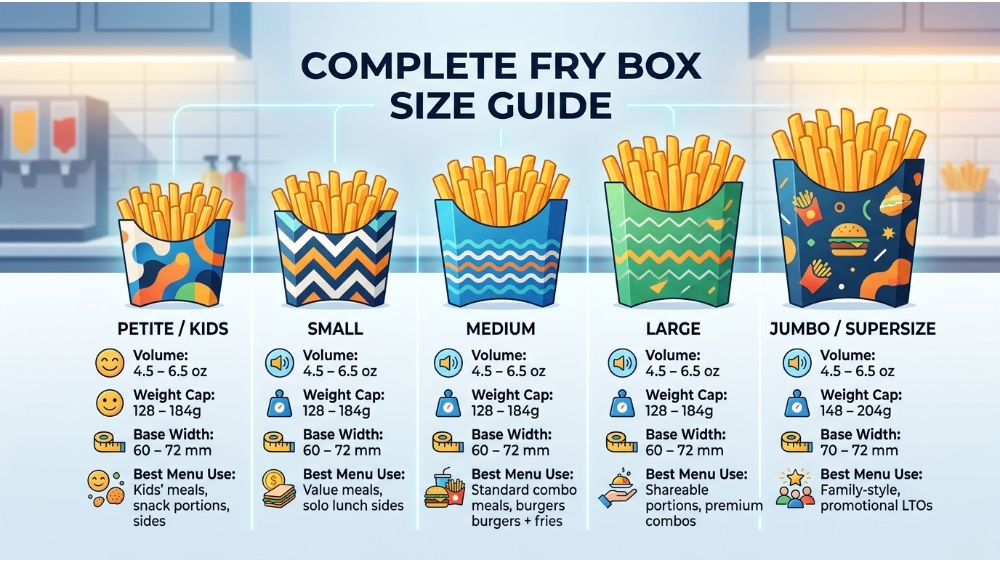
French fry boxes are not standardized across the industry, but three dominant volume tiers have emerged over decades of QSR and fast-casual use: small (2.5–4 oz / 70–113g), medium (4.5–6.5 oz / 128–184g), and large (7–9 oz / 198–255g). These refer to the fill volume of the container, not its exterior dimensions. A standard fry scoop—the cone-shaped or folded carton—typically ranges from 2 to 9 ounces in capacity, with comprehensive dimension data published by EatHealthy365 showing that exterior heights vary from 75mm to 160mm depending on the style.
The most common material thickness for these boxes is 18pt to 24pt solid bleached sulfate (SBS) paperboard, which provides the structural rigidity needed to hold hot, oil-coated fries without collapsing. The engineering specifications from Teal Packaging confirm that wall angles and fold-lock designs are as critical as the base area—a wider base distributes weight better and prevents tipping in delivery bags, while a narrower base reduces material cost and fits smaller hands.
Box Size Label
Volume (fl oz)
Weight Capacity (g)*
Typical Base Width (mm)
Best Menu Use
Petite / Kids
2 – 2.5 oz
55 – 70g
45 – 52
Kids’ meals, snack portions, sides
Small
2.5 – 4 oz
70 – 113g
52 – 60
Value meals, solo lunch sides
Medium
4.5 – 6.5 oz
128 – 184g
60 – 72
Standard combo meals, burgers + fries
Large
7 – 9 oz
198 – 255g
72 – 85
Shareable portions, premium combos
Jumbo / Supersize
9.5 – 12 oz
269 – 340g
85 – 95
Family-style, promotional LTOs
*Weight capacity varies by fry cut thickness (shoestring vs. steak cut) and oil absorption. These are industry averages.
How Many Ounces of Fries Fit in a Small, Medium, and Large Fry Box?
The fluid ounce capacity of a fry box does not translate directly to the weight of fries it holds, because fries are irregular solids with void space between them. A 6-ounce fry box typically holds between 150 and 180 grams of finished fries, depending on cut thickness and how aggressively the box is filled. A 2018 study published in Nutrition Journal by Vermote et al. demonstrated that when restaurant staff were trained to reduce portion sizes from a baseline of 200g to 159g—a 20% reduction—they achieved this simply by changing the fry scoop used, not the box size. That tells us that the box volume sets the upper bound, but staff behavior and scooping tools determine the actual weight delivered.
For accurate portion control, weigh your fries after boxing for a week. A small box (3 oz capacity) should consistently yield 80–85g of shoestring fries. A medium (5 oz) should yield 140–150g. A large (8 oz) should yield 210–225g. If your weights are inconsistent, the issue is either the box geometry—too wide a base encourages overfilling—or the scooping protocol, not the box itself. The Idaho Potato Commission’s foodservice guidelines recommend calibrating portion scoops to the target weight and training staff to level, not heap, the scoop before boxing.
Why Does Fry Box Volume Vary Between Suppliers?
Two boxes both labeled “medium” can differ by as much as 1.5 ounces in capacity. This happens because there is no ISO standard for fry box sizing; each manufacturer designs their own die-lines based on their specific folding machinery and the blank size they can efficiently cut from parent paperboard sheets. One supplier’s medium may have a taller front panel and a shallower back, while another uses a deeper base with the same external footprint.
This variance matters when you switch suppliers. If you’ve calibrated your food cost to a 5 oz medium box and your new supplier’s medium box holds 6.5 oz, you’re either giving away 30% more fries per order or your staff will underfill the box—leading to customer complaints about a “half-empty” container. The solution is to specify your required volume in milliliters or fluid ounces to your supplier, not just a label like “small” or “large.” Request the exact internal fill volume in the packaging spec sheet, and verify it with a water fill test: fill the box with water to the rim, pour it into a measuring cup, and confirm the number.
How Do I Match Fry Box Sizes to My Menu Portions?
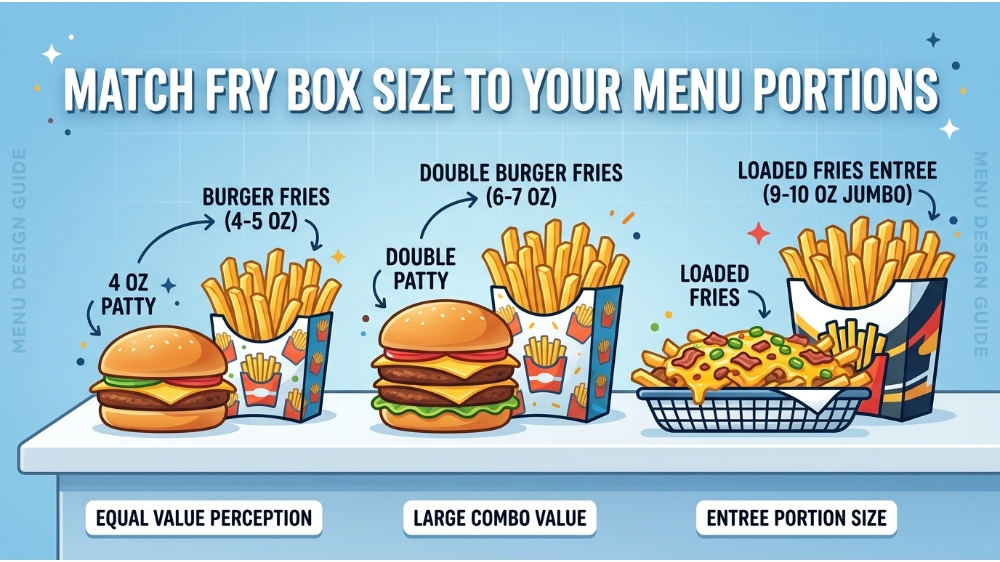
Match your fry box size to your protein portion, not the other way around. A burger-centric menu with 4 oz patties typically pairs with a 4–5 oz medium fry box, because the visual balance of a 4 oz patty next to a 4 oz fry portion reads as “equal value” to the customer. A double-patty burger or chicken sandwich—which is larger in the hand—requires a 6–7 oz large fry box to maintain the same perceived meal value. A food truck serving loaded fries as the main item, however, needs a 9–10 oz jumbo box or even a tray format, because the fries are the entrée.
Your price point also dictates the box size. A $10 combo meal has an expected fry portion of roughly 140g in the US market; a $15 premium combo is expected to deliver 180–200g. Undersizing the box relative to the price triggers negative value perception, which is one reason why delivery reviews frequently mention “small fries” even when the box is technically full. The psychological effect of the box size matters as much as the actual weight, which is why many custom-printed fry boxes with a wide, branded front face are used to visually anchor the portion size.
What Role Does Venting Play in Fry Box Size and Performance?
Venting is the single most under-engineered feature in fry packaging. A completely sealed fry box traps steam released by the hot fries, causing the starches on the fry surface to absorb moisture and turn limp within five minutes. The Idaho Potato Commission’s foodservice research explicitly states that “venting is critical to maintaining crispness,” and that fry boxes should include perforations or an unsealed flap to allow steam to escape. The size of the box influences how much steam is trapped: a larger box has more headspace, so condensation takes longer to saturate the internal environment, but without active venting, even a jumbo box will steam its contents.
The ideal fry box vent design features two or three small perforations (3–5mm diameter) on the back panel near the top, allowing steam to rise and exit without cooling the fries excessively. Some premium vented fry boxes also include a folded flap that can be partially opened by the customer, giving them control over steam release. For delivery operations, a box with both structural rigidity and passive venting is non-negotiable; unvented boxes are acceptable only for dine-in where the fries are consumed within three minutes of landing on the tray. Learn more about venting by reading Why do French Fry Boxes have Holes?
What Materials Are Used for Fry Boxes and How Do They Affect Size Choice?
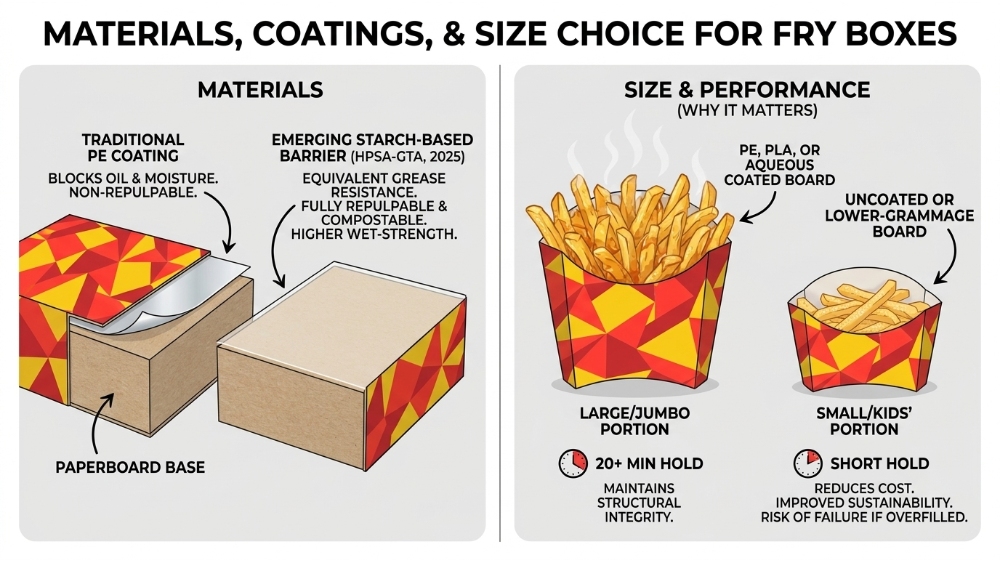
Almost all fry boxes are made from paperboard, but the coating on that board determines its grease resistance and structural performance under heat. Traditional fry boxes use a polyethylene (PE) extrusion coating on the inside to block oil and moisture from wicking into the paper fibers. However, emerging research on starch-based barrier coatings (HPSA-GTA) published in 2025 shows that modified starch formulations can achieve equivalent grease resistance without plastic linings, making the box fully repulpable and compostable while maintaining a higher wet-strength tolerance than uncoated board.
Why does this matter for size choice? A PE-coated box can hold a full 8 oz portion of hot, greasy fries for 20 minutes without softening, whereas an uncoated kraft box of the same dimensions may begin to sag at the seams after 10 minutes—especially if the fries are heavily oiled. If you’re selecting a large or jumbo box, you must specify a coated board (PE, PLA, or aqueous) to guarantee structural integrity during the extended hold times that large portions require. Conversely, a small kids’ box filled with a dry, lightly salted portion can use an uncoated or lower-grammage board without risk of failure, which reduces cost and improves your sustainability profile.
How to Choose the Right Fry Box Size for Delivery vs. Dine-In
Dine-in fry boxes have different requirements than delivery fry boxes. For dine-in, you prioritize open-top formats (like a scoop or boat) that maximize visual fry exposure and branding, and you can tolerate a smaller vent because the fries are eaten immediately. For delivery, you need a box with a tuck-top or lock-lid closure that prevents spillage during transit, along with active venting and a grease-resistant coating. A medium box (5 oz) that works beautifully for a dine-in combo will fail on a 15-minute delivery run if it doesn’t have a secure lid and adequate airflow.
The delivery box should be sized one tier larger than your dine-in box for the same portion weight, because the additional headspace prevents the lid from pressing against the fries and crushing them. For example, if you serve a 4 oz dine-in portion in a small box, serve the same weight in a medium delivery box—the extra volume protects the fries from compression and provides more air volume to absorb initial steam before venting kicks in. This is why many QSRs now use custom-lidded fry cartons specifically engineered for third-party delivery, with a raised lid design that clears the fry pile by at least 15mm.
Quick decision framework:
Dine-in / counter: Open-top scoop or boat, 2–6 oz, uncoated or light coating, minimal venting needed
Standard delivery (10–25 min): Lock-lid box, 5–9 oz, aqueous or PLA-coated, 3 vents + raised lid
Long delivery (25+ min): Separate compartment box or sleeve-over-tray with absorbent base layer to wick condensation
Frequently Asked Questions
What is the most common french fry box size for a standard combo meal?
The medium size, at 4.5 to 6.5 fluid ounces (128–184g), is the industry standard for burger-and-fry combo meals. It balances portion expectations with food cost for most QSR and fast-casual operations.
How do I stop my takeout fries from getting soggy in the box?
Choose a box with perforated venting and adequate headspace. Also, allow fries to drain briefly after frying to reduce surface oil, and avoid closing the lid completely on short trips—leave the flap slightly open for steam to escape.
Are larger fry boxes always better for customer satisfaction?
No. A large box that is half-empty creates a worse perception than a smaller box that is filled to the brim. Right-size your box to your actual portion weight and train staff to fill consistently.
Can I use the same fry box for both dine-in and delivery?
Not ideally. Dine-in boxes prioritize presentation and open access; delivery boxes prioritize closure security and venting. A hybrid box exists (tuck-top with perforations), but it compromises on both ends. Consider two SKUs if your delivery volume is significant.
Need custom fry boxes sized to your exact portion and delivery radius?
Talk to a packaging engineer about matched sizing, coating options, and venting design for your menu and service model.