What GSM Should Paper Bowls Use? A Guide to Strength, Heat Resistance & Leak Protection
Paper Bowl GSM Guide: Strength, Heat & Leak Protection
Foodservice Packaging Guide
What GSM Should Paper Bowls Use? A Guide to Strength, Heat Resistance & Leak Protection
Most paper bowls for hot food use paperboard between 250 and 350 GSM, and large soup bowls sit near the top of that range. But GSM alone does not decide strength, heat resistance or leak protection. Board thickness, coating and seam quality do the rest. Here is how to choose the right GSM for your menu, and how to verify it before you place a bulk order.
GSM is one of the most misread numbers on a paper bowl quotation. It tells you how heavy the paperboard is, not how stiff, heat-tolerant or leak-proof the finished bowl will be. A 350 GSM bowl with a weak seam can leak, while a well-built 280 GSM bowl can outperform it.
This guide explains what GSM measures, how it works with thickness and coating, which ranges suit soup, rice, salad and oily food, and how to check a quotation before you order. For custom paper bowls and other takeaway packaging, Maibao Packaging supports B2B buyers from specification to production.
What GSM Means for Paper Bowls, and How It Differs from Thickness
GSM stands for grams per square meter. It is the weight of one square meter of paperboard, measured under the method defined in ISO 536. A bowl made from 300 GSM board uses paperboard that weighs 300 g per square meter, before any coating is added.
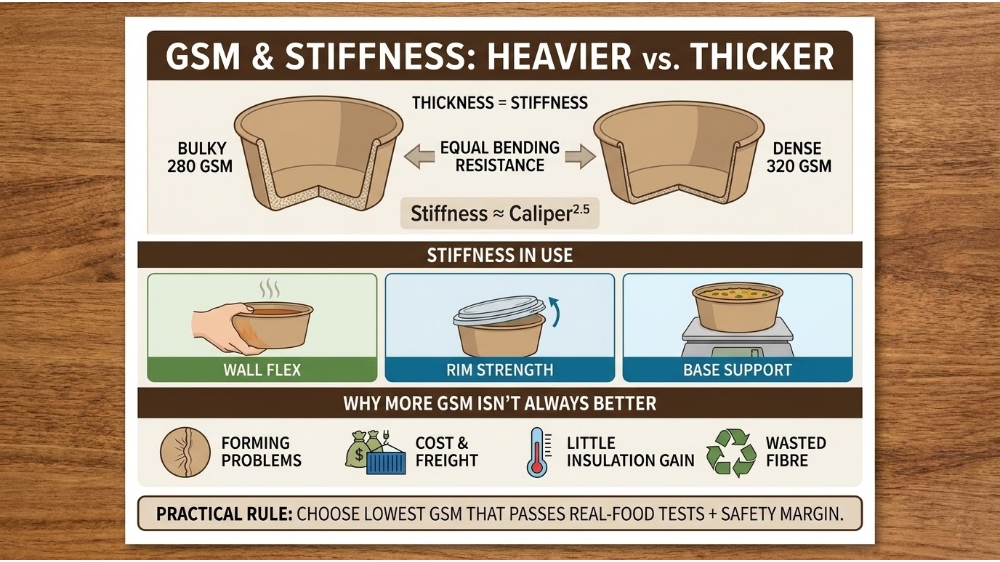
Thickness, also called caliper, is a separate measurement. It is the physical depth of the board, usually stated in microns and measured under ISO 534. The link between the two is bulk, which is caliper divided by grammage. A high-bulk board has more air between its fibres, so it is thicker at the same weight.
This is why two suppliers can both quote 300 GSM and deliver bowls that feel different in the hand. One may use a bulky, virgin-fibre board. The other may use a denser sheet with recycled content. Same weight, different caliper, different stiffness. Treat GSM as a starting specification and always ask for the caliper next to it.
How GSM Affects Stiffness and Where Heavier Paper Stops Helping
Heavier board is usually stiffer, but thickness does most of the work. In an ideal homogeneous sheet, bending stiffness rises with the cube of caliper. For commercial solid bleached and folding box boards, the exponent is closer to 2.5. In practice, a board that is 10% thicker can be roughly a quarter to a third stiffer. That is how a bulky 280 GSM board can match a dense 320 GSM one.
In a bowl, stiffness shows up in three places: the wall flexing when a customer grips a hot bowl, the rim holding its shape under a lid, and the base carrying a full portion. Larger diameters need more board because the walls have less support. Supplier guides commonly pair 8-24 oz bowls with about 300 GSM and 26-32 oz bowls with about 320 GSM or more.
Why more GSM is not automatically better:
Forming problems: heavy board resists pressing and curling, which can cause wrinkles and micro-cracks at seams and rims, the places where leaks start
Cost and freight: every extra gram is bought, shipped and stored on every bowl, across thousands of units
Little insulation gain: a few extra GSM on a single-wall bowl barely changes the heat a customer feels
Wasted fibre: over-specified board adds material with no measurable benefit in use
The practical rule is simple. Choose the lowest GSM that passes your real-food tests, then add a safety margin, rather than defaulting to the heaviest option on the price list.
For hot food, GSM helps a bowl keep its shape, but the coating and the food decide how long it lasts. Paperboard does not melt at serving temperatures. The real limits are the softening of the barrier layer and the loss of fibre strength once moisture reaches the board.
Polyethylene (PE) is the standard lining for hot liquids because it tolerates temperatures well above normal soup service. PLA, a plant-based lining, softens at lower temperatures than PE. If you plan to use a PLA-lined bowl for boiling soup or stew, confirm the supplier’s rated temperature first.
Where GSM does matter is wall and rim stability. Heavier, thicker board stays firmer when it is warm and damp, which reduces flexing and rim distortion during a 20-40 minute delivery. Steam adds to the problem, because a tight lid traps moisture that can soften the rim and lid seat. The test is time under heat, not just peak temperature.
Hand heat is a separate issue. A single-wall paper bowl conducts heat to the customer regardless of small GSM differences. If customers complain that bowls are too hot to hold, consider a double-wall bowl or a sleeve instead of moving up in GSM.
GSM, Coating and Leak Resistance
Leak protection comes mainly from the coating and the construction, not from GSM. The paperboard provides structure, and the coating provides the barrier. A bowl needs both to hold liquid.
Most bowls use a thin PE layer, often around 15-20 GSM, on the food-contact side. Double-PE, coated on both sides, is used where the outside meets condensation, such as with cold or frozen contents. PLA linings are usually applied heavier, at roughly 30 GSM in some manufacturers’ specifications, to reach a comparable barrier.
On a quotation, this appears as two numbers. A line such as 300 + 18 PE means 300 GSM board with an 18 GSM PE coating. Reading both numbers tells you far more than the board weight alone.
When a bowl leaks, the cause is usually the side seam, the bottom joint or the rim curl. These areas are pressed, folded and bonded, and any crack in the coating exposes raw board edges that wick liquid. Oily, acidic and saucy foods penetrate faster than plain water. GSM plays an indirect role here: the right board weight lets the bowl form cleanly and hold seam pressure, while board that is too heavy or too light can bond poorly.
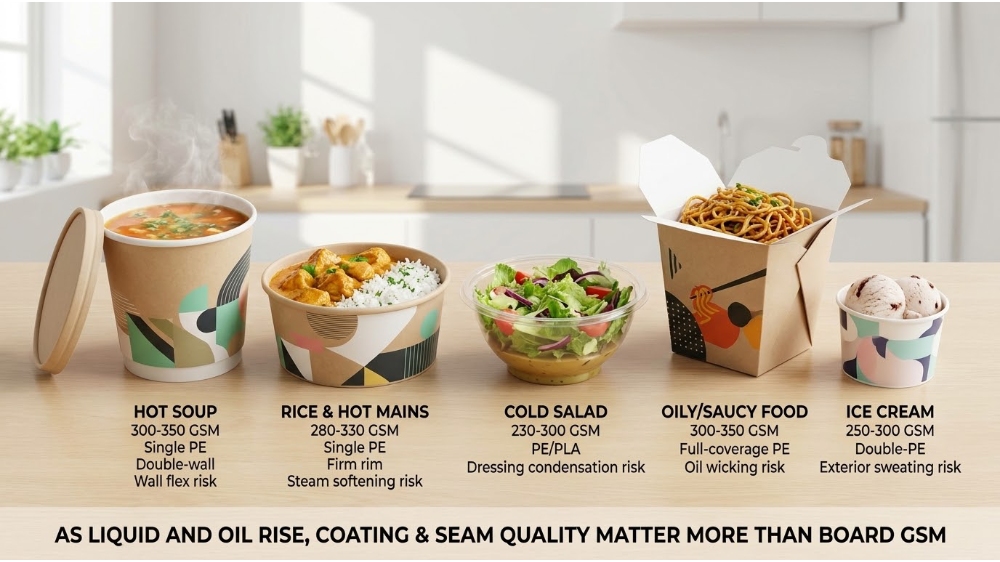
Recommended GSM and Structure by Food Type
Use these ranges as starting points to validate with your own food, not as fixed standards. Board bulk and stiffness vary between suppliers.
Food type
Starting board GSM
Coating and structure
Main risk to test
Hot soup, broth, stew
300-350, larger sizes at the top
Single PE, snug lid, double-wall if hand heat is a concern
Wall flex and seam wicking over long holds
Rice and hot mains
280-330
Single PE, firm rim, secure lid fit
Steam softening the rim and portion weight
Cold salad and grain bowls
230-300
PE, or PLA for cold-only use
Dressing and condensation at the base
Oily or saucy food
300-350
Full-coverage PE with tight seam and base bond
Oil wicking at seams and rim
Ice cream and cold desserts
250-300
Double-PE
Exterior sweating softening the wall
The pattern to notice is that as liquid and oil content rise, coating and seam quality matter more than another 20 GSM of board.
How to Evaluate GSM on a Supplier Quotation
Compare quotations line by line, not by the headline GSM. Two identical “300 GSM” lines can hide different fibre, caliper and coating.
Base board or finished GSM: confirm whether the number refers to the board alone or includes the coating
Coating weight and sides: PE or PLA, grams per square meter, one side or both
Caliper in microns: request the measured value and its tolerance
Bowl dimensions: top diameter, height, volume and the matching lid
Batch tolerance: the acceptable GSM variation between production runs
Food-contact documentation: declarations that suit your target market
If two suppliers quote the same GSM at very different prices, treat the gap as a question to ask, not a bargain. It usually reflects fibre quality, coating weight or forming quality. Ask for samples taken from the production line, not only a hand-picked sales sample.
What to Test Before Placing a Bulk Order
Sample testing under your real conditions reveals more than any datasheet. Run these checks with your actual menu, lids and delivery bags.
Hot-hold test: fill with food at service temperature and hold for 30 and 60 minutes, checking wall flex, rim shape and any weeping
Grip test: lift a full bowl with one hand and note wall collapse and heat at the fingers
Leak and seam test: place the filled bowl on a paper towel, tilt it, and inspect the seam and base joint, then repeat with your oiliest sauce
Transport test: lid on, bagged and moved along a real delivery route
Lid and stack fit: lids should seat firmly and bowls should nest without crushing
Condensation test: for cold foods, check for exterior sweat and base softening after an hour
Batch check: compare pre-production samples against a production sample before final approval
Final takeaway: the right GSM for paper bowls is the lowest board weight that passes real-food tests for your bowl size, temperature and hold time. Most hot-food bowls land between 250 and 350 GSM, with large soup bowls near the top.
Treat GSM as one line of the specification, alongside caliper, coating and seam quality. When a bowl flexes or leaks, the fix is usually a better barrier, a tighter seam or a double-wall structure, not simply heavier paper. Ask for full specifications, test with your own menu, and confirm the results on production samples before you commit.
Need paper bowls matched to your menu?
Talk to a packaging specialist about board weight, coating and structure for your bowl sizes, food types and hold times.
Most bowls use between 250 and 350 GSM of base board. Small cold bowls sit toward the lower end, and large hot soup bowls toward the upper end. The number only makes sense alongside caliper and coating weight.
Is 350 GSM too heavy for a small bowl?
Often, yes. A small bowl has short, well-supported walls, so extra weight adds cost without a clear strength gain, and thick board can crack at tight rim curls. Test a lighter grade first.
Does higher GSM make a paper bowl microwave-safe?
No. Microwave suitability depends on the coating, adhesives, inks and construction, not board weight. Only microwave bowls that the supplier has specifically rated for it.
Is a PLA-lined bowl as heat-resistant as a PE-lined bowl?
Not necessarily. PLA softens at lower temperatures than PE, so it suits many cold and warm foods better than boiling liquids. Ask for the supplier’s rated temperature and test with your hottest product.
Post time:
Sep-29-2026
For inquiries about our products or pricelist, please leave your email to us and we will be in touch within 24 hours.