What Are Fiber Bowls Made Of? Materials, Manufacturing & Foodservice Applications Explained
What Are Fiber Bowls Made Of? Materials & Uses Explained
Foodservice Packaging Guide
What Are Fiber Bowls Made Of? Materials, Manufacturing & Foodservice Applications Explained
A fiber bowl looks like a simple disposable, but three separate decisions sit inside it: the plant fiber, the barrier that stops leaks, and the certification that decides where it can be discarded. Here is what goes into each layer, and how to match a bowl to the food you actually serve.
Most fiber bowls are made from plant pulp, usually sugarcane bagasse, bamboo, wheat straw, or a blend of them. The pulp is mixed with water, formed into a bowl shape on a mold, then hot-pressed and dried. A small dose of additive or a thin barrier coating gives the wall its resistance to grease and moisture.
That means the fiber sets strength, color, and cost, the additive sets how well the bowl handles hot and oily food, and the certificate sets the end-of-life claim. This guide covers each raw material, the molding process, PFAS-free barriers, real-world performance, and a specification checklist for restaurants, distributors, and brands buying molded fiber bowls in bulk.
The Raw Materials: Bagasse, Bamboo, and Wheat Straw
Molded fiber bowls fall into two fiber families: agricultural residues and purpose-grown fibers. Both are cellulose-rich, which is why they bond into a rigid wall once water is pressed out.
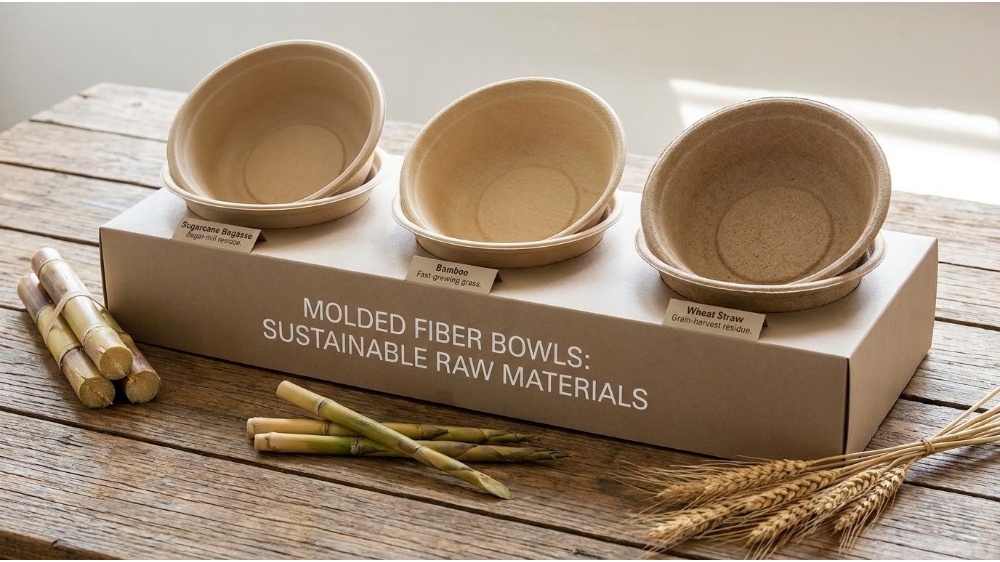
Sugarcane bagasse is the fibrous residue left after juice is squeezed from sugarcane. Sugar mills produce it in large volumes, so it is the most common base for compostable fiber bowls. Bagasse pulp forms a smooth, fairly dense wall and is available in natural tan or bleached white.
Bamboo grows quickly and yields longer fibers than most residues. Longer fibers interlock better, so bamboo pulp tends to add stiffness and rim strength. It is often blended with bagasse to lift the strength of larger bowls.
Wheat straw is what remains after grain harvest. It is low-cost and widely available in grain-growing regions, but its shorter, silica-rich fibers usually give a rougher surface. It performs best in blends or in bowls where a matte, rustic finish is acceptable.
Fiber
Source
Typical strength
Look and feel
Sugarcane bagasse
Sugar-mill residue
Good, consistent
Smooth; natural or white
Bamboo
Fast-growing grass
High rim and wall stiffness
Fine texture; light tan
Wheat straw
Grain-harvest residue
Moderate; best in blends
Rougher, matte surface
Note that fiber choice alone does not make a bowl “better.” A well-engineered bagasse bowl will outperform a poorly formed bamboo bowl. Wall thickness, density, and the additive package matter just as much as the plant source.
Agricultural, Virgin, and Recycled Fiber: Which Suits Food Contact?
For direct food contact, agricultural fiber and virgin wood pulp are the safer starting points. Recycled fiber can be used in some markets, but it faces tighter scrutiny.
Agricultural fiber (bagasse, wheat straw, bamboo) has a clean supply chain and no printing-ink history. That makes it easier to document for food-contact compliance and easier to market as tree-free.
Virgin wood fiber is consistent and strong. Buyers who choose it should ask whether the wood comes from certified, responsibly managed forests.
Recycled fiber reduces virgin material demand, but it can carry residues from inks, adhesives, and mineral oils picked up in earlier life. Because these residues can migrate into food, recycled pulp is more common in trays, egg cartons, and protective packaging than in bowls holding hot, wet food. If a supplier offers recycled-fiber food bowls, request migration test results, not just a recycled-content claim.
How a Molded Fiber Bowl Is Made, from Pulping to Drying
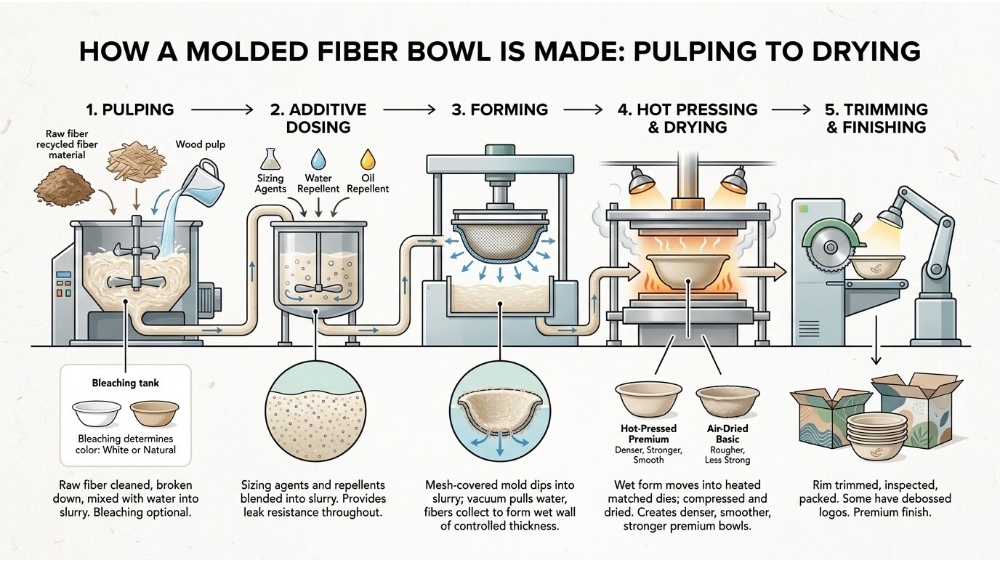
Molded fiber manufacturing is a wet-forming process. The same logic applies whether the bowl is a 12 oz soup bowl or a 32 oz salad bowl.
1. Pulping
Raw fiber is cleaned, broken down mechanically or with mild processing, and mixed with water into a slurry that is mostly water. Bleaching, if used, happens at this stage and determines whether the bowl is white or natural.
2. Additive dosing
Sizing agents and water- and oil-repellent additives are blended into the slurry. Adding protection here, rather than only on the surface, is why many fiber bowls resist leaks without a visible liner.
3. Forming
A mesh-covered mold is dipped into the slurry, and vacuum pulls water through the mesh. Fibers collect on the mold in the shape of the bowl, building a wet wall of controlled thickness.
4. Hot pressing and drying
The wet form moves into heated matched dies that compress the wall and drive out remaining moisture. This step separates premium bowls from basic ones. Hot-pressed, thermoformed walls are denser, smoother, and stronger than air-dried or lightly pressed walls, which is why they hold up better to hot soup and sauces.
5. Trimming and finishing
The rim is trimmed, the bowl is inspected, and it is packed. Some plants add debossed logos at the pressing stage, since standard ink printing on rough fiber is limited.
Coatings, Additives, and the PFAS Question
Bare fiber absorbs liquid, so every bowl needs some form of barrier. The barrier you choose determines heat tolerance, recyclability, and regulatory risk.
PFAS (per- and polyfluoroalkyl substances) were once widely used to make fiber grease-proof. Because these chemicals persist in the environment, many jurisdictions now restrict them. Several U.S. states, including California, Washington, New York, Maine, and Minnesota, limit intentionally added PFAS in food packaging. The European Union’s packaging regulation also sets PFAS limits for food-contact packaging that began applying in August 2026. Any bowl sold across borders should be specified as PFAS-free from the start.
The main PFAS-free approaches are:
Internal sizing and non-fluorinated repellents: added to the pulp; no visible film; common in bagasse bowls for hot, moderately oily food.
Aqueous barrier coatings: a thin water-based layer on the surface; good grease resistance and compatible with many recovery streams.
PLA or PBAT lining: a bio-based or compostable-polymer film; strong liquid barrier, but PLA softens at relatively low temperatures, so it suits cold or warm food better than boiling soup.
PE lining: reliable barrier, but it blocks compostability and complicates recycling.
Do not accept “PFAS-free” on trust:
Ask for a third-party total organic fluorine test on the finished bowl
Confirm the test covers the coating and additives, not only raw pulp
Request a fresh report for each production batch or supplier change
Performance with Hot Food, Cold Food, Microwaves, and Freezers
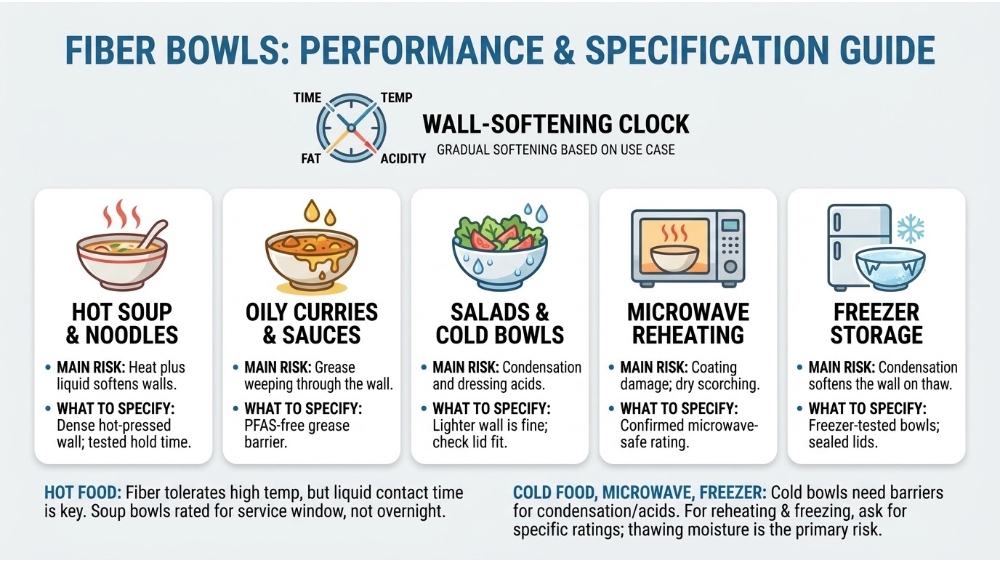
A bowl does not fail all at once. Its wall softens gradually, and the speed depends on temperature, fat, acidity, and time. Think of it as a “wall-softening clock” that you need to match to your service window.
Use case
Main risk
What to specify
Hot soup and noodles
Heat plus liquid softens walls
Dense hot-pressed wall; tested hold time
Oily curries and sauces
Grease weeping through the wall
PFAS-free grease barrier
Salads and cold bowls
Condensation and dressing acids
Lighter wall is fine; check lid fit
Microwave reheating
Coating damage; dry scorching
Confirmed microwave-safe rating
Freezer storage
Condensation softens the wall on thaw
Freezer-tested bowls; sealed lids
Hot food. Fiber tolerates high temperatures well, since it contains no plastic that melts. The real limit is time in contact with liquid. Bowls designed for soup or ramen are typically rated for a service window, not overnight storage.
Cold food. Cold bowls face condensation more than heat. Acidic dressings, citrus, and vinegar break down sizing faster than plain water, so salad bowls kept for hours need a proper barrier. Read Guide of Choosing Foodservice Containers for Frozen Desserts to learn about cold food paper bowl in detail.
Microwave and freezer. Plain fiber contains no metal, so uncoated bowls generally handle reheating. The risks come from linings and additives, so buyers should ask for a specific microwave and freezer rating rather than assume. Freezing is rarely the problem; thawing moisture is.
Compostability and Certifications: What Labels Prove
“Plant-based” and “compostable” are different claims. A bowl made from bagasse can still fail a compost test if its coating or additives do not break down.
Look for certification that covers the finished product, not just the fiber. Common frameworks include ASTM D6400 in North America (often verified through BPI), EN 13432 in Europe (through schemes such as TÜV Austria’s OK compost or DIN CERTCO), and AS 4736 in Australia. These generally address industrial composting; home-compost claims need separate certification.
Food-contact compliance is a separate document. Depending on market, that means U.S. FDA food-contact rules, EU Regulation 1935/2004, or Germany’s LFGB standard. A supplier should be able to give you a declaration of conformity and test reports for the exact bowl you are buying.
Finally, remember that compostable is only useful if a local facility accepts it. In areas without commercial composting, a bowl’s low-impact material story may matter more than its compost label.
How to Specify Fiber Bowls for a Foodservice Program
Start with your menu, not the catalog. List the hottest, oiliest, and longest-held item you serve, then choose the bowl that survives that item, and use the same platform across your lighter menu.
Fiber bowl specification checklist:
Fiber source: bagasse, bamboo, wheat straw, or blend; bleached or natural
Wall build: hot-pressed or air-dried; bowl weight in grams for each size
Barrier: PFAS-free test report on the finished bowl
Performance: tested hold time at your serving temperature; microwave and freezer ratings
Compliance: food-contact declaration and compost certificate for the exact product
Fit: lid compatibility, nesting height, and stack stability in transit
Before committing to a bulk order, run a simple trial. Fill sample bowls with your real hottest and oiliest dish, seal them, and check the wall at 15, 30, and 60 minutes. Note any weeping, softening at the base, or rim distortion. Suppliers who welcome this test are usually the ones with tested products behind their claims.
Because material, barrier, and certification decisions interact, it helps to work with a packaging partner that can match bowls, lids, and custom branding to your menu in one program. For a sourcing consultation on molded fiber bowls, contact Maibao Packaging.
Need fiber bowls that match your menu and your compliance needs?
Talk to a packaging specialist about fiber selection, PFAS-free barriers, certifications, and custom options for your foodservice program.
No. Paper bowls are cut and formed from paperboard sheets and usually need a plastic or bio-polymer lining. Fiber bowls are molded directly from pulp slurry, so the wall can be liquid-resistant without a separate film.
Are fiber bowls plastic-free?
Not automatically. Bowls made with internal sizing or aqueous coatings can be plastic-free, but PLA, PBAT, or PE linings are polymers. Ask the supplier to state the barrier type in writing.
Can fiber bowls go in the oven?
Generally no. Molded fiber bowls are designed for serving and microwave reheating, not for oven cooking, where dry fiber can scorch. Follow the maximum temperature on the supplier’s specification sheet.
Is bagasse or bamboo better for bowls?
It depends on the bowl. Bagasse is often the practical, cost-competitive choice for everyday soup and takeout bowls, while bamboo blends can add stiffness for larger or heavier bowls. Wall density and barrier quality matter more than fiber name alone.
Post time:
Sep-28-2026
For inquiries about our products or pricelist, please leave your email to us and we will be in touch within 24 hours.