Paper Bowl Sizes Guide: Standard Capacities, Dimensions, and Uses
Paper Bowl Sizes Guide: Capacities, Dimensions & Uses
Paper Packaging Guide
Paper Bowl Sizes Guide: Standard Capacities, Dimensions, and Uses
From a 6 oz sauce cup to a 32 oz ramen or family-style bowl — how top diameter, wall height, rim standardization, and where the bowl actually sits (counter, cold case, delivery bag) decide the size that works in practice.
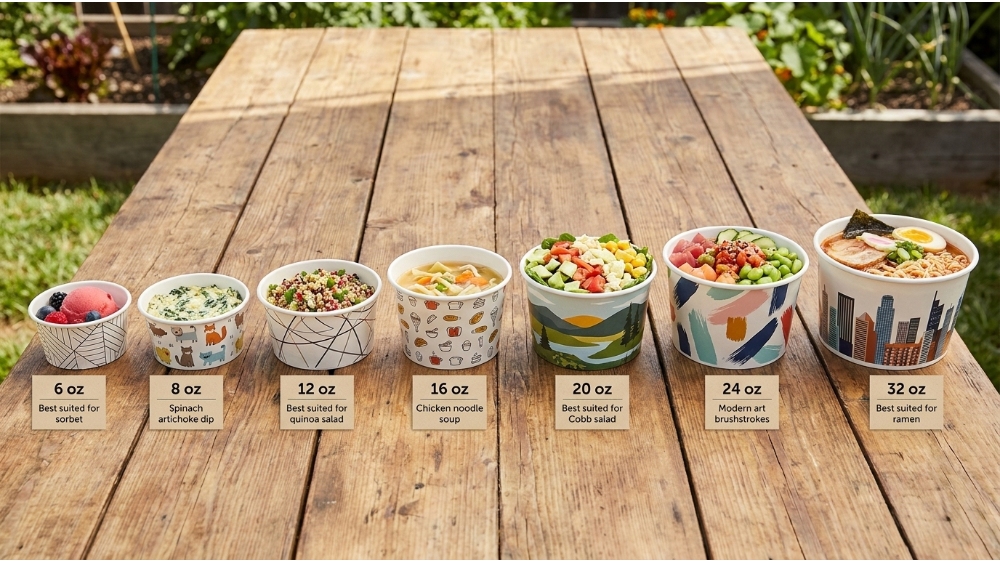
A standard paper bowl runs from a 6 oz snack cup at roughly 3.75 inches across up to a 32 oz entrée or ramen bowl at 7 inches wide, with the 12–16 oz band covering most everyday soup, salad, and rice-bowl service. But the ounce number alone won’t tell you whether a bowl fits your counter, your cold case, or your delivery bag — two bowls both labeled “12 oz” can differ by more than an inch in diameter depending on whether they’re built wide and shallow or narrow and deep.
This guide lines up the ounce-to-inch conversions most charts leave incomplete, explains why bowl “profile” matters as much as volume, and covers what most size charts skip entirely: how coffee counters standardize on two sizes instead of eight, how supermarket cold cases and salad bars physically constrain which bowl shape fits, and how lid rim engineering lets one lid cover several bowl heights. For a full range of ready-to-order paper bowls, see this paper bowl packaging overview.
What Counts as a “Standard” Paper Bowl Size?
A paper bowl’s labeled size is a volume rating in fluid ounces (US) or milliliters (rest of world) — not a fixed diameter. The same “16 oz” label can sit on a wide, shallow salad bowl or a narrower, deeper soup cup, because manufacturers trade width for depth to hit the same fill volume.
Unlike paper bags, which carry a load-bearing SOS or barrel-fraction number tied to a reference product weight, paper bowls are rated purely by how much liquid or loose food they hold to the rim — typically 6, 8, 12, 16, 20, 24, or 32 oz in North American foodservice, and 250, 355, 500, 750, or 1,000 ml equivalents elsewhere. That volume-only rating is exactly why sizing mistakes happen on reorders: a buyer sees “12 oz” on a spec sheet and assumes it matches the 12 oz bowl they used last year, when the two may differ meaningfully in top diameter and therefore in how food looks, stacks, and travels.
Demand for this format is large and still climbing. Valuates Reports puts the global paper bowl market at roughly $4.65 billion in 2024, projected to reach about $7.2 billion by 2031 at a 6.5% compound annual growth rate — driven largely by foodservice operators and grocery grab-and-go programs replacing plastic and foam bowls at volume rather than switching a handful of SKUs. Estimates vary by research firm (some broader “disposable bowls” reports covering plastic and foam alongside paper put the 2024 base closer to $28–29 billion), but every major forecast agrees on the same direction: steady, multi-year growth pulled by takeout, delivery, and single-use-plastic restrictions rather than a short-term spike.
Paper Bowl Size Chart: Ounces, Diameter, and Capacity Compared
Most general-purpose paper bowls fall into seven working sizes — 6, 8, 12, 16, 20, 24, and 32 oz — with top diameter climbing from about 3.75 inches to 7 inches as capacity increases. The chart below uses the wide-format construction most common in general foodservice and retail use; section 03 below covers the narrower, deeper “soup-profile” alternative that shares the same ounce labels but different dimensions.
Larger salads, rice bowls, generous single portions
24 oz
~6.5 in
~2.5 in
~750 ml
Poke, grain bowls, hearty stews with toppings
32 oz
~7 in
~3 in
~1,000 ml
Ramen, family-style, meal-prep, catering portions
These brackets track the same portioning logic most disposable-bowl guides use: small bowls under roughly 12 oz for sides and snacks, a versatile 12–16 oz middle band that covers the majority of both home and foodservice use, and 20 oz-plus bowls reserved for entrées, hearty salads, and full-meal formats. As a portioning rule of thumb, capacity should run about 1.5 to 2 times the actual food volume so there’s headroom for toppings, lids, and spill-free transport — a ratio [UK packaging supplier PandaPak bases on British Dietetic Association portion guidance] for takeaway and delivery service.
Why Do Two Bowls Labeled “12 oz” Measure Differently?
The same ounce rating can describe a wide, shallow bowl or a narrow, deep one, because manufacturers use two distinct constructions to hit identical volumes for different jobs. A 12 oz salad bowl and a 12 oz soup cup can differ by more than an inch in top diameter even though they hold the same amount of food.
This is the gap most size charts skip, and it’s the single most common reason a reordered “12 oz” bowl arrives the wrong shape. A wide-format 12 oz bowl — the general-purpose style used for salads, sides, and light entrées — typically measures close to 5 inches across and 2 inches deep. A soup-profile 12 oz cup, by contrast, is built narrower and taller specifically to keep hot liquid from sloshing and to fit a one-hand carry: closer to 3.5–4 inches across and 2.5–3.5 inches tall, a shape one packaging guide notes is “more common in soup containers than in wide-format paper bowls”.
Construction profile
12 oz diameter
12 oz height
Typical use
Wide-format (general purpose)
~5 in (127 mm)
~2 in (51 mm)
Salads, sides, takeout entrées, retail deli
Deep / soup-profile
~3.5–4 in (90–100 mm)
~2.5–3.5 in (70–86 mm)
Hot soup, broth, single-serve liquid items
The practical takeaway for buyers: never order on the ounce number alone. Ask for top diameter and height on the spec sheet, or request a physical sample, before committing to a production run — especially if the bowl needs to fit an existing lid, a fixed shelf slot in a cold case, or a specific dispenser stack.
What Size Bowls Do Coffee Shops and Fast-Casual Counters Use?
Coffee counters and fast-casual chains rarely stock more than two or three bowl sizes, sized to order tiers rather than to individual menu items. A breakfast yogurt or oatmeal ride in an 8–12 oz cup, a lunch salad or rice bowl needs 12–16 oz, and a full entrée or sharing portion needs 16 oz or larger.
That tiering shows up consistently across foodservice sizing guidance: breakfast items like yogurt, cereal, or oatmeal are generally served in the 8–12 oz range, lunch portions such as salads, rice bowls, or pasta fit the 12–16 oz band, and larger 16–32 oz bowls handle stews or full dinner plates with sides, while kids’ meals or small snacks typically use 6–10 oz cups. Fast-casual grain-bowl and poke concepts skew toward the top of that range — a wide, shallow 24–32 oz bowl gives enough surface area to layer rice, protein, and toppings without everything sliding together in transit, a profile one foodservice packaging guide describes as needed for “layering without mixing” in grain and Buddha-bowl formats.
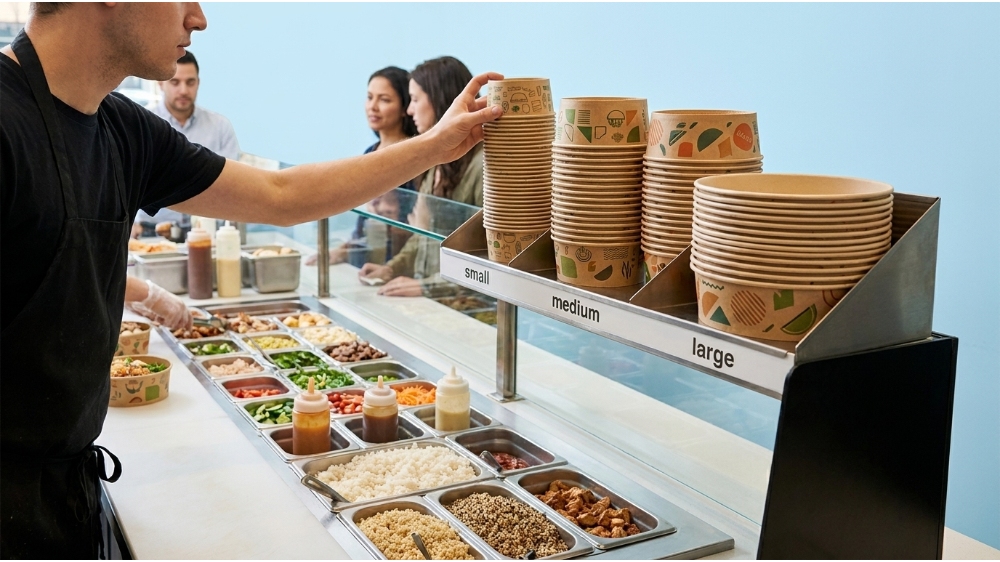
The same fixed-SKU logic that shapes checkout-counter paper bag stocking applies here: a barista or line cook grabbing bowls mid-rush needs a rack or dispenser stack that holds a known, consistent size, not five near-identical options. Most quick-service operations settle on a small (8–12 oz), a medium (16 oz), and a large (24–32 oz) rather than a size for every menu line — fewer SKUs means faster training, simpler inventory counts, and less risk of a line cook grabbing the wrong bowl during peak hours.
How Do Supermarket Cold Cases and Salad Bars Shape Bowl Sizing?
Grocery salad bars and grab-and-go cold cases favor wide, shallow bowls because they need to sit flat and visible on a fixed shelf, not a deep one that hides food or tips on a narrow ledge. Reach-in refrigerated merchandisers hold packaged food between roughly 33°F and 41°F on open or glass-front shelving that ranges from about 10 to 36 inches wide and can run more than 90 inches long.
This is a constraint most paper bowl guides never mention, but it directly explains why grab-and-go bowls skew toward the wide-format profile rather than the tall soup-cup shape. A supermarket’s open-air merchandiser or self-service reach-in case is built for eye-level visibility and quick grab-and-restock — Foodservice Equipment & Supplies notes refrigerated display cases range from small wall-mounted pie cases to large freestanding grab-and-go merchandisers, and shelf depth on these units is typically shallow enough that a tall, narrow bowl either gets hidden behind the shelf edge or tips when a shopper reaches past it. A wide 16–24 oz salad or grain bowl, by contrast, sits stably on a shallow shelf and displays its full contents through the glass front — which is part of why prepared-food sections lean on wide-format bowls almost exclusively, reserving the deep soup-cup profile for hot bar and soup-station service instead.
Deli and bakery display cases add a second constraint: unit height. Full-height deli cases run around 48 inches, built for larger merchandising volume, while low-profile units sit closer to 30 inches for tight counter spaces — meaning the vertical stacking height available for pre-filled or dispensed bowls varies by store format, and a packaging buyer supplying multiple store formats needs to confirm bowl height fits the shortest case in the chain, not just the flagship layout.
Before finalizing a grab-and-go or cold-case bowl order, check:
Shelf depth on the shallowest reach-in unit in your store network, not just the largest format
Whether the bowl needs a dome lid for display integrity under glass or open-air airflow
Case temperature range (commonly 33–41°F) against the bowl’s coating for condensation resistance
Whether wide-format or deep-profile better suits the specific prepared-food category being merchandised
What Size Fits Soup, Ramen, Poke, and Grain Bowls?
Everyday soup service works in 12–16 oz, delivery-bound soups and stews need 16–24 oz with a secure lid, and dedicated ramen or noodle bowls need a specialty 26–32 oz size with straight sides. Grain, poke, and Buddha bowls need a wide 24–32 oz profile rather than depth, since the format depends on layering rather than liquid volume.
Portion context changes the right pick even within a single food category. For a sit-down catered meal with a soup course, 12–16 oz is generally appropriate — generous enough to satisfy as a course without creating a full-meal portion before the entrée arrives. For meal-prep and delivery orders where soup or stew travels sealed in a bag, the 16–24 oz range paired with a dome or flat press-lock lid is the more common standard, since delivery time and jostling both increase spill risk versus a bowl eaten on-site.
Ramen and other noodle-soup formats are the clearest exception to general soup sizing: a standard 16 oz bowl is undersized once noodles, broth, and toppings are combined, typically piling food above the rim in an unstable, spill-prone way. Purpose-built ramen bowls in the 26–32 oz range with straight sides and fitted lids are sized specifically for that format, and operators running a dedicated noodle-soup menu are generally better served sourcing a purpose-built bowl rather than stretching a standard 16 oz cup to fit.
Lid and Rim Compatibility: What to Check Before Ordering
Many manufacturers engineer a “family” of bowl sizes around one shared top rim diameter, so a single lid SKU fits several heights and volumes at once. That’s why a café can stock one lid size for both its 12 oz and 16 oz bowls, provided both share the same manufacturer’s rim spec — but it also means mixing bowls across suppliers is the single most common source of lid-fit failures. Explore food box family by reading food container sizes guide.
This rim-family design exists for the same reason grocery chains standardize checkout bag sizes: fewer SKUs behind the counter means faster service and less inventory risk. A bowl family typically holds diameter constant across two or three volume tiers and adds depth to increase capacity — which is exactly the wide-format construction shown in the size chart above. The tradeoff is that a bowl built for maximum lid compatibility within its own family may not share a rim spec with a competitor’s “same size” bowl, so a reorder from a new supplier should always be checked against a physical sample or confirmed rim measurement, not assumed compatible because the ounce label matches.
Before locking in a lid-and-bowl combination, confirm:
Rim diameter in millimeters, not just the ounce label, matches across every bowl size in the order
Whether the lid is dome (for stacked or bulky toppings) or flat press-lock (for liquids and delivery)
Material pairing — PE, PLA, or foil-lined bowls each interact differently with hot-fill and lid seal
Whether switching bowl suppliers requires re-testing lid fit before a full production run
How to Choose the Right Paper Bowl Size for Your Situation
The right size depends less on the food itself and more on who’s buying and where the bowl has to perform — a coffee counter optimizing for register speed, a grocery chain merchandising in an open cold case, a delivery kitchen needing a secure lid seal, or a caterer plating a single course. Matching the buyer’s constraint to a size avoids both an undersized bowl that spills and an oversized one that reads as a skimpy portion.
Who’s choosing
Recommended size
Why
Coffee shop / café counter
8–12 oz core, 16 oz for light meals
Matches breakfast and single-item order tiers; fast to bag one-handed
Fast-casual / grain-bowl concept
16 oz, 24 oz, 32 oz ladder
Wide-format profile supports layering without mixing ingredients
Grocery deli / salad bar
12–24 oz wide-format bowls
Sits flat and visible on shallow reach-in and open-air cold case shelving
Delivery / dark kitchen
16–24 oz with dome or flat lid
Balances portion size against spill risk over transit time
Dedicated ramen / noodle bar
26–32 oz specialty, straight sides
Standard 16 oz undersized once broth, noodles, and toppings combine
Caterer / sit-down soup course
12–16 oz
Satisfies as a course without filling the guest before the entrée
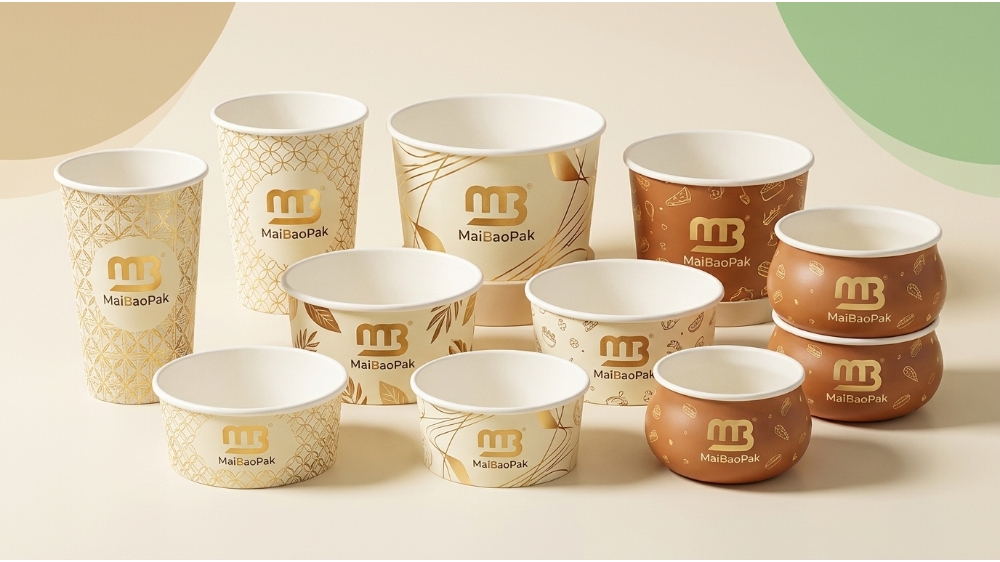
Businesses evaluating a full lineup rather than a single size can review ready-made paper bowl options or fully bespoke, custom-printed runs by capacity, profile, and lid compatibility before committing to production. Whatever the segment, the same rule applies: confirm actual diameter and height against a physical sample, not just the ounce label, before finalizing a size. Connect Maibao packaging expert to save time & cost when preparing for your businesses.
Not sure which bowl size fits your menu or store format?
Talk to a packaging specialist about matching paper bowl capacity, profile, and lid compatibility to your actual order volume and display case dimensions.
What is the most versatile paper bowl size for a small restaurant?
A 16 oz wide-format bowl covers the widest range of everyday uses — soup, salad, rice bowls, and single-portion entrées — while still fitting most standard lid families. Most small operations pair it with a 12 oz for sides and a 24–32 oz for combo or family-style orders rather than stocking a size for every menu item.
Why do two “12 oz” bowls from different suppliers look different?
One is likely a wide-format bowl (about 5 inches across, 2 inches deep) built for salads and sides, while the other is a deep soup-profile cup (about 3.5–4 inches across, 2.5–3.5 inches tall) built for hot liquids. Always confirm diameter and height on the spec sheet rather than relying on the ounce label alone.
What size paper bowl works best in a grocery store cold case?
Wide-format bowls in the 12–24 oz range generally perform best, since they sit flat and stay visible on the shallow, open-air shelving used in most reach-in and self-service merchandisers. Deep, narrow bowls are more prone to tipping or hiding behind the shelf edge in that setting.
How much bigger should a bowl be than the actual food portion?
A common rule of thumb is 1.5 to 2 times the actual food volume, leaving headroom for toppings, sauce, and lid clearance without spilling. Delivery and takeout orders generally need the higher end of that range to survive transit and handling.
Post time:
Jul-20-2026
For inquiries about our products or pricelist, please leave your email to us and we will be in touch within 24 hours.