

This guide breaks down exactly how each storage condition changes packaging performance, so you can set warehouse standards instead of guessing at them. For a full look at bulk food packaging formats and materials, visit Maibao Packaging.
Paper Food Packaging Storage: Humidity & Temperature Guide
Packaging Storage & Warehouse Guide
How Should Paper Food Packaging Be Stored? A Guide to Moisture, Temperature & Warehouse Conditions
Paper food packaging performs exactly as well as the warehouse it sits in. Push humidity, temperature, sunlight, or floor contact outside a narrow range, and the same carton that arrived flat and rigid leaves the warehouse weaker, bowed, or carrying a smell it should never pick up.
Paper food packaging should be stored at 40–55% relative humidity, 18–24°C (65–75°F), off the floor, away from direct sunlight and strong odors, and rotated on a first-in-first-out basis. Paperboard is hygroscopic — it constantly exchanges moisture with the surrounding air — so a warehouse that drifts outside this range doesn’t just “feel humid.” It measurably lowers compression strength, invites condensation on cartons, and lets the board absorb odors it will later pass into food.
Why Humidity Is the Biggest Threat to Paperboard Strength
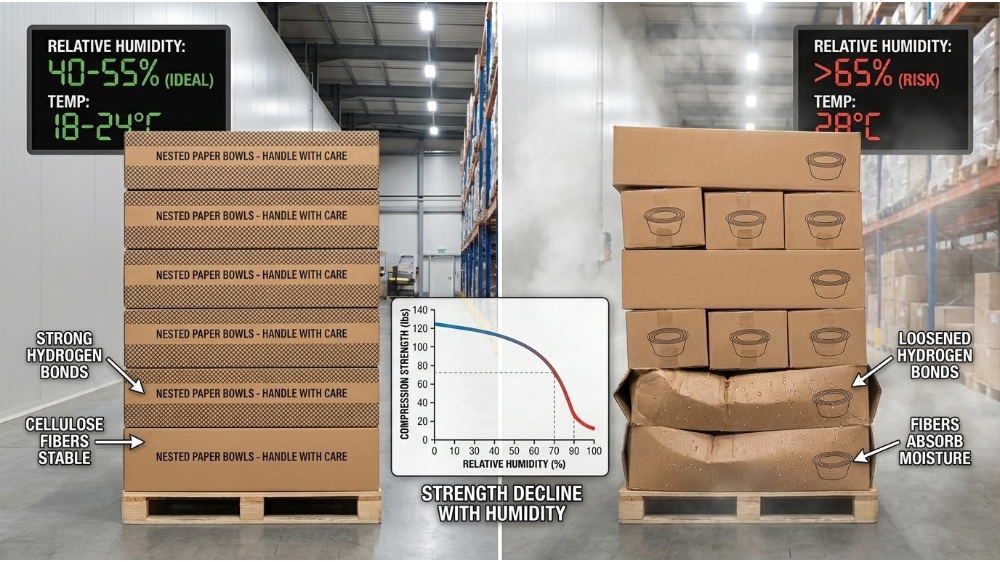
Relative humidity above roughly 40–55% is the single fastest way to weaken paper food packaging, because paperboard’s cellulose fibers absorb moisture straight out of the air and the hydrogen bonds holding the fiber network together loosen as they do.
Paper and board are hygroscopic materials — they never stop trying to equalize moisture with their surroundings. Research on corrugated box performance shows that once relative humidity climbs past about 30%, paper fibers begin absorbing measurable moisture, and compression strength declines in a second-order polynomial pattern as humidity keeps rising. The effect isn’t small: one study on corrugated cardboard found that compression strength dropped by roughly 36–40% when relative humidity rose from 70% to 90%, depending on temperature.
For a buyer, this translates directly into product failure. A humidity-weakened carton of nested bowls, clamshells, or cup sleeves doesn’t need to get wet to fail — it just needs to sit in a warehouse above the safe range long enough for the board to soften, so the bottom cases in a stack bow or crush under normal warehouse handling.
Baseline storage range for paper food packaging:
- Relative humidity: 40–55%
- Temperature: 18–24°C (65–75°F)
- No direct sunlight or exterior-door exposure
- Cartons on pallets or shelving, never on bare floor
- FIFO rotation, oldest pallets checked first
| Condition | Recommended range | Risk if out of range |
|---|---|---|
| Relative humidity | 40–55% | Below 30%: brittle, cracking board. Above 65%: strength loss, warping, mold risk |
| Temperature | 18–24°C (65–75°F) | Swings of 10°C or more trigger surface condensation on cartons |
| Sunlight / heat | Shaded, indirect | Print fading, uneven drying, localized warping |
| Floor contact | Pallets or shelving | Wicked ground moisture, bottom-layer deformation |
| Stack height | Within carton’s rated load | Compression collapse, worsened by humid, softened board |
| Odor sources | Segregated storage zone | Absorbed odors transfer into packaged food later |
Temperature Swings, Condensation & Surface Moisture
Sudden temperature changes cause condensation on paper packaging even when the warehouse’s average humidity reading looks fine, because moving cartons between a cold zone and a warm room drops the surrounding air below its dew point right at the packaging surface.
This is why packaging near loading docks, refrigerated staging areas, or exterior walls is disproportionately at risk. One logistics case found relative humidity inside a temperature-controlled truck fluctuating between 70% and 99%, moving corrugated moisture content well outside any stable warehouse target. The same swing happens inside ocean shipping containers, where trapped warm, moist air condenses on the cooler container roof and walls overnight — a phenomenon known in freight as “container rain” — and drips directly onto the top layers of paper cartons.
The practical fix is acclimation, not just climate control. Paper suppliers commonly recommend bringing paper cartons into the working environment about 24 hours before opening them, especially after they’ve traveled through a much colder or hotter zone, so the board’s temperature equalizes before it’s exposed to open air.
Sunlight Exposure and Warehouse Ventilation
Direct sunlight and poor airflow degrade paper packaging in two different ways: UV exposure dries and fades the surface unevenly, while stagnant air lets pockets of higher humidity build up near exterior walls, loading docks, and roll-up doors where fresh outdoor air keeps entering.
Paper storage guidance is consistent on this point: keep paper away from direct sunlight and away from external doorways, since both act as constant sources of temperature and humidity fluctuation that the rest of the warehouse doesn’t experience. A pallet parked against a sun-facing window or directly inside a dock door effectively lives in its own microclimate, drifting outside the storage range long before a central humidity gauge shows a problem.
In practice, this means positioning paper food packaging toward the interior of the warehouse, running HVAC or dehumidification to keep air actively circulating rather than settling, and treating dock-adjacent zones as short-term staging only — not long-term storage for stock that still needs to hold its full compression strength.
Pallet Storage, Carton Stacking & Floor Contact
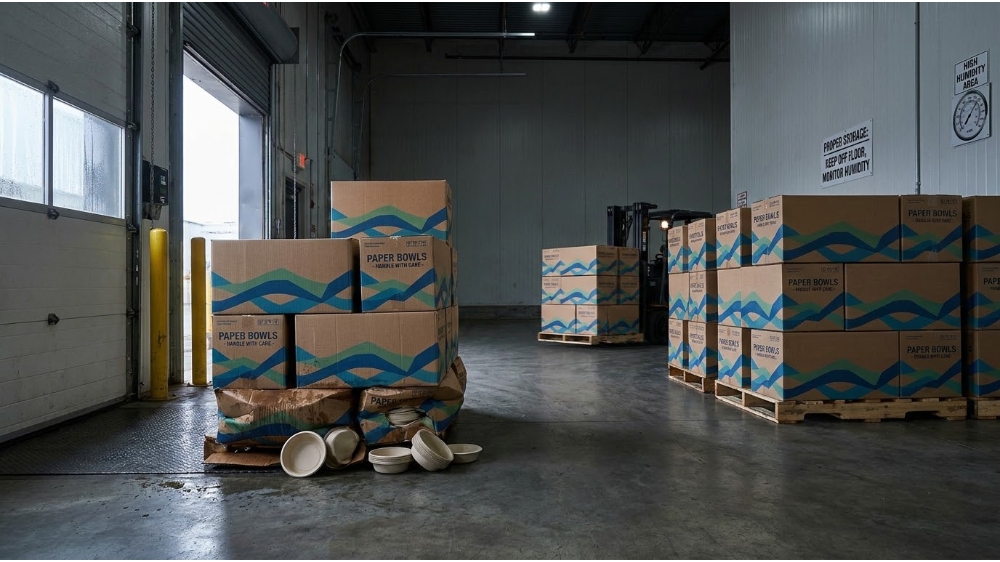
Cartons stored directly on a concrete floor, or stacked beyond their rated load, absorb ground moisture and carry uneven compression stress — and both problems compound each other long before the packaging is unpacked.
Concrete floors wick ambient ground moisture upward even when the slab looks and feels dry, and that moisture moves straight into the bottom layer of any carton sitting on it. Standard paper-handling guidance addresses this directly: stack cartons flat rather than on end, and keep them on pallets or solid shelving so they never have direct contact with the floor. Wire shelving isn’t a safe substitute either, since it can indent the board where the wires press against it.
Stack height matters just as much. A carton that has already lost compression strength to elevated humidity is far more likely to crush or bow under a stack that was sized for dry conditions, and once the bottom cases deform, the nested bowls, clamshells, or cups inside them deform with the box. Rotate pallets so the same cases don’t sit at the bottom of a stack for an entire storage cycle, and keep the highest stacks away from dock doors, where humidity swings hit hardest.
Odor Contamination and Pest Control
Paperboard is porous enough to absorb ambient odors during storage and release them back into food later, so paper food packaging needs to be kept away from chemicals, fuel, cleaning agents, and any other materials with a strong smell.
This isn’t a minor cosmetic issue. Industry guidance on food-contact paperboard notes that paperboard may absorb odorants during storage, and care should be taken to store it away from sources of taint, since the packaging is expected to protect a product’s flavor, not alter it. A pallet of takeout boxes stored next to solvent-based printing stock, pesticide, or fuel for warehouse equipment can carry that smell straight through to the food it eventually holds, regardless of how well the box was manufactured.
Pests are a separate but related risk. Cardboard’s fluted core and cellulose content make it attractive nesting material for insects like silverfish and cockroaches, and stacks left in contact with the floor or against exterior walls are the first ones affected. Keeping packaging off the floor, inspecting incoming pallets before they enter general storage, and never leaving cardboard scraps or food debris in the storage area all reduce this risk without adding a separate pest-control step to the rotation process.
FIFO Rotation, Shelf Life & Opened Cartons
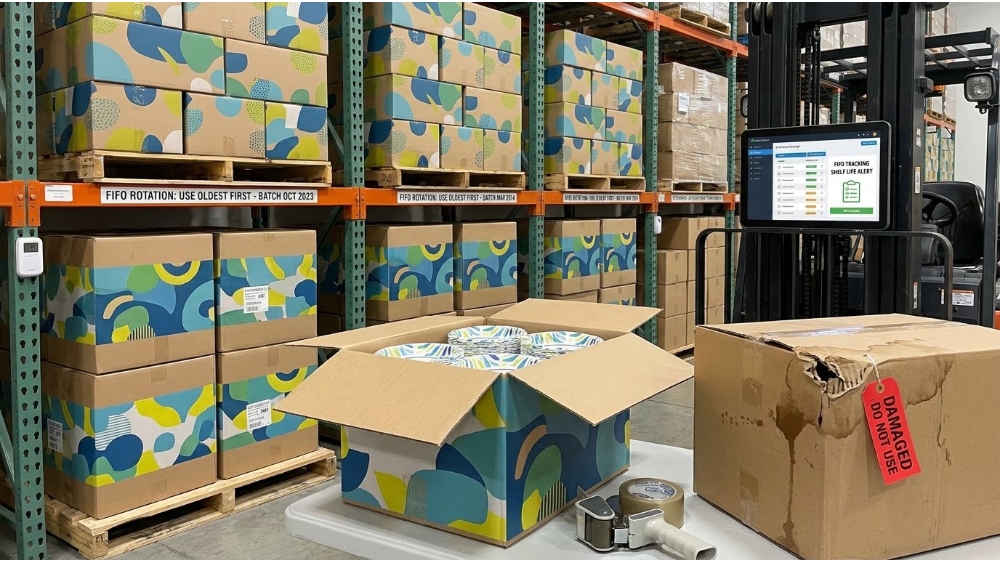
Even correctly stored paper packaging has a working shelf life, and the two variables a warehouse actually controls inside that shelf life are stock rotation and what happens to a case once it’s been opened.
First-in-first-out rotation matters because older stock accumulates more cycles of humidity swings the longer it sits, and each cycle adds cumulative stress to the board even if no single day looks extreme. Modern paper warehousing increasingly relies on inventory software to track age and support FIFO rotation, precisely because manually tracking which pallet arrived first becomes unreliable once storage volume grows.
Damaged cartons need to be pulled out of that rotation immediately, not folded back into general stock. A torn corner, water-stained flap, or crushed edge compromises the protective barrier for everything inside that case, and mixing damaged cases into a FIFO queue just guarantees the problem reaches a kitchen eventually. Opened cartons carry a related risk: once a case is broken open, the packaging inside loses the buffering that a sealed case provided, and the exposed layers will equalize with warehouse humidity within hours rather than weeks. Reseal partially used cases at the end of a shift, and for stock that will sit longer than a normal cycle — seasonal overstock, or packaging still on its original pallet after arriving by container — re-acclimate it for about 24 hours after unloading before breaking the pallet down, and check the bottom layer for early bowing before releasing it to production.
Frequently Asked Questions
How long can paper food packaging be stored before it needs to be used?
Under stable 40–55% relative humidity and 18–24°C conditions, unopened cases of coated paperboard packaging typically hold their strength and printed finish for 12 to 24 months. Uncoated or lightly coated board degrades faster in fluctuating conditions, so treat a supplier’s shelf-life figure as a starting point and inspect the oldest pallets before relying on it.
Can paper packaging still be used if the cartons look slightly bowed?
A bowed carton indicates the board has already lost compression strength, which means it’s more likely to crush or deform further under normal stacking. Pull a sample from that pallet and check it before committing the batch to production, rather than assuming a cosmetic issue only.
Does moving packaging between refrigerated and room-temperature storage cause problems?
Yes, even if the humidity gauge in each room looks normal. Moving cartons between zones with different temperatures cools the packaging surface below the surrounding air’s dew point, causing condensation to form on contact. Let cartons acclimate at room temperature before opening a case that just moved between zones.
What’s the fastest sign a warehouse is too humid for paper packaging?
Check the bottom layer of the oldest pallets and any cases nearest exterior walls first — they’ll feel soft or bow at the corners before visible mold appears anywhere else. That bottom-layer softening is usually the earliest warning that humidity has been running outside the 40–55% range.
Setting up warehouse standards for bulk paper food packaging?
Talk to Maibao Packaging about carton specifications, coatings, and packing formats matched to your storage conditions and order volume.
Post time: Sep-23-2026