Paper Bowls vs. Plastic Bowls for Takeout: Key Differences in Heat, Leaks, Cost & Sustainability
Paper Bowls vs Plastic Bowls: Takeout Heat, Leak & Cost
Takeout Bowl Selection Guide
Paper Bowls vs. Plastic Bowls for Takeout: Key Differences in Heat, Leaks, Cost & Sustainability
Neither material wins everywhere. A bowl that is perfect for a lunchtime salad can fail a 30-minute curry delivery, and the reverse is also true. This guide compares paper and plastic takeout bowls on six practical buying factors, then matches each material to the food and the way it is served.
The short answer: PE-coated paper bowls suit hot soup, noodles, and rice for short-to-medium holds, and they print well. Polypropylene (PP) bowls suit long delivery holds, oily sauces, and customer reheating, because they stay rigid and tolerate more heat. Clear PET bowls belong with cold food only. The deciding factors are food temperature, hold time, reheating, and how the bowl is disposed of.
Below, paper bowls vs. plastic bowls are compared on heat, leaks, strength, microwave use, cost, and disposal. The final sections turn those results into a food-by-food and condition-by-condition selection guide for takeout operators and buyers of disposable bowls.
Heat Resistance: What Each Material Really Tolerates
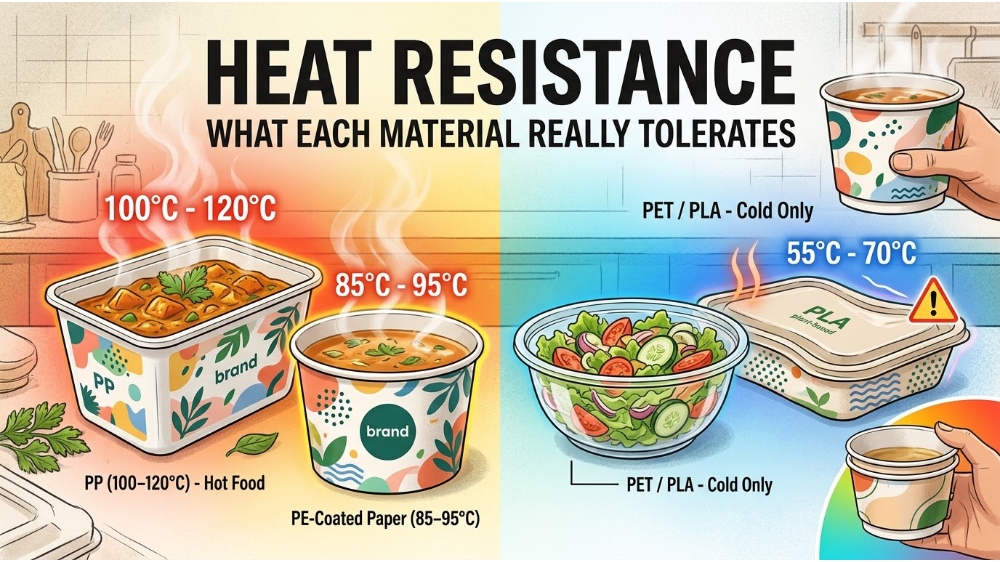
Most takeout failures start with a mismatch between the food’s temperature and the material’s limit. Hot soup leaves the kitchen at roughly 85–95°C (185–203°F), and curry or oily sauces can run hotter at the surface during reheating.
Paper bowls
Paperboard itself handles heat well, but the thin lining that makes it waterproof sets the limit. PE (polyethylene) coating melts at roughly 105–115°C, which is comfortably above serving temperature for soup. It leaves less margin for hot oil or long microwave cycles. PLA-lined paper (a plant-based coating) softens at a much lower temperature, so it is better for cold and warm food than for boiling-hot liquids held for a long time.
Plastic bowls
PP (polypropylene) is the standard hot-food plastic. Commonly rated for use around 100–120°C, it keeps its shape with hot curry, broth, and reheated rice. PET and rPET soften at about 70°C, and PLA bowls and lids soften around 55–60°C. Both are cold-food materials, even when they look identical to a PP bowl.
Hand comfort is a separate issue. A single-wall bowl of either material passes heat to the customer’s hand, while a double-wall paper bowl creates an air gap that feels cooler. Lid fit usually matters more than wall material for heat retention: a tight lid holds temperature, and a vented lid releases steam and heat together.
Heat limits at a glance:
PE-coated paper: good for hot soup and sauces; watch hot oil and long reheating
PP: best all-round hot-food plastic, including reheating
PET / rPET: cold and ambient food only
PLA (bowl or lid): cold food only; hot steam can warp it
Leak and Grease Resistance: Where Bowls Actually Fail
A leak-proof takeout bowl is rarely defeated by its wall. Leaks happen at the lid-to-rim seal, the paper side seam, and the bottom joint. When comparing leak-proof takeout bowls, test those three points before anything else.
Plastic bowls have an advantage in construction: the wall and rim are formed in one piece, and snap-fit or locking lids grip a stiff rim. Paper bowls have a rolled rim that gives a good seal when the lid is matched to it, but a mismatched lid can pop under pressure in a delivery bag. Choosing the lid and bowl as one system matters more than choosing the bowl alone.
Grease is the second test. A PE lining blocks oil well, so PE-coated paper bowls handle curry and dressings for normal holds. Water-based barrier coatings are improving, but oil that sits against the coating for a long time is the condition to verify with your supplier. Fiber bowls such as bagasse have historically relied on added chemicals for grease resistance, which links this question directly to PFAS rules (see the sustainability section).
Plastic does not absorb oil, so it never soaks through, but it can still stain. Turmeric and tomato-based sauces stain plastic permanently, which matters if customers reuse or reheat the bowl.
Strength, Rigidity, and Microwave Reheating
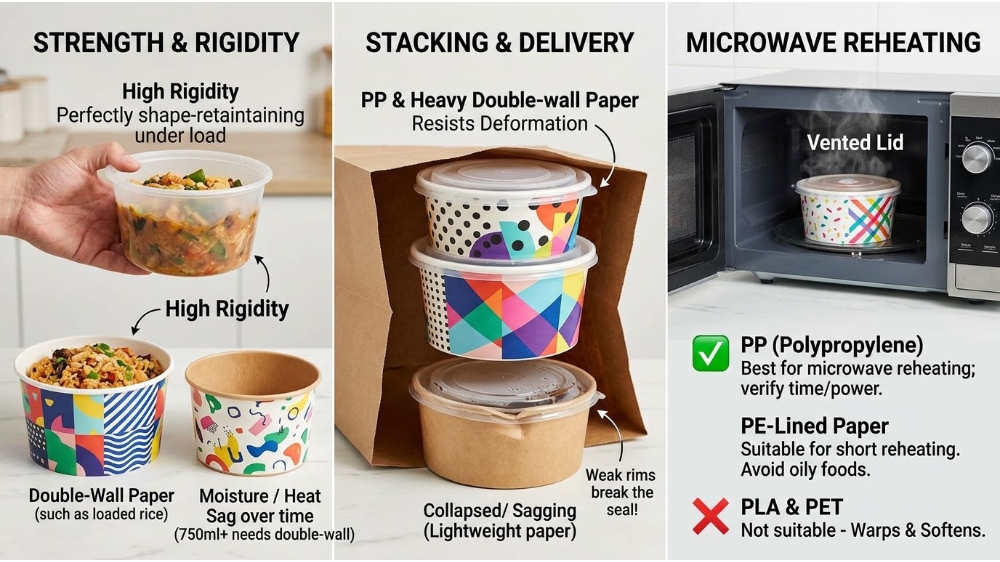
Plastic bowls hold their shape better when full, hot, and gripped one-handed. Paper bowls are stiff when dry but lose some rigidity as liquid and heat work on the board over time. Larger paper bowls (above roughly 750 ml) need a heavier board or a double wall to avoid sagging when picked up.
Rigidity also affects stacking. Bowls packed into delivery bags carry weight from other containers, and a soft wall can distort the rim and break the lid seal. For heavy dishes such as loaded rice bowls or large noodle soups, rigid PP or heavy double-wall paper is the safer choice.
Microwave claims need careful reading. A “microwave safe” label means the bowl was approved for reheating food under stated conditions, not for unlimited heating.
PP: the usual choice for microwave reheating; check the marking and the supplier’s stated time and power.
PE-lined paper: suitable for short reheating when labeled microwave safe; avoid long cycles with oily food.
PLA and PET: not suitable; they warp or soften.
Lids: most should be removed or vented before heating, whatever the bowl material.
If customers commonly reheat your food at home or in an office, build that use case into the specification from the start rather than relying on a general claim.
Cost: Unit Price vs. Cost per Delivered Meal
The cheapest bowl on the quotation is not always the cheapest bowl in service. Unit price for paper and plastic varies with size, wall thickness, coating, lid type, print, order volume, and market, so no single material is always cheaper.
A better cost formula:
Bowl price + matching lid price
Leak rate × cost of a remake, refund, or lost customer
Storage space and cartons per pallet or container load
Printing: direct print on paper vs. labels or sleeves on plastic
Local plastic fees, taxes, or waste-disposal costs
Lids are often overlooked. A low-cost bowl paired with a loose lid will cost more through refunds than a slightly dearer bowl with a secure seal. Branding also shifts the comparison: paper offers a large printable surface, which can remove the need for separate stickers or sleeves. Learn more about paper bowl costs by Paper Bowl Wholesale Pricing: 10 Cost Factors Explained.
Sustainability and Disposal: What Happens After the Meal
Sustainability depends less on the material label than on what local infrastructure can do with the used bowl. Food residue, coatings, and mixed materials all reduce the odds of recycling.
Paper bowls come from renewable fiber, but a PE lining means many municipal paper streams will not accept them, and they need facilities that can separate the coating. PLA-lined bowls are marketed as compostable, yet they typically need industrial composting, which only works where collection exists. PP bowls are widely recyclable in principle, but acceptance varies by region, and soiled or black-pigmented plastic is often missed by sorting equipment.
Regulation is moving quickly. Under the EU Packaging and Packaging Waste Regulation, PFAS limits for food-contact packaging apply from 12 August 2026, with no general stock-exhaustion period. This affects grease-resistant paper and fiber bowls in particular, so buyers should ask suppliers for PFAS compliance documentation, not only a “PFAS-free” claim.
The practical rule: choose the end-of-life claim you can prove in your market. A recyclable or compostable label that your customers cannot act on has little value. You could read Paper Bowl Sustainability Claims: A B2B Buyer’s Guide to understand paper bowl sustainability deeperly.
Soup, Salad, Rice, Curry, Noodles, and Cold Food
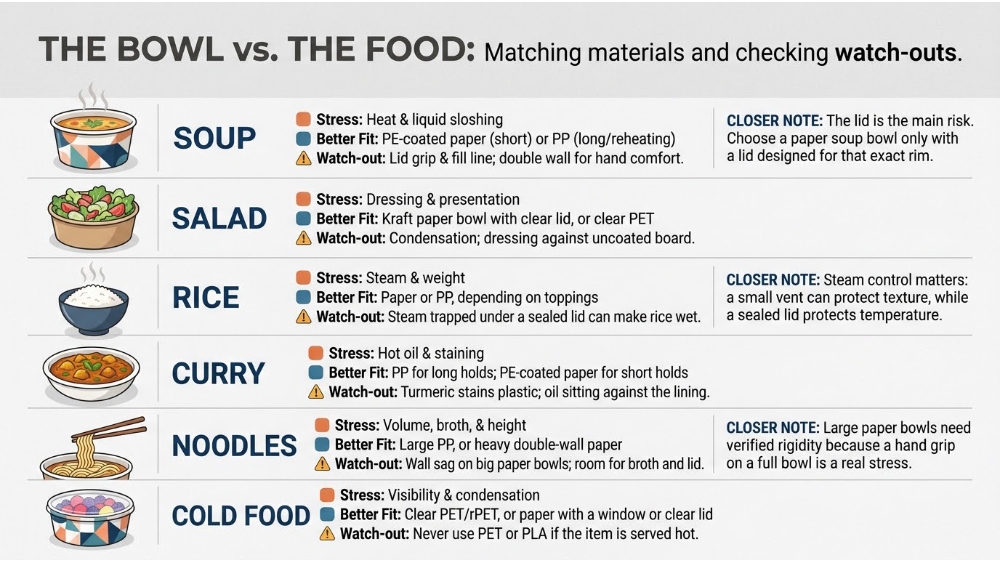
Each dish stresses a bowl differently. Use the table to match the main stress to the better-fitting material, then check the watch-out before ordering.
Food
Main stress
Better fit
Watch-out
Soup
Heat and liquid sloshing
PE-coated paper for short holds; PP for long holds or reheating
Lid grip and fill line; double wall for hand comfort
Salad
Dressing and presentation
Kraft paper bowl with clear lid, or clear PET
Condensation; dressing against uncoated board
Rice
Steam and weight
Paper or PP, depending on toppings
Steam trapped under a sealed lid can make rice wet
Curry
Hot oil and staining
PP for long holds; PE-coated paper for short holds
Turmeric stains plastic; oil sitting against the lining
Noodles
Volume, broth, and height
Large PP, or heavy double-wall paper
Wall sag on big paper bowls; room for broth and lid
Cold food
Visibility and condensation
Clear PET/rPET, or paper with a window or clear lid
Never use PET or PLA if the item is served hot
Three of these dishes deserve a closer note. For soup, the lid is the main risk, so choose a paper soup bowl only with a lid designed for that exact rim. For noodles, large paper bowls need verified rigidity because a hand grip on a full bowl is a real stress. For rice, steam control matters: a small vent can protect texture, while a sealed lid protects temperature.
Which Bowl Fits Which Operating Condition
Food type tells you half the story; the service model tells you the rest. Start from the longest realistic hold, not the average one.
Counter pickup or dine-in, under 20 minutes: either material works, so decide on brand, print, and disposal.
Delivery of 30 minutes or more with hot, oily sauces: PP, or PE-coated paper with a locking lid in a sealed bag.
Customers reheat the food: PP, or paper bowls explicitly rated for microwave use.
Cold or chilled menu: clear PET/rPET for visibility, or paper with a clear lid for a natural look.
Strong branding and visual identity: paper, because the bowl itself becomes the print surface.
Strict regional regulation: choose the material you can document, including coating composition and PFAS compliance.
Questions to ask a supplier before ordering:
What is the coating type, and what hot-fill temperature and hold time was it tested at?
What are the microwave conditions behind the claim: time, power, and lid status?
Which lid material and rim style are matched to this bowl?
Can you provide PFAS and food-contact compliance documents for my market?
What disposal claim can be supported where my customers live?
So the useful question is not which material is better. It is which material fits the food, the hold time, and the disposal system you actually operate in. Many menus end up using both: paper for soups, rice bowls, and salads, and PP for curry, long-hold delivery, and reheated meals. A sourcing partner that can specify bowl, lid, and print together reduces the guesswork. For a recommendation matched to your menu and delivery radius, contact Maibao Packaging.
Need takeout bowls matched to your menu?
Talk to a packaging specialist about matching bowl material, lid fit, and print to your food, hold times, and delivery radius.
Fill it with your real food at serving temperature, fit the lid, and seal it in a delivery bag. Tilt and shake it, then check for leaks, wall softening, and lid movement at 10, 20, and 30 minutes.
Can one lid work for hot and cold food?
Not always. Clear PET or PLA lids suit cold food but can warp under hot steam, while PP lids handle both. Always confirm the lid material, not only the bowl.
Are plastic-free paper bowls realistic for hot, oily food?
They are realistic for many foods, especially with water-based barrier coatings. Hot oily dishes held for a long time are the hardest case, so request test data for your exact dish and hold time.
What bowl sizes suit soup versus noodles and rice?
Single soup portions commonly use about 350–480 ml (12–16 oz). Rice and noodle meals more often need around 750–1,100 ml. Confirm the fill line and lid headroom with your own portion.
Post time:
Oct-07-2026
For inquiries about our products or pricelist, please leave your email to us and we will be in touch within 24 hours.