Paper Bowl Cost: 10 Factors That Affect Wholesale Pricing
Paper Bowl Wholesale Pricing: 10 Cost Factors Explained
Wholesale Packaging Pricing Guide
Paper Bowl Cost: 10 Factors That Affect Wholesale Pricing
A paper bowl’s unit price is determined long before you request a quote. From paperboard GSM to coating chemistry, MOQ thresholds to container utilization, ten interconnected variables shape what you pay per thousand units. Understanding each factor gives procurement teams the leverage to negotiate, specify, and source with precision.
Paper bowls have become the default packaging format for soups, salads, grain bowls, acai, ice cream, and hot deli items across foodservice. The global paper cups and paper bowls market continues to expand as plastic restrictions tighten in the EU, North America, and parts of Asia-Pacific. But for buyers, the pricing landscape is opaque. Two suppliers can quote for what sounds like the same bowl and land 40% apart.
This guide breaks down the ten factors that actually determine wholesale paper bowl pricing—what each one contributes to the unit cost, how they interact, and where the negotiation leverage sits.
Why Paper Bowl Cost Varies So Much
A paper bowl is not a commodity. It is an engineered food-contact product with dozens of specification variables, and each variable carries a cost consequence. The same nominal “16 oz paper bowl” can be produced at 210 GSM with a single PE coating, or at 320 GSM with double PE and a compostable aqueous barrier—and the FOB price difference between those two products can exceed 200%.
The variation comes from three structural sources: material inputs (paperboard, coatings, inks), manufacturing complexity (tooling, printing method, forming speed), and commercial terms (MOQ, lead time, payment terms). Most buyers focus on the third category during negotiation, but the first two determine the floor price. You cannot negotiate below the material and conversion cost—and that floor is set by the specification.
Understanding which factors you control—and which are fixed by your application—is the first step toward intelligent procurement.
What Is Included in Paper Bowl Cost?
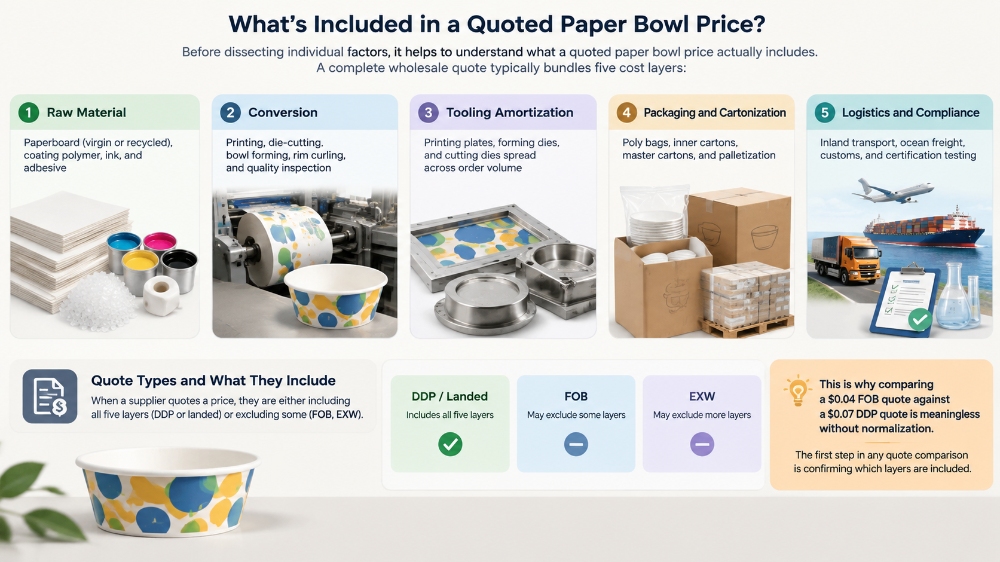
Before dissecting individual factors, it helps to understand what a quoted paper bowl price actually includes. A complete wholesale quote typically bundles five cost layers:
The five cost layers in a paper bowl quote:
Raw material: Paperboard (virgin or recycled), coating polymer, ink, and adhesive
Conversion: Printing, die-cutting, bowl forming, rim curling, and quality inspection
Tooling amortization: Printing plates, forming dies, and cutting dies spread across order volume
Packaging and cartonization: Poly bags, inner cartons, master cartons, and palletization
Logistics and compliance: Inland transport, ocean freight, customs, and certification testing
When a supplier quotes a price, they are either including all five layers (DDP or landed) or excluding some (FOB, EXW). This is why comparing a $0.04 FOB quote against a $0.07 DDP quote is meaningless without normalization. The first step in any quote comparison is confirming which layers are included.
Bowl Size and Capacity
Bowl size directly drives material consumption. A 12 oz bowl uses roughly 40% less paperboard than a 32 oz bowl of the same GSM and construction. But the relationship is not perfectly linear—larger bowls require thicker board to maintain structural rigidity, and the rim curl consumes proportionally more material as diameter increases.
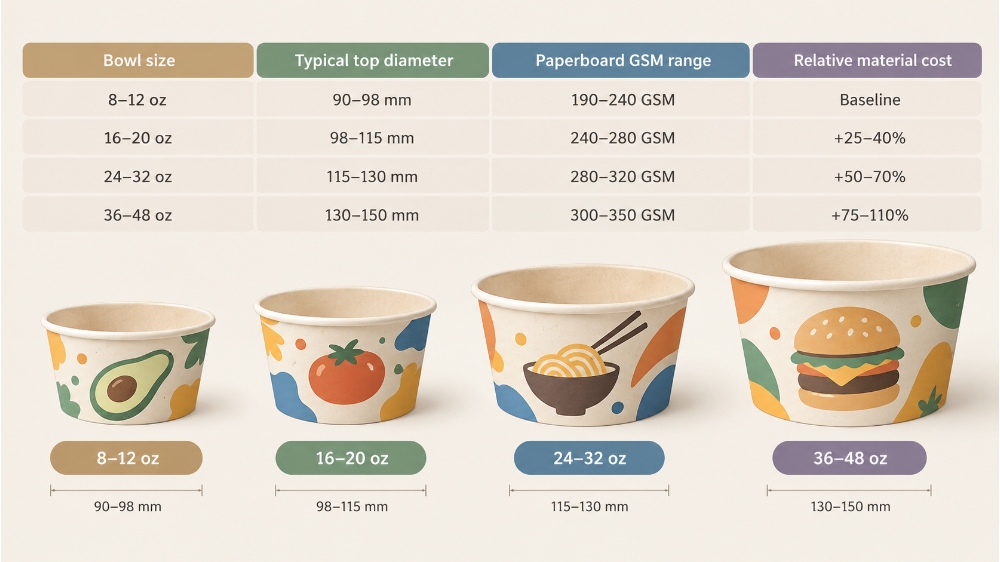
Standard sizes and their typical material profiles:
Bowl size
Typical top diameter
Paperboard GSM range
Relative material cost
8–12 oz
90–98 mm
190–240 GSM
Baseline
16–20 oz
98–115 mm
240–280 GSM
+25–40%
24–32 oz
115–130 mm
280–320 GSM
+50–70%
36–48 oz
130–150 mm
300–350 GSM
+75–110%
The practical implication: if your application allows a smaller bowl without compromising portion perception, downsizing is one of the fastest cost reduction levers. Moving from a 20 oz to a 16 oz bowl can reduce per-unit cost by 15–20% while still holding a standard serving.
GSM (grams per square meter) is the single most important specification variable in paper bowl pricing. It determines the weight of paperboard per unit area, which directly drives raw material cost. Standard foodservice paper bowls range from 190 GSM (light-duty, cold applications) to 350 GSM (heavy-duty, hot and greasy foods).
Three paperboard grades dominate the market:
Virgin bleached board offers the highest brightness, best print fidelity, and strongest barrier performance. It costs 15–25% more than recycled alternatives but is often required for direct food contact with fatty or aqueous foods.
Virgin unbleached (kraft) board provides a natural aesthetic and good strength at slightly lower cost than bleached. It is popular for eco-positioned brands but has lower print contrast.
Recycled board is the lowest-cost option but carries limitations: it cannot be used for direct food contact in many jurisdictions without a functional barrier layer, and its strength-to-weight ratio is lower, requiring higher GSM for equivalent rigidity.
The cost impact of GSM is approximately linear: moving from 240 GSM to 280 GSM increases paperboard cost by roughly 16–18%, which translates to 8–12% on the finished bowl price depending on other factors.
Coating and Lining
Coating is the second-largest cost driver after paperboard. Its function is to provide a barrier against moisture, grease, and heat—without it, a paper bowl would fail within minutes of contact with soup or sauce.
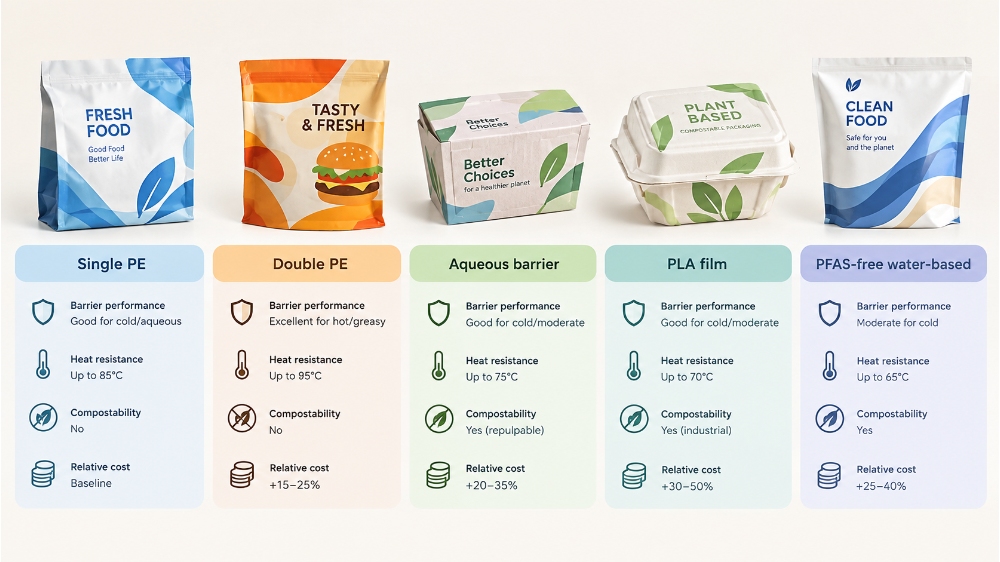
Coating type
Barrier performance
Heat resistance
Compostability
Relative cost
Single PE
Good for cold/aqueous
Up to 85°C
No
Baseline
Double PE
Excellent for hot/greasy
Up to 95°C
No
+15–25%
Aqueous barrier
Good for cold/moderate
Up to 75°C
Yes (repulpable)
+20–35%
PLA film
Good for cold/moderate
Up to 70°C
Yes (industrial)
+30–50%
PFAS-free water-based
Moderate for cold
Up to 65°C
Yes
+25–40%
The coating decision is increasingly driven by regulation rather than cost alone. The EU PPWR (Regulation 2025/40) introduces PFAS limits for food-contact packaging from August 2026, which will force many buyers to reformulate. A life cycle assessment study published in the British Food Journal (2024) compared kraft paper bowls against plastic alternatives and found that coating choice significantly affects both environmental footprint and end-of-life options. For hot soup applications, double PE remains the performance standard, but aqueous and PLA coatings are closing the gap.
Beyond material, the physical design of the bowl affects cost through tooling complexity and forming speed. Key structural variables:
Wall construction: Single-wall bowls are the simplest and cheapest. Double-wall (or air-pocket) bowls add an outer layer for insulation and rigidity, increasing material cost by 30–45% but eliminating the need for a separate sleeve.
Rim type: A simple rolled rim is standard. A curled rim with a snap-fit lid groove requires more precise tooling and slower forming speeds, adding 5–10% to conversion cost.
Bottom design: Flat bottoms are standard. Recessed or stepped bottoms improve nesting and stackability but require additional forming stages.
Venting: Some hot-food bowls incorporate vent holes or steam channels. These add minimal material cost but require die modification, which is amortized across order volume.
For most buyers, the structural decision comes down to whether the application requires insulation (double-wall) and whether a lid will be used (rim groove). Both add cost but may eliminate accessories that would cost more separately.
Printing and Customization
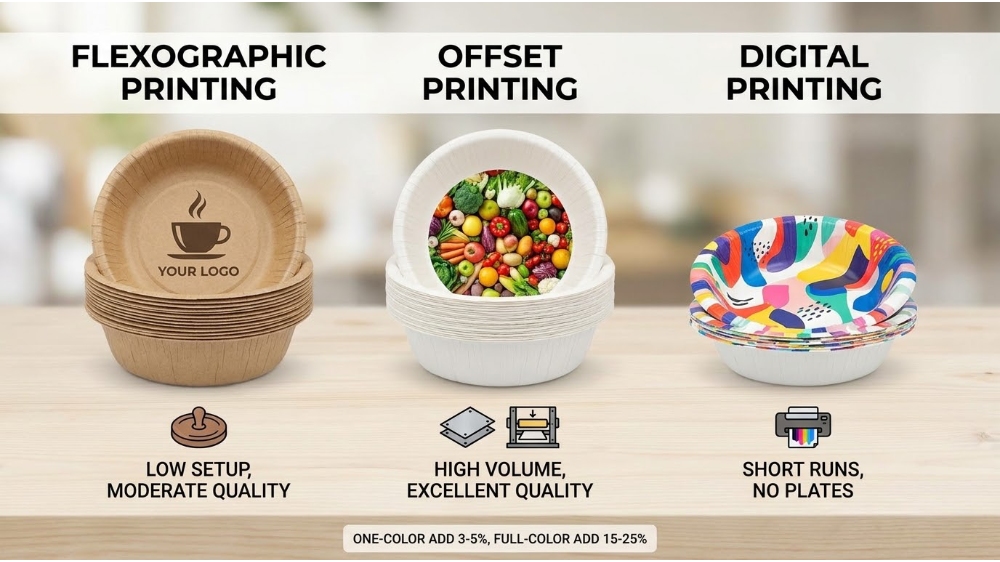
Printing is where branding meets cost. The three primary methods for paper bowls differ significantly in setup cost, per-unit cost, and print quality:
Flexographic printing uses rubber or photopolymer plates. Setup cost is low ($200–$800 per color), making it ideal for large runs of simple designs. Print quality is moderate—fine gradients and photographic images are difficult to reproduce.
Offset printing uses metal plates and transfers ink via a blanket cylinder. Setup cost is higher ($800–$2,500 per color), but print quality is excellent. It is cost-effective only at high volumes (typically 50,000+ units).
Digital printing requires no plates, making it viable for short runs and variable data. Per-unit cost is high at volume, but for orders under 10,000 units, it can be cheaper than flexo when setup is factored in.
The number of colors matters. A one-color logo print adds 3–5% to the unit cost. A full-color photographic wrap can add 15–25%. For many foodservice applications, a single-color logo on a natural kraft bowl delivers brand recognition at minimal cost.
Lids and Accessories
Lids are frequently quoted separately, but their cost is part of the total packaging cost per serving. Paper bowl lids come in three main types:
Paper lids are the lowest-cost option but provide minimal leak resistance. They are suitable for dry or semi-dry applications.
PET or PP lids offer clear visibility and good leak resistance. They cost 2–4x more than paper lids but are preferred for delivery and takeout where spillage is a concern.
PLA lids are the compostable alternative to PET. They cost 20–40% more than PET but align with sustainability positioning.
Beyond lids, accessories include sleeves (for hot bowls), inserts (for portion control), and sauce cups. Each adds cost. A double-wall bowl that eliminates the need for a sleeve can be cheaper overall than a single-wall bowl plus sleeve, even though the bowl itself costs more.
MOQ and Order Volume
MOQ (minimum order quantity) is the factor buyers most often underestimate. Paper bowl manufacturing has significant fixed costs—printing plates, forming dies, and machine setup time. These costs are amortized across the order volume, which means per-unit price drops as volume increases.
Typical MOQ and pricing relationships:
Order volume
Relative unit price
Typical MOQ tier
5,000 units
140–160%
Digital print, small runs
10,000 units
120–135%
Flexo, standard
50,000 units
100% (baseline)
Flexo, optimized
100,000+ units
85–92%
Offset or high-volume flexo
The implication for buyers: if your annual volume is below 50,000 units, consider consolidating orders or partnering with a distributor who aggregates demand. If you are above 100,000 units, you have leverage to negotiate directly with manufacturers and to specify premium printing methods at lower relative cost.
Packaging and Carton Configuration
How bowls are packed for shipment affects both material cost and freight cost. Key variables:
Nesting ratio: Bowls nest inside each other. A higher nesting ratio (more bowls per stack) means more units per carton, which reduces carton material and freight cost per unit. Some bowl designs achieve 15:1 nesting; others only 8:1.
Carton size and strength: Standard export cartons use corrugated board (typically 5-ply for heavy loads). Oversized cartons waste material and cube. Undersized cartons risk crushing.
Poly bagging: Individual poly bags add cost and are increasingly restricted by packaging regulations. Bulk packing without individual bags is cheaper and more sustainable but may not suit all distribution channels.
For ocean freight, carton configuration directly affects container utilization. A 10% improvement in nesting ratio can reduce total landed cost by 3–5% by fitting more units per container.
Shipping and Destination Market
Shipping is where FOB pricing diverges most from landed cost. The main components:
Inland transport from factory to port adds $0.002–$0.005 per unit depending on distance and volume.
Ocean freight from Asia to North America or Europe adds $0.018–$0.032 per unit for standard paper bowls, based on current container rates and typical carton density. Rates fluctuate with fuel costs and global capacity.
Customs and duties vary by destination market. Paper bowls typically attract low or zero duty in most markets, but anti-dumping duties can apply in some cases.
Last-mile delivery from port to warehouse adds $0.005–$0.015 per unit depending on distance and order size.
The total landed cost premium over FOB is typically 30–50% for imported paper bowls. This is why domestic suppliers can sometimes compete on landed cost even with higher FOB pricing—especially for smaller orders where freight doesn’t amortize as well.
Certifications, Testing and Quality Requirements
Compliance is a cost center that buyers often overlook until it delays a shipment. Key certifications and their cost implications:
FDA food-contact compliance (21 CFR 176.170 for fatty/aqueous foods, 21 CFR 176.180 for dry foods) is mandatory for the US market. Suppliers must provide documentation, and periodic testing is required.
EU food-contact compliance (Regulation 1935/2004 and GMP Regulation 2023/2006) applies to European imports. The EU PPWR (Regulation 2025/40) adds PFAS restrictions from August 2026.
Compostability certifications (EN13432 for Europe, ASTM D6400 for US, AS4736 for Australia) require independent laboratory testing and annual renewal. These add $2,000–$8,000 in annual costs, which are amortized across production volume.
Forestry certifications (FSC, PEFC, SFI) add a premium of 3–8% on paperboard cost but are increasingly required by large buyers and retailers.
For buyers, the key is to confirm which certifications your market requires—and to verify that suppliers can provide valid certificates, not just claims. Non-compliant packaging can be seized at customs, resulting in total loss.
Paper Bowl Cost by Foodservice Application
Different applications demand different specifications, which drives different price points. Here is a practical framework:
Application
Typical spec
Relative cost index
Key requirement
Cold salad / acai
210–240 GSM, single PE or aqueous
100
Moisture barrier, clarity
Ice cream / frozen dessert
190–220 GSM, single PE
90–95
Cold resistance, print quality
Hot soup / chili
280–320 GSM, double PE
140–160
Heat + grease barrier
Grain bowl / poke
240–280 GSM, single PE or PLA
110–125
Rigidity, sustainability
Hot deli / pasta
280–320 GSM, double PE + vent
150–170
Venting, heat retention
The cost index is relative to a baseline cold salad bowl. Hot applications cost 40–70% more due to higher GSM and double coating. Buyers can reduce cost by matching specification to actual temperature and hold time—using a 240 GSM single-PE bowl for a 5-minute soup hold is a waste of material; using it for a 30-minute delivery is a failure.
How to Compare Paper Bowl Quotes From Different Suppliers
Quote comparison is where procurement teams win or lose. Most quotes are not apples-to-apples. Here is a normalization checklist:
Normalize every quote across these seven dimensions:
GSM and board grade: Confirm exact GSM and virgin vs. recycled
Coating type and weight: Single vs. double, PE vs. aqueous vs. PLA
Dimensions: Top diameter, bottom diameter, height, and capacity in oz
Print method and colors: Flexo vs. offset vs. digital, number of colors
Incoterm: FOB, EXW, CIF, or DDP—and which port/warehouse
MOQ and lead time: Volume tier and production schedule
Certifications: FDA, EU compliance, FSC, compostability
Once normalized, compare landed cost per unit, not FOB. Then compare total cost of ownership, including storage, handling, and any accessory costs. A supplier with a slightly higher unit price but better nesting and cartonization may deliver lower total cost.
How to Reduce Paper Bowl Cost Without Sacrificing Quality
Cost reduction in paper bowls is not about finding the cheapest supplier. It is about optimizing specification to match actual requirements. The highest-impact levers:
Right-size the GSM. Many buyers over-specify “to be safe.” Moving from 320 GSM to 280 GSM for a hot soup bowl that is consumed within 15 minutes can reduce cost by 12–15% without perceptible performance loss.
Consolidate SKUs. Fewer bowl sizes means larger order volumes per SKU, which improves MOQ tier pricing and reduces tooling amortization.
Optimize nesting and cartonization. Work with your supplier to maximize bowls per carton and cartons per container. This reduces freight cost, which is often 20–30% of landed cost.
Choose flexo for simple designs. If your brand can be represented with one or two colors, flexo printing delivers acceptable quality at significantly lower setup and per-unit cost than offset.
Consider domestic sourcing for small volumes. For orders under 20,000 units, domestic suppliers may offer lower landed cost despite higher FOB pricing, because you avoid ocean freight, customs delays, and large MOQ commitments.
For businesses scaling paper bowl procurement across multiple locations, working with a supplier who can provide consistent specifications, tested performance, and volume flexibility eliminates the hidden costs of inconsistency.
Need paper bowl pricing that balances cost and performance?
Talk to a packaging specialist about matching bowl specification, coating, and volume to your menu, your hold times, and your delivery model.
What is the average wholesale price of a paper bowl?
FOB pricing for standard paper bowls ranges from $0.03–$0.08 per unit for basic cold-use bowls at high volume, and $0.08–$0.20 for hot-food bowls with double coating and custom printing. Landed cost typically adds 30–50% for imported bowls.
How much does GSM affect paper bowl cost?
GSM is the largest material cost driver. Moving from 240 GSM to 320 GSM increases paperboard cost by roughly 30%, which translates to 15–22% on the finished bowl price depending on coating and printing.
Is it cheaper to buy paper bowls from China or domestically?
For orders above 50,000 units, imported bowls from Asia typically have lower landed cost despite freight and duties. For orders under 20,000 units, domestic suppliers are often more cost-effective because you avoid large MOQs and ocean freight minimums.
How can I reduce paper bowl cost without losing quality?
The top levers are right-sizing GSM to actual hold time, consolidating SKUs to increase volume per order, choosing flexo printing for simple designs, and optimizing nesting and cartonization to reduce freight cost per unit.
Post time:
Sep-16-2026
For inquiries about our products or pricelist, please leave your email to us and we will be in touch within 24 hours.