Can You Microwave Paper Bowls? What Restaurants & Consumers Should Know
Are Paper Bowls Microwave Safe? Coatings, Lids & Limits
Foodservice Packaging Guide
Can You Microwave Paper Bowls? What Restaurants & Consumers Should Know
Sometimes. A paper bowl is microwave-safe only when its coating, lid, seams and printing are all rated for the heat of the food inside. Plain fiber bowls and heat-rated PE-lined bowls usually handle short reheating. Wax-coated bowls, standard PLA linings and anything with metal parts do not.
Can you microwave paper bowls? Yes, but only if the bowl is designed and labeled for it. Paper itself is rarely the problem. The risk comes from what is added to it: plastic or bio-based linings, wax, adhesives, metallic print and the lid. Each has its own temperature limit, and the food inside decides how close the bowl gets to that limit.
Three conditions matter most. The coating must tolerate the food’s temperature, the lid must be vented and rated for microwave use, and the heating must stay short. Water-based foods peak near 100°C (212°F). Oily or sugary foods can climb far higher, and that is where most paper bowl failures begin.
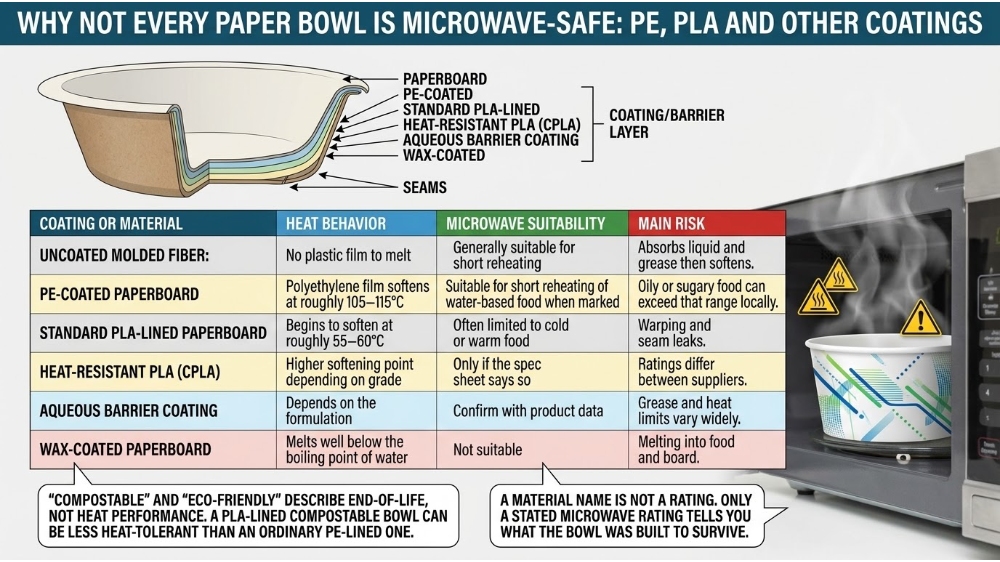
Why Not Every Paper Bowl Is Microwave-Safe: PE, PLA and Other Coatings
A paper bowl is a laminate, not plain paper. Bare paperboard cannot hold soup for more than a few minutes, so manufacturers add a barrier layer. The bowl is only as heat-tolerant as its weakest layer, usually the coating and the seams it helps form.
Coating or material
Heat behavior
Microwave suitability
Main risk
Uncoated molded fiber
No plastic film to melt
Generally suitable for short reheating
Absorbs liquid and grease, then softens
PE-coated paperboard
Polyethylene film softens at roughly 105–115°C
Suitable for short reheating of water-based food when marked
Oily or sugary food can exceed that range locally
Standard PLA-lined paperboard
Begins to soften at roughly 55–60°C
Often limited to cold or warm food
Warping and seam leaks
Heat-resistant PLA (CPLA)
Higher softening point, depending on grade
Only if the spec sheet says so
Ratings differ between suppliers
Aqueous barrier coating
Depends on the formulation
Confirm with product data
Grease and heat limits vary widely
Wax-coated paperboard
Melts well below the boiling point of water
Not suitable
Melting into food and board
Two points follow from this. First, “compostable” and “eco-friendly” describe end-of-life, not heat performance. A PLA-lined compostable bowl can be less heat-tolerant than an ordinary PE-lined one. Second, a material name is not a rating. Only a stated microwave rating tells you what the bowl was built to survive.
What Happens to a Paper Bowl During Microwave Heating
Microwaves heat the food, not the bowl. The bowl warms by contact, so the hottest part of the food sets the temperature the coating has to survive. This is why the same bowl can be fine with broth and fail with a chili-oil noodle dish.
How food type changes the heat load on the bowl:
Broth, soup, moist rice: surface temperature is capped near boiling, about 100°C
Tomato, sugar or starch-thickened sauces: local hot spots and spattering above boiling
Oil-rich dishes: fat can heat well past 100°C and reach the softening range of PE
Dry or very small portions: little water to absorb energy, so the packaging itself can scorch
When heat, moisture and time combine, three failure patterns appear. The first is coating breakdown. The film softens or develops pinholes, liquid soaks into the fiber, and the wall loses strength. The second is moisture softening. Steam condenses inside the board, the sidewalls sag, and the bowl becomes hard to lift, which creates a spill and scald risk. The third is deformation at the joints. Rims curl, the side seam opens, or the bottom seal lets go and the bowl leaks. Read Paper Bowls for Soup: GSM, Coatings & Leak-Proof Buying Guide to figure out how paper bowl withstand the heat.
A sagging wall, a plastic or burnt smell, or liquid on the outside means stop heating and transfer the food.
Lids, Seams and Printed Details: Does the Lid Also Need to Be Microwave-Safe?
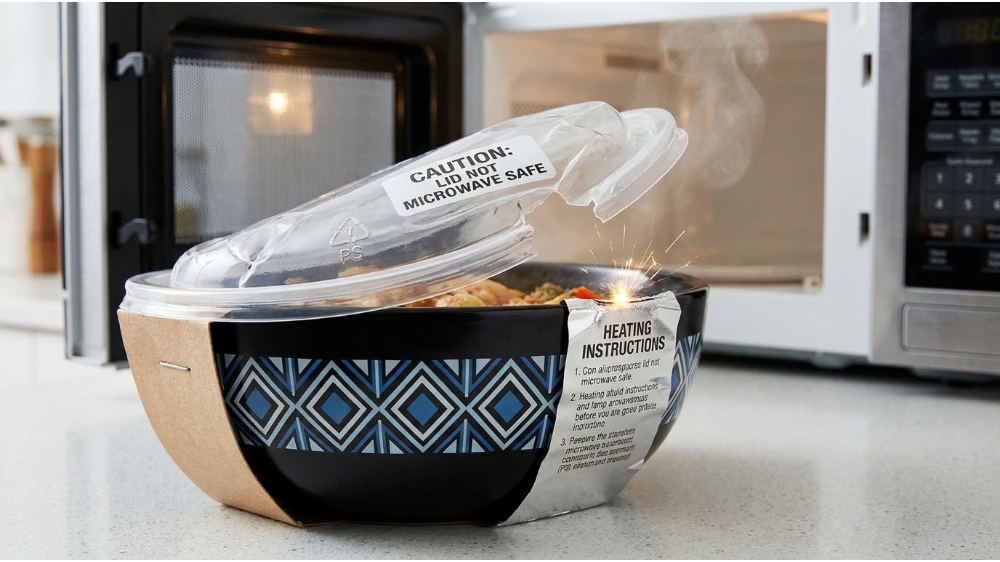
Yes. A microwave-safe bowl with the wrong lid is not a microwave-safe pack. Lids are often made from a different material, so they need their own rating.
Polypropylene (PP) lids generally tolerate microwave heating and are the usual choice for hot food. Polystyrene (PS) lids tend to warp. Standard PET lids soften at relatively low temperatures and are usually meant for cold or warm contents. PLA and CPLA lids depend on the grade.
Sealing matters as much as material. A tightly closed lid traps steam, and pressure can pop the lid or release a burst of steam when it is opened. Vent the lid or lift one edge before heating, and open it away from your face afterward.
Check the small details too. Staples, foil linings, wire handles, and metallic or foil-stamped print can cause arcing, which means visible sparks and possible fire. Some adhesives and hot-melt seals also soften before the coating does, so a bowl can fail at the seam even when the film is intact.
Short Reheating vs. Prolonged Heating
Microwave ratings for paper bowls almost always assume reheating, not cooking. Warming soup for one to two minutes is a very different load from cooking frozen food for ten.
Short reheating gives the coating little time to soften. Prolonged heating does the opposite: steam soaks the fiber, hot spots build up, and boil-over pushes hot liquid into the seam.
A safer routine is simple. Heat in intervals of 30 to 60 seconds, stir between intervals to even out hot spots, and use medium power for dense or oily food. Never run a paper bowl empty or with a very small amount of food. Treat the bowl as single-use, since a bowl that has absorbed steam and grease is weaker the second time.
Restaurants: Can You Reheat Food in Paper Bowls?
Restaurants can, but they should decide first who is doing the reheating. A bowl that suits a customer warming soup at home may not suit a kitchen microwave used all day.
Commercial microwaves often run at 1,000 W or more, a harsher condition than many home ovens, so specify the bowl for the stronger case.
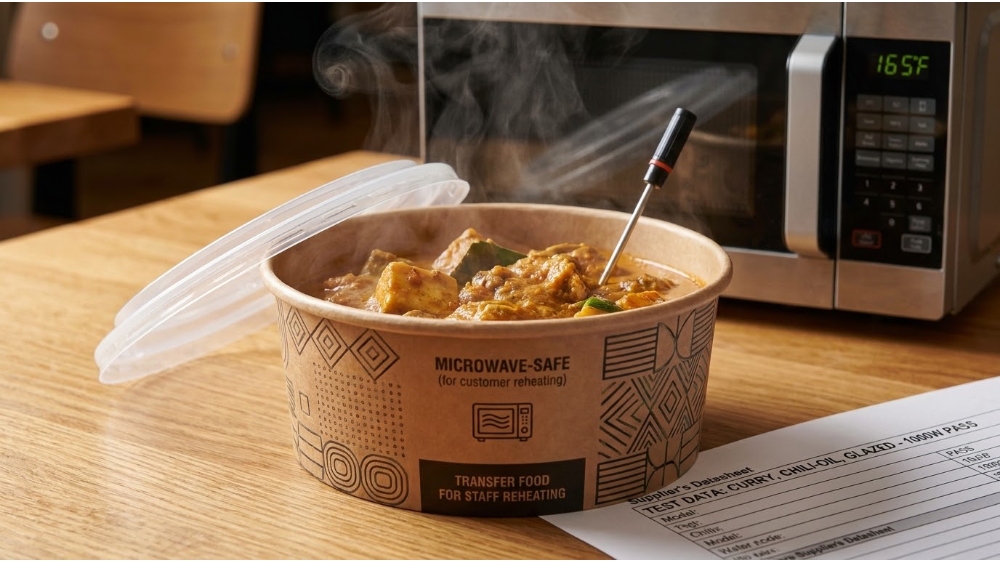
Food safety rules add another constraint. Guidance such as the US FDA Food Code calls for reheating to 165°F (74°C), and local rules vary. A bowl has to survive that temperature plus the hot spots around it. For staff reheating, the most reliable method is to warm food in a dedicated microwave-safe container and then transfer it to the paper bowl for service.
If you print a microwave-safe icon or a heating instruction on your packaging, you own that claim. Ask your supplier for data that matches your real menu, and test the exact bowl-and-lid pairing you ship. Specify for your hottest item, not your average one. Curries, chili-oil dishes and glazed foods are the tough cases.
Consumers: What to Check on the Packaging
Look for an explicit microwave-safe marking on both the bowl and the lid. The standard symbol is a microwave icon with wavy lines, often printed on the base. If there is no marking, treat the bowl as not rated.
Run a quick check before heating:
Remove any lid that is not marked microwave-safe, or vent the one that is.
Look for metal, including staples, foil trim, wire handles and gold or silver print.
Read for phrases such as “cold use only” or “not for hot food,” which rule out heating.
Note whether the bowl looks waxy or shiny, since wax coatings are not for the microwave.
If you cannot confirm the rating, move the food to a ceramic or glass dish. Buyers stocking bowls in bulk should ask for the maximum temperature and heating time, not just a general “microwave-safe” statement.
How Suppliers Test Microwave Suitability
Good testing uses the worst case. A bowl that passes with water can still fail with oil or sauce.
A typical protocol fills the bowl with water, edible oil and a sugary or salty sauce. It heats each in a microwave of known wattage for a defined time. Afterward, the tester checks for deformation, leakage at the seam and base, coating discoloration or peeling, arcing, odor, lid fit and the wall temperature a person would feel when lifting the bowl.
Food-contact compliance is a separate layer. Suppliers should provide declarations under the rules of your market, such as US FDA food-contact requirements or the EU framework regulation on food contact materials, plus migration data that reflects the intended heating. Many buyers also ask for a PFAS-free declaration for grease-resistant fiber products.
The result should be read with its conditions. “Microwave-safe” is thin without the food type, heating time and power level behind it. Ask for those three details in writing.
Microwave safety checklist:
Bowl and lid both carry a microwave-safe marking or a spec-sheet rating
Coating is identified (PE, heat-rated PLA, aqueous or uncoated fiber) and is not wax
No staples, foil, wire handles or metallic ink
Lid is vented or removed, never sealed tight
Maximum heating time, power and food type are stated
Dry or oil-dominant food is heated only if the bowl is rated for it
Heat in short intervals, stir, and let the bowl stand before lifting
Final Takeaway
Paper bowls can go in the microwave when the whole pack is built for it. The coating, lid, seams and print must all match the heat of the food, and heating should stay short and controlled. Uncoated fiber and heat-rated PE-lined bowls are the most predictable choices for reheating, while wax, standard PLA and any metal detail are the usual points of failure. Oily and sugary foods are the hardest test. When you are buying for a menu, define the reheating scenario first, then choose the coating and lid to fit it. For a bowl specification matched to your menu, contact Maibao Packaging.
Need paper bowls specified for hot food and reheating?
Talk to a packaging specialist about matching coating, lid and print method to your menu, your hold times and how your customers will reheat.
Not automatically. Compostable describes how the bowl breaks down, not how it handles heat. Bowls lined with standard PLA can soften at low temperatures, so look for a stated microwave rating.
Can microwaving a paper bowl release chemicals into food?
Bowls made for food contact must meet food-contact rules in their market, and the risk rises when a bowl is heated beyond its rated conditions. If a bowl warps, smells or discolors, stop and transfer the food.
How long can you microwave a paper bowl?
There is no universal time, because it depends on the rating and the food. As a rule of thumb, short reheating of one to three minutes in intervals suits rated bowls, while cooking-length heating does not.
Does a paper bowl need a microwave-safe label to be sold as microwavable?
Requirements for claims differ by country and retailer. Whatever the rule, a printed claim should be backed by test data that matches the intended food, time and power, and buyers can ask for that data.
Post time:
Sep-30-2026
For inquiries about our products or pricelist, please leave your email to us and we will be in touch within 24 hours.