Compostable vs. Recyclable vs. Biodegradable Paper Bowls: How to Choose the Right Option for Your Business
Paper Bowl Sustainability Claims: A B2B Buyer’s Guide
Sustainable Foodservice Packaging Guide
Compostable vs. Recyclable vs. Biodegradable Paper Bowls: How to Choose the Right Option for Your Business
Every paper bowl on the market claims to be some shade of “eco-friendly.” But compostable, recyclable, and biodegradable are three separate disposal pathways, each with its own coating chemistry, certification requirements, and infrastructure limits. Pick the wrong one and a sustainability claim becomes a compliance risk instead of a selling point.
A paper bowl looks like a simple, low-risk packaging decision. It isn’t. The word printed on the rim—compostable, recyclable, or biodegradable—is a legal claim, a procurement requirement, and a bet on infrastructure that may or may not exist wherever your product actually ends up. Most buying guides explain what the three words mean in isolation. Few explain what happens when a claim meets a real waste stream, a real customer, and a real audit.
This guide breaks down each disposal pathway, the coating chemistry that actually determines it, the certifications worth trusting, and a sourcing framework built around the question that matters most to a food business: not “which label sounds greenest,” but “which claim can I actually substantiate in the markets I sell into.”
What Compostable, Recyclable, and Biodegradable Actually Mean for a Paper Bowl
The three terms describe different end-of-life mechanisms, and none of them are interchangeable in a regulatory sense.
Compostable means a product has been tested and certified to break down into usable compost under specific conditions, on a specific timeline, verified against a named standard—typically ASTM D6400 in North America or EN 13432 in Europe. Recyclable means the material can be mechanically or chemically reprocessed into a new product, provided a facility exists that accepts and can actually process it. Biodegradable is the loosest of the three: it means a material will eventually break down via natural biological processes, but with no standardized timeframe, no required test method, and no default assumption about the disposal environment. Learn about difference between compostable and biodegradable by reading Compostable VS Biodegradable: Which Eco-friendly Packaging is Actually Better.
That last gap is where most packaging claims fail. In the United States, an unqualified biodegradable claim is only defensible if the marketer can show the entire product breaks down completely within roughly one year after customary disposal—and customary disposal means a landfill, an incinerator, or a recycling facility, not a backyard compost pile. Almost nothing sold as a “biodegradable paper bowl” can meet that bar once it actually reaches a landfill, where low oxygen and low microbial activity can keep organic material intact for decades.
The one-sentence version:
Compostable = certified to break down under defined, testable conditions
Recyclable = reprocessable, but only where a facility accepts the exact material
Biodegradable = will break down eventually, with no enforceable timeline or test
Compostable Paper Bowls: Material, Certification, and Real End-of-Life
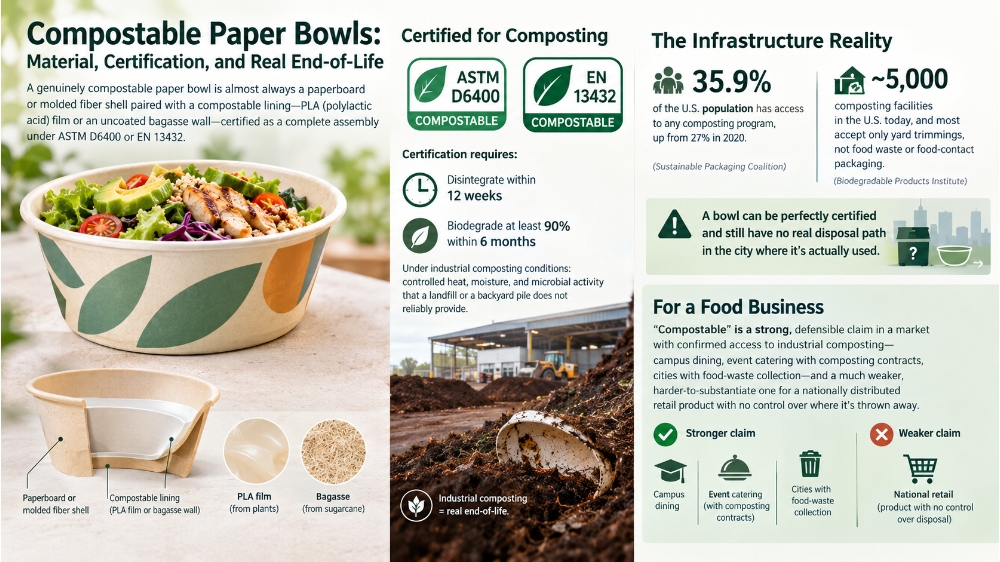
A genuinely compostable paper bowl is almost always a paperboard or molded fiber shell paired with a compostable lining—PLA (polylactic acid) film or an uncoated bagasse wall—certified as a complete assembly under ASTM D6400 or EN 13432. Certification under either standard requires the item to disintegrate within twelve weeks and biodegrade at least 90% within six months under industrial composting conditions: controlled heat, moisture, and microbial activity that a landfill or a backyard pile does not reliably provide.
This is where the claim runs into a hard infrastructure ceiling. Recent research from the Sustainable Packaging Coalition found that only about 35.9% of the U.S. population has access to any composting program, up from 27% in 2020—meaningful growth, but still a minority. The Biodegradable Products Institute notes that of the nearly 5,000 composting facilities operating in the U.S. today, most accept only yard trimmings, not food waste or food-contact packaging. A bowl can be perfectly certified and still have no real disposal path in the city where it’s actually used.
For a food business, that means “compostable” is a strong, defensible claim in a market with confirmed access to industrial composting—campus dining, event catering with composting contracts, cities with food-waste collection—and a much weaker, harder-to-substantiate one for a nationally distributed retail product with no control over where it’s thrown away.
Recyclable Paper Bowls: What Your Local MRF Actually Accepts
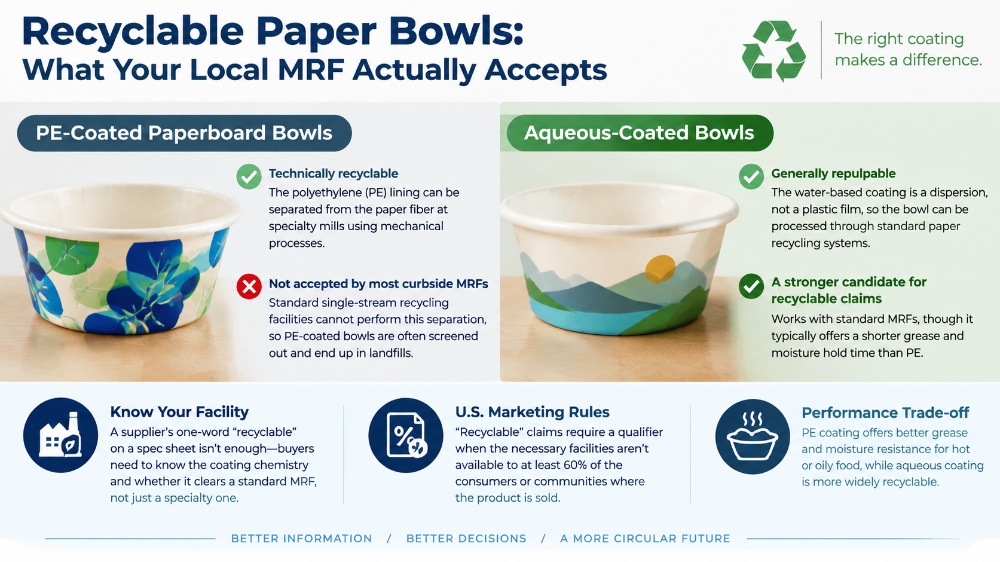
A recyclable paper bowl is only as recyclable as its lining allows. Polyethylene (PE)-coated paperboard bowls can technically be recycled, but only at specialty mills equipped to mechanically separate the plastic film from the paper fiber. Most curbside single-stream materials recovery facilities (MRFs) cannot perform that separation, so PE-coated bowls that arrive in a standard recycling bin are frequently screened out and landfilled anyway—recyclable in theory, not in that facility’s practice.
Aqueous- or water-based-coated bowls behave differently. Because the coating is a dispersion rather than a plastic film, the bowl is generally repulpable through standard paper recycling processes, without requiring specialty separation. That makes aqueous coating the stronger candidate for a broad, defensible “recyclable” claim—though it typically offers a shorter grease and moisture hold time than PE, which matters for hot or oily food.
U.S. marketing rules require a qualifier on “recyclable” claims when the necessary facilities aren’t available to at least 60% of the consumers or communities where the product is sold. In practice, this means a supplier’s one-word “recyclable” on a spec sheet is not enough—buyers need to know the coating chemistry and whether it clears a standard MRF, not just a specialty one.
Biodegradable Paper Bowls: The Claim With the Least Legal Protection
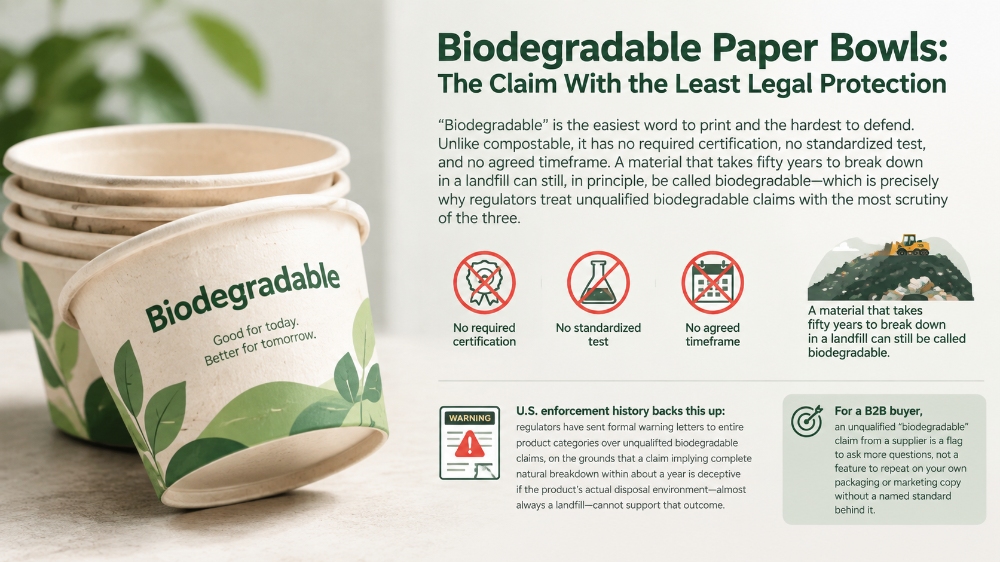
“Biodegradable” is the easiest word to print and the hardest to defend. Unlike compostable, it has no required certification, no standardized test, and no agreed timeframe. A material that takes fifty years to break down in a landfill can still, in principle, be called biodegradable—which is precisely why regulators treat unqualified biodegradable claims with the most scrutiny of the three.
U.S. enforcement history backs this up: regulators have sent formal warning letters to entire product categories over unqualified biodegradable claims, on the grounds that a claim implying complete natural breakdown within about a year is deceptive if the product’s actual disposal environment—almost always a landfill—cannot support that outcome. A paper bowl with a PE or PLA lining marketed simply as “biodegradable,” with no reference to a testing standard or disposal environment, carries real exposure for the brand printing it on the package, not just the manufacturer.
For a B2B buyer, an unqualified “biodegradable” claim from a supplier is a flag to ask more questions, not a feature to repeat on your own packaging or marketing copy without a named standard behind it.
Compostable vs. Recyclable vs. Biodegradable: The Differences That Matter to Buyers
Laid side by side, the practical differences are less about environmental philosophy and more about what a buyer has to prove, verify, and control.
Claim
Certification required
Depends on
Common failure mode
Compostable
Yes — ASTM D6400 or EN 13432, tied to the finished SKU
Access to an industrial composting facility
Certified product lands in a landfill with no compost program nearby
Recyclable
No single universal certification; coating must be independently verified as separable or repulpable
Local MRF capability and lining chemistry
PE-coated bowl rejected at a standard single-stream MRF
Biodegradable
No standard certification or enforceable test
Actual disposal environment and timeframe
Claim can’t be substantiated once the product reaches a landfill
A strong claim on one dimension never automatically extends to the others. A certified-compostable bowl is not automatically recyclable—in fact, a PLA lining will contaminate a paper recycling stream if it ends up there by mistake. A recyclable bowl is not automatically compostable. And a biodegradable bowl may be neither, in any enforceable sense.
Why the Lining Decides Everything
The paperboard base of almost any paper bowl is, on its own, both compostable and recyclable. What actually determines the bowl’s real-world disposal route is the thin functional lining that keeps liquid, grease, and heat from soaking through the fiber.
PE-coated paperboard
Excellent grease and moisture barrier, suited to hot soups, broths, and oily food. Not compostable under any standard. Recyclable only where a specialty mill can separate the polyethylene film—rare in standard municipal recycling.
PLA-lined paperboard or molded fiber
Compostable under industrial conditions when the finished bowl carries ASTM D6400 or EN 13432 certification. Not recyclable through conventional paper streams; a PLA liner is treated as a contaminant by most paper mills.
Aqueous or water-based coating
Repulpable and broadly recyclable, and some formulations also qualify as compostable. The trade-off is a shorter hold time against very hot, very oily, or long-duration wet food, making it a better fit for shorter-service applications.
Unlined bagasse or molded fiber
Naturally compostable and generally acceptable in standard paper recycling if kept clean, but weak on grease resistance without an added coating—fine for dry or lightly moist food, a poor fit for broth or fried items without reinforcement. Explore fiber paper bowls
Lining
Compostable
Recyclable
Best food application
PE-coated
No
Only at specialty mills
Hot soup, broth, long-hold oily food
PLA-lined
Yes, if certified
No — contaminates paper stream
Cold or hot food where composting is available
Aqueous-coated
Sometimes
Yes, broadly
Salads, grain bowls, shorter-hold hot food
Unlined bagasse
Yes
Yes, if uncontaminated
Dry or lightly moist food
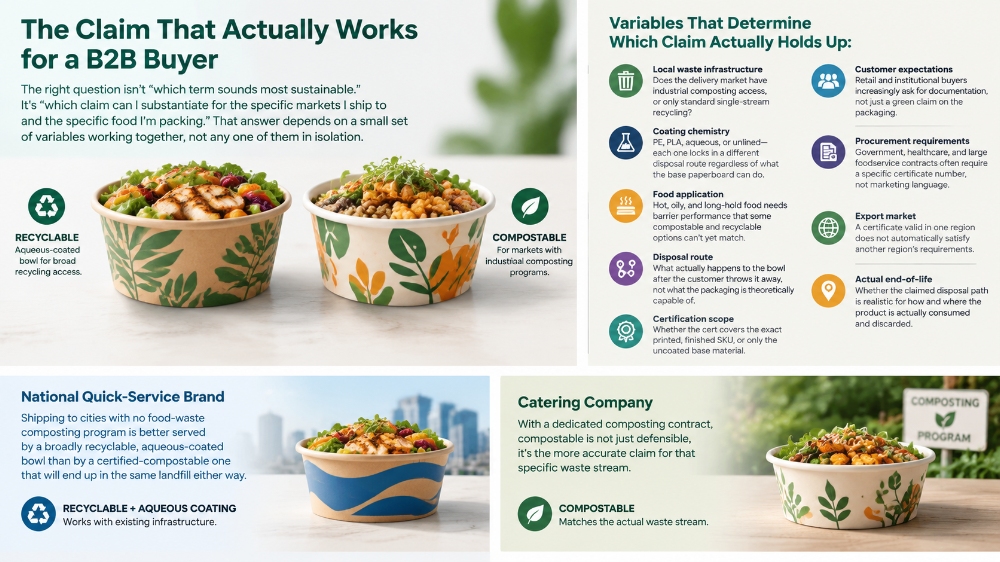
The Claim That Actually Works for a B2B Buyer
The right question isn’t “which term sounds most sustainable.” It’s “which claim can I substantiate for the specific markets I ship to and the specific food I’m packing.” That answer depends on a small set of variables working together, not any one of them in isolation.
Variables that determine which claim actually holds up:
Local waste infrastructure: does the delivery market have industrial composting access, or only standard single-stream recycling?
Coating chemistry: PE, PLA, aqueous, or unlined—each one locks in a different disposal route regardless of what the base paperboard can do
Food application: hot, oily, and long-hold food needs barrier performance that some compostable and recyclable options can’t yet match
Disposal route: what actually happens to the bowl after the customer throws it away, not what the packaging is theoretically capable of
Certification scope: whether the cert covers the exact printed, finished SKU, or only the uncoated base material
Customer expectations: retail and institutional buyers increasingly ask for documentation, not just a green claim on the packaging
Procurement requirements: government, healthcare, and large foodservice contracts often require a specific certificate number, not marketing language
Export market: a certificate valid in one region does not automatically satisfy another region’s requirements
Actual end-of-life: whether the claimed disposal path is realistic for how and where the product is actually consumed and discarded
A national quick-service brand shipping to cities with no food-waste composting program is better served by a broadly recyclable, aqueous-coated bowl than by a certified-compostable one that will end up in the same landfill either way. A catering company with a dedicated composting contract is in the opposite position: compostable is not just defensible, it’s the more accurate claim for that specific waste stream. Neither business is wrong—they’re solving for different infrastructure.
Certifications and Documents to Verify Before You Place a Bulk Order
A claim printed on a supplier’s product page is not evidence. Before committing to a bulk order, a buyer should request documentation that ties the claim to the exact product being purchased.
What to request from a supplier:
The original certificate, certificate number, and issuing body (BPI for ASTM D6400/D6868 in North America; TÜV Austria for EN 13432 in Europe)
Confirmation of the covered SKU list—inks, adhesives, and printed finishes are not automatically included in a base-material certificate
The certificate’s validity period and a way to verify it directly through the certifying body’s public database
For recyclable claims, repulpability or MRF-acceptance test data, since no single universal “recyclable” certification exists the way it does for compostable claims
Whether the certification supports industrial composting only, or also home composting—these are separate claims with separate standards
Treat “biodegradable” as a marketing term rather than a certification. If a supplier’s only differentiator for a product is the word biodegradable, with no test standard, no certifying body, and no defined timeframe attached, that is a signal to ask for more detail before repeating the claim on your own packaging.
Which Option Fits Your Food Business
There is no single correct answer across every food business—only the option that matches your food, your customer’s disposal habits, and the infrastructure you’re actually selling into.
Hot soup, ramen, and broth-based bowls need strong grease and moisture resistance over a longer hold time, which still favors PE-coated or high-performance aqueous-coated paperboard depending on whether your market can recycle a PE liner. Explore grease and moisture resistance paper bowl with plastic liner
Salads, poke, and grain bowls carry less oil and heat, making certified-compostable bagasse or PLA-lined options genuinely practical, provided your customer base has real composting access.
Institutional and catering operations with a composting contract are the clearest case for compostable packaging, because the disposal route is controlled rather than assumed.
National retail and grocery deli programs generally do better with a broadly recyclable, aqueous-coated bowl, since recycling infrastructure is more consistent across regions than composting access.
Export-focused brands should match certification to the destination market first—EN 13432 and TÜV Austria for the EU, ASTM D6400 and BPI for the U.S. and Canada—rather than assuming one certificate travels everywhere.
The sustainability claim that holds up is the one built backward from your actual waste stream, not the one that reads best on the box. For sourcing guidance on matching paper bowl material, lining, and certification to your specific menu, markets, and compliance requirements, a packaging supplier working across compostable, recyclable, and coated paperboard formats can help align the claim with what your customers can actually do with it.
Need help matching your paper bowl claim to real disposal infrastructure?
Talk to a packaging specialist about lining chemistry, certification scope, and sourcing paper bowls built for the markets you actually sell into.
What’s the main difference between compostable and biodegradable paper bowls?
Compostable requires certification against a defined standard—ASTM D6400 or EN 13432—proving breakdown within a set timeframe under industrial conditions. Biodegradable has no standardized test or timeline, making it a far weaker and harder-to-substantiate claim.
Can a PE-coated paper bowl be recycled?
Only where a mill can mechanically separate the polyethylene liner from the paper fiber. Most standard curbside single-stream recycling programs cannot do this, so a blanket “recyclable” claim on a PE-coated bowl needs a facility-access qualifier.
Do I need different certifications to sell paper bowls in the US versus the EU?
Yes. Compostability claims in North America are typically backed by BPI certification against ASTM D6400 or D6868, while EU claims rely on TÜV Austria’s OK compost certification against EN 13432. A certificate valid in one market does not automatically satisfy the other.
Is a compostable paper bowl always the more sustainable choice?
Not if your market lacks industrial composting access. A certified-compostable bowl that ends up in a landfill offers no real advantage over a well-designed recyclable bowl, so the right choice depends on local waste infrastructure, not the label alone.
Post time:
Sep-16-2026
For inquiries about our products or pricelist, please leave your email to us and we will be in touch within 24 hours.