Round vs. Square Paper Bowls: Which Shape Is Better for Foodservice Packaging?
Round vs Square Paper Bowls: A Foodservice Buying Guide
Foodservice Packaging Guide
Round vs. Square Paper Bowls: Which Shape Is Better for Foodservice Packaging?
A soup bowl and a poke bowl solve the same problem — hold food, seal it, move it — but the shape underneath them is not a style choice. It changes how much a case holds, how fast a lid seats, how a stack behaves on a delivery bike, and how much shelf a supplier ends up billing for. Here is the engineering case for round versus square paper bowls, section by section.
Paper bowls look like a commodity item until an operator tries to switch shapes mid-contract. Cases suddenly weigh differently on the truck, the same 750ml capacity looks smaller on the counter, and the lid that used to snap on in one motion now needs to be rotated into place. Shape is a packaging engineering decision disguised as a design preference, and it touches almost every cost line in a foodservice packaging program: cube utilization in the warehouse, case count per pallet, seconds per order at the pack station, and how full a bowl looks when a customer opens the bag.
This guide breaks the round-vs-square decision down by the variables that actually move cost and quality — usable volume, stacking behavior, lid fit, transport stability, shelf presentation, print area, nesting economics, and daily kitchen workflow — so a packaging buyer can match bowl geometry to a specific menu instead of defaulting to whatever shape a supplier happens to stock.
Usable Space: Which Shape Fills More Food Per Footprint
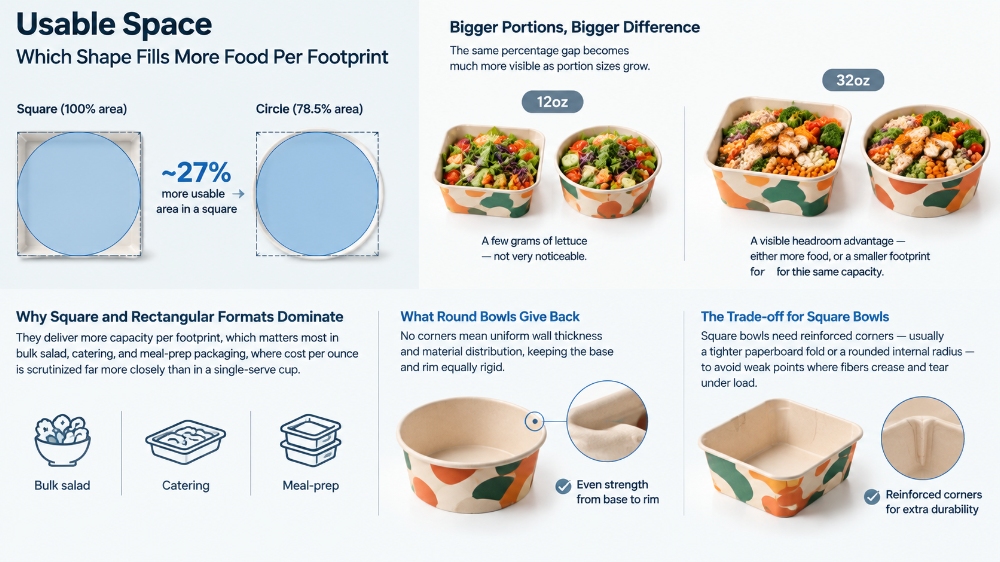
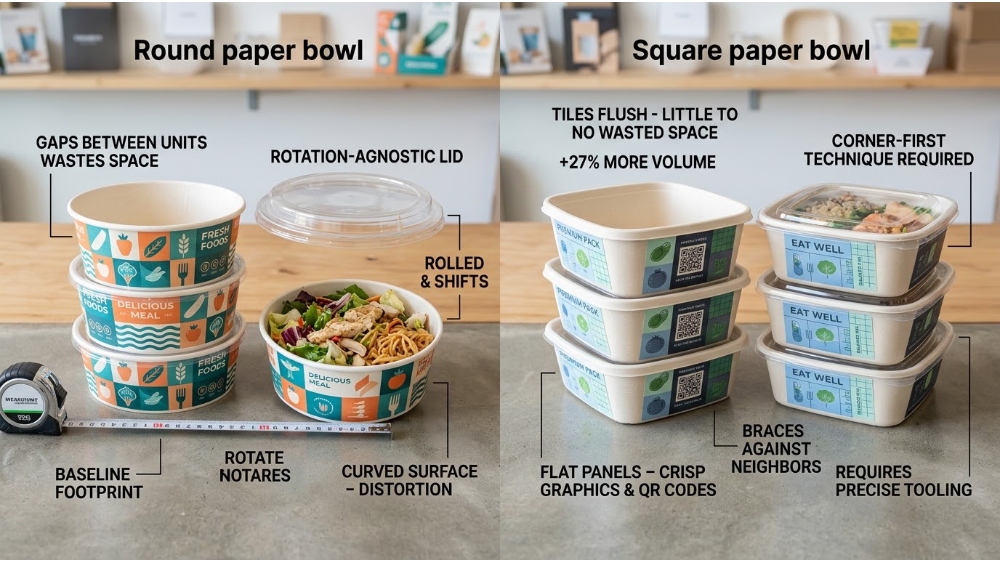
Start with the geometry, because it decides everything downstream. For two bowls with the same width across the opening, a square cross-section always holds more volume than a round one. A circle inscribed inside a square uses roughly 78.5% of the square’s area — the remaining space sits in the four corners, unused. Put another way, a square container built to the same width as a round one has about 27% more usable cross-sectional area before either bowl gets a single inch taller.
That gap matters more as portion sizes grow. On a 12oz salad bowl the difference is a few grams of lettuce nobody notices. On a 32oz grain bowl or a family-size side dish, the same percentage gap becomes visible headroom — either the square bowl holds more of the same menu item, or a supplier can shrink a square bowl’s footprint and still hit the same stated capacity as a larger round one. This is the reason square and rectangular formats dominate bulk salad, catering, and meal-prep packaging, where cost per ounce of capacity is scrutinized far more closely than in a single-serve cup.
Round bowls give some of that efficiency back in a different way: because there are no corners, wall thickness and material distribution stay uniform, which keeps the base and rim equally rigid. A square bowl needs reinforced corners — usually a tighter paperboard fold or a rounded internal radius — to avoid weak points where fibers crease and tear under load. So the usable-space advantage of a square bowl is real, but it is not free; it is paid for with slightly more complex tooling at the corner.
The core geometry, in one line:
Same opening width: square bowl ≈ 27% more usable volume than round
Round bowls trade that volume for uniform wall strength and no weak corners
The gap widens as portion size increases — it matters most above 16-20oz
Stacking and Shelf Storage: Which Shape Saves More Space
Empty paper bowls spend most of their life stacked in a sleeve, sitting in a dry-storage room, waiting for a shift. Storage efficiency is a footprint problem, and footprint is where square shapes win outright. Rectangular and square containers tile a shelf edge-to-edge with no gap, because their flat sides touch flush against the next unit and against the wall of the shelf. Round containers leave a lens-shaped gap between every pair of adjacent bowls — the same geometric penalty from the usable-space section, just applied to the empty container instead of the food inside it.
On a standard dry-storage shelf with a fixed depth, that gap adds up. A rack of square-format sleeves can sit flush against a wall or against another rack with zero wasted air between them; round-bowl sleeves need extra clearance to prevent the case from rolling or shifting, and operators often leave a hand’s width of buffer between rows out of habit. Multiply that across a walk-in shelving unit and a restaurant with limited back-of-house square footage effectively pays rent on empty air every time it stocks round bowls.
Vertically, both shapes stack the same way — sleeve on sleeve, case on case — since paper bowl cases are boxed identically regardless of what shape is inside them. The real difference shows up in bulk, loose stacking at a self-serve or catering station: a stack of square bowls holds its column true because flat walls resist rotation, while a stack of round bowls can twist slightly with each added unit unless the taper angle is tightly controlled. For high-traffic self-serve setups, that twist is a minor annoyance; for automated dispensers that drop one bowl at a time, it is a jam risk that square formats mostly avoid.
Lid Fit and Seal Performance: Round vs. Square Lids
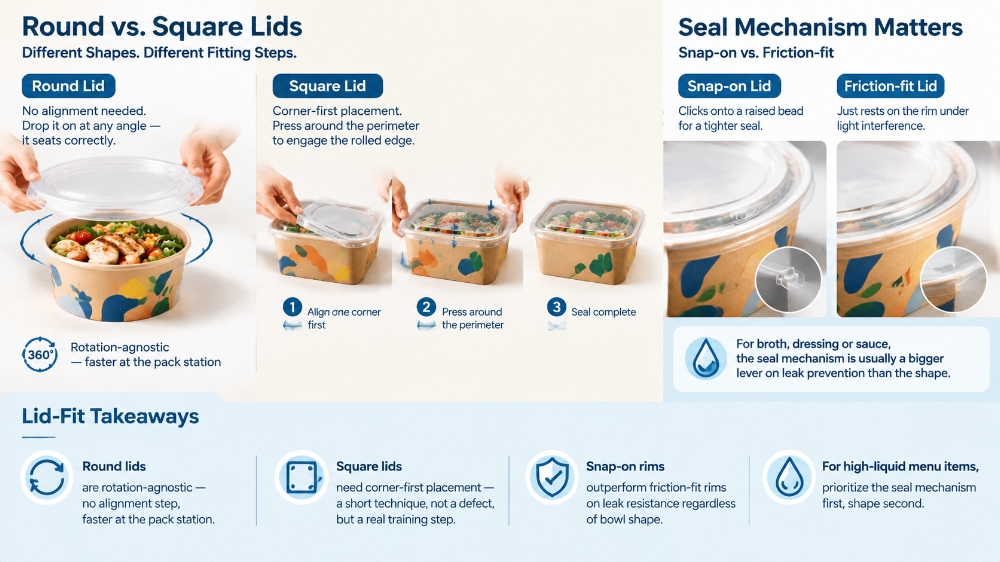
Lid fit is where round bowls have the strongest structural argument. A circular rim has no orientation — a round lid can be dropped onto a round bowl at any angle and it seats correctly on the first try, because every point on the rim is equidistant from the center. That radial symmetry is why rolled-rim, snap-on, and friction-fit lid systems were engineered around round bowls first, and why the vast majority of mature lid tooling on the market is round.
Square and rectangular paper bowls typically use the same rolled-rim sealing principle, but the lid has to be corner-fed rather than dropped straight down — an employee lines up one corner first, then presses around the perimeter to engage the rolled edge on all four sides. It is not a difficult technique, but it is a technique: new staff need a short adjustment period before the motion becomes automatic, and a corner set down slightly off-angle can leave a gap that a round lid would never allow, because a round lid self-corrects rotationally and a square one does not.
Seal mechanism matters as much as shape. Snap-on lids, which click onto a raised bead around the rim, hold a noticeably tighter seal than simple friction-fit lids that just rest on the rim under light interference — the gap between the two is large enough to change delivery-failure rates, not just spillage anecdotes. For any bowl carrying broth, dressing, or sauce, the seal mechanism is usually a bigger lever on leak prevention than the shape of the bowl itself; shape decides how forgiving the fitting process is, mechanism decides how well the seal holds once it’s on.
Lid-fit takeaways:
Round lids are rotation-agnostic — no alignment step, faster at the pack station
Square lids need corner-first placement — a short technique, not a defect, but a real training step
Snap-on rims outperform friction-fit rims on leak resistance regardless of bowl shape
For high-liquid menu items, prioritize the seal mechanism first, shape second
Transport and Delivery Stability
Once a bowl leaves the counter, its shape decides how it behaves inside a delivery bag, a bike pannier, or a catering tray during transit. Round bowls have one meaningful advantage here: no corners to catch. In a bag jostled at speed, a round bowl rotates in place rather than digging a corner into the bowl next to it, which reduces the chance of a lid popping loose from lateral pressure. That same rotational give is a disadvantage when bowls need to stay upright and separated — round bowls roll if they tip, while square bowls, once tipped, tend to stay tipped rather than roll further and spill.
Square bowls hold their orientation better in a packed, multi-item order. Because their flat sides contact each other directly, a set of square bowls loaded together in a delivery bag locks into a stable block that resists shifting — closer to how the sides of moving boxes brace each other in a truck than how round items behave in the same space. For orders with multiple bowls — a family meal, a catering drop-off, a multi-item combo — that mutual bracing meaningfully reduces the chance of one container sliding, tipping, and putting pressure on the lid of the item next to it.
The practical rule most delivery-heavy operators land on: single-bowl orders with liquid contents favor round, because rotation absorbs shock without concentrating force on one seal point; multi-bowl orders favor square, because the bracing effect keeps the whole bag from shifting in transit. Bag packing habits matter too — a bowl loaded on its side or under heavier items will fail regardless of shape, so transport stability should be treated as a packing-procedure question as much as a bowl-geometry one.
Presentation and Portion Perception: What Customers See First
Shape changes how full a bowl looks before a customer eats a single bite, independent of the actual volume inside it. Round bowls read as generous and casual — the shape customers associate with soup, ramen, and scratch-made comfort food, largely because that association was built by decades of round soup crocks and takeout containers. A round bowl filled to a slight dome looks abundant because the eye reads the curved surface as continuous fullness.
Square and rectangular bowls read differently: cleaner, more composed, closer to a plated restaurant presentation than a takeout default. That reads as premium for grain bowls, bento-style meals, and multi-component dishes where distinct ingredients are visible in neat sections rather than mixed together. The flat base also lets ingredients sit in visible layers rather than pooling toward a curved center, which is why poke bowls and salad bowls built for a photo-first customer increasingly ship in square or rectangular formats even when the round version is cheaper.
Portion perception research on food containers has repeatedly found that people judge how much they’ve been given by the container’s shape and height as much as by its stated volume — a phenomenon well documented in studies of bowl and glass geometry influencing self-served portions. The practical version for packaging buyers: a shallow, wide round bowl can make a modest portion look generous, while the same volume in a tall, narrow square container can look smaller even though nothing about the actual food quantity changed. Matching bowl shape to how a menu item wants to be perceived — generous comfort food versus composed premium meal — is a presentation lever most operators leave unused.
Printable Surface Area and Branding
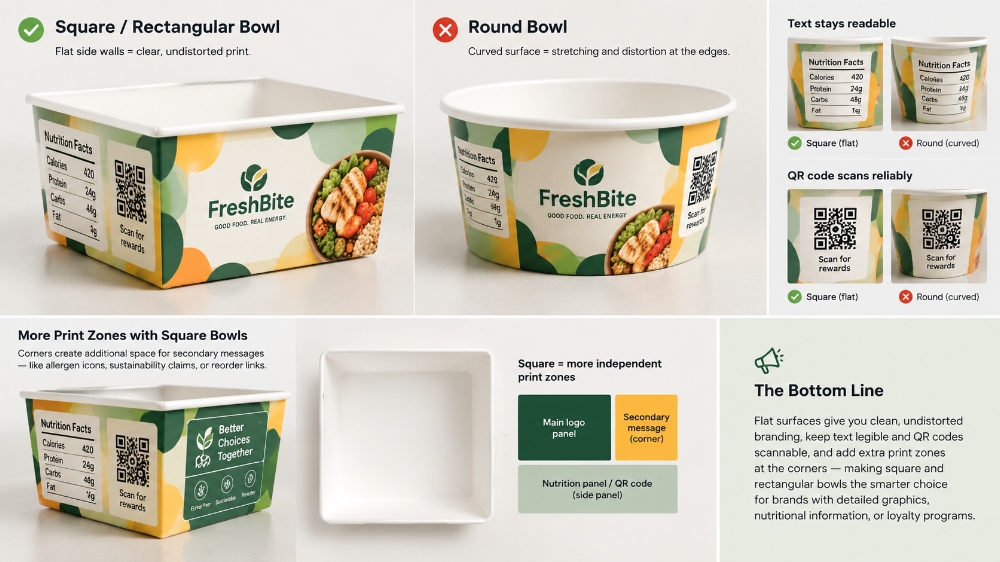
Flat panels print better than curved ones, full stop. A square or rectangular bowl offers an unbroken, flat side wall that a logo, nutritional panel, or QR code can sit on without any distortion — text stays legible at any viewing angle, and a QR code scans reliably because the camera sees a true flat plane rather than a curved surface bending the pattern at the edges.
Round bowls wrap printed graphics around a continuous curve, which works fine for simple logos and color blocking but introduces visible stretching or compression at the far edges of a design as the eye moves around the bowl — the same distortion familiar from printed coffee cups, where a wide logo often has to be redesigned specifically to survive the wrap. For brands running detailed illustrations, multi-language nutritional information, or dense QR-driven loyalty programs, that flat, undistorted surface area is a real production advantage, and it is one of the more overlooked reasons packaging teams standardize on square formats for their flagship menu items even when round would be cheaper to source.
Corner space on a square bowl also functions as usable print real estate in a way a round bowl’s continuous curve cannot — brands frequently reserve one corner panel for a secondary message (allergen icon, sustainability claim, reorder link) distinct from the primary logo panel, effectively getting more independent print zones out of the same total surface area.
Nesting and Manufacturing Efficiency
Nesting — the way empty bowls telescope into each other for shipping and storage — is a function of wall taper, not just shape. Round bowls nest with a naturally forgiving, self-centering action: because the rim is symmetrical in every direction, a round bowl slides into the one below it without needing to be rotated into a specific position, and manufacturing tolerances can be looser without the nest jamming. This is the same principle that makes round paper cups stack cleanly in a dispenser without staff ever thinking about orientation.
Square bowls can nest just as tightly, but the tooling has to hold a consistent draft angle on all four walls and, critically, get the corner radius right — too sharp a corner and the bowls lock together under their own nesting pressure instead of sliding apart cleanly at the register or prep line; too generous a radius and the manufacturing advantage of the square shape (flat print area, tight tessellation) starts to erode toward a rounded-rectangle compromise. That corner-radius tolerance is the single biggest reason square paper bowl tooling costs more to develop than round tooling, even though the finished bowl often uses a comparable amount of paperboard.
On the shipping side, well-designed nesting cuts the empty-container footprint dramatically — nestable formats can reduce the space taken up by empty units by well over half compared to non-nesting designs, which lowers freight cost per bowl and reduces the number of trucks needed to move the same order volume. Round and square paper bowls both benefit from this if the nesting geometry is engineered correctly; the shape itself is secondary to whether the manufacturer actually validated the taper and radius for clean nesting rather than just for a good-looking sample.
Restaurant Workflow: Prep, Fill, Seal, Serve
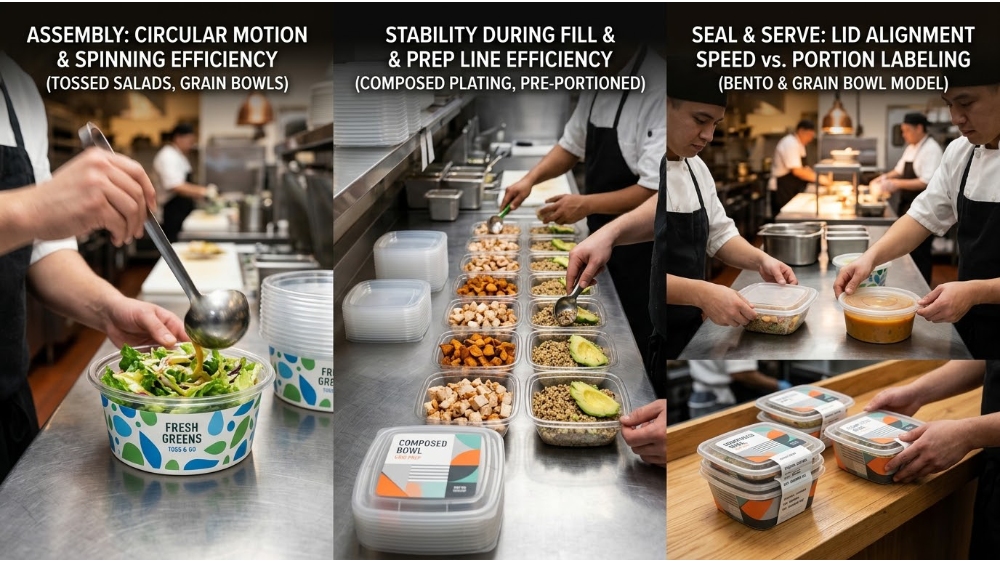
On the line, shape changes muscle memory more than it changes speed on any single task — but muscle memory compounds across hundreds of orders a shift. Ladling soup or scooping rice into a round bowl matches the natural circular motion of a ladle or scoop, and a round bowl can be spun in place on the counter, which is exactly why tossed salads, dressed grain bowls, and anything that benefits from a quick swirl are built around round formats. Square bowls resist that spinning motion — the corners catch a spoon or a hand mid-turn — so operations that toss or mix ingredients directly in the serving container generally find round more efficient at the actual assembly step.
Where square bowls win is everything around the fill step. They sit stable without rolling while an employee’s hands are busy with toppings, they line up in a tight grid on a prep rail the same way steam-table pans do, and they don’t need a bowl-holder or divot cut into the counter to stop them rolling off the edge — a small thing that matters a great deal on a fast, cluttered line during a rush. Lid application, as covered earlier, tips slightly toward round for raw speed, since there’s no corner to align.
The net effect: kitchens built around mixing, tossing, and liquid-forward menu items tend to gravitate toward round bowls for the assembly experience, while kitchens built around composed, pre-portioned, multi-component plating — the bento and grain-bowl model — gravitate toward square, because stability during fill and print area for portion labeling matter more than spin-friendliness.
Round vs. Square Paper Bowls: Side-by-Side Comparison
Factor
Round paper bowl
Square paper bowl
Usable volume per footprint
Baseline — no corner fill
~27% more at the same opening width
Shelf and case storage
Gaps between units waste shelf depth
Tiles flush — little to no wasted space
Lid application
Rotation-agnostic, fastest to seat
Corner-first technique required
Transport stability, single item
Rotates to absorb shock
Holds orientation; can tip and stay tipped
Transport stability, multi-item bag
Can roll and shift against neighbors
Braces against neighbors, resists shifting
Presentation style
Generous, casual, comfort-food association
Composed, premium, plated-meal association
Print surface
Curved — some distortion at wide angles
Flat panels — crisp graphics and QR codes
Nesting tolerance
Forgiving, self-centering
Requires precise corner-radius tooling
Best line workflow
Tossing, mixing, ladling, liquid-forward menus
Composed fill, stable prep, grid-style stations
Best menu fit
Soups, noodles, ramen, dressed salads, poke
Grain bowls, bento meals, catering, meal-prep
How to Choose the Right Bowl Shape for Your Menu
The decision comes down to which variable is actually costing money or causing complaints in a given operation, not which shape looks better in a supplier catalog. Four questions narrow it quickly.
Is the menu item liquid-forward or mixed in the bowl?
Soups, broths, noodle dishes, and anything tossed or dressed table-side benefit from round geometry — the rotation-agnostic lid seats faster, and the shape supports the spinning motion used to mix or plate. This is also where seal mechanism (snap-on versus friction-fit) matters more than shape itself, since liquid contents are the most leak-sensitive category in the whole packaging program.
Is storage space or case count the binding constraint?
Operations with tight dry-storage rooms, high case-volume delivery models, or aggressive per-unit packaging cost targets should default to square. The combined effect of higher usable volume per footprint and flush shelf tiling adds up to fewer cases ordered and less storage rented for the same throughput.
Does the order typically include multiple bowls per bag?
Family meals, catering, and multi-item combo orders travel better in square formats because the flat sides brace against each other and resist the shifting that leads to popped lids in transit. Single-bowl, grab-and-go orders lean the other way, since round bowls absorb bag jostling by rotating rather than transferring force into one seal point.
Does the brand need heavy print real estate?
Detailed illustrations, nutrition panels, allergen call-outs, or QR-driven loyalty programs read cleanest on a flat square panel. If the print need is a simple logo and color block, a round bowl’s curved surface is not a meaningful limitation.
For menus that split across both categories — a fast-casual concept selling both ramen and grain bowls, for example — running two bowl formats side by side is common and usually cheaper in the long run than forcing one shape to cover every dish poorly.
Need help matching bowl shape to your menu and delivery volume?
Get a side-by-side sample set — round and square, matched to your typical portion sizes and hold times — before committing to a bulk order.
Are square paper bowls more space-efficient than round ones?
Yes, in two ways: a square bowl holds about 27% more volume than a round bowl of the same opening width, and square footprints tile shelves and cases without the gaps that round bowls leave between units.
Do round or square paper bowls hold more food for the same stated capacity?
At the same labeled capacity, a round bowl typically needs to be slightly taller or wider than a square one to reach the same volume, since the square’s flat corners capture space a circle cannot. In practice, both shapes are engineered to their stated capacity — the efficiency difference shows up in footprint, not in the ounce marking on the bowl.
Which shape is better for hot soups and liquids?
Round bowls are generally the better fit for liquid-forward dishes because rotation-agnostic lids seat faster and more reliably, and the shape supports ladling and swirling motions common to soup and noodle service. The seal mechanism — snap-on versus friction-fit — matters more than shape for leak prevention on any liquid item.
Can square paper bowls use the same lids as round bowls?
No — lids are shape-matched to the bowl rim, so a square bowl needs a square lid and a round bowl needs a round lid. What can be shared across both is the sealing technology (rolled rim, snap-on, or friction-fit), which is typically available for both bowl shapes from the same manufacturer.
Post time:
Sep-17-2026
For inquiries about our products or pricelist, please leave your email to us and we will be in touch within 24 hours.