

Bakery Delivery Packaging: Prevent Damage in Transit
Bakery Packaging Guide
A bakery box can look perfect at the counter and still fail in a moving vehicle. Safe delivery depends on controlling five risks at once: movement, crushing, surface contact, moisture, and temperature—then proving the complete pack works on the actual route.
The correct way to package bakery products for delivery is to design a complete protective system around the actual food, not to choose a box by appearance alone. The product needs a food-safe contact layer, a rigid outer structure, internal restraint, suitable moisture control, and a delivery process that keeps the pack level and separated from heavier orders.
This guide is written for bakery chains, cafés, dessert brands, catering teams, distributors, and procurement managers sourcing commercial bakery packaging. It explains how to convert product dimensions, texture, filling, temperature, and delivery time into a packaging specification that can be repeated across stores and production batches. For a broader view of coordinated boxes, bags, cups, wraps, and accessories, explore MaibaoPak’s custom bakery packaging solutions.
Why Do Bakery Products Get Damaged During Delivery?
Bakery products are usually damaged because the package allows movement, transfers stacking pressure, touches a delicate surface, traps damaging moisture, or loses temperature control. A box prevents damage only when its size, strength, internal fit, and handling method work together.
A delivery vehicle creates a very different environment from a bakery counter. Braking pushes products forward, turns create sideways movement, road vibration loosens decorations, and stacked orders apply compression to lids and sidewalls. Even when the outer box shows no visible dent, the product may slide far enough for frosting, glaze, fruit, or chocolate work to touch the wall.
Damage can also start before the driver leaves. A warm pastry sealed too early may release steam that condenses on the lid and softens a crisp surface. A chilled mousse cake placed in an oversized carton may remain cold but still shift because the board is not located. A cupcake insert may hold the base securely while leaving too little headroom for a tall swirl.
Five failure modes to diagnose:
- Sliding: the product or cake board moves inside the pack during acceleration, braking, or turns.
- Crushing: the lid, sidewall, handle, or stacked order transfers force into the food.
- Surface contact: frosting, glaze, fruit, chocolate, or flaky layers touch the box or insert.
- Moisture damage: trapped steam, grease migration, or condensation changes texture and weakens paperboard.
- Temperature failure: chilled or cream-filled products spend too long outside their validated control range.
Start every packaging project by defining what “damage” means for that SKU. A slightly cracked cookie may be unacceptable in a premium gift box but acceptable in a crumble topping application; a 3 mm frosting smear may be a complete failure for a celebration cake. Clear acceptance criteria make packaging tests objective instead of visual guesswork.
How Should Bakery Packaging Change by Product Type?
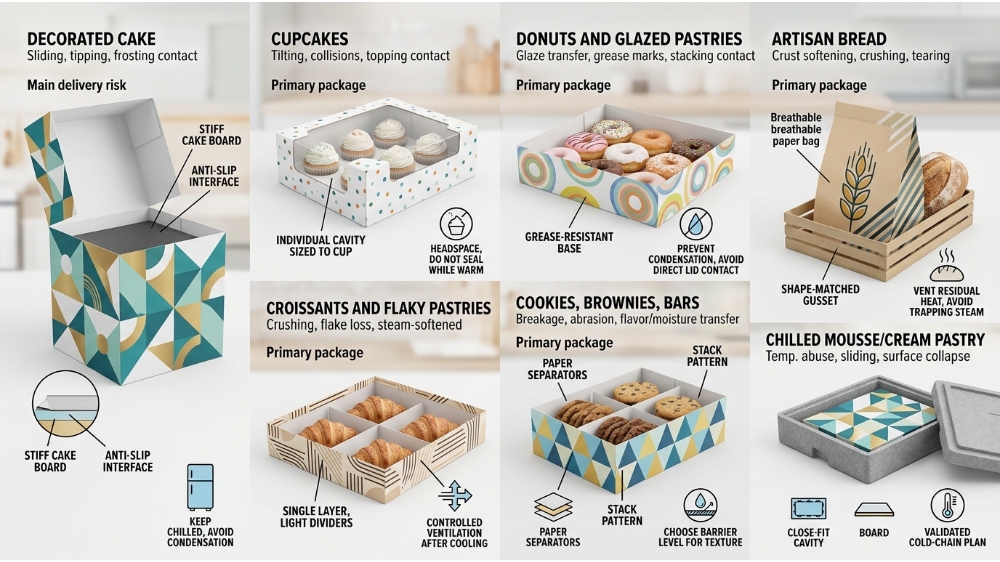
Different bakery products fail in different ways, so one universal box cannot protect an entire menu. Match the package to the product’s structure, surface, moisture, temperature, weight, and expected delivery time. You could read Top 7 Bakery Packaging Materials for more detail.
A useful specification starts with the food, not the packaging catalogue. Record the finished product’s maximum width, depth, height, total weight, center of gravity, surface sensitivity, grease level, filling type, serving temperature, and whether customers expect the product to remain crisp, soft, chilled, or visually untouched.
| Bakery product | Main delivery risk | Primary package | Internal control | Moisture rule |
|---|---|---|---|---|
| Decorated cake | Sliding, tipping, frosting contact, lid compression | Rigid cake box with reinforced base and correct height | Stiff cake board, base locator or anti-slip interface | Keep chilled when required; avoid uncontrolled condensation |
| Cupcakes | Tilting, collisions, topping contact | Rigid carton or clear-lid carrier | Individual cavities sized to the cup diameter | Allow enough headspace; do not seal while excessively warm |
| Croissants and flaky pastries | Crushing, flake loss, steam-softened crust | Shallow rigid pastry box | Single layer or light dividers; no tight compression | Use controlled ventilation after adequate cooling |
| Donuts and glazed pastries | Glaze transfer, grease marks, stacking contact | Wide, shallow box with grease-resistant base | Single layer where appearance matters; dividers for premium sets | Prevent condensation and direct lid contact |
| Cookies, brownies, bars | Breakage, abrasion, flavor or moisture transfer | Carton, tray, pouch, or tin according to fragility | Stack pattern, paper separators, tray cells, or void control | Choose barrier level for the intended shelf and texture |
| Artisan bread | Crust softening, crushing, bag tearing | Breathable paper bread bag or fitted carton | Shape-matched gusset; secondary crate for bulk orders | Vent residual heat; avoid trapping steam around a crisp crust |
| Chilled mousse or cream pastry | Temperature abuse, sliding, surface collapse | Rigid tray-and-box system inside insulated transport | Close-fit cavity, board, collar, or divider | Use a validated cold-chain plan, not packaging appearance alone |
Packaging should also reflect order configuration. One tart delivered alone needs a different secondary pack from twelve tarts delivered with hot drinks, bread, and a celebration cake. The food-contact pack protects the individual item; the delivery tote, crate, or insulated bag protects the order as a system.
How Much Clearance Should a Bakery Box Have?
A bakery box needs enough clearance to prevent contact but not so much empty space that the product can build momentum and slide. Measure the finished product at its largest real production size, then size the board, insert, and box as one system.
For cakes, do not select the box from the nominal cake diameter alone. Include the actual decorated diameter, piping, side decorations, cake-board dimensions, topper height, and the space needed to lower the product without scraping the walls. The cake box sizes guide provides a useful starting chart, but production samples still need to be measured because decoration styles change the required clearance.
Horizontal clearance and vertical clearance solve different problems. Horizontal space prevents side contact during packing, while the board or insert must stop that space from becoming a sliding lane. Vertical space protects toppings and toppers, but excessive height can reduce stacking efficiency and may allow a tall product to sway if its base is not stable.
Measure in this order:
- Measure the maximum finished product dimensions, not the recipe pan or nominal menu size.
- Choose the cake board, tray, cup cavity, or food-contact wrap that supports the product.
- Set internal box dimensions around that support component and the required hand clearance.
- Check lid deflection, sidewall bowing, handle stress, and stacking pressure with the actual product weight.
- Repeat the fit check across normal production variation, not only the best-looking sample.
For cupcakes, the critical dimensions are the bottom cup diameter, upper cup diameter, insert opening, overall decorated height, and the distance between neighboring toppings. Click to explore cupcakes box
For croissants and laminated pastries, the pack should prevent side compression without squeezing the product into a tight grid that breaks flaky edges. Click to explore croissants packaging
How Do Cake Boards, Inserts, and Dividers Prevent Movement?
Internal components prevent damage by locating the product, spreading its weight, and keeping delicate surfaces away from walls and neighboring items. Their job is not to fill space randomly; it is to control movement without crushing the food.
A cake board acts as both a handling platform and a structural component. It should remain flat under the cake’s weight, resist grease or moisture long enough for the intended delivery, and fit the box base closely enough to limit travel. A thin board that bends can destabilize the cake even inside a strong box.
The board still needs to be located. Depending on the product and package, this can be achieved with a die-cut base recess, corner stops, a locking tray, a food-safe non-slip interface, or a board shape that matches the carton. Tape, improvised adhesives, and non-food-contact materials should not be introduced without a reviewed specification.
Cupcake inserts must secure the cup body while leaving enough room to remove the product without touching the frosting. Openings that are too large allow cups to tilt; openings that are too small deform the cup or make staff force it into position. For macarons, petit fours, and premium pastries, individual cells reduce collision and stop flavors, colors, and surface finishes from transferring.
Dividers are especially valuable in mixed bakery assortments. Place heavier, firmer items where they cannot migrate into fragile products, and separate moist or strongly flavored items when contact could change texture or aroma. For a dedicated delivery structure, a custom cake takeaway box can combine the base, locking flaps, height, and branding into one repeatable format.
Tips: We’ve prepared How to Package Cake for Safe Delivery Guide for your bakery businesses.
How Do You Control Condensation Without Drying Out Baked Goods?
Control moisture by matching the package’s ventilation and barrier level to the product’s desired texture and temperature. Crisp products generally need residual steam to escape, while soft or shelf-life-sensitive products may need a stronger moisture barrier after they have cooled correctly.
Packaging a product while it is still releasing substantial heat and moisture can create a high-humidity microclimate. The vapor condenses on cooler walls or windows, then returns to the food surface. This can soften croissant layers, make pie crusts leathery, dissolve sugar decoration, fog transparent windows, and weaken unprotected paperboard.
Cooling does not mean leaving food exposed without control. Establish a product-specific time between baking, finishing, chilling, and packing. A crisp baguette may use a breathable paper format, while cookies intended to remain soft may need a sealed inner wrap. MaibaoPak’s custom paper bread bags illustrate how shape, grease resistance, breathability, and branding can be specified together for commercial bakery use.
Food quality and food safety must be treated separately. Cream-filled pastries and other products that require time and temperature control need a validated cold-chain process; the FDA Food Code is a regulatory reference for retail food safety, but local legal requirements and the bakery’s own hazard analysis should determine the actual operating limits.
For chilled orders, prevent cold packs from touching delicate products or creating localized condensation. Use an insulated secondary carrier, separate the refrigerant from the retail carton, keep cartons level, and test the complete pack over the longest credible route—including loading delay and customer handoff—not only the average drive time.
What Is the Safest Packing Method for Each Bakery Product?
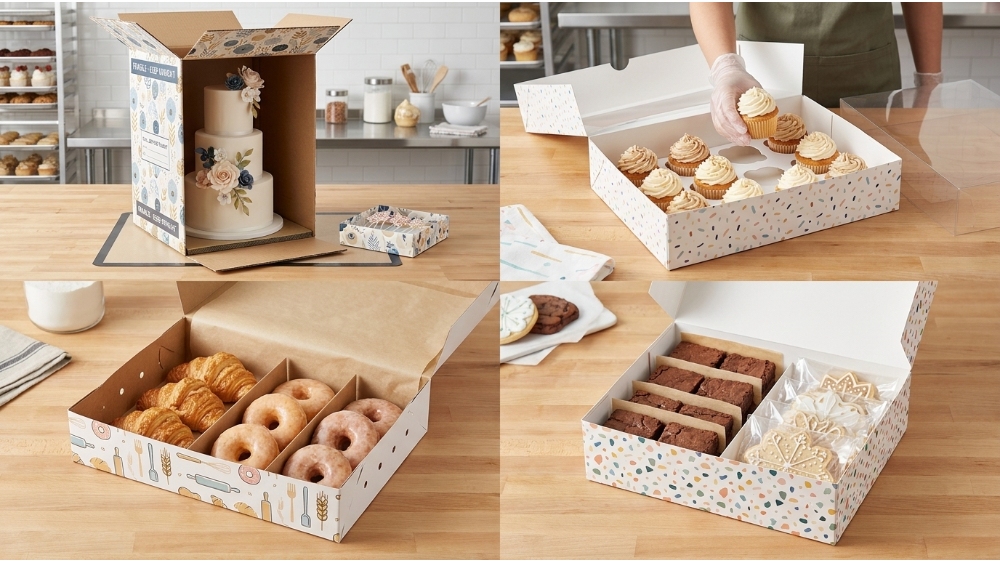
The safest method combines a product-specific retail pack with an internal restraint and a delivery-ready secondary carrier. The following methods provide a practical baseline, but each must be tested with the bakery’s actual recipe, decoration, portion size, and route.
How should decorated cakes be packed for delivery?
Place the cake on a rigid, grease-resistant board inside a correctly sized, reinforced box with full height clearance. Locate the board, keep the carton level, and transport it alone on a flat non-slip surface whenever the design is tall, heavy, or highly decorated.
Chill the cake to the validated finishing temperature before loading when the recipe requires it. Remove or separately pack unstable toppers when practical, protect high-value decorative elements from side contact, and use external orientation labels as reminders—not as substitutes for a physically stable package. Explore the Rigid Food-Grade Packaging for Cake Transport
How should cupcakes be packed for delivery?
Use individual insert cavities matched to the baking cup and enough lid height for the tallest standard topping. Keep cavities far enough apart that frosting cannot touch during vibration or removal.
Load each cupcake vertically without forcing the cup through the opening. Test removal with gloved staff, because an insert that protects during transit but causes frosting damage at handoff is not a successful design. Explore Cupcakes Box we prepared for you
How should croissants, donuts, and pastries be packed?
Use a shallow rigid box that prevents compression and allows products to remain in a single layer when appearance matters. Add grease-resistant paper or a tray, and use controlled ventilation after the products have cooled enough for packing.
Do not stack flaky pastries under dense items, and do not let glazed surfaces touch the lid. Mixed assortments may need dividers so heavy donuts cannot slide into delicate laminated products during braking. Click to see the donuts packaging for your businesses
How should cookies, brownies, and bakery bars be packed?
Pack sturdy products in controlled stacks or rows, but use separators, trays, or individual wraps for brittle, decorated, or flavor-sensitive items. Limit empty space so the contents cannot repeatedly strike the carton walls.
Choose the moisture barrier according to the target texture: a crisp cookie and a fudgy brownie should not automatically share the same sealed compartment. In gift assortments, use cells or dividers to protect edges and preserve presentation after opening. Explore cookies packaging we prepared to you
How should artisan bread be packed for delivery?
Allow residual heat and steam to dissipate according to the bakery’s cooling process, then use a shape-matched breathable bag or carton that supports the loaf without compressing the crust. Protect multiple loaves with a rigid crate or secondary carton rather than overfilling a carry bag.
Long baguettes need correctly positioned handholds and sufficient paper strength at the base and gussets. For sliced or soft bread, a stronger moisture barrier may be appropriate once the loaf has cooled, particularly when the intended holding time is longer.
How Should Bakery Orders Be Loaded Inside a Delivery Bag or Vehicle?
Keep bakery orders flat, separated, and restrained inside a clean secondary carrier that cannot collapse onto the retail box. Vehicle loading is part of the packaging system because a perfect carton will still fail if it slides, tips, or carries another order’s weight.
Use a level shelf, crate, or boot platform with a clean non-slip surface. Place heavy and low-risk items at the bottom only when the retail packs are designed to bear the load; celebration cakes, tall cupcakes, and fragile pastries should normally remain unstacked. Do not wedge a box so tightly that side pressure deforms it.
Separate hot and chilled orders. A warm food container beside a cream cake can raise the local temperature inside a delivery bag, while a cold pack against a paper carton can create condensation and weaken the board. Drinks also need their own stable carrier so a leaking lid cannot damage bakery packaging.
The handoff process should state where drivers may hold the package, which side must remain upright, whether toppers are packed separately, and whether the customer needs refrigeration instructions. “Fragile” and “this side up” labels support the process, but physical restraint and driver training provide the real protection.
Driver loading checklist:
- Confirm the retail box is fully locked and the product is seated in its insert or board locator.
- Place the order on a flat, clean, non-slip surface with no loose objects beside it.
- Keep drinks, sauces, hot food, and refrigerants from contacting the bakery carton.
- Do not stack on fragile boxes unless the tested packaging specification explicitly allows it.
- Use the route and handoff instructions printed on the order label or delivery SOP.
How Do You Test Bakery Delivery Packaging Before a Bulk Order?
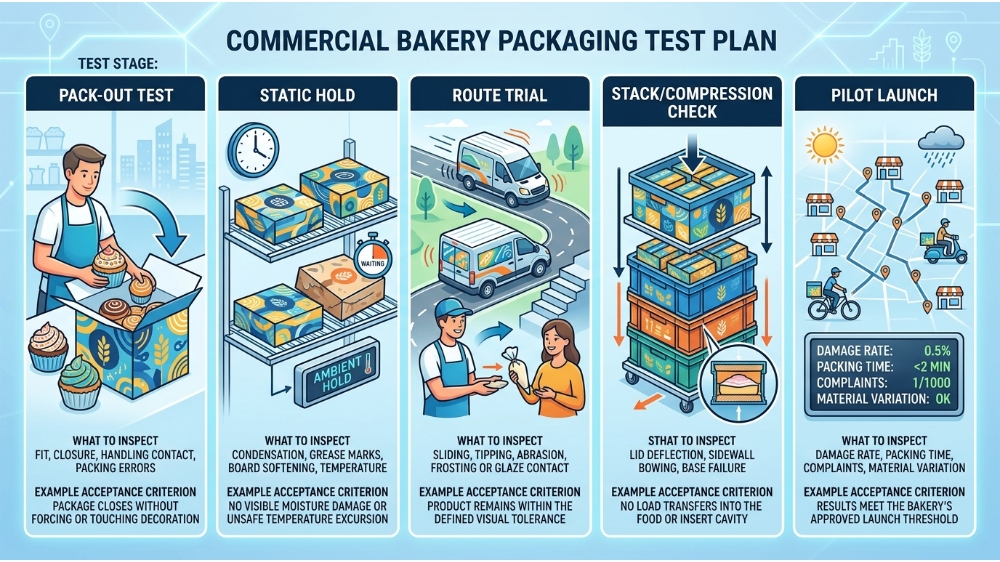
Test the packaged product, not the empty box, under the motions, temperatures, waiting times, and stacking conditions of the real delivery route. Define pass-or-fail criteria before testing so appearance, structure, leakage, temperature, and customer presentation can be judged consistently.
Begin with controlled in-house route trials. Pack products exactly as store staff would, load them into the actual delivery bag or vehicle position, and drive a route that includes braking, turns, rough surfaces, stairs, waiting time, and final handoff. Evaluate the product immediately and again after the intended customer holding period.
For parcel delivery or larger distribution programs, use a qualified packaging laboratory and a test plan appropriate to the network. The ISTA 3A overview explains that parcel-package evaluation considers vibration, shock, and other transport stresses, while also noting that a general simulation may not represent every specific distribution condition.
Record the failure location, not only the final result. A smeared cake could indicate board movement, insufficient side clearance, poor vehicle restraint, or a temperature-dependent frosting weakness. Change one variable at a time—box dimensions, board stiffness, insert geometry, ventilation, secondary restraint, or operating procedure—then repeat the route.
| Test stage | What to simulate | What to inspect | Example acceptance criterion |
|---|---|---|---|
| Pack-out test | Normal staff assembly and loading speed | Fit, closure, handling contact, packing errors | Package closes without forcing or touching decoration |
| Static hold | Maximum expected waiting time | Condensation, grease marks, board softening, temperature | No visible moisture damage or unsafe temperature excursion |
| Route trial | Braking, turns, vibration, stairs, handoff | Sliding, tipping, abrasion, frosting or glaze contact | Product remains within the defined visual tolerance |
| Stack/compression check | Actual tote and order configuration | Lid deflection, sidewall bowing, base failure | No load transfers into the food or insert cavity |
| Pilot launch | Multiple stores, staff, routes, and weather conditions | Damage rate, packing time, complaints, material variation | Results meet the bakery’s approved launch threshold |
Do not approve a bulk custom order from a flat dieline, digital render, or empty sample alone. Request production-representative material, print, coating, insert, and closure samples, then test them with the heaviest and most fragile products in the planned size range.
How Can a Bakery Build a Repeatable Packaging SOP?
A repeatable SOP connects each menu SKU to an approved package, packing method, temperature rule, loading position, and acceptance standard. This prevents staff from improvising when order volume rises or multiple stores use the same packaging inventory.
Create a packaging specification sheet for every product family. Include the approved box and insert code, internal dimensions, material and coating, board or tray, maximum product weight and height, packing temperature, cooling requirement, closure method, label position, secondary carrier, stacking rule, and delivery-time limit.
Use photographs or simple diagrams for staff training, especially where cupcake orientation, board placement, divider assembly, or topper handling matters. Track damage by SKU, store, route, driver, weather, and package batch; otherwise a packaging issue can be confused with a production, handling, or delivery problem.
Procurement should also control substitutions. A box with the same external size may have different internal clearance, board stiffness, coating, window position, or locking performance. Require written approval and route testing before replacing a critical component.
For growing bakery groups, the most efficient approach is often to source the full packaging system together: cake boxes, pastry cartons, inserts, cake boards, bread bags, carry bags, cups, labels, and shipping cartons. MaibaoPak’s one-stop food packaging service is structured for B2B brands that need coordinated design, material selection, sampling, manufacturing, quality control, and bulk delivery across multiple packaging formats.
Need bakery packaging designed for real delivery conditions?
Share your product dimensions, photos, weight, temperature, order mix, delivery time, and current damage points. MaibaoPak can help translate them into a coordinated box, insert, board, bag, and testing specification for commercial production.
Frequently Asked Questions
What is the best packaging for bakery product delivery?
The best bakery delivery packaging is a product-specific system: a food-contact wrap or tray, a correctly sized rigid box, and an insert or board that prevents movement. Choose the structure according to the product’s weight, height, surface finish, moisture, temperature, and delivery time.
How do you keep a cake from sliding in a delivery box?
Use a rigid cake board that closely matches the box footprint, then secure the board with a food-safe anti-slip pad or purpose-designed base locator. Keep the box level on a non-slip vehicle surface and never place another order on top unless the system has been tested for stacking.
Should hot pastries be sealed immediately for delivery?
No, not when trapped steam will soften a crisp crust or create condensation. Let the product complete its required cooling step, then use controlled ventilation or breathable paper packaging while still protecting it from contamination and excessive drying.
How should bakery products be packaged for long-distance shipping?
Long-distance parcel shipping requires a different system because the pack may be tilted, dropped, vibrated, compressed, or delayed. Select products that tolerate the route, immobilize the retail pack inside a tested shipping carton, and validate food safety, shelf life, and transport performance before offering the service.
Post time: Aug-05-2026