How to Package a Cake for Delivery? A Bakery Owner’s Guide to Safe Cake Transportation
Safe Cake Delivery Packaging: A Bakery Owner’s Guide
Bakery Packaging Guide
How to Package a Cake for Delivery? A Bakery Owner’s Guide to Safe Cake Transportation
A cake leaves the bakery flawless—perfect crumb, smooth buttercream, intricate fondant details. Ten minutes in a standard box, it’s sliding, smudged, or sweating. Safe cake delivery requires a systematic approach to stabilization, moisture control, and material selection. This guide breaks down the physics of cake transport and provides a tiered packaging system to match every delivery radius.
A finished cake is one of the most fragile items in the takeout and delivery ecosystem. Its structure relies on delicate crumb adhesion, temperature-sensitive frostings, and precise decoration placement. Once it leaves the bakery counter, it faces vibration, temperature swings, and humidity shifts—all of which can transform a showpiece into a collapsed, smeared disappointment within minutes. The difference between a cake that arrives intact and one that doesn’t is not luck; it’s a systematic packaging protocol built on food science and engineering.
This guide draws on food packaging research, material science, and real-world bakery operations to deliver a comprehensive framework for safe cake transportation. For broader takeout packaging systems including custom printed boxes and inserts, explore the cake packaging collection.
What Are the Essential Components of a Cake Delivery Box System?
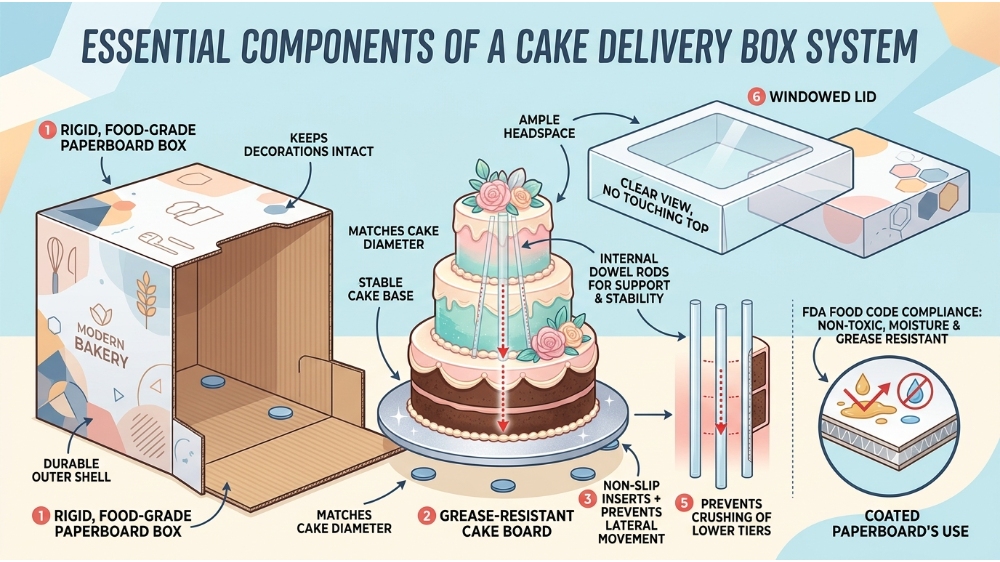
A reliable cake delivery package is not a single box—it is a system of interlocking components. The foundation is a rigid, food-grade paperboard box with sufficient height clearance. Inside, a grease-resistant cake board (or cake circle) provides a stable base that matches the cake’s diameter. Non-slip inserts or adhesive dots prevent lateral movement. For multi-tiered or heavily decorated cakes, dowel rods or straws transfer weight downward, preventing the upper tiers from crushing the lower ones. Finally, a windowed or solid lid with adequate headspace keeps decorations from touching the top. The FDA Food Code specifies that all food-contact packaging materials must be non-toxic and resistant to grease and moisture migration, which directly informs the selection of coated paperboard over uncoated alternatives for cakes with buttercream or ganache.
Non-negotiable cake delivery components:
Rigid paperboard box with minimum 2-3 inches of lid headspace
Grease-resistant cake board (same diameter as the cake)
Non-slip mat or adhesive dots for base stabilization
Dowel rods for tiered or tall cakes (one per tier)
Ventilation strategy (holes or gap) to manage condensation
How Do You Keep a Cake from Sliding in the Box During Delivery?
Sliding is the most immediate threat to a cake’s appearance. When a delivery driver accelerates, brakes, or turns, inertia pushes the cake against the box walls. Without stabilization, the cake shifts, smearing frosting against the sides and potentially collapsing the crumb structure. The solution is a two-point restraint system: a friction-generating base and a physical stop. A non-slip silicone or rubberized mat placed under the cake board increases the coefficient of friction between the board and the box floor, resisting horizontal movement. For additional security, adhesive dots or double-sided tape (food-contact safe) can fix the board directly to the box base. Research from the Institute of Food Technologists confirms that vibration during transport accelerates structural fatigue in baked goods, and mechanical stabilization is the primary countermeasure. For cakes exceeding 3 inches in height, a central dowel inserted through the cake and into the board anchors the entire structure, preventing the cake from shearing off its base during sudden stops.
Do Cake Boxes Need Ventilation Holes? Moisture Physics
This is where cake packaging diverges from fry packaging. Unlike fries, which release high volumes of steam immediately, cakes release moisture slowly but continuously. The primary risk is condensation: as warm cake cools inside a sealed box, moisture evaporates from the crumb, rises, and condenses on the cooler lid. Droplets then fall back onto the frosting, causing fondant to dissolve, buttercream to weep, and decorations to run. Ventilation holes help equalize internal humidity with ambient air, but they must be smaller and fewer than fry box holes—typically 2-4 small perforations (2-3mm diameter) on the upper side panels. This allows gradual moisture egress without creating drafts that dry out the cake. However, for short-hold deliveries (under 20 minutes), a completely sealed box with an absorbent insert (like a food-grade silica packet or a clean paper towel) can be more effective than vents, as it traps moisture without letting in external humidity. The key is matching the ventilation strategy to the hold time and ambient conditions—a nuance missed by generic packaging advice.
Ventilation rules for cake boxes:
Short holds (<20 min): sealed box + absorbent liner works best
Medium holds (20-45 min): 2-4 small side vents (2-3mm each)
Long holds (>45 min): vented box + moisture-absorbing insert
Never vent from the top—condensation drips directly onto the cake
What Is the Best Cake Box Material for Delivery?
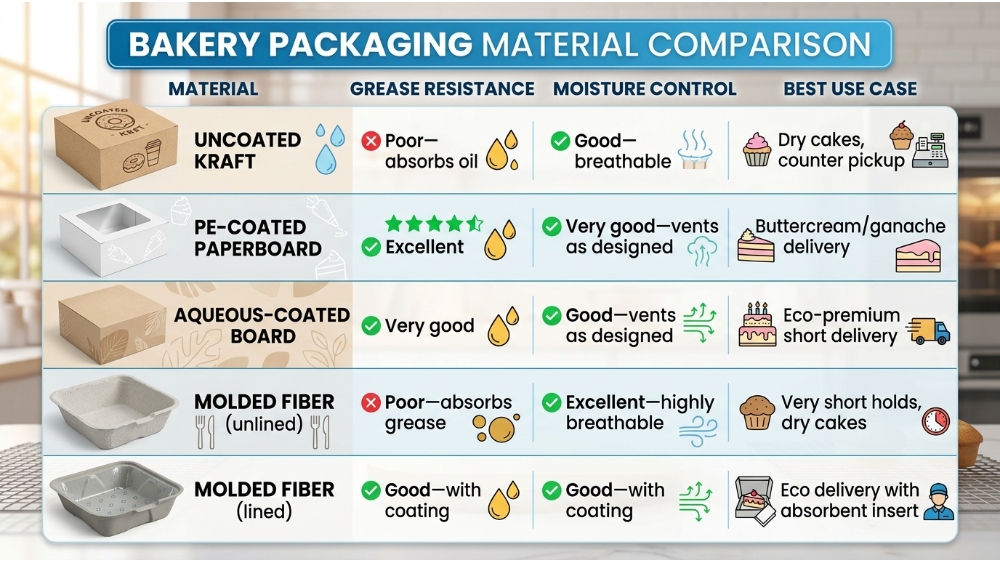
Material choice determines how the box handles grease, moisture, and structural load. Uncoated kraft paperboard is breathable and inexpensive but absorbs grease from buttercream and ganache, leading to stains and softened corners. It is suitable only for short-hold, dry cakes like pound cakes or angel food cakes. PE-coated paperboard offers a grease barrier that prevents oil wicking while maintaining rigidity. This is the industry standard for delivery cakes because it resists moisture from the cake while allowing controlled vapor transmission through uncoated areas or vents. Aqueous-coated board is a repulpable alternative that provides moderate grease resistance—effective for up to 30-minute holds but less durable under high humidity. Molded fiber (pulp) boxes are eco-friendly and highly breathable, but they aggressively absorb moisture unless internally lined, making them risky for frostings. A 2023 IFT review of food packaging materials emphasizes that coated paperboard balances barrier properties with structural integrity better than any other single material for high-moisture baked goods. For bakeries prioritizing sustainability, a lined molded fiber box with a separate grease-absorbing insert can work, but it requires field testing with the actual cake type. Learn material in detail by reading Top 7 Bakery Packaging Materials Guide.
Material
Grease resistance
Moisture control
Best use case
Uncoated kraft
Poor—absorbs oil
Good—breathable
Dry cakes, counter pickup
PE-coated paperboard
Excellent
Very good—vents as designed
Buttercream/ganache delivery
Aqueous-coated board
Very good
Good—vents as designed
Eco-premium short delivery
Molded fiber (unlined)
Poor—absorbs grease
Excellent—highly breathable
Very short holds, dry cakes
Molded fiber (lined)
Good—with coating
Good—with coating
Eco delivery with absorbent insert
How Do You Stabilize a Layered Cake for Transport?
Layered cakes are structural composites: multiple tiers of cake crumb separated by filling and frosting. Each layer introduces a shear plane—a point where horizontal or vertical force can cause separation. For single-tier layered cakes (6-8 inches tall), a single central dowel (wooden or plastic) driven through the entire cake and into the base cake board anchors the layers together, preventing them from sliding apart. For multi-tier cakes (wedding style), each tier requires its own support system: a cake board under each tier, dowels in the lower tier to carry the weight of the upper tiers, and a central dowel through all tiers for final alignment. The National Restaurant Association recommends that any cake exceeding 4 inches in height should use dowel reinforcement for delivery. Beyond dowels, the box itself must have a snug fit—excess space allows the cake to accelerate during transport. Using a box that is no more than 1-2 inches wider than the cake board minimizes movement, while foam or crumpled paper fillers occupy dead space without touching the cake itself. Click to explore the box packaging for layered cakes
Hold time—the interval between packaging and customer receipt—is the single most important variable in packaging design. For under 20 minutes (counter pickup or adjacent delivery), a standard PE-coated box with no vents and a simple absorbent paper liner is sufficient. The cake is consumed before condensation becomes a problem. For 20 to 45 minutes (average delivery), a box with 2-4 side vents (2-3mm) and a non-slip base is recommended. This allows gradual moisture release while maintaining temperature. For 45 to 90 minutes (long-distance courier), a two-component system is required: a vented inner box with a moisture-absorbing pad, placed inside an insulated outer bag. The outer bag moderates temperature swings, while the inner box manages humidity. USDA guidelines on perishable food transport note that temperature fluctuations accelerate moisture migration, so insulation and venting must work in tandem for extended holds. Bakeries should test their packaging with their actual delivery fleet—running a full route simulation—to identify failure points before scaling.
Hold-time packaging matrix for cakes:
Under 20 min: PE-coated box, sealed, absorbent liner—counter pickup standard
20–45 min: PE-coated box, 2-4 side vents, non-slip base—delivery baseline
45–90 min: Vented inner box + absorbent pad + insulated outer bag
90+ min: Active temperature control + specialized courier packaging
What Size Cake Box Do You Need for Your Bakery?
Sizing errors are among the most frequent packaging failures. A box that is too short crushes decorations; a box that is too wide allows sliding. The golden rule: the box diameter (or length/width for rectangular cakes) should be exactly 1-2 inches larger than the cake board diameter. This provides a small gap for easy insertion without excessive movement. The height should be at least 2 inches taller than the tallest point of the cake (including decorations like figurines, macarons, or fresh flowers). For standard layer cakes (2 layers, 4-5 inches tall), a 6-inch tall box is typical. For 3-layer or taller cakes, an 8-inch or 10-inch tall box is necessary. Additionally, the cake board must match the box size—a board that is too small won’t provide enough leverage for non-slip pads. Standard round cake sizes translate to box sizes: an 8-inch cake requires a 9-10 inch box; a 10-inch cake requires an 11-12 inch box; a 12-inch cake requires a 13-14 inch box. For sheet cakes, the box should be 2 inches longer and wider than the sheet pan, with the same 2-inch height clearance. Learn cake box sizes in detail by reading Cake Box Sizes Guide for Different Cake Types.
How to Choose the Right Cake Packaging for Your Business
Selecting the right cake packaging requires evaluating your menu, delivery radius, and operational workflow. Start by categorizing your cakes by frosting type: Buttercream and cream cheese frostings are soft and prone to smudging—they require a snug-fitting box with a non-slip base and minimal headspace to reduce movement. Fondant-covered cakes are more durable against smudging but highly sensitive to condensation—vented boxes with moisture-absorbent inserts are critical. Naked cakes (minimal frosting) are structurally fragile and require robust dowel reinforcement and a box with excellent friction control. Next, map your delivery routes: if the average delivery takes 25 minutes, design for 35 minutes to account for traffic and courier handling. Then, test. Pack a sample cake, run a simulated delivery (including a car ride over real roads), and inspect at 10-minute intervals. If the cake shifts, add adhesive dots or a thicker non-slip mat. If condensation appears, add vents or an absorbent pad. If the box warps, upgrade to a heavier grammage paperboard (e.g., 24pt vs. 18pt). This iterative process—not a one-size-fits-all solution—produces the most reliable packaging system. For bakeries scaling delivery, partner with a supplier who offers sample testing, custom sizing, and consistent quality across orders. For a sourcing consultation on cake boxes, stabilizing inserts, and custom-printed bakery packaging, contact Maibao Packaging.
Need cake packaging that survives the delivery route?
Work with a packaging specialist to match box size, material, stabilizers, and venting to your specific cake menu and delivery radius.
How do you package a cake for delivery without ruining it?
Use a rigid, grease-resistant box that is 1-2 inches wider than the cake, with a non-slip base and 2 inches of lid clearance. Stabilize the cake with a dowel if it exceeds 4 inches in height, and manage condensation with side vents or an absorbent liner depending on hold time.
What is the best cake box for delivery?
A PE-coated paperboard box with a snug-fitting lid, side vent holes (2-4 small perforations), and a non-slip interior base is the most reliable all-purpose format for delivery holds of 20-45 minutes. For longer holds, pair it with an insulated outer bag.
Do cake boxes need holes for ventilation?
Not always. For short holds (under 20 minutes), sealed boxes with absorbent liners prevent condensation better than vents. For longer holds, small side perforations allow gradual moisture escape without drying out the cake.
How do bakeries ship cakes without damage?
Professional bakeries use a tiered system: a coated paperboard box with a non-slip mat, dowel rods for structural support, and moisture control tailored to the frosting type. They test packaging with actual delivery simulations and adjust based on hold time and route conditions.
Post time:
Aug-07-2026
For inquiries about our products or pricelist, please leave your email to us and we will be in touch within 24 hours.