

Cake Box Sizes Guide: Standard Dimensions & Chart
Bakery Packaging Guide
Cake Box Sizes Guide: Standard Dimensions for Different Cake Types
From a 6-inch mini box to a stacked wedding tier — how cake diameter, height allowance, serving count, and display-case depth all decide the “right” box size.
A standard cake box runs from a 4″ x 4″ mini box up to a 20″ x 20″ wedding-tier box, with 8″, 10″ and 12″ boxes covering most everyday bakery orders. The right pick depends less on the cake’s advertised diameter and more on frosting clearance, box height, serving count, and where the box has to physically sit — on a delivery seat, inside a café’s countertop case, or on a supermarket refrigerator shelf.
This guide lines up every standard size in inches and centimeters, then goes further than a typical size chart by connecting box height to real serving-chart math, and by sizing boxes against the equipment that actually constrains them — coffee-shop display cases, commercial bakery merchandisers, and grocery freezer depth. For a full range of ready-to-order options, see this cake box and packaging overview.
What Is a “Standard” Cake Box Size?
A cake box’s labeled size almost always refers to the outer footprint of the box in inches — 8″, 10″, 12″ — not the diameter of the cake it holds. That gap exists on purpose: a box needs enough side clearance so frosting and piped decoration never touch the walls, plus enough interior height to clear candles, toppers, or a second and third tier without the lid pressing into the icing.
The phrase “cake box size” also means different things depending on who’s asking. A home baker searching “10 inch cake box” is usually trying to confirm a single round layer cake will fit without smearing the buttercream. A wedding cake decorator is asking whether a stacked, dowel-supported tier will survive transport upright. And a packaging buyer is asking for length x width x height in inches for die-cut and printing specs. None of these three questions share the same answer, which is why a size chart listing only “10-inch box” leaves out the detail that actually determines whether the order works.
Demand for cake packaging sits inside a genuinely large and still-growing category. The Patisseries and Cake Shops industry in the United States is valued at roughly $5.4 billion in 2026, spread across more than 3,180 businesses that have expanded at close to an 8% annual clip since 2020, according to IBISWorld’s industry data. That demand isn’t only local bakeries: Fortune Business Insights projects the global cakes market to grow from $89.69 billion in 2026 to $128.31 billion by 2034, with North America posting a 5.0% growth rate in 2025 alone — volume that increasingly moves through cafés, grocery in-store bakeries, and delivery apps rather than walk-in counters only, which is exactly why box size now has to account for display cases and cold storage, not just a box on a countertop.
Cake Box Size Chart: Inches, cm, and Cake Diameter Compared
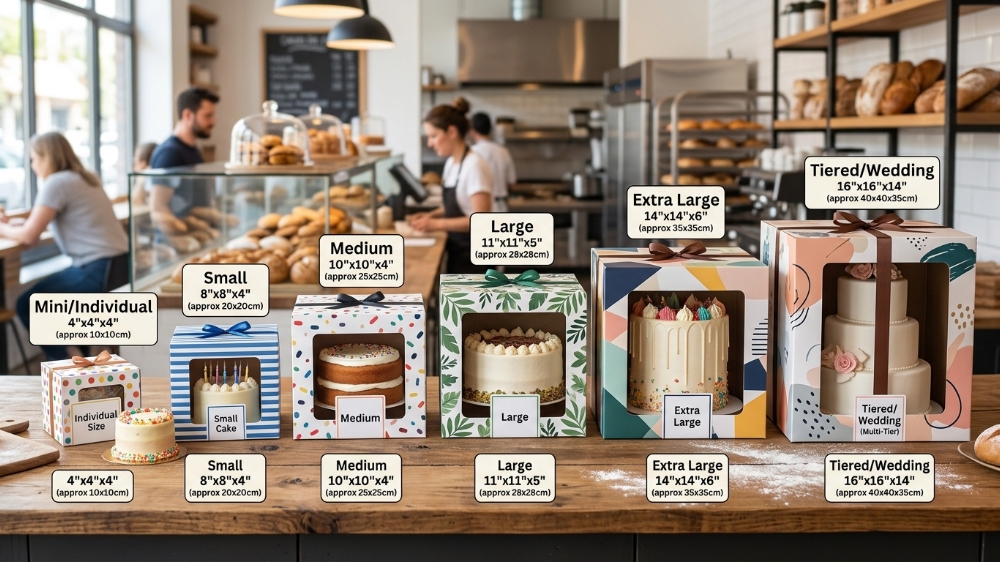
Box outer dimension and cake diameter are two different specifications, and mixing them up is the most common reason a “10-inch” box order arrives too tight for a fully frosted 10-inch layer cake. The chart below lines up cake diameter, typical outer box dimensions, standard height, and metric conversions so the numbers you compare match real packaging.
| Size | Cake diameter | Typical box (outer) | Metric | Best suited for |
|---|---|---|---|---|
| Mini / Individual | 3–4″ | 4″ x 4″ x 4″ | ~10 x 10 cm | Smash cakes, individual portions, gift-sized treats |
| Small | 6″ | 7″ x 7″ x 4″ or 8″ x 8″ x 4″ | ~18–20 cm | Small birthday cakes, single-layer orders |
| Medium | 8″–9″ | 10″ x 10″ x 4″ | ~25 cm | The most-ordered everyday bakery size, 2-layer cakes |
| Large | 10″ | 11″ x 11″ x 5″ or 12″ x 12″ x 5″ | ~28–30 cm | Family celebrations, 15–25 servings |
| Extra Large | 12″–14″ | 14″ x 14″ x 6″ | ~35 cm | Larger parties, heavily decorated cakes needing height |
| Tiered / Wedding | Multi-tier, 6″–14″ base | 14″ x 14″ x 10″ up to 20″ x 20″ x 12″ | ~35–50 cm | Stacked wedding and celebration cakes, reinforced construction |
These brackets aren’t arbitrary. Bakery packaging suppliers converge on the same handful of footprints because a standard cake box commonly measures around 10″ x 10″ x 4″ for everyday orders, with a 1kg-class box closer to 8″ x 8″ x 4″ and a 3kg-class box closer to 14″ x 14″ x 6″, per BoxesGen’s bakery box dieline guide — a step pattern that lets a kitchen stock a handful of die-cut sizes rather than a custom box for every cake on the menu. Wedding-scale boxes stretch further still: wedding cake boxes commonly run 14″ x 14″ x 10″ up to 20″ x 20″ x 12″, sturdy enough to support the combined weight of a multi-tier stack rather than a single layer.
Why the Box Number Is Never the Cake Number
A box labeled 10″ x 10″ does not give a 10-inch cake 10 inches of clearance — corrugated or paperboard wall thickness eats into that number immediately, and clearance has to be measured against the frosted, decorated cake, not the bare cake layers. Confirming which measurement a supplier is quoting before ordering avoids the single most common cake-packaging mistake.
Clearance conventions are fairly consistent across suppliers. Staysure Packaging’s sizing breakdown recommends at least half an inch of clearance on all sides beyond the cake’s measured diameter or width, scaling up for taller, more heavily decorated cakes. That clearance protects two things at once: it keeps the box walls from smearing buttercream during transport, and it leaves enough room for the lid to close without pressing down on piped decoration, fondant toppers, or fresh flowers.
Box height is the other number that gets overlooked, and it should be sized off the finished cake, not the raw layer count. A standard two-layer cake with frosting typically needs 4 to 5 inches of interior height, while Staysure’s size ranges put small cakes at 3–4 inches of height, medium cakes at 4–5 inches, and large or extra-tall cakes at 6 inches and up once tiers or heavy decoration are involved. Tiered cakes compound this fast: sizing guidance for tiered construction shows that each tier averages roughly 3.5 inches of finished height, plus about a quarter-inch of dowel-rod clearance between tiers, plus another inch of headroom above the top tier’s icing for the lid — three numbers that stack quickly once you’re past two tiers.
Before finalizing a cake box order, confirm:
- Whether the published dimension is outer (box) or inner (usable) space
- Clearance against the fully frosted and decorated cake, not the bare layers
- Box height against your tallest tier or topper — 4″ standard vs. 6″+ for tall or multi-tier builds
- Whether a tiered build should ship assembled or disassembled for safe transport
Cake Box Sizes by Cake Type: Layer, Tiered, Sheet, and Cupcake
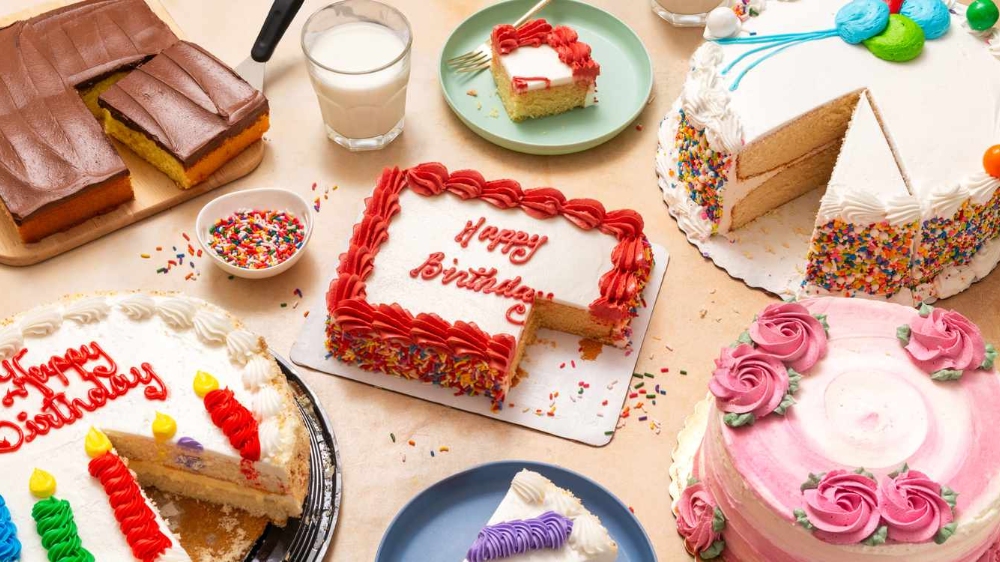
Different cake formats don’t just scale the same box up or down — a sheet cake, a stacked wedding tier, and a box of cupcakes each solve a different packaging problem, so the size logic changes with the format, not just the diameter.
Round and square layer cakes
A standard 8–9 inch round layer cake is the most-ordered size at most bakeries, and it typically ships in a 10″ x 10″ x 4″ box with roughly half an inch of clearance built in. Square cakes of the same labeled diameter need slightly more room corner-to-corner than round cakes of the same width, since a square cake’s diagonal exceeds its side length — a detail that also explains why square cakes yield noticeably more servings than a round cake of the same size, a point covered in the serving section below. Click to know more about round cake box if you need.
Tiered and wedding cakes
Tiered cakes are sized by the bottom tier’s footprint, not an average of all tiers, and height is the constraint that breaks first. A four-tier stack built from 6″, 8″, 10″, and 12″ rounds can reach 14 to 16 inches of finished height, which exceeds what most single corrugated boxes and standard refrigerator shelving can safely accommodate, so the professional approach is to ship the lower tiers in separate same-footprint boxes and deliver the top tier inside the base box, then stack the cake on-site after refrigerated transport. Ready-made tiered box systems reflect this same logic, with dedicated tall-format boxes sized specifically to a tier’s diameter and finished height rather than a generic square carton.
Sheet cakes
Sheet cakes trade height for footprint. A quarter-sheet (roughly 9″ x 13″) and a half-sheet (roughly 13″ x 18″) are the two most common catering sizes, and both typically ship in a shallow 3–4 inch tall box, since sheet cakes are rarely stacked or heavily built up in height the way a layer or tiered cake is. This shallow-and-wide profile is also why sheet cakes fit more efficiently into standard refrigerator and delivery-vehicle shelving than an equivalent-serving round or tiered order. Click here to get sheet cakes box free samples.
Cupcakes and mini cakes
Cupcake and mini-cake boxes are sized by count and insert layout rather than diameter. A box built for a dozen cupcakes commonly measures around 14″ x 10″ x 4″, while a 24-cupcake box typically runs closer to 19″ x 14″ x 4″, with a fitted insert holding each cupcake in place so frosting doesn’t transfer between compartments. Mini cakes and individual gift-sized portions use the smallest standard footprint in the category, often 4″ x 4″ x 4″ or 6″ x 6″ x 3″, sized for a single portion rather than a shared cake.
What Size Fits a Café, Coffee Shop, or QSR Bakery Case?
A café or coffee-shop counter doesn’t buy cake boxes the way a wedding bakery does — the constraint isn’t the cake’s diameter, it’s the grab-and-go case the finished slice or mini cake has to sit inside before a customer ever sees a box. Countertop refrigerated bakery cases sold for café and QSR use commonly range from roughly 27.5 inches up to 73 inches wide, in a compact countertop format built for spaces where floor room is limited, which is why café-focused cake and pastry packaging skews toward individual slice boxes and small 6–8 inch whole-cake formats rather than the 14-inch-plus boxes a dedicated bakery stocks.
That case footprint also shapes box height, not just width. Because most countertop café cases are shallower and shorter than a full-service bakery merchandiser, whole cakes sold through a coffee-shop counter are usually capped around 6–8 inches in diameter and 4–5 inches tall — tall enough for a standard two-layer build, but short enough to clear the case’s interior shelf height without the box lid brushing the glass above it. Pre-sliced and grab-and-go formats sidestep this limit entirely by packaging single slices in a shallow 4–5 inch box, which is also why compact slice and mini-cake boxes with a quick-fold design are built specifically for high-turnover counter service rather than for a full cake order.
For QSR and fast-casual chains running a fixed bakery-case program across many locations, the same standardization logic that governs pizza-box ladders applies to cake: rather than stocking a size for every cake on the menu, most operators fix on two or three box footprints — typically a mini/individual size, an 8-inch whole-cake size, and a slice box — that all share the same fold tooling and fit the same case dimensions company-wide.
Commercial Bakery Display Cases and Retail Freezer Dimensions
Beyond the café counter, a cake box has to fit inside genuinely industrial equipment: full-service bakery display cases in dedicated bakeries and grocery in-store bakeries, and standalone freezer or cooler cases on a supermarket floor. Both come in fairly standardized dimensions that set a hard ceiling on box size.
Full-size refrigerated bakery merchandisers — the four-sided glass cases used in dedicated bakeries and larger cafés — commonly offer an interior usable depth of roughly 24 inches and an interior shelf height around 32 inches across adjustable glass shelving, based on manufacturer specifications for 48-, 60-, and 71-inch refrigerated cake display cases. These units are built to hold temperatures in the 36°F to 43°F range and are NSF-7 compliant for open food display, which matters for box choice: a box destined for one of these cases needs a base sturdy enough to be lifted in and out repeatedly on a glass shelf, and a height that leaves headroom below the shelf above it — generally under 10 inches for anything but the bottom shelf.
Grocery and supermarket-scale display equipment runs on a different, wider standard. Full-size supermarket bakery and deli merchandising cases are commonly available in a standard 30-inch depth, with a wider 36-inch depth option for higher-volume departments, per Hillphoenix’s retail display case specifications — deeper than a café countertop case, which is why grocery in-store bakeries can merchandise larger whole cakes, sheet cakes, and multi-box displays that a coffee-shop counter simply doesn’t have the depth to hold. That extra depth is also what allows supermarket bakery departments to run dedicated cake-decorating stations built into the same case line, keeping the finished product, the box, and the decorating counter within a few feet of each other.
Before finalizing a bakery-case or retail cake box order, check:
- Case interior depth — roughly 24″ for a countertop bakery merchandiser, 30″–36″ for full supermarket cases
- Shelf-to-shelf height clearance against your box’s finished height, not just the cake’s
- Whether the case is refrigerated (36–43°F) or dry, since that changes box material and lining needs
- How many boxes need to sit front-to-back without blocking branding on the box behind it
How to Choose the Right Cake Box Size for Your Situation
The “right” standard size changes depending on who’s buying — a home baker packing a single order, a café stocking a countertop case, a wedding cake decorator building a stacked tier, a grocery in-store bakery merchandising dozens of cakes a day, or a caterer sizing sheet cakes for a large event. Matching the buyer’s situation to a size, rather than defaulting to whatever number sounds biggest, avoids both crushed decoration and wasted packaging spend.
| Who’s choosing | Recommended size | Why |
|---|---|---|
| Home baker / small bakery | 8″–10″ core, 4″–6″ for minis | Two or three sizes cover most birthday and everyday orders without excess packaging spend |
| Café / coffee shop / QSR | 6″–8″ whole cake, slice boxes for grab-and-go | Matches countertop display case depth and height; keeps turnover fast at the counter |
| Wedding / tiered cake decorator | 14″–20″ reinforced, sized to bottom tier | Handles combined tier weight and finished height; ship disassembled above 3 tiers |
| Caterer / event planner | Quarter or half sheet, 3″–4″ depth | Maximizes servings per box footprint for large guest counts without stacking height |
| Grocery / retail in-store bakery | 10″–14″ sized to 30″–36″ case depth | Fits full supermarket bakery-case dimensions and supports higher daily turnover |
Serving count is the other variable that should drive size, not just diameter. Because slice width, not just cake width, determines yield, an 8-inch square cake yields around 32 standard wedding-style servings versus roughly 22 from an 8-inch round of the same labeled size — a gap driven entirely by the curved perimeter’s waste on a round cake, sometimes called the Wilton adjustment. That same shape effect shows up in party-style serving too: square cakes commonly offer up to 25% more servings than a round cake at the same size label, and at party-cut widths an 10-inch round cake produces roughly 28 to 38 servings depending on how generously it’s sliced. Buyers ordering by guest count rather than diameter should size the box to the shape and cut style they actually plan to serve, not just the inch number on the menu.
Businesses evaluating a full lineup rather than a single size can review options such as custom cake box designs, branded bakery boxes for bulk ordering, or fully bespoke packaging sized by cake diameter and case fit before committing to a production run. Whatever the segment, the same rule applies: test the actual cake, box, and display case together before finalizing a size — the inch number on a spec sheet is only the starting point. Try to ask Maibao Packaging expert for cake box help.
Not sure which size fits your menu?
Talk to a packaging specialist about matching cake box size, height clearance, and display-case dimensions to your actual product line.
Frequently Asked Questions
What is the standard cake box size for a 10-inch cake?
A 10-inch layer cake typically ships in an 11″ x 11″ x 5″ or 12″ x 12″ x 5″ box, depending on how much clearance the supplier builds in. Confirm interior versus outer dimensions before ordering, since frosted cakes need more side clearance than bare cake layers.
Why is my cake box bigger than my cake?
Boxes are sized with at least half an inch of clearance around the fully frosted and decorated cake to protect icing and toppers in transit. Box height is also built up from the finished cake, including any tiers or decorations, so the usable interior space is intentionally larger than the raw cake diameter.
What size box does a tiered wedding cake need?
A tiered cake is boxed by its bottom tier’s footprint, commonly in a 14″ x 14″ x 10″ up to 20″ x 20″ x 12″ box for smaller stacks. Stacks above three tiers are usually shipped disassembled in separate same-size boxes and stacked on-site rather than boxed fully assembled.
What size cake box fits a café or coffee shop display case?
Most café and QSR countertop bakery cases fit whole cakes up to about 6–8 inches in diameter and 4–5 inches tall, matching the shallower depth of a countertop case versus a full bakery merchandiser. Pre-sliced grab-and-go formats use a shallow 4–5 inch slice box instead of a whole-cake box.
Post time: Jul-17-2026