How to Choose a Plastic Cup Supplier: 10 Factors to Check Before a Bulk Order
Plastic Cup Supplier Guide: 10 Checks Before a Bulk Order
B2B Packaging Sourcing Guide
How to Choose a Plastic Cup Supplier: 10 Factors to Check Before a Bulk Order
A bulk cup order is unforgiving. Once 200,000 units are molded, printed, and boxed, a 0.3mm rim mismatch or the wrong resin for your filling line isn’t a minor issue—it’s a container of unusable inventory. Here is the buyer-side framework for vetting a plastic cup supplier before you commit to volume.
Choosing a plastic cup supplier looks simple from the outside: pick a size, pick a color, get a quote. In practice, a bulk plastic cup order sits at the intersection of material chemistry, mold tolerances, printing methods, and food-contact regulation—and most sourcing failures trace back to a factor the buyer never asked about, not one the supplier hid.
This guide is written for procurement teams, beverage brands, and packaging buyers placing a first bulk order or switching suppliers. It walks through the ten factors that separate a reliable plastic cup supplier from one that will cost you a rejected container or a failed store launch, in the order a buyer should actually evaluate them.
Material Options: PET, PP, PS, and PLA for Bulk Cups
Material selection is a chemistry question that a supplier can explain, but it is a purchasing decision the buyer has to make. Before comparing suppliers, you need to know which resin fits your filling line, your shelf environment, and your price target—because a supplier who only offers one material will always tell you it’s the right one.
PET (polyethylene terephthalate)
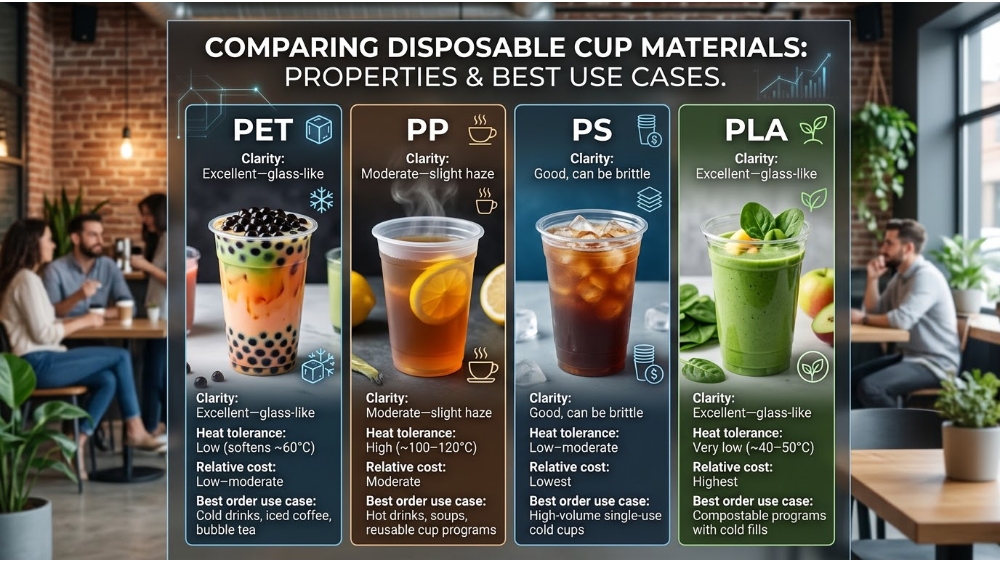
PET is the default choice for cold beverages, iced coffee, and bubble tea because of its glass-like clarity and rigidity at low temperatures. It holds its shape under carbonation and doesn’t cloud when chilled, but it softens and can deform above roughly 60°C, which rules it out for hot-fill applications. Click to explore PET cups for cold drinks
PP (polypropylene)
PP tolerates higher temperatures—typically up to 100–120°C depending on the grade—making it the standard for hot drinks, soup cups, and reusable cup programs. The trade-off is a slightly hazy, translucent finish rather than PET’s water-clear look, and a marginally softer wall unless thickness is increased. Click to explore PP cups
PS (polystyrene)
PS is the lowest-cost option for single-use cold cups and is common in high-volume, low-margin foodservice settings. It’s rigid and easy to mold but more brittle under impact and stress-cracks more easily when exposed to certain oils or high-fat contents—worth flagging if your product isn’t a plain beverage.
PLA (polylactic acid)
PLA is a plant-based, compostable resin used where brands need an alternative to conventional plastic. It performs similarly to PET in clarity but has a lower heat tolerance (around 40–50°C) and requires industrial composting infrastructure to break down as intended—a detail buyers frequently overlook when marketing “compostable” claims to their own customers. Expect a 20–40% cost premium over PET at comparable volumes.
Material
Clarity
Heat tolerance
Relative cost
Best order use case
PET
Excellent—glass-like
Low (softens ~60°C)
Low–moderate
Cold drinks, iced coffee, bubble tea
PP
Moderate—slight haze
High (~100–120°C)
Moderate
Hot drinks, soups, reusable cup programs
PS
Good, can be brittle
Low–moderate
Lowest
High-volume single-use cold cups
PLA
Excellent—glass-like
Very low (~40–50°C)
Highest
Compostable programs with cold fills
Ask any prospective supplier which resins they run in-house versus which they subcontract. A supplier who molds PET daily but outsources PLA to a converter is adding a hidden supply-chain link you’ll want to know about before, not after, you place the order. Click to explore PLA cups
Product Specifications to Confirm Before You Order
Material only sets the baseline. The specification sheet is where a bulk order actually succeeds or fails, and it needs to be locked in writing before a single mold is run—not agreed to verbally on a sales call.
Capacity and fill line
Confirm both nominal capacity (the marketed size, like 16oz) and actual brim-full capacity, since the two can differ by 5–10%. Your filling equipment calibrates to actual volume, not the number printed on the cup, so a mismatch here creates underfilled or overflowing product on the line. Learn more about plastic cup sizes by Plastic Cup Sizes Explained Guide.
Dimensions and taper angle
Top diameter, base diameter, height, and wall taper angle determine whether the cup fits your existing lid stock, your cup-dispenser hardware, and your carrier trays. A taper angle change of even a few degrees can throw off nesting depth and dispenser compatibility.
Wall thickness and weight tolerance
Wall thickness (measured in mm, not just described as “standard” or “heavy-duty”) drives both rigidity and material cost. Ask for a weight tolerance range in grams—a swing of more than about ±0.3g per cup across a production run usually signals inconsistent extrusion or thermoforming control. Read Plastic Cup Gram Weight Guide to know about plastic cup weight in detail.
Rim diameter and stacking/nesting
Rim diameter tolerance is the single most consequential spec on this list, because it determines lid fit (more on that below) and how tightly cups nest for shipping and storage. Tight, consistent nesting reduces the cubic volume you’re freighting and the shelf space your foodservice customers need—both of which affect your landed cost per unit.
Specs to put in writing on the purchase order:
Nominal capacity and actual brim-full capacity (mL/oz)
Top diameter, base diameter, height, and taper angle
Wall thickness in mm and gram weight tolerance range
Rim outer diameter (OD) with tolerance in mm
Nesting count per sleeve and case pack quantity
Cup and Lid Compatibility: The Detail Most Buyers Miss
This is where most bulk orders quietly go wrong. A cup and a lid can each individually meet spec and still fail together, because compatibility is a function of tolerance stacking, not any single dimension.
Rim dimensions and lid fit
The lid’s inner diameter and the cup’s rim outer diameter need to be matched within a tight tolerance—typically ±0.1–0.2mm for a secure snap or seal. If your cup supplier and lid supplier are different vendors, this tolerance has to be communicated explicitly between both parties; assuming “standard sizing” is how mismatched batches happen.
Dome lids vs. flat lids
Dome lids add headspace for whipped toppings, boba, or ice, and typically use a different rim engagement than flat sipper lids. If you’re switching lid styles mid-contract—say, moving from a flat hot-drink lid to a dome cold-drink lid—confirm the rim profile is compatible with both before ordering cups at volume.
Sealing film compatibility
For cup-sealed formats like bubble tea or ready-to-drink beverages, the sealing film needs a rim surface and material composition it can actually heat-bond to. PP and PET respond differently to sealing film adhesives and sealing temperatures, which is a separate technical conversation worth having in detail if your product line uses heat-sealed film rather than snap lids.
Before approving cup-and-lid compatibility, request:
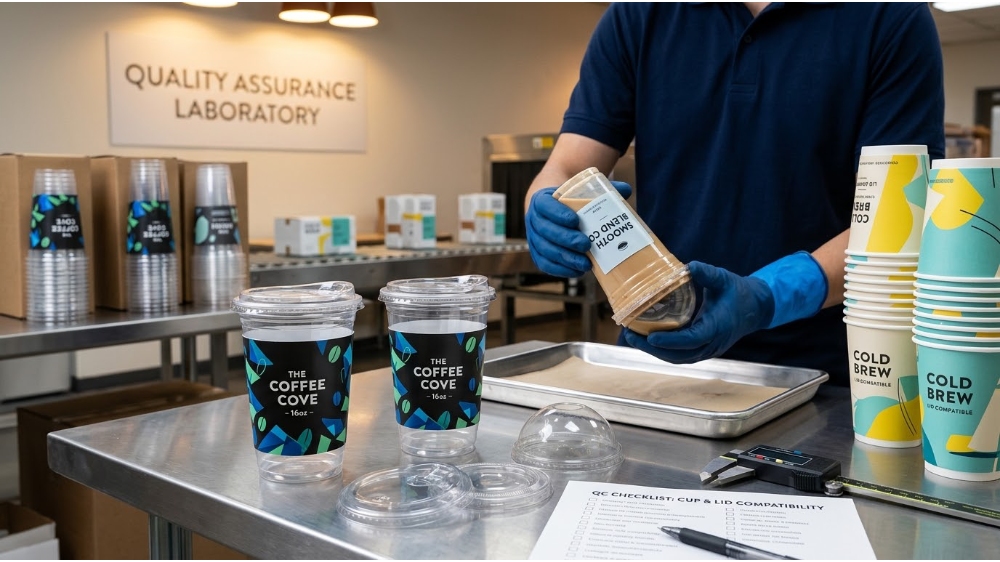
A physical fit test using cups and lids from the same production batches you’ll actually order
A leakage test: filled, lidded cups inverted and left for 30–60 minutes
A drop test on filled, sealed units from a standard handling height
Confirmation of sealing film compatibility if your line uses heat-sealed film rather than snap lids
Never approve lid compatibility from a spec sheet alone. Two suppliers’ “95mm rim” cups are not guaranteed to be interchangeable—tolerance stacking between different tooling can produce a fit that looks fine on paper and leaks in the field.
Food-Contact Compliance Documents to Request
Compliance is not a formality to check off—it’s the paperwork that protects your business if a retailer, distributor, or regulator asks for it later. Request these documents before, not after, placing a bulk order.
Food-contact certification
Ask for documentation confirming the resin and finished cup meet food-contact requirements for your target market—for example, FDA 21 CFR compliance for the United States or EU Regulation 10/2011 for the European market. A supplier exporting internationally should be able to produce market-specific certificates on request, not just a generic “food grade” claim. Understand about cup certifications in detail by reading Compostable Cup Certifications: BPI vs ASTM D6400 vs EN 13432.
Migration testing reports
Migration testing measures whether chemical components of the plastic transfer into food or beverage contents under specified conditions—overall migration limits and, where relevant, specific substance limits. Ask for a current migration test report tied to the actual resin and cup design you’re ordering, not a report from a different SKU or an older formulation.
Material documentation and traceability
Request a certificate of analysis (COA) for the resin lot and confirmation of resin source. Traceability matters most when something goes wrong: if a batch is later flagged, you need to know exactly which resin lot, production run, and shipment it came from.
Compliance document checklist for a new supplier:
Food-contact compliance certificate matching your target market
Migration test report for the specific resin and cup design
Resin certificate of analysis with lot traceability
Material safety data documentation for the finished product
Manufacturing Capability: What to Verify Before You Commit
The manufacturing process a supplier uses shapes what’s actually achievable in your order—wall consistency, minimum thickness, and how quickly a design change can be implemented.
Extrusion and thermoforming vs. injection molding
Thin-wall PET and PP cups are typically produced by extruding sheet stock and thermoforming it into shape—fast, cost-efficient for high volumes, and the standard process for most beverage cups. Injection molding is used for thicker-walled cups, lids, and reusable cup lines, offering tighter dimensional control at a higher per-unit tooling cost. Ask which process applies to your specific product, since the two have different tolerance capabilities and different minimum order thresholds.
Production capacity
Ask directly how many machines are running your target material and size range, and what their daily output is. A supplier quoting a fast turnaround on paper but running your order on a single shared line is a lead-time risk you won’t see until your order is already late.
Quality control checkpoints
A credible manufacturer should be able to describe incoming resin inspection, in-line thickness gauge monitoring during production, and a defined sample pull rate for outgoing inspection—not just “we check the cups before shipping.” Ask what percentage of each run gets inspected and what the rejection criteria are.
Questions to ask about manufacturing capability:
Which process—thermoforming or injection molding—applies to your product?
How many dedicated machines and daily output capacity for this size/material?
What in-line QC checks run during production, not just before shipment?
What is the documented defect/rejection rate on comparable past orders?
Custom Printing Capability for Branded Cups
Printing is often where a bulk order’s true cost and true MOQ get set—the printing method usually drives the minimum order quantity more than the cup itself does.
Screen printing
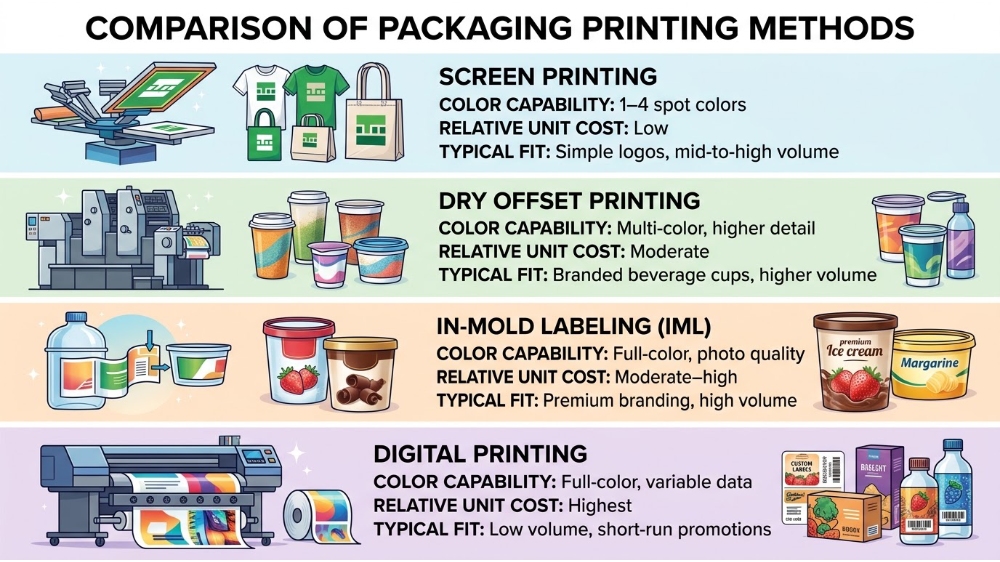
Screen printing is the most common and cost-efficient method for one- to four-color logos, especially at mid-to-high volumes. It works well on curved cup surfaces but has practical limits on fine detail and gradient work.
Offset (dry offset) printing
Dry offset printing wraps higher-fidelity, multi-color artwork around cylindrical containers and is a common standard for branded beverage cups needing sharper detail than screen printing allows.
In-mold labeling (IML)
IML fuses a pre-printed label into the cup during molding, producing a premium, photograph-quality finish with no risk of the print wearing off. It typically requires higher volumes to justify the tooling and setup cost.
Digital printing
Digital printing supports low-volume runs and variable artwork (different designs within the same order) but carries a higher per-unit cost than screen or offset printing at scale.
Print area and color matching
Cup taper limits how much of the surface can carry a full wrap-around print without distortion—ask for a print-area mockup before finalizing artwork. For color matching, insist on a physical draw-down or pre-production proof against your Pantone reference; a screen rendering of your logo color is not a reliable predictor of how ink cures on the actual cup material.
Printing method
Color capability
Relative unit cost
Typical fit
Screen printing
1–4 spot colors
Low
Simple logos, mid-to-high volume
Dry offset
Multi-color, higher detail
Moderate
Branded beverage cups, higher volume
IML
Full-color, photo quality
Moderate–high
Premium branding, high volume
Digital printing
Full-color, variable data
Highest
Low volume, short-run promotions
MOQ: Standard Cups vs. Custom Printed vs. Custom Molds
Minimum order quantity is rarely one number—it changes depending on how much customization you’re asking for, and this is where B2B buyers most often get an unpleasant surprise mid-negotiation.
Standard (blank) cup MOQ
Unprinted cups in a supplier’s existing mold and size range carry the lowest MOQ, since no new tooling or print setup is involved—often in the range of 10,000–20,000 units per size/material combination, though this varies by supplier.
Custom printed cup MOQ
Adding a custom logo via screen or offset printing raises the MOQ to cover setup and changeover costs—commonly 20,000–50,000 units per design, with lower-volume digital printing available as an exception at a higher unit price.
Custom mold MOQ
A fully custom shape, capacity, or rim profile requires new tooling, and suppliers need enough volume to amortize that tooling cost—typically well into six figures per order, and sometimes structured as a tooling fee plus a lower recurring MOQ on subsequent orders.
MOQ negotiation questions worth asking upfront:
Is MOQ per SKU/design, or can colors and print variants be mixed within one MOQ?
Does a custom mold include a tooling fee, and does it lower MOQ on reorders?
Can MOQ be split across two shipments to ease inventory carrying cost?
Sampling Before Bulk Production: Non-Negotiable Steps
Never approve a high-volume order based only on photos or a specification sheet. A pre-production sample is the only reliable way to verify that everything discussed above—material, dimensions, lid fit, and print quality—actually holds up in physical form.
What to test on a physical sample
Run the sample through the same conditions your finished product will face, not just a visual check.
Pre-production sample test checklist:
Cup rigidity: squeeze test and drop test at typical handling height
Rim fit: test with the actual lid batch you intend to use, not a generic lid
Leakage test: filled and lidded, inverted, held for at least 30–60 minutes
Stacking/nesting test: confirm sleeves nest to the depth quoted for shipping
Printing verification: check color match, print adhesion, and wear resistance
Beverage test: fill with your actual product (hot, cold, or oil-based) and hold for the expected shelf/service time
Request that the pre-production sample be pulled from the same tooling and resin lot that will run your bulk order—not a “reference sample” from a previous customer’s batch. A sample from different tooling tells you almost nothing about what you’re about to receive at volume.
Lead Time and Supply Capacity for Repeat Orders
Lead time quoted for a single sample order and lead time under real production load are two different numbers, and the gap between them is where seasonal beverage brands get caught out.
Seasonal demand
If your cup demand spikes seasonally—iced beverages in summer, holiday cup designs in Q4—ask how the supplier’s production calendar handles peak-season order stacking across their full customer base, not just your account in isolation.
Repeat orders and capacity reservation
For recurring bulk orders, ask whether the supplier can reserve a production slot or maintain safety stock of your specific SKU, versus queuing every reorder as a new job behind other customers’ work.
Stock cups vs. custom production
For urgent timelines, ask whether the supplier keeps stock (uncustomized or lightly customized) cups on hand that can ship faster than a full custom production run, even at a modest premium—useful as a bridge while a custom order is in progress.
Lead time questions for large or repeat orders:
What is quoted lead time under normal load vs. peak season?
Can a production slot be reserved for recurring orders?
Is safety stock or a stock-cup bridge option available for urgent needs?
Total Sourcing Cost: Beyond the Unit Price
The lowest quoted unit price is frequently not the lowest total cost. A complete cost comparison between suppliers needs to include several line items that don’t appear on the first quote.
Cost factor
Why it matters
Unit price
The baseline number, but incomplete on its own
Freight and container efficiency
Nesting depth and case pack determine cubic volume shipped
Tooling amortization
Custom molds add upfront cost that must be spread across order volume
Reject rate / quality cost
A higher defect rate erodes savings from a lower unit price
MOQ carrying cost
Overstock from a high MOQ ties up warehouse space and working capital
Duties and import cost
Varies by material, origin, and destination market
A supplier priced 5% lower but with a nesting depth that fits fewer units per container, or a defect rate that requires re-inspection on arrival, can easily end up costing more per delivered, usable unit. Ask each supplier under consideration for a landed-cost estimate that includes freight and expected reject rate, not just a factory-gate unit price.
For buyers running multiple SKUs—cups, lids, sleeves, and carriers—working with a single packaging partner who can quote and coordinate the full set often reduces both total freight cost and the coordination overhead of managing several vendors on one product launch. For a sourcing consultation on plastic cups, lids, and matched beverage packaging systems, contact Maibao Packaging.
Ready to vet a plastic cup supplier for your next bulk order?
Get a landed-cost quote, spec sheet review, and pre-production sample plan matched to your material, lid type, and volume.
What is a typical MOQ for custom printed plastic cups?
Custom printed cups using screen or offset printing typically require 20,000–50,000 units per design, while unprinted standard cups can start lower, around 10,000–20,000 units. Custom molds carry a much higher MOQ to cover tooling costs.
Which plastic cup material is best for cold beverages vs. hot?
PET is the standard for cold drinks due to its clarity and rigidity at low temperatures but softens above roughly 60°C. PP handles hot fills up to 100–120°C but has a slightly hazier finish than PET.
How do I know if a cup and lid will actually fit before bulk production?
Request a physical fit test using cups and lids from the exact production batches you intend to order, then run a leakage test with the filled and lidded cup inverted for 30–60 minutes. A spec-sheet match alone does not guarantee a physical fit.
What food-contact documents should I request from a plastic cup supplier?
Ask for a food-contact compliance certificate matching your target market (such as FDA or EU standards), a migration test report specific to your resin and cup design, and a certificate of analysis with resin lot traceability.
Post time:
Sep-14-2026
For inquiries about our products or pricelist, please leave your email to us and we will be in touch within 24 hours.