PP vs. PET Cups for Bubble Tea: Sealing Compatibility, Clarity, Strength & Cost
PP vs PET Bubble Tea Cups: Which Seals Best? Buyer Guide
Bubble Tea Packaging Guide
PP vs. PET Cups for Bubble Tea: Sealing Compatibility, Clarity, Strength & Cost
A shop owner loads a fresh roll of film, runs a batch of PET cups through the sealer, and half the lids lift at the corner within the hour. Swap in PP cups on the same machine, same settings, and the seal holds. This isn’t random—cup material changes how a sealing machine behaves, and getting the pairing wrong is one of the most common, most avoidable operational headaches in a bubble tea shop.
Ask ten bubble tea shop owners whether they use PP or PET cups, and you’ll get ten different answers—along with at least a few sealing horror stories. A Reddit thread among boba shop owners on this exact question drew responses ranging from “PP is all I’ve ever used, no issues” to “switched to PET for the clarity and now my sealer jams constantly.” Both experiences are real, and both are explained by the same underlying mechanics: cup material, rim geometry, and sealing film chemistry all have to line up, or the seal fails.
This guide breaks down exactly why that happens, what each material is actually good at, and how to make a sourcing decision that holds up on a busy shift—not just on a supplier’s spec sheet.
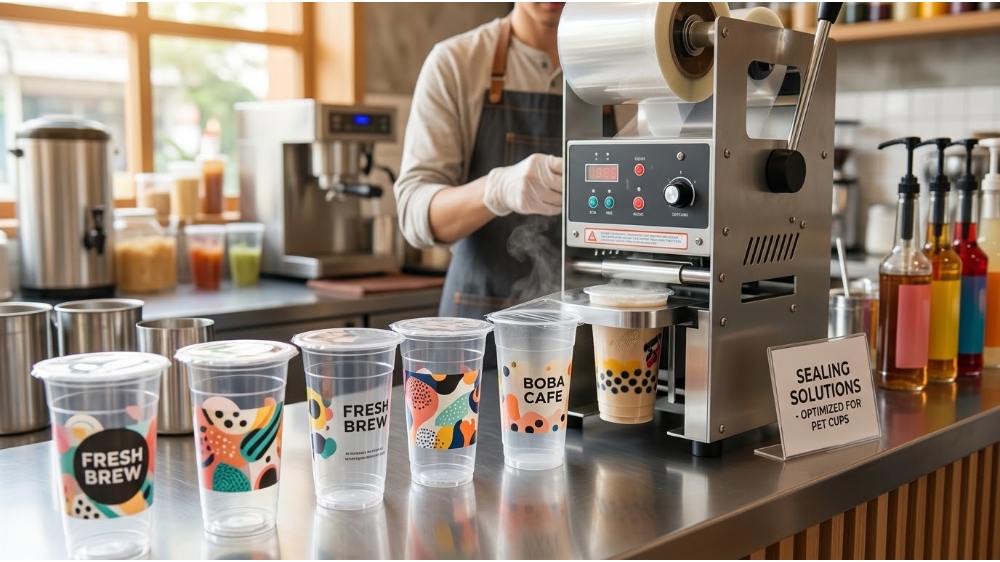
Automatic cup sealing—heat-pressing a plastic film over the rim instead of snapping on a lid—is now the default in most bubble tea shops, and it only works with rigid plastic cups. Paper cups need special coated film and adapter rings; foam cups are rarely sealed at all. That leaves two materials doing almost all of the work in the industry: polypropylene (PP) and polyethylene terephthalate (PET).
The reason these two dominate isn’t accident. Both are FDA-compliant for food and beverage contact, both mold cleanly into the tall, narrow, wide-rimmed shape a boba drink needs, and both can survive a straw punching through a sealed film without splitting. From there, the two materials diverge sharply—and that divergence is exactly what determines whether a shop’s sealing machine runs smoothly or fights every cup.
PP vs PET: What Is the Difference?
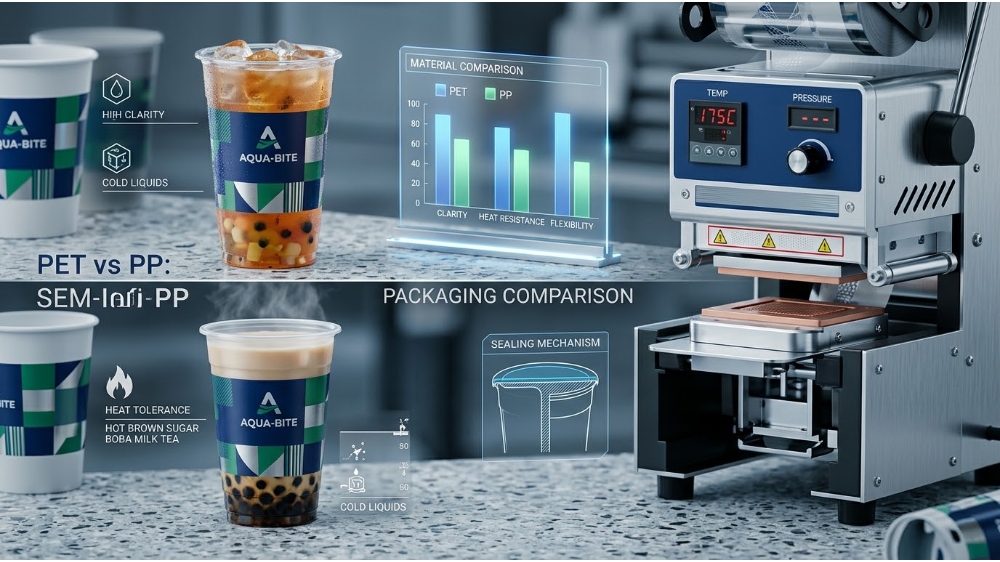
At the material level, PP and PET are different plastic families with different behavior under heat and stress. PP is a semi-flexible thermoplastic with a relatively high melting point, which is why it shows up in microwave-safe containers and hot-fill packaging. PET is a rigid, glass-clear polyester with a lower practical heat tolerance, which is why it dominates cold beverage bottles and clear deli containers. Neither is “better” in the abstract—they’re built for different jobs, and a bubble tea cup asks something specific of each. Read PET Cup Guide to know more about PET in detail.
Factor
PET
PP
Clarity
Excellent
Lower / variable
Rigidity
High
More flexible
Heat resistance
Lower
Higher
Cold drink presentation
Excellent
Good
Crack resistance
Good
Very good
Sealing applications
Depends on system
Common
Typical applications
Cold drinks
Beverage / foodservice depending on spec
Cost
Varies
Varies
That table is the quick answer. The rest of this guide is about the one factor it can’t fully capture: what happens when either cup meets a cup sealing machine.
This is the question that actually decides day-to-day operations, and it comes down to how each material responds to seven variables working together.
Sealing temperature. Every sealer heats a die that presses film onto the cup rim. PP tolerates a wider heat range without deforming, so shops running slightly hotter settings—common when a machine hasn’t been recalibrated in a while—get away with it on PP but not on PET, where excess heat can warp the rim or cloud the plastic.
Sealing pressure. PP’s flexibility lets the rim compress slightly under the sealing head, helping the film seat evenly even if the machine’s pressure isn’t perfectly uniform. PET’s rigidity means the rim doesn’t give—so any unevenness in the press head, any slight machine wear, shows up as a gap in the seal rather than being absorbed by the material.
Dwell time. This is the fraction of a second the heated die stays in contact with the film and rim. PP generally seals reliably across a broader dwell-time window. PET has a narrower window: too short and the film doesn’t fully bond; too long and heat can distort the rigid rim.
Cup rim design. Many PP cups are manufactured with a rim profile specifically engineered to help film grip and seal—sometimes described as a U-shaped or reinforced rim. This is a deliberate design compensation, because PP’s lower rigidity would otherwise make the seal less predictable. PET cups typically rely on the material’s natural stiffness to hold shape against the sealing die instead.
Film material. The sealing film’s adhesive layer is chemically formulated to bond to a specific plastic. This is the single biggest cause of “my sealer won’t seal” complaints industry-wide, and it’s covered in full in the mismatch section below.
Machine calibration. Sealing machines are typically factory-set around one cup diameter and one material profile—most commonly 95mm for PP or 98mm for PET. A machine calibrated for one and fed the other, even if the physical mold happens to fit, is often running the wrong temperature and dwell time for that material by default.
Cup deformation under heat. Because PP softens more readily, it’s more forgiving of minor calibration drift—it deforms just enough to still seal. PET holds its shape almost until failure, which means a poorly calibrated machine won’t gradually produce weaker seals on PET; it will produce a run of clean seals and then a batch of clear failures once a threshold is crossed.
The short version:
PP is generally more forgiving across a wider range of machine settings
PET can seal just as reliably, but needs tighter calibration and the correct PET-compatible film
Rim design and film chemistry matter as much as the base material itself
A “PP is easier to seal” cup can still fail badly with the wrong film loaded
Why Does PET Sometimes Have Sealing Problems?
This is the exact pain point that surfaces repeatedly in boba shop owner discussions: PET cups going into a sealing machine and coming out with film that lifts, wrinkles, or never bonds cleanly in the first place. The frustration is real, but it almost always traces back to one of a few identifiable causes rather than a flaw in PET itself.
The most common culprit is a film-to-cup mismatch. PP sealing film is formulated to bond with PP plastic; it is not built to adhere the same way to PET’s smoother, more chemically inert surface. A shop that switches cup suppliers, or that buys generic “clear sealing film” without checking the material spec, can end up running PP film against PET cups—and get exactly the poor adhesion this thread’s commenters described. The seal may look fine coming off the machine and then fail hours later, which is often worse than an obvious failure at the register.
The second cause is calibration drift for a rigid material. Because PET doesn’t compress or deform to absorb small mechanical inconsistencies the way PP does, a sealing machine that’s slightly out of alignment—worn gaskets, an uneven press head, temperature settings left over from a previous cup order—produces uneven pressure across the rim. On PP, that unevenness is partly masked by the material flexing into place. On PET, it shows up directly as a partial seal.
The third is rim tolerance variation between suppliers. Not all 98mm PET cups are manufactured to identical tolerances. A cup with a rim that’s fractionally out of spec for a given machine’s mold will seal inconsistently even with the correct film, which is why testing a sample batch before a bulk order matters more for PET than for PP.
None of this means PET can’t be sealed reliably—commercial boba shops run PET cups at scale every day. It means PET is less tolerant of shortcuts: the wrong film, a poorly maintained machine, or an unverified cup supplier will surface as a visible problem faster on PET than it would on PP.
PP Cups: Sealing Performance and Limitations
PP earns its reputation as the easier cup to seal, but it isn’t without trade-offs, and a fair comparison has to include them.
Rigidity. PP’s flexibility is an asset at the sealing station and a liability everywhere else. Stack PP cups too high, fill them with a heavy, hot, topping-loaded drink, or expose them to a hot car during summer delivery, and they can flex or slightly deform in ways a rigid PET cup won’t.
Clarity. Standard PP has a cloudier, sometimes slightly hazy appearance compared to PET’s glass-like transparency. For drinks sold partly on visual appeal—layered fruit teas, drinks with visible boba or jelly toppings—this is a real merchandising drawback, even though clarified PP formulations have narrowed the gap in recent years.
Heat resistance. This is PP’s clearest advantage: it holds its shape at higher temperatures than PET, making it the safer default for hot beverages, hot-fill processes, or shops that serve both hot and cold drinks out of one cup format.
Sealing behavior. As covered above, PP’s flexibility and common rim engineering make it broadly compatible across a wide range of sealing machines and calibration settings, which is a large part of why it remains the default cup for many shops.
Appearance. PP reads as the more utilitarian, everyday cup. Shops competing on speed and value lean into this; shops positioning around a premium, photo-forward drink often don’t.
Transportation. PP is lighter and generally less prone to shattering on impact, which reduces breakage in transit and lowers freight weight—an underrated cost factor at wholesale volume.
PET Cups: When Their Clarity and Rigidity Matter
PET’s core selling point is optical clarity, and there are specific categories of bubble tea drinks where that clarity is doing real commercial work, not just aesthetic polish.
Fruit tea sold with visible fruit pulp, jelly cubes, or popping boba benefits directly from a cup that doesn’t dull the color. Layered drinks—a matcha-over-milk gradient, a brown sugar boba with visible syrup striping down the cup wall—are essentially unsellable through a hazy cup, since the layering is the entire visual pitch. Milk tea with visible tapioca pearls settling at the bottom photographs and displays better through PET as well.
PET’s rigidity also has a functional upside beyond looks: taller cup formats and jumbo sizes hold their column shape better under their own weight when filled, which matters for 24oz–32oz formats increasingly common in the category. The trade-off is that this same rigidity makes PET less forgiving on impact—a dropped PET cup is more likely to crack or shatter at a seam than a dropped PP cup is to survive unmarked, particularly in cold weather when PET becomes more brittle.
How to Match Cup Material With Sealing Film
This is the single highest-value technical fact in this entire guide, because getting it wrong is what produces most of the sealing complaints discussed above: sealing film is not universal by default. PP film is formulated to chemically bond to PP plastic. PET film is formulated to bond to PET. Load the wrong one, and the machine can run perfectly while the seal itself fails.
Cup
Film
Machine Setup
Result
PP cup
PP-compatible film
Compatible sealer, correct calibration
✅ Reliable seal
PET cup
PET-compatible film
Compatible sealer, correct calibration
✅ Reliable seal
PET cup
PP film (mismatched)
Any sealer
❌ Weak or failed seal
There is a middle option worth knowing about: some suppliers offer a broader-compatibility film—sometimes marketed as a universal or multi-material film—designed to bond acceptably across PP, PET, and even some paper or PLA cups. These can simplify inventory for a shop running mixed cup formats, but “broader compatibility” is not the same as “identical seal strength” across every material, and the only way to confirm performance is a real test run.
This table reflects how sealing film chemistry generally works, not a guarantee for any specific product. Actual compatibility always depends on the exact film formulation, the sealer model, and the cup manufacturer’s tolerances—which is precisely why the questions in the final section of this guide matter before placing a bulk order.
PP vs PET for Different Bubble Tea Drinks
Quick reference by drink type:
Classic milk tea: either material works well; choice usually comes down to cost and branding, not performance
Fruit tea with visible pulp or jelly: PET’s clarity is a genuine merchandising advantage
Smoothies and blended drinks: PP’s heat and impact tolerance suits thicker, heavier-filled cups better
Fresh juice: PET showcases color and freshness; watch for citrus oils and long-term chemical compatibility with either plastic
Iced coffee with visible layers: PET is the stronger presentation choice
Classic tapioca (boba) drinks: PP remains the most common economical default across the industry
None of these are hard rules—plenty of successful shops run PP across their entire menu, and plenty run PET exclusively for brand consistency. The point is that drink category is a legitimate input into the material decision, not just cost or habit.
Which One Should a Bubble Tea Business Choose?
There’s no universally correct answer, but there is a clear way to reason through it. Weigh the decision against six criteria that actually affect daily operations:
Decision Factor
Favors PP
Favors PET
Product visibility
Lower priority
Layered, colorful, or topping-forward drinks
Sealing reliability
Broader machine tolerance
Reliable with correct film + calibration
Existing machine setup
Standard 95mm sealers
Requires 98mm-compatible or universal sealer
Unit cost
Typically lower
Typically higher
Transportation / breakage
Lighter, more impact-tolerant
Heavier, more breakage risk in transit
Customer perception
Everyday, value-forward
Premium, photo-forward
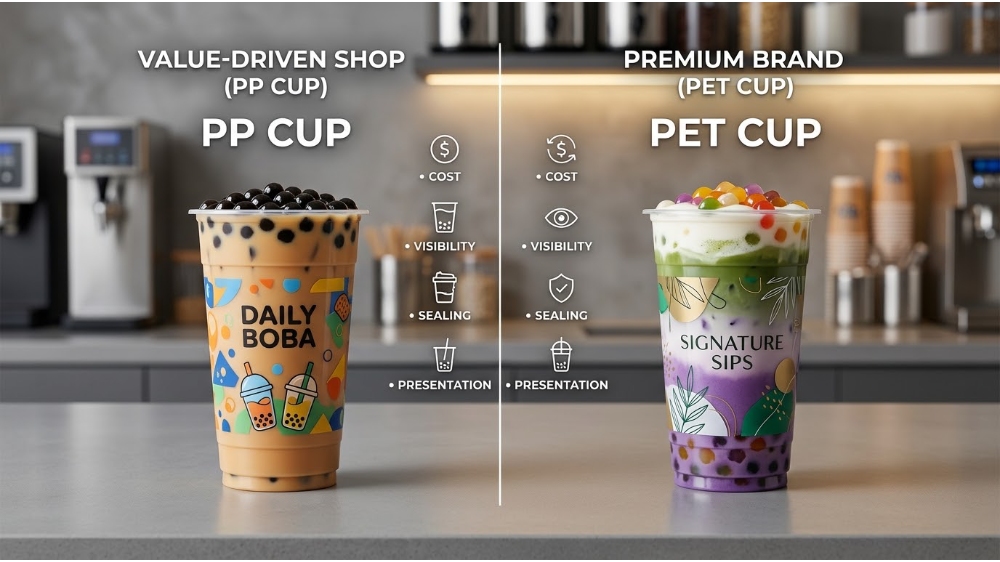
Most operators land on one of two patterns: a value- or volume-driven shop standardizes on PP for cost and sealing simplicity, while a shop built around visually distinctive drinks and premium branding accepts PET’s higher cost and tighter calibration requirements for the presentation payoff. Some multi-SKU operations use both—PP for the high-volume classic menu, PET reserved for a handful of signature, photo-driven drinks.
Questions to Ask Your Cup Supplier Before Ordering
A cup that looks identical to your current one in a product photo can behave completely differently on your sealer. Before placing a bulk order—especially with a new supplier—get clear answers to these questions in writing.
Supplier checklist:
What material is the cup made from, exactly—PP, PET, or a blend?
Which sealing film is confirmed compatible with this specific cup?
What sealing temperature and dwell time are recommended for this cup?
What sealing machine models or brands has this cup actually been tested on?
What is the exact cup rim diameter and manufacturing tolerance?
Is this cup verified suitable for automatic sealing, or only for snap-on lids?
Can a sample batch be tested on our own machine before bulk production is confirmed?
That last question is the one to insist on. Spec sheets describe intended performance; a real test run on your actual sealer, with your actual film, is the only way to confirm it.
Not sure which cup fits your sealing setup?
Talk to a packaging specialist about matching cup material, rim design, and sealing film to the machine you already run—before you commit to a bulk order.
Neither is universally better—PP generally seals more reliably across a wider range of machine settings and costs less, while PET offers superior clarity for drinks where visual presentation matters. The right choice depends on your menu, your sealing machine, and your branding priorities.
Can I use PP film on PET cups, or vice versa?
Not reliably. PP film is formulated to bond with PP plastic and typically produces a weak or failed seal on PET cups. Always confirm film-to-cup compatibility with your supplier rather than assuming one film works universally.
Why does my sealing machine work with PP cups but not PET cups?
This is usually a mismatched film, a machine calibrated for a different cup diameter or material, or a rim tolerance issue with a specific cup supplier. Because PET is more rigid, it’s less forgiving of small calibration errors than PP.
Are PP cups safe for hot bubble tea?
Yes—PP has a notably higher heat tolerance than PET, which is why it’s the more common choice for shops serving hot drinks or running mixed hot-and-cold menus through the same cup format.
Post time:
Sep-10-2026
For inquiries about our products or pricelist, please leave your email to us and we will be in touch within 24 hours.