How Much Does Plastic Cup Weigh? Why Grams Matter in Sourcing
Plastic Cup Gram Weight Guide: PET vs PP for B2B Sourcing
Packaging Sourcing Guide
How Much Does a Plastic Cup Weigh? Why Grams Matter in Sourcing
Two cups can look identical on a spec sheet and still behave completely differently on a delivery truck. The difference usually comes down to a single number most buyers never ask for: gram weight. Here is how cup capacity, resin choice, and wall thickness combine to set that number—and why it deserves more attention than “light” or “heavy duty” ever will.
A plastic cup‘s gram weight is not a marketing detail—it is a measurable output of three decisions made long before the cup reaches a filling line: how much liquid it needs to hold, which resin it is molded or thermoformed from, and how thick its wall is at every point from base to rim. Change any one of those inputs and the gram weight shifts, along with cost per unit, crush resistance, stacking behavior, and freight economics. Click Plastic Cup Pricing Guide to learn plastic cup costs in detail.
This guide breaks down what actually determines a plastic cup’s weight, why that number belongs on every sourcing spec sheet, and answers the question buyers ask most often but rarely get a straight answer to: does a heavier cup mean a better one?
Cup Capacity and How It Drives Gram Weight
Capacity sets the baseline for gram weight before material or thickness enters the equation. A larger cup has more surface area—more wall to fill, a wider base, and a taller circumference—so it starts from a heavier baseline even before a supplier chooses a resin or a gauge. A 2oz sampling cup and a 32oz cold-drink cup are not the same product scaled up; they are different structural problems, because the taller and wider a cup gets, the more its walls need reinforcement to resist bowing under the weight of its own contents.
This is why comparing gram weight across capacities without normalizing for size is misleading. A 9oz cup at 4 grams and a 22oz cup at 10 grams are not automatically “better” or “worse” than each other—the fair comparison is gram weight per unit of capacity, sometimes expressed as grams per fluid ounce. That ratio is what actually tells a buyer whether a supplier is using material efficiently or simply making a bigger cup with the same wall specification and calling it heavy duty. Learn more about plastic cup sizes by Plastic Cup Sizes Explained: PET & PP Dimensions Guide.
PET vs PP: Two Resins, Two Different Weight Profiles
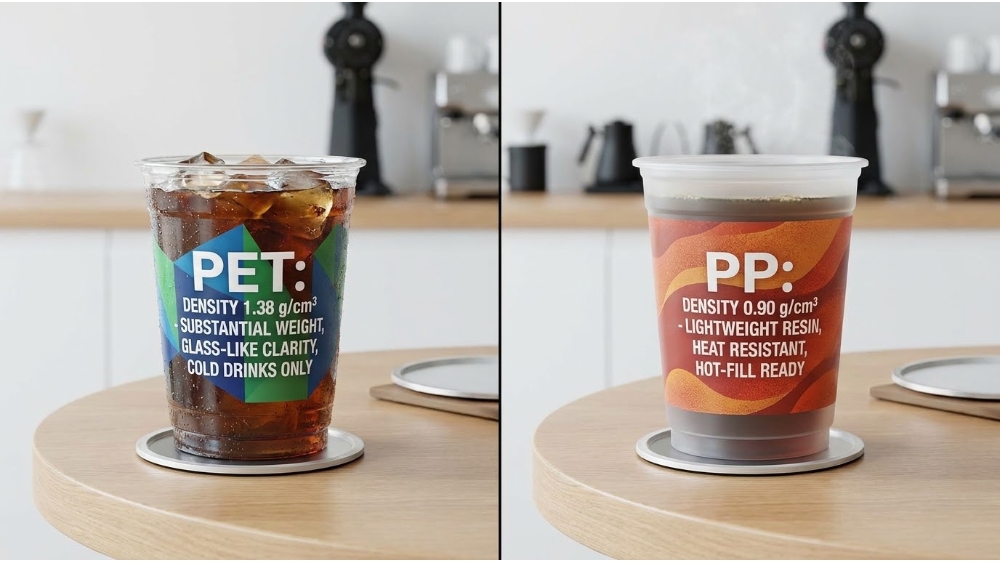
The resin behind a cup changes its gram weight before a single millimeter of wall thickness is decided, because PET and PP simply do not weigh the same at equal volume. PET (polyethylene terephthalate) has a density of roughly 1.38 g/cm³, while PP (polypropylene) sits closer to 0.90–0.93 g/cm³. That means a PET cup and a PP cup built to the exact same wall thickness and shape will not weigh the same—the PET cup will be measurably heavier simply because its molecules pack more densely.
This density gap explains a lot of what buyers notice anecdotally: PET cold cups often feel more substantial and glass-like in hand than PP cups of a similar size, even when the wall gauge is comparable. PP compensates with a different set of strengths—lower density means less resin by weight per cup, better heat resistance up to roughly 100–120°C for hot-fill and microwave use, and a lower melting point that simplifies processing. PET wins on optical clarity and rigidity at thinner gauges but softens around 70°C, which rules it out for hot beverages.
Property
PET
PP
Density
~1.38 g/cm³
~0.90–0.93 g/cm³
Typical wall thickness
0.30–1.00mm
0.25–1.20mm
Heat tolerance
Softens near 70°C
Stable to 100–120°C
Optical clarity
Excellent, glass-like
Naturally hazier
Best application
Cold beverages, iced drinks
Hot fill, microwaveable, reusable
Wall Thickness: The Variable That Actually Sets Gram Weight
If resin sets the density, wall thickness is the lever that turns that density into an actual gram figure. Gram weight roughly follows a simple relationship: surface area multiplied by wall thickness multiplied by material density. Of those three factors, wall thickness is the one a supplier can adjust most freely on the same tooling, which makes it the most common—and most easily hidden—place where cost gets cut.
Standard thermoformed cup walls run anywhere from about 0.25mm on ultra-light disposable cups to 1.2–1.5mm on heavy-duty or reusable formats. A shift of even 0.1mm across a full production run changes total resin consumption by a noticeable percentage, which is exactly why wall thickness—not resin type alone—is usually the first place a cost-cutting supplier looks when a buyer isn’t actively checking gram weight batch to batch.
Quick way to think about it:
Same resin, thicker wall = heavier cup, more crush resistance, higher material cost
Same resin, thinner wall = lighter cup, more flex, lower material cost
Thickness is rarely uniform—rims, bases, and side walls often carry different gauges by design
Why Gram Weight Is the Spec Buyers Should Ask For
Descriptions like “heavy duty” or “premium feel” are subjective and impossible to verify on a production line. Gram weight is not. It is a single, repeatable number that a quality control team can check with a scale on any sample pulled from any carton, which makes it one of the few cup specifications that actually catches problems before they reach a customer.
Typical ranges give a sense of scale: a 9oz PP foodservice cup often falls between 3.5 and 4.5 grams, a 16oz PET cold cup commonly runs 9 to 13 grams, and a 22oz PP smoothie or bubble tea cup often lands between 10 and 14 grams. These are not fixed rules—they vary by supplier, mold, and market—but they give a buyer a baseline to negotiate against and a tolerance range to hold a supplier to.
The practical value shows up over time, not on the first order. A supplier under margin pressure can thin a wall by a fraction of a millimeter across a production run without changing the visual design at all. A buyer who has specified a gram weight tolerance—say, plus or minus 0.3 grams—catches that shift immediately on an incoming QC check. A buyer who only specified “same as last time” usually finds out when cups start collapsing at the customer’s counter.
Rigidity vs Weight: What Really Prevents Crushing
It is tempting to assume rigidity is simply a function of how much plastic a cup contains, but structure does more work than mass. Ribbed or embossed side walls distribute stress across a corrugated surface instead of a flat one, letting a thinner-walled cup resist side-crush forces that would deform a smooth-walled cup at the same gram weight. Tapered profiles, rolled rims, and reinforced base rings each add targeted stiffness exactly where a cup is most likely to fail—under a stacked lid, at the rim during sealing, or at the base under a filled cup’s own weight.
This is why two cups at the same gram weight can perform very differently in a warehouse or on a delivery run. A flat-walled cup with no structural reinforcement needs extra grams of material just to reach adequate rigidity, while a well-engineered ribbed design can hit the same crush resistance with noticeably less resin. Buyers evaluating rigidity purely by weight are measuring the wrong variable; a compression or stack test tells the real story that a scale alone cannot.
Transparency and Clarity: Does It Depend on Weight
Clarity is largely a function of resin choice and processing quality, not gram weight. PET is inherently glass-clear across its normal thickness range, and a well-processed PET cup stays optically clean whether it is molded at 0.35mm or 0.9mm—clarity only starts to degrade at the extreme thick end, where light has to travel through more material and minor haze can appear. PP, by contrast, has a naturally more translucent, slightly milky appearance regardless of wall thickness, because of how its crystalline structure scatters light; no amount of added weight will make standard PP as clear as PET.
Gloss and surface finish—often confused with “quality” in a buyer’s hand—come down to mold polish and cooling control during forming, not material quantity. A heavier cup molded on a worn or poorly maintained tool can look duller and less premium than a lighter cup produced on well-maintained tooling. If visual clarity or shelf presentation matters for a brand, the conversation with a supplier should be about resin grade and mold condition, not gram weight.
Stacking, Nesting, and Transport: How Grams Change Freight Cost
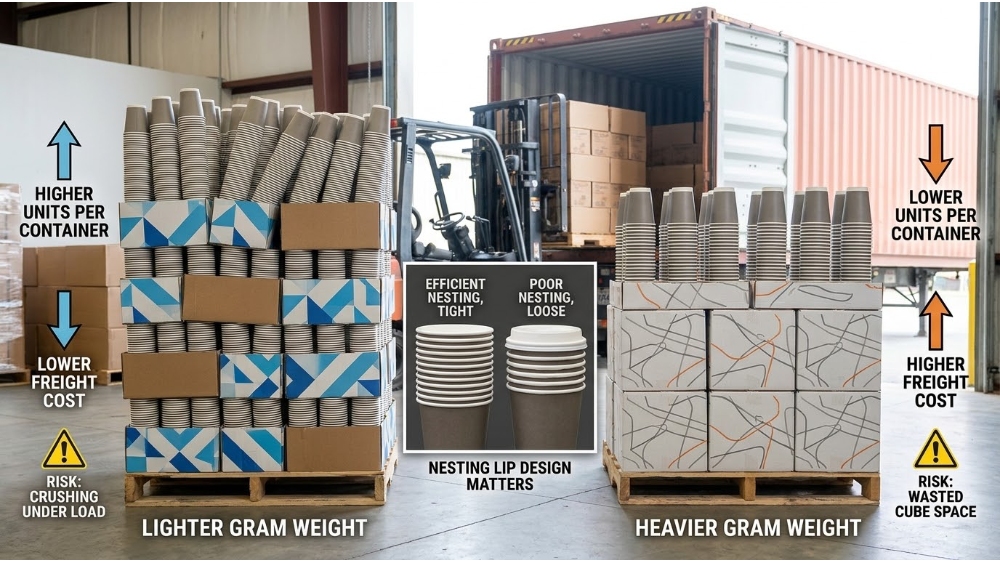
Gram weight has a direct, compounding effect on logistics long before a cup reaches a customer. Heavier cups mean fewer units fit within a container’s weight allowance, and thicker walls—especially at the nesting lip where cups stack inside one another—reduce how tightly cups can nest, which lowers how many fit per case and per pallet. Both effects push freight cost per unit upward, sometimes by more than the raw material savings a lighter cup was chosen to capture in the first place.
The nesting lip design matters as much as overall thickness here. A poorly designed lip can cause cups to wedge together too tightly, making them difficult to separate one at a time at the point of use—a real complaint from foodservice staff—while an overly loose lip lets stacks lean and topple during transport vibration. Getting this right is a design and tooling decision, not simply a matter of choosing a lighter or heavier gram weight.
Factor
Lighter gram weight
Heavier gram weight
Units per container
Higher
Lower
Stack stability
More prone to flex or lean
More resistant to deformation
Freight cost per unit
Lower, if nesting is efficient
Higher, all else equal
Risk in transit
Crushing under load
Wasted cube space if over-built
Material Cost and Environmental Material Use
Resin is priced by weight, so material cost scales almost linearly with gram weight once resin type is fixed—every additional gram in a cup design is an additional gram purchased across every unit in a production run, multiplied across container-scale volumes. This is the direct financial reason lightweighting has become a standard cost-reduction target for packaging buyers: shaving a fraction of a gram off a high-volume SKU compounds into meaningful savings without changing the resin itself.
The same math applies to environmental material use. A lighter cup consumes less virgin resin per unit, which reduces the total plastic entering the supply chain for a given number of cups produced. Many suppliers now offer recycled-content options—PET being the most common—that reduce virgin material dependency without necessarily changing gram weight, giving buyers a second lever besides thickness reduction. The trade-off runs in both directions: push weight down too aggressively and a cup loses the rigidity needed to survive filling, transport, and use, which creates a different kind of waste through product failure and returns.
Does a Heavier Plastic Cup Mean Better Quality?
Not automatically, and treating gram weight as a shortcut for quality is one of the more expensive assumptions a buyer can make. Weight is an output of design decisions, not a design goal in itself—two cups at the same gram weight can perform completely differently depending on how that weight was distributed and what the cup was engineered to do.
A heavier cup with a flat, unreinforced wall and a poorly rolled rim can still crack under stacking pressure or split at the seam during filling, while a lighter cup with strategic ribbing, a properly tapered profile, and a reinforced base ring can outperform it on every practical test that matters: drop resistance, stack load, and rim seal integrity. The rim in particular is an underrated failure point—a rim that isn’t rolled or curled correctly concentrates stress exactly where lids seal and where a customer’s mouth contacts the cup, regardless of how much plastic sits in the side walls.
Quality, in other words, is the product of several variables working together, not any single number on a spec sheet.
What actually determines cup quality:
Structure: ribbing, taper angle, and base geometry distribute stress more effectively than raw mass
Material: resin grade and consistency matter as much as resin quantity
Design: rim rolling, nesting lip precision, and wall transitions prevent the most common failure points
Application fit: a cup built for hot fill needs different properties than one built for cold, stacked transport
The right question for a buyer to ask a supplier is not “how heavy is this cup,” but “what gram weight, at what thickness distribution, produces the crush resistance and rim integrity this application actually needs.” That framing catches both a supplier cutting corners on a lightweight cup and a supplier padding gram weight on a poorly engineered one.
How to Choose the Right Gram Weight When Sourcing
Start with the application, not the material. A cup for hot beverages, on-premise dining, or repeated reuse has different structural demands than a single-use cold cup destined for a single stacking and transport cycle. Matching resin and gram weight to that end use prevents both under-engineering, which shows up as field failures, and over-engineering, which shows up as unnecessary cost and freight weight.
Request a spec sheet that lists gram weight with a stated tolerance range, not just a target number—this is the single easiest way to hold a supplier accountable across production runs and catch resin substitution or wall thinning before it reaches a customer. Ask for compression or stack test data alongside the gram weight, since weight alone does not confirm crush resistance. Where possible, request a small pilot batch and weigh a sample across the batch to confirm consistency before committing to full-volume production.
For buyers managing multiple cup formats and capacities across a product line, working with a single packaging partner that can hold consistent gram weight, material specification, and structural design across the full range removes one of the most common sources of quality variance between production runs.
Sourcing plastic cups and need the gram weight, material, and structure to actually match your application?
Talk through PET vs PP, wall thickness, and stacking design with a packaging specialist before committing to a production run.
Not automatically. Weight is an outcome of resin, thickness, and structure working together—a lighter cup with good ribbing and a properly rolled rim can outperform a heavier cup with a flat, unreinforced wall.
What is the average weight of a plastic cup?
It depends heavily on capacity and resin: a 9oz PP cup often runs 3.5–4.5 grams, while a 16oz PET cold cup commonly falls between 9 and 13 grams. Always compare gram weight relative to capacity, not as an absolute figure.
Is PET or PP heavier for the same cup size?
PET is heavier at equal wall thickness because its density (~1.38 g/cm³) is significantly higher than PP’s (~0.90–0.93 g/cm³). This is why PET cold cups often feel more substantial in hand than PP cups of similar dimensions.
How can I check gram weight consistency from a supplier?
Specify a gram weight tolerance range on the spec sheet and weigh sample cups from incoming cartons on a standard scale. Requesting pilot batch samples before a full production run is the most reliable way to catch drift early.
Post time:
Sep-08-2026
For inquiries about our products or pricelist, please leave your email to us and we will be in touch within 24 hours.