How Much Weight Can Paper Bags Hold? What Determines Their Load Capacity?
Paper Bag Load Capacity: GSM, Strength & Construction Guide
Foodservice Packaging Guide
How Much Weight Can Paper Bags Hold? What Determines Their Load Capacity?
A paper bag fails when you least expect it — the bottom splits, the handle rips, or the side tears under the weight of a single heavy bottle. Understanding paper bag load capacity isn’t just about GSM; it’s about fiber type, construction, and environmental conditions that can halve your bag’s strength before it even reaches the customer.
A paper bag’s load capacity is not a single number — it’s a dynamic property influenced by grammage (GSM), fiber length, adhesive quality, fold geometry, and ambient humidity. For foodservice operators, choosing the wrong bag means spilled orders, unhappy customers, and wasted food. This guide breaks down the physics and engineering behind paper bag strength, giving you a practical framework to match packaging to real-world weights.
Whether you’re bagging a single pastry or a full family meal, understanding the variables that govern paper bag load capacity will help you avoid tears, leaks, and complaints. We’ll cover GSM ranges, construction differences, moisture effects, and recycled versus virgin fiber — all backed by industry testing standards and material science.
What is the average weight capacity of a standard paper bag?
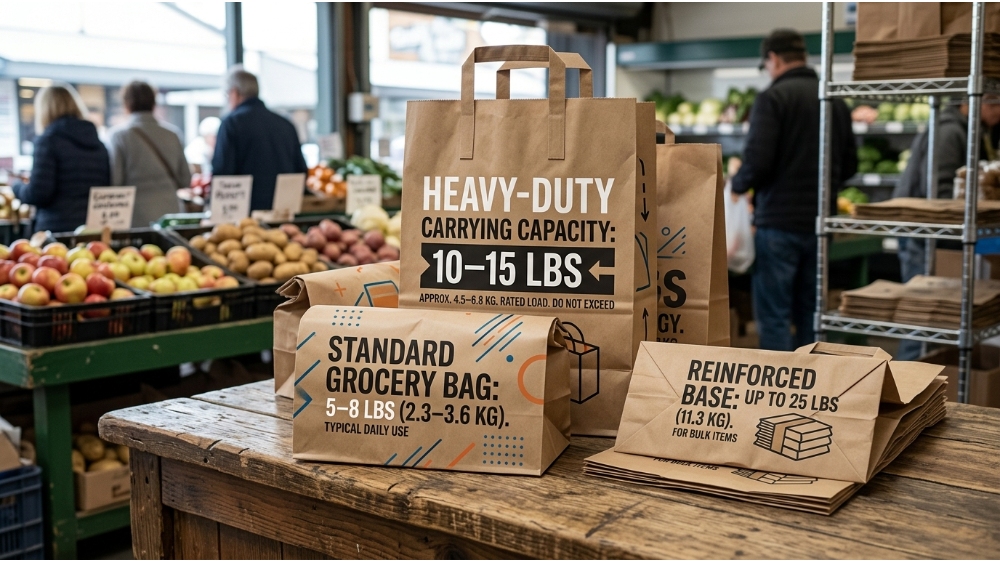
A typical brown kraft grocery bag (about 1/6 barrel size, 30 lb basis weight) holds roughly 5–8 pounds (2.3–3.6 kg) under normal dry conditions. However, this is a conservative estimate; many heavy-duty bags are rated for 10–15 pounds, and specialty reinforced bags can carry up to 25 pounds. The actual number depends on the bag’s dimensions, GSM, and bottom construction.
Industry standards often use the “drop test” to determine safe working load — a bag filled with sand or weighted product is dropped from a fixed height, and the load at which it fails is recorded. Foodservice suppliers typically specify a maximum recommended weight, but these figures assume perfect conditions: dry contents, proper handling, and no exposure to moisture. In real-world scenarios, the effective capacity can be 20–40% lower once humidity and rough handling are factored in.
How does paper GSM determine load capacity?
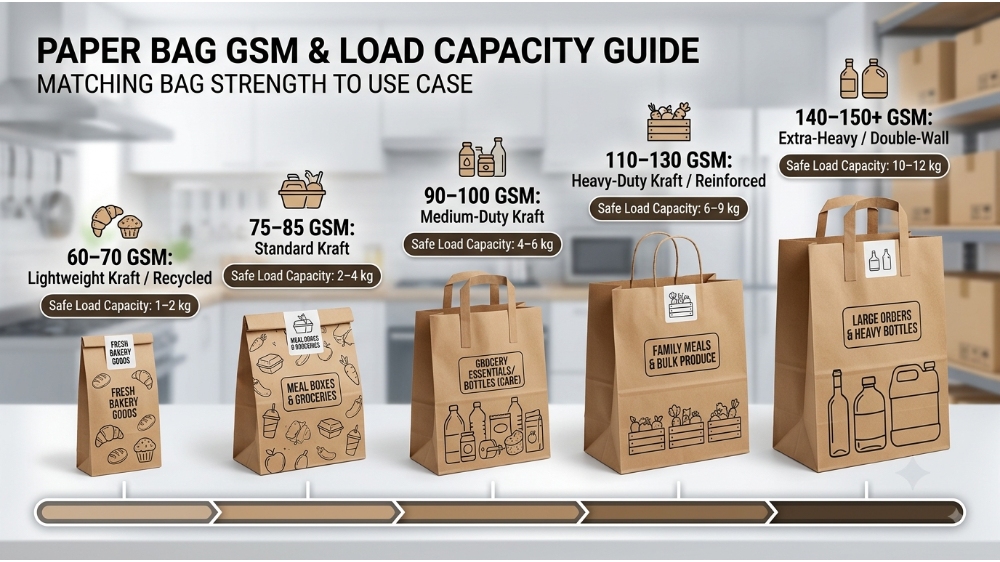
GSM (grams per square metre) is the most direct measure of paper thickness and density. Higher GSM means more fibre per unit area, which generally translates to higher tensile strength and burst resistance. For paper bags, the GSM range typically falls between 60 and 150 gsm for standard grocery and takeout bags, with 80–100 gsm being the most common for medium-duty applications.
However, GSM alone does not guarantee performance. The fibre orientation, pulp quality, and manufacturing process (e.g., whether the paper is machine-glazed or felt-finished) also affect strength. A 100 gsm bag made from long-fibre virgin kraft will out-perform a 100 gsm bag made from short-fibre recycled pulp. The table below gives approximate safe load ranges for different GSM grades, based on data from food packaging material tests and industry practice.
GSM Range
Typical Paper Type
Safe Load Capacity (kg)
Common Use Case
60–70
Lightweight kraft / recycled
1–2 kg
Small bakery items, pastries
75–85
Standard kraft
2–4 kg
Single meal boxes, small groceries
90–100
Medium-duty kraft
4–6 kg
Multiple items, bottles (with care)
110–130
Heavy-duty kraft / reinforced
6–9 kg
Family meal deals, bulk produce
140–150+
Extra-heavy / double-wall
10–12 kg
Large orders, heavy glass bottles
It’s important to note that these capacities assume dry contents and proper handling. Adding handles or gussets can alter the effective load, as the stress points change. Always test your actual product in the bag under your specific conditions before committing to a bulk order.
Why do some paper bags tear at the bottom? The role of construction
The bottom fold is the most stressed part of a paper bag. Three common bottom styles exist: flat bottom (square), pinch bottom (star-shaped), and gusseted bottom. Flat-bottom bags (often used for grocery sacks) distribute weight evenly across a rectangular base, offering the highest stability and tear resistance. Pinch-bottom bags, common in bakery and takeout, concentrate stress at the folded points, making them more prone to rupture under heavy loads. Learn more in detail by 7 Essential Paper Bag Types for Food & Retail.
Adhesive quality is equally critical. The glue used to seal the bottom must be strong enough to hold the weight but flexible enough to withstand flexing. Many failures occur at the adhesive line, not the paper itself. Additionally, handle attachment (if present) introduces new stress points; punched holes with reinforced tabs are far stronger than simple die-cut handles. For maximum load capacity, choose bags with a flat, glued bottom and side gussets that allow the bag to expand and distribute weight more evenly.
Construction factors that affect load capacity:
Bottom style – flat/square > pinch/star
Gusset depth – deeper gussets allow better weight distribution
Adhesive type – hot-melt vs. cold glue (hot-melt generally stronger)
Paper is hygroscopic — it absorbs water vapour from the air, which disrupts the hydrogen bonds between cellulose fibres. As moisture content rises above 8–10%, the paper’s tensile strength drops sharply. Research has shown that at 80% relative humidity, a paper bag can lose up to 40% of its load-bearing capacity compared to dry conditions.
This is critical for foodservice because many takeout items (hot soups, salads, or even freshly fried foods) release steam that condenses inside the bag. The moisture wicks into the paper, weakening it at the exact moments it’s being carried. To mitigate this, some bags are coated with a moisture-resistant barrier (like PE or aqueous coating) that keeps the fibre dry without sacrificing recyclability. For operators in humid climates or with high-moisture menus, selecting a coated bag or adding a grease-absorbing insert can preserve strength during delivery.
Does recycled paper perform as well as virgin kraft?
Recycled fibre is shorter and more brittle than virgin fibre because each recycling cycle cuts the fibre length. For paper bags, this translates to lower burst strength and reduced tear resistance at the same GSM. A 2022 study published in Heliyon compared 150, 120, and 100 gsm recycled papers and found that while recycled material can achieve adequate strength for light-duty applications, it consistently underperforms virgin kraft by 15–30% in load tests.
That said, recycled content is increasingly demanded by eco-conscious consumers, and many suppliers blend recycled with virgin fibre to balance sustainability with performance. For bags intended to carry heavy items (over 5 kg), a high proportion of virgin kraft is strongly recommended. For light bakery or dry goods, high-recycled content bags are perfectly adequate. Always check the burst strength (ISO 2759) rating provided by the manufacturer — a good target for medium-duty use is a burst index above 3.5 kPa·m²/g.
How to choose the right paper bag for your product weight
Start by calculating the maximum weight your bag will ever need to hold — not the average, but the worst-case scenario (e.g., a large order with multiple beverages). Then add a safety margin of at least 25% to account for moisture, handling, and temperature variations. For example, if your heaviest order weighs 4 kg, choose a bag rated for at least 5 kg.
Next, consider the shape and size of your products. Bulky items like pizza boxes or tall bottles require a bag with enough depth and width to prevent stress concentration at the corners. If you’re using handles, ensure they are reinforced with paperboard tabs or fabric, and test the bag with a representative load to confirm that the handles don’t tear out. Click to learn paper bag sizes by Paper Bag Sizes Chart: Standard Dimensions & Capacity Guide.
Finally, factor in your average delivery time and environmental conditions. If your deliveries exceed 20 minutes, moisture buildup becomes a significant concern — opt for a bag with a moisture-resistant coating or a separate inner liner. For operators with diverse menus, consider offering two bag grades: a standard bag for dry items and a heavy-duty version for wet or bulk orders.
Need packaging that matches your exact load requirements?
Talk to a packaging specialist about custom GSM, bottom construction, and coating options tailored to your menu weight and delivery profile.
What is the maximum weight a standard grocery paper bag can hold?
A typical 30 lb basis weight (about 80–90 gsm) grocery bag is rated for 5–8 pounds (2.3–3.6 kg) under dry conditions. However, actual performance depends on construction and humidity; many operators limit them to 6 pounds for safety.
How does GSM affect paper bag strength?
Higher GSM means thicker paper with more fibre, which generally increases tensile and burst strength. A 120 gsm bag can hold roughly twice the weight of a 70 gsm bag of similar construction, but fibre type (virgin vs. recycled) also matters.
Do paper bags with handles hold less weight than those without?
Not necessarily, but the handle attachment point becomes the weakest link. Properly reinforced handles (with paperboard tabs or fabric) can support the same load as a handleless bag, while simple die-cut handles significantly reduce capacity.
Can I use a paper bag for heavy liquids like soup?
Paper bags are not designed for liquids — they will soak through and lose strength rapidly. For soups or sauces, use a coated paper bag with a water-resistant barrier or place the liquid container in a separate plastic liner inside the bag.
Post time:
Aug-13-2026
For inquiries about our products or pricelist, please leave your email to us and we will be in touch within 24 hours.