Are Paper Bags Biodegradable, Recyclable, or Compostable? A Complete Sustainability Guide
Are Paper Bags Biodegradable? Recycling & Compost Guide
Sustainable Packaging Guide
Are Paper Bags Biodegradable, Recyclable, or Compostable? A Complete Sustainability Guide
Paper bags are everywhere—from grocery checkouts to restaurant takeout. But what really happens when they leave your hands? This guide breaks down biodegradability, recyclability, and compostability so you can make packaging choices that match your sustainability claims.
A paper bag seems like a simple choice—it’s paper, so it must be sustainable, right? Not exactly. The reality of whether a paper bag is biodegradable, recyclable, or compostable depends on its material, coatings, inks, and the conditions it ends up in. This guide unpacks the science, the certifications, and the practical decisions that matter for foodservice brands.
For businesses switching from plastic to paper, understanding these three end-of-life pathways is essential. A bag that’s technically compostable may not break down in a backyard bin; a recyclable bag with a plastic lining can contaminate an entire bale of paper. This guide helps you navigate the food packaging landscape with clarity and confidence.
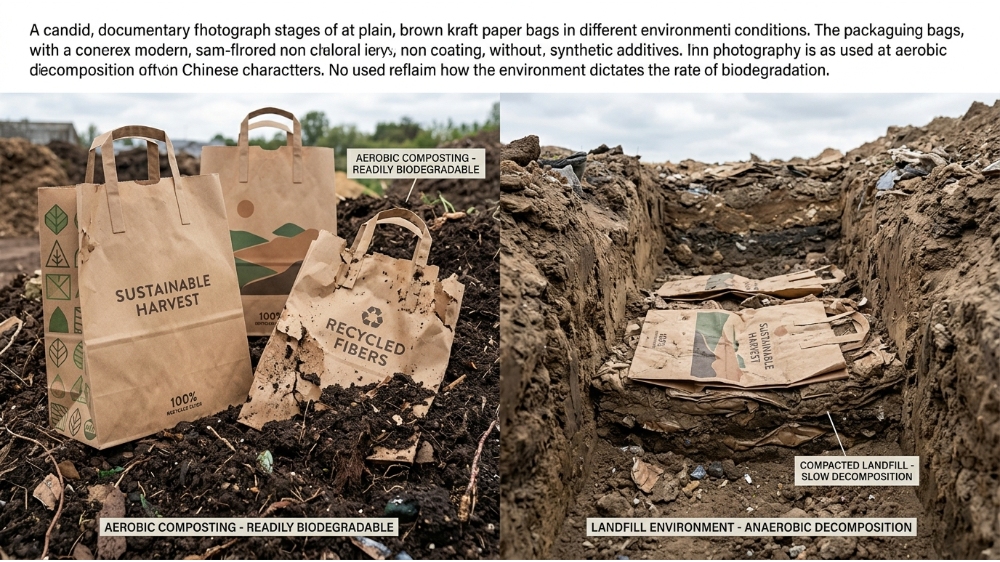
Yes, plain paper bags without coatings or synthetic additives are biodegradable. Under the right conditions—moisture, oxygen, and microorganisms—they break down into natural elements like water, carbon dioxide, and biomass. However, biodegradation is not instantaneous; it can take anywhere from a few weeks to several years depending on environmental factors.
Biodegradability means a material can be broken down by microorganisms. For paper, this is a natural process because paper is made from cellulose fibers, which are organic. The U.S. Environmental Protection Agency (EPA) notes that paper products are among the most readily biodegradable materials in aerobic environments. However, the presence of coatings—such as polyethylene (PE) or wax—can significantly slow or prevent biodegradation, leaving behind microplastics.
In a landfill, where oxygen is limited, paper decomposes anaerobically, producing methane—a potent greenhouse gas. A 2023 study from the Journal of Environmental Management found that paper bags in modern landfills can take decades to break down due to compaction and lack of moisture. So while paper is inherently biodegradable, the real-world outcome depends heavily on disposal conditions.
Can paper bags be recycled?
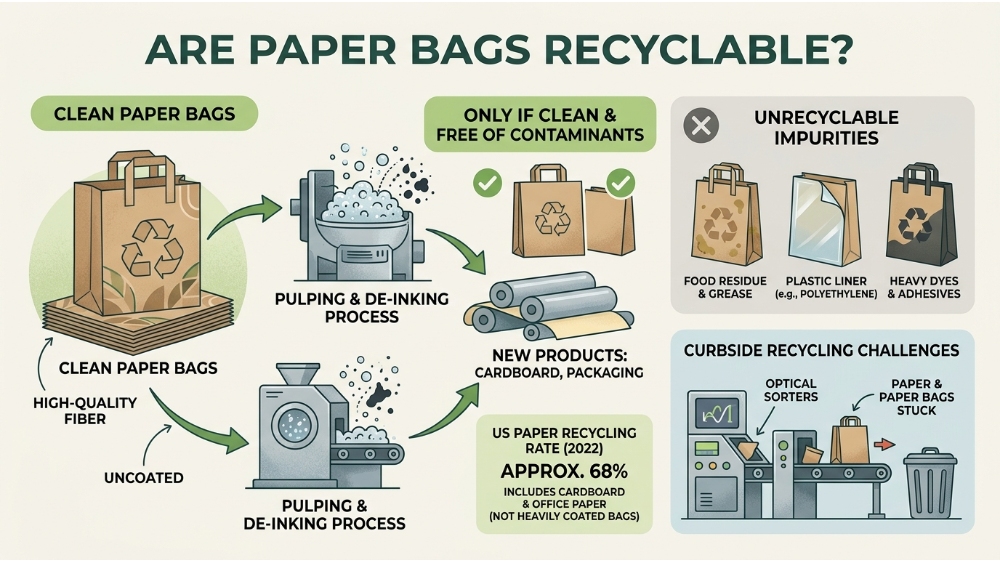
Yes, but only if they are clean and free of contaminants.Recyclable paper bags must be made of high-quality fiber without plastic linings, heavy dyes, or food residue. The recycling process pulps the paper, removes inks and adhesives, and reforms it into new paper products.
The Federal Trade Commission (FTC) Green Guides require that any product labeled as recyclable must have access to recycling facilities for a substantial majority of consumers. In practice, this means that a paper bag with a polyethylene liner—common for grease-resistant food bags—is often not recyclable curbside because it can clog sorting machinery. The American Forest & Paper Association (AF&PA) reports that the U.S. paper recycling rate was around 68% in 2022, but that figure includes corrugated cardboard and office paper, not heavily coated or food-soiled bags.
Recyclable paper bag checklist:
No plastic or wax lining
Minimal ink and no metallic foils
Free of food residue or grease stains
Accepted by your local recycling program
Are paper bags compostable?
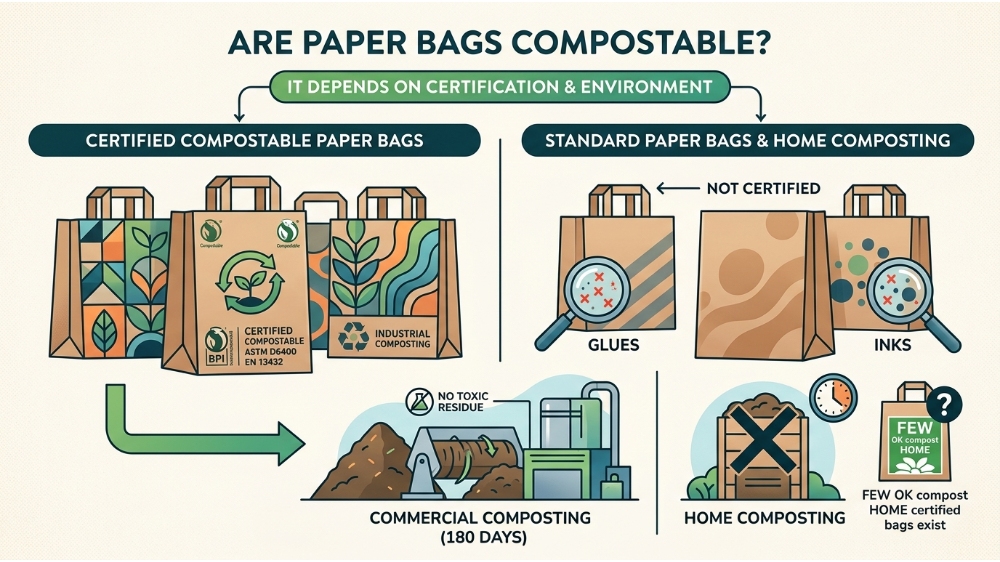
Yes, if they meet specific compostability standards (ASTM D6400 or EN 13432).Compostable paper bags are designed to break down in a commercial composting facility within 180 days, leaving no toxic residue. However, most standard paper bags are not certified compostable and may contain glues or inks that inhibit composting.
A compostable bag must disintegrate and biodegrade at a rate comparable to known compostable materials, such as leaves or food waste. The Biodegradable Products Institute (BPI) certifies products that meet ASTM D6400 standards for industrial composting. However, home composting is a different story—few paper bags carry the OK compost HOME certification, which requires breakdown at lower temperatures over a longer period.
It’s crucial to distinguish between “compostable” and “biodegradable.” All compostable materials are biodegradable, but not all biodegradable materials are compostable. Compostability requires a specific time frame, disintegration rate, and absence of ecotoxicity—criteria that standard biodegradable paper may not meet.
Biodegradable vs. recyclable vs. compostable: key differences
These three terms are often used interchangeably, but they mean very different things in practice. The table below summarizes the core differences.
Property
Biodegradable
Recyclable
Compostable
Definition
Breaks down naturally via microorganisms
Can be reprocessed into new paper
Breaks down in composting conditions
Time frame
Varies (weeks to years)
N/A (depends on facility)
180 days (commercial)
Certification needed
No universal standard
None required
ASTM D6400 / EN 13432
Residue
Can leave microplastics if coated
Minimal fiber loss
No toxic residue
Best use case
Low-impact disposal
Closed-loop systems
Foodservice waste streams
The choice between these pathways depends on your local infrastructure. A compostable bag is useless if your city doesn’t have an industrial composting facility. A recyclable bag is better, but only if consumers actually put it in the recycling bin and it’s accepted curbside.
Certifications to look for
Navigating green claims requires third-party verification. Here are the most respected certifications for paper bags.
BPI Certified Compostable – Verifies that a product meets ASTM D6400 for commercial composting. BPI is the leading authority in North America.
OK compost INDUSTRIAL – European standard (EN 13432) for industrial composting.
OK compost HOME – Rigorous certification for home composting conditions.
FSC® Certified – Ensures the paper comes from responsibly managed forests. While not an end-of-life certification, it’s a key sustainability benchmark.
Recyclable logo (Möbius loop) – Indicates the product is recyclable, but check with local programs as acceptance varies.
For foodservice operators, the combination of FSC certification and BPI compostability is the gold standard. It ensures responsible sourcing and a viable end-of-life pathway. However, as of 2024, fewer than 15% of U.S. communities have access to industrial composting facilities, according to BioCycle’s annual survey.
How to choose the right paper bag for your brand
Choosing a paper bag is not a one-size-fits-all decision. Start with three questions: Where will it end up? What is it carrying? What do your customers expect?
If your bags are used for dry, shelf-stable goods like baked goods or dry groceries, a plain kraft paper bag with no coating is ideal. It’s recyclable and biodegradable. If you’re packaging greasy or wet food, you’ll need a grease-resistant barrier—often a water-based coating or a separate liner. In that case, check whether the coating is compostable or if the bag needs to be disposed of as general waste.
For brands with strong sustainability commitments, consider a dual-certified bag: FSC-certified paper with BPI-certified compostable coating. This allows you to market both responsible sourcing and end-of-life compostability. However, always test the bag with your actual product in real-world conditions—a bag that leaks or fails structurally will undermine your brand more than any sustainability claim.
Need paper bags that align with your sustainability goals?
Whether you need custom-printed kraft bags, compostable liners, or recyclable takeout packaging, our team can help you match materials to your menu and your values.
Plain paper bags are biodegradable, but not all are certified compostable. Compostability requires specific conditions and certifications (ASTM D6400). A biodegradable bag may break down in months or years; a compostable bag breaks down within 180 days in a commercial facility.
Can I put paper bags in my compost bin at home?
Only if they are explicitly labeled as home-compostable (OK compost HOME). Most paper bags are designed for commercial composting or recycling; they may contain inks or glues that don’t break down in a backyard bin.
Are paper bags better than plastic bags for the environment?
Generally, yes—paper has a lower marine litter footprint and is renewable. However, paper production is energy- and water-intensive. A paper bag used once has a higher carbon footprint than a single plastic bag but outperforms plastic when recycled or composted.
What happens to paper bags in a landfill?
In a landfill, paper bags decompose anaerobically (without oxygen), producing methane. This process can take decades. Recycling or composting diverts paper from landfills and reduces greenhouse gas emissions.
Post time:
Aug-10-2026
For inquiries about our products or pricelist, please leave your email to us and we will be in touch within 24 hours.