

Paper Bag Sizes Chart: Standard Dimensions & Capacity Guide
Paper Packaging Guide
Paper Bag Sizes Explained: Standard Dimensions, Capacity, and Selection Guide
From a 4-lb pastry sack to a 1/6 barrel grocery bag — how width, gusset depth, “SOS number,” and checkout-counter logistics all decide the size that actually works at the register.
A standard paper bag runs from a 5″ x 3″ x 9″ favor bag up to a 16″ x 12″ x 5″ retail carrier or a 12″ x 7″ x 17″ grocery sack, with the “medium” band — roughly 8″ to 10″ wide — covering most café, deli and boutique counters. The right pick depends less on a single inch number and more on the fill weight the bag is rated to carry, the gusset depth that lets it stand upright, and where it has to sit next — in a checkout bag rack, on a barista counter, or on a warehouse shelf between orders.
This guide lines up every commonly used paper bag size in inches and centimeters, then goes further than a typical size chart by decoding the “SOS” and barrel-fraction numbers printed on foodservice bags, and by explaining why grocery chains, coffee counters, and boutiques converge on different size ladders even when the bags look similar in a photo. For a full range of ready-to-order paper packaging, see this packaging solution overview.
What Is a “Standard” Paper Bag Size?
A paper bag‘s labeled size is almost never a single number the way a pizza box is. Foodservice and grocery bags are sold by a width x gusset x height measurement in inches, but they’re also frequently labeled by an “SOS number” or barrel fraction (6#, 12#, 1/8 BBL, 1/6 BBL) that refers to how many pounds of a reference product — historically sugar — the bag was originally sized to hold. Retail and gift bags, by contrast, are usually sold under plain “small / medium / large” labels with no weight rating at all, because the products going inside them are boxed or wrapped rather than loose.
That difference in labeling means “what size paper bag do I need” has at least three different correct answers depending on who’s asking. A café owner buying counter bags cares about ounces or pounds of food weight. A packaging buyer specifying a custom print run cares about width x gusset x height in inches or millimeters for the die-cut template. A retail buyer restocking a checkout counter mostly cares about how many bags fit in the dispenser rack without jamming. None of these audiences are well served by a chart that only lists “medium bag: 8 x 10 inches,” which is why sizing mistakes are so common on reorders.
Demand for paper bags is large and growing quickly enough that sizing logistics matter at scale. Fortune Business Insights projects the global paper bag packaging market growing from $8.05 billion in 2026 to $12.73 billion by 2034, a pace that reflects retailers and restaurants replacing plastic checkout bags at volume rather than switching a handful of SKUs. Within that market, Future Market Insights expects retail to lead end-use with roughly 42% share in 2026, with SOS-style bags projected to lead by bag type through 2036 — meaning the flat-bottom, self-standing bag format covered in the SOS section below is likely to be the single most-ordered paper bag style for the next decade, not a niche foodservice item.
Paper Bag Size Chart: Inches, cm, and Capacity Compared
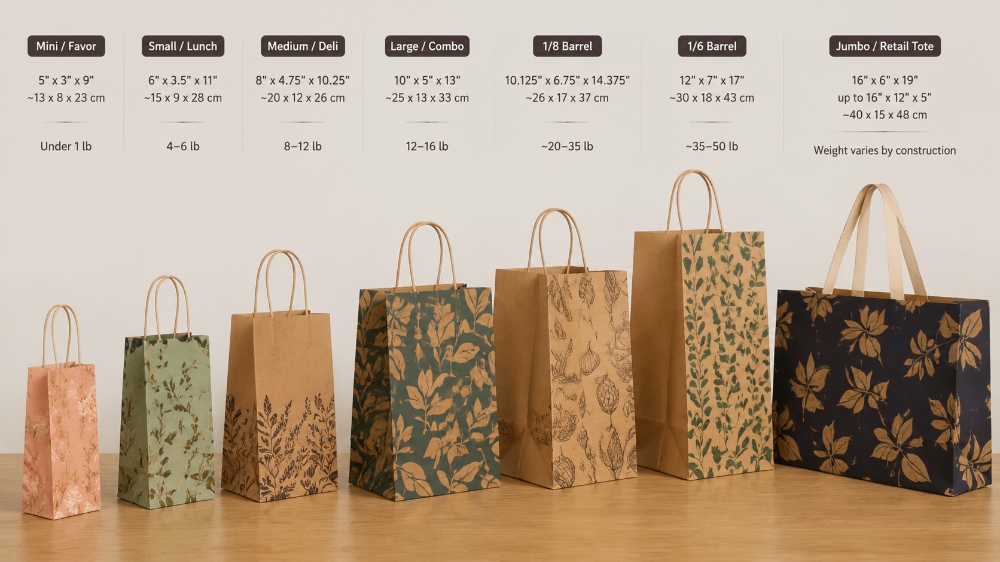
Bag width and fill capacity are two different specifications, and treating them as interchangeable is the most common reason a “medium” bag order arrives too small for a lunch combo or too flimsy for a bottle of wine. The chart below lines up nominal size class, typical width x gusset x height, metric conversion, and the fill weight each class is generally rated for.
| Size class | Typical dimensions (W x G x H) | Metric | Typical fill rating | Best suited for |
|---|---|---|---|---|
| Mini / Favor | 5″ x 3″ x 9″ | ~13 x 8 x 23 cm | Under 1 lb | Party favors, jewelry, single bakery item |
| Small / Lunch | 6″ x 3.5″ x 11″ | ~15 x 9 x 28 cm | 4–6 lb | Single sandwich, pastry, small snack order |
| Medium / Deli | 8″ x 4.75″ x 10.25″ | ~20 x 12 x 26 cm | 8–12 lb | Café counters, delis, boutique retail |
| Large / Combo | 10″ x 5″ x 13″ | ~25 x 13 x 33 cm | 12–16 lb | Full combo meals, multi-item takeout |
| 1/8 Barrel Grocery | 10.125″ x 6.75″ x 14.375″ | ~26 x 17 x 37 cm | ~20–35 lb | Small grocery orders, bakery, produce |
| 1/6 Barrel Grocery | 12″ x 7″ x 17″ | ~30 x 18 x 43 cm | ~35–50 lb | Standard supermarket order, family takeout |
| Jumbo / Retail Tote | 16″ x 6″ x 19″ up to 16″ x 12″ x 5″ | ~40 x 15 x 48 cm | Weight varies by construction | Apparel, catering, gift sets, bulk retail |
These size brackets aren’t arbitrary — they track the same “small under 7.5 inches, large over 12 inches” split that Better-Package’s paper bag size chart uses to separate compact retail bags from apparel- and gift-sized ones, and the same step pattern shows up again once bags move into food and grocery weight classes. Weight capacity, not just footprint, is also where paper diverges most from plastic: Hongren’s shopping bag dimensions guide notes paper bags typically handle 5 to 10 pounds per bag versus more than 17 pounds for a stretch plastic bag of similar size, which is the main reason grocery-weight paper bags rely on a thicker “barrel” construction rather than simply scaling up a retail bag’s paper stock.
The SOS/Barrel Number System: What “6#” or “1/6 Barrel” Actually Means
Most size charts skip this entirely, but it’s the number printed on the majority of foodservice paper bags in North America, so it’s worth decoding properly. “SOS” stands for “self-opening sack” — the flat-bottom, gusseted bag style that stands upright on its own — and its size numbers (1#, 2#, 4#, 6#, 8#, 10#, 12#, 16#, 20#, 25#) historically refer to how many pounds of granulated sugar the bag could hold while still folding closed at the top. Above 25#, sizing switches to barrel fractions — 1/8 barrel, 1/6 barrel, 1/4 barrel — a naming convention left over from when bulk dry goods were shipped and portioned out of wooden barrels.
This isn’t a marketing legend; it’s been tested directly. Wisconsin Converting filled a 4# and a 6# SOS bag with sugar on a kitchen scale and confirmed both held their labeled weight with enough headspace left to fold and seal the top, and the same source notes standard SOS bags are sold across the full 1# to 1/6 barrel range in recycled kraft, white, colored, grease-resistant, and heavyweight substrates. The practical upshot for buyers: the number on the bag isn’t a marketing size like “large” — it’s a load-bearing spec you can sanity-check against your actual product weight before you order a pallet.
Barrel-fraction bags follow the same logic at higher capacity. A 1/6 barrel kraft grocery bag measures 12″ x 7″ x 17″ and is commonly produced in a 65-lb rated construction that adds height for larger grocery and takeout loads, while the next size down — the 1/8 barrel sack measures 10-1/8″ x 6-3/4″ x 14-3/8″ and is typically built from 52-lb basis-weight kraft paper, tough enough for milk cartons or ground meat without the bottom failing. Basis weight and fill rating are related but not identical: WebstaurantStore’s paper bag guide notes capacities are also expressed in ounces, pecks, quarts and liters depending on whether the product inside is loose dry goods, produce, or packaged items — one more reason to match the rating system to what’s actually going in the bag rather than assuming every “large” label means the same thing.
| SOS / barrel number | Typical dimensions (W x G x H) | Reference fill weight | Common use |
|---|---|---|---|
| 4# | 5″ x 3.25″ x 9.75″ | ~4 lb | Pastry, small snack, coffee counter |
| 6# | 6″ x 3.63″ x 11.06″ | ~6 lb | Sandwich, single-meal takeout |
| 8# | 6.25″ x 4″ x 12.44″ | ~8 lb | Deli, bakery, light grocery |
| 12# | 7″ x 4.5″ x 13.75″ | ~12 lb | Full combo meal, multi-item order |
| 20# | 8.25″ x 5.25″ x 16.13″ | ~20 lb | Large family or catering-scale orders |
| 1/8 Barrel | 10.125″ x 6.75″ x 14.375″ | ~35 lb (52-lb paper) | Small grocery run, bakery, produce |
| 1/6 Barrel | 12″ x 7″ x 17″ | ~50 lb (57–65-lb paper) | Standard grocery checkout, family takeout |
Before finalizing an SOS or grocery bag order, confirm:
- Whether the number on the bag is a nominal fill weight or a basis-weight paper spec
- Gusset depth against your bulkiest single item, not your average order
- Whether wet or greasy contents require a coated or grease-resistant substrate
- Handle style — none, twisted paper, or flat handle — against how far the bag travels
What Size Bags Do Coffee Shops and Fast-Food Counters Use?
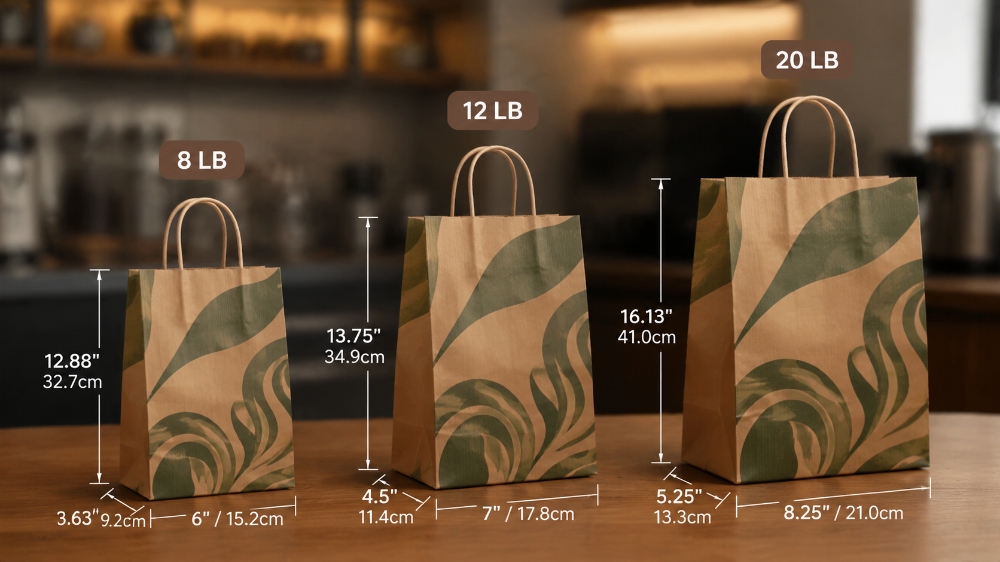
Coffee counters and quick-service kitchens rarely size a bag to a specific menu item — they size it to an order-value tier that every register and expo station can grab without thinking, which is why the same handful of SOS numbers keep showing up across unrelated chains. A single espresso drink and a pastry ride in a small bag; a combo meal needs a bag tall enough to stand a drink cup upright without tipping; a family or group order needs a wide-mouth bag that a runner can bag multiple boxes into quickly during a rush.
That order-tier logic maps closely onto the SOS ladder above. Industry sizing for full-service and quick-service takeout puts the 8-lb bag at roughly 6″ x 3.63″ x 12.88″ as the sandwich-and-single-drink standard, the 12-lb bag at about 7″ x 4.5″ x 13.75″ for a full combo meal, and the 20-lb bag at roughly 8.25″ x 5.25″ x 16.13″ for large multi-item orders — almost exactly the counter-to-family progression a drive-thru or coffee bar needs, without requiring five different SKUs behind the register. Coffee counters specifically lean toward the smaller end of that range because most orders are drinks plus at most one or two baked goods; the gusset depth matters more than the height, since a 12-oz or 16-oz cup — see this related standard takeaway coffee cup size guide for the full cup ladder — needs a wide enough base to sit flat rather than lean against the bag wall.
Checkout-counter and drive-thru logistics add a constraint that a size chart alone won’t show: bags are almost always stored pre-opened in a stacked dispenser or bag rack mounted under or beside the register, and that rack has a fixed slot width. A bag that’s even half an inch wider than the rack slot won’t stack cleanly and will slow down bagging during a rush — which is why most counter-service operations standardize on two sizes (a small/medium for single orders, a large for combos) rather than trying to match a bag exactly to every menu item.
Grocery and Supermarket Paper Bag Sizing
Supermarket checkout bags look simple from the customer side — one bag size, brown kraft, handles or no handles — but the sizing logic behind that single SKU is more deliberate than it looks. Grocery chains standardize on one or two barrel-fraction sizes precisely so that baggers don’t have to think about which bag fits which order; instead, the checkout process is built around packing multiple bags of a known, fixed size rather than selecting a bag to match the order.
The 1/6 barrel bag at 12″ x 7″ x 17″ is the size most commonly stocked for general supermarket and takeout use, and its 7-inch gusset is wide enough to stand up produce, boxed goods, and bottled items side by side without the bag tipping in a cart or car trunk. For grocery formats that carry heavier reusable or premium bags rather than single-use kraft sacks, sizing guidance for grocery and fresh-food retail points to 16–20 inches of width with an 8–10 inch gusset as the stability sweet spot, generally rated to carry 10–15 kg (22–33 lb) — noticeably larger than a single-use kraft sack because reusable formats are meant to replace multiple disposable bags per trip.
Behind the checkout lane, storage footprint is the other constraint that shapes which size a store actually stocks. Flat-packed barrel bags are stored in the same footprint as the register stand itself, so a chain running thousands of lanes has a direct cost incentive to standardize on one bag height rather than stocking a ladder of sizes per lane — the same fixed-SKU logic that drives large pizza chains toward two or three box sizes rather than a size for every pie diameter. A store that deviates from the single 1/6-barrel standard usually does so only for a specific reason: a wine and spirits section stocking narrow bottle bags, or a bakery counter stocking a smaller 1/8 barrel or 8# bag for single-item purchases.
Before finalizing a grocery or supermarket bag order, check:
- Whether one barrel-fraction size covers 90%+ of basket sizes, or two sizes are genuinely needed
- Basis weight against your heaviest common item — glass jars and multi-liter bottles need thicker stock
- Storage footprint at the register stand, since flat-packed bags still need shelf space per lane
- Whether handle style (none vs. twisted paper) affects carry distance to a car versus a cart
Retail, Boutique, and Gift Paper Bag Sizes
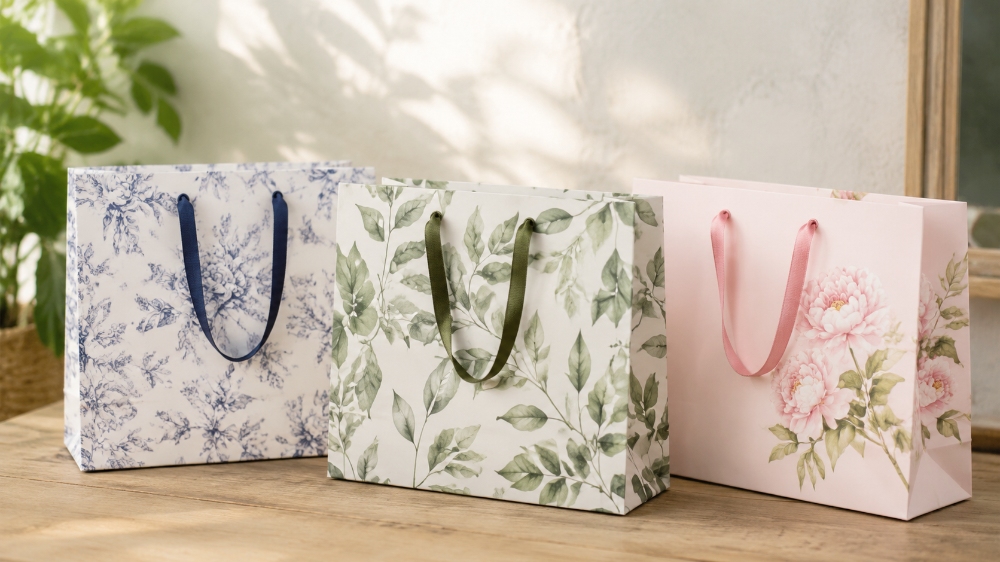
Retail and gift bags follow a looser, less standardized ladder than food and grocery bags, mostly because the products inside are already boxed, folded, or wrapped rather than loose — so the bag has to fit an outer package dimension rather than a weight target. Small retail and gift paper bags are generally defined as under 7.5 inches in both length and height with a 2–4 inch gusset, while large bags run over 12 inches in length and height with a gusset of 5 inches or more, leaving a wide “medium” band in between that covers most apparel, cosmetics, and general merchandise.
Because there’s no weight rating driving the size, branding surface area becomes the deciding factor almost as often as product fit does. Larger retail bags are frequently chosen a size up from the strict minimum specifically because a bigger front panel gives more room for logo placement, foil stamping, or full-bleed print — a tradeoff that doesn’t exist in foodservice sizing, where the SOS number is a hard capacity ceiling rather than a design choice. Wine and bottle bags are the clearest example of product-shape-driven sizing in this category: a single-bottle bag is built tall and narrow specifically to hold and stabilize one bottle, rather than sized off any general small/medium/large chart.
How to Choose the Right Paper Bag Size for Your Situation
The “right” standard size changes depending on who’s buying — a café or coffee counter optimizing for register speed, a QSR chain standardizing across thousands of units, a grocery chain packing one fixed SKU per lane, a boutique retailer prioritizing branding, or a packaging buyer specifying a custom print run. Matching the buyer’s situation to a size — rather than defaulting to whatever number sounds safely “large” — avoids both torn bags and wasted packaging spend.
| Who’s choosing | Recommended size | Why |
|---|---|---|
| Coffee shop / café counter | 4#–6# for drinks and pastries, 8# for light meals | Fast to bag one-handed; gusset holds a cup upright without tipping |
| QSR / drive-thru chain | 8#, 12#, and 20# on a fixed three-size ladder | Matches order-value tiers; keeps every register stocking the same SKUs |
| Independent restaurant takeout | 12#–1/8 barrel core, 20# for catering | Covers combo meals and family orders without excess SKUs |
| Grocery / supermarket chain | 1/6 barrel (12″ x 7″ x 17″) as the default | Standardizes checkout-lane storage and bagging speed across all lanes |
| Boutique / retail / gift buyer | Medium (8″x5″x10″) core, large for apparel and gift sets | Prioritizes branding surface and product presentation over weight rating |
Businesses evaluating a full lineup rather than a single size can review ready-made options such as custom-printed kraft paper bags or fully bespoke packaging by fill weight and gusset depth before committing to a production run. Whatever the segment, the same rule applies: test the actual product, fill weight, and carry distance together before finalizing a size — the number printed on a spec sheet is only the starting point. Click to get connected with your packaging expert, Maibao Packaging.
Not sure which size fits your menu or store?
Talk to a packaging specialist about matching paper bag size, basis weight, and checkout-lane logistics to your actual order volume.
Frequently Asked Questions
What does the number on a paper bag, like “8#” or “1/6 BBL,” actually mean?
It’s a nominal fill-weight rating, historically based on how many pounds of sugar the bag could hold while still folding closed at the top. Above 25 pounds, sizing switches from a plain number to a barrel fraction (1/8, 1/6, 1/4 barrel), a naming convention carried over from bulk dry-goods shipping.
What size paper bag do most grocery stores use?
Most supermarkets standardize on a 1/6 barrel bag, roughly 12″ x 7″ x 17″, because one fixed size simplifies storage and bagging speed across every checkout lane. Bakery or wine sections may stock a smaller 1/8 barrel or bottle-specific bag alongside it.
Why is my takeout bag bigger than the food inside it?
Bags are sized to the order-value tier (single item, combo, or family order) rather than to the exact food volume, so counters can bag quickly without weighing each order. A slightly oversized bag also gives a drink cup or box enough gusset depth to stand upright without tipping.
How much weight can a standard paper bag hold?
A typical paper bag holds roughly 5 to 10 pounds per bag, noticeably less than a comparably sized plastic bag, because paper doesn’t stretch to redistribute load. Heavier grocery-weight bags use thicker basis-weight kraft paper and a wider gusset specifically to raise that ceiling.
Post time: Jul-17-2026