Why Do Paper Food Boxes Leak Oil? 7 Ways to Improve Grease Resistance
Why Do Paper Food Boxes Leak Oil? 7 Ways to Improve Grease Resistance
Foodservice Packaging Guide
Why Do Paper Food Boxes Leak Oil? 7 Ways to Improve Grease Resistance
A paper box that looks sturdy can turn translucent and greasy within minutes of contact with hot food. Oil leakage isn’t just a cosmetic issue—it’s a failure of material science. This guide explains why paper leaks, how grease-resistant packaging works, and seven concrete ways to choose boxes that actually contain your menu items.
A paper food box is a paradox. It looks solid, feels durable, and yet, within minutes of holding a hot shawarma or a basket of fried chicken, oil spots bloom across the surface. In some cases, the box leaks entirely—soaking through the paper, staining the delivery bag, and reaching the customer’s hands. This isn’t a manufacturing defect; it’s the predictable behavior of untreated paper in contact with hot, greasy food.
This guide explains the physics of oil penetration, breaks down the engineering behind grease-resistant paperboard, and provides a framework for selecting the right packaging for your menu. For related guidance on burger boxes, fry boxes, and full takeout packaging systems, explore the food packaging.
Why Does Oil Leak Through Paper Food Boxes?
Paper is a porous network of cellulose fibers. These fibers are naturally hydrophilic (water-attracting) but also oleophilic (oil-attracting) to varying degrees. When hot oil or grease from food contacts the paper surface, it lowers the surface tension of the fibers, allowing the liquid to penetrate the capillaries of the paper sheet rapidly—a process known as wetting.
Several factors accelerate this penetration. Temperature is a primary driver: hot oil has lower viscosity than cold oil, so it flows more easily into the paper’s pores. Food pressure—the weight of the food itself—forces oil into the fibers. Contact time matters too: a box that holds food for 20 minutes will show significantly more oil migration than one used for 5-minute counter service. Research on oil migration from compacted food into fibrous packaging found that larger particle systems leaked up to 50% of their oil into paper, demonstrating how food structure directly affects leakage.
The underlying mechanism is capillary action. Paper fibers act like tiny straws; once oil wets the fiber surface, it wicks along the fiber network, traveling both laterally and through the thickness of the board. This is why an oil stain on the outside of a box often appears minutes before any visible leak—the oil has already migrated through the fiber matrix. A study published in ACS Environmental Au confirmed that uncoated paper fully absorbed oil within 24 hours, with visible leaching through the sheet.
What Makes a Paper Food Box Grease Resistant?
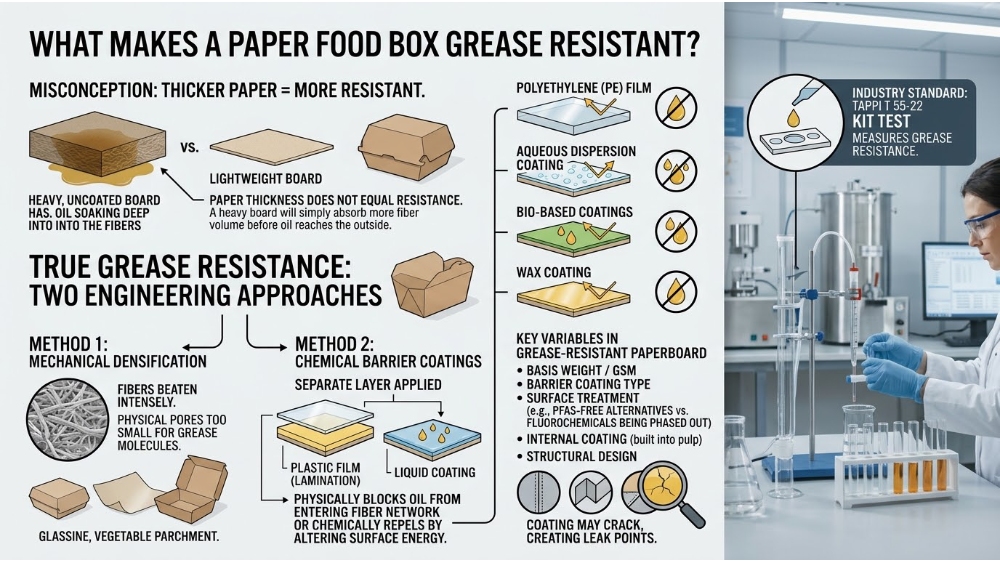
Grease resistance is not a single property—it’s the result of multiple design decisions working together. The most common misconception is that thicker paper is more grease-resistant. Paper thickness does not equal grease resistance. A heavy, uncoated board will absorb just as much oil as a lightweight one; it simply has more fiber volume to soak up before the oil reaches the outside.
True grease resistance comes from two engineering approaches: mechanical densification and chemical barrier coatings.
Mechanical densification involves beating pulp fibers so intensely that the physical pores between fibers become too small for grease molecules to pass through. This is how glassine and vegetable parchment achieve their greaseproof properties—without any chemical coating. However, this approach is expensive and produces a paper that is stiff and less printable.
Chemical barrier coatings are far more common in foodservice packaging. These are applied as a separate layer—either a plastic film (lamination) or a liquid coating applied during or after the papermaking process. The coating physically blocks oil from entering the fiber network or chemically repels it by altering the surface energy of the paper.
Key variables in grease-resistant paperboard include:
Basis weight / GSM — Heavier boards provide more substrate for coating adhesion but don’t inherently resist oil.
Barrier coating type — Polyethylene (PE), aqueous dispersions, wax, or bio-based coatings each perform differently.
Surface treatment — Some boards are treated with fluorochemicals (now being phased out) or PFAS-free alternatives.
Internal coating — Some paperboards have grease-resistant chemistry built into the pulp itself.
Structural design — Seams, folds, and creases can crack coatings, creating leak points.
The industry standard for measuring grease resistance is the Kit Test (TAPPI T 559 cm-22), which uses a series of numbered reagents with varying surface tension to determine a “kit rating”. A higher kit number indicates better grease resistance. ISO 16532-1:2008 provides an alternative method that measures the time for simulated fat material (palm kernel oil) to penetrate the sheet.
7 Ways to Improve Grease Resistance
Improving grease resistance in paper food boxes requires a systematic approach. Here are seven proven methods, ranked from foundational to advanced.
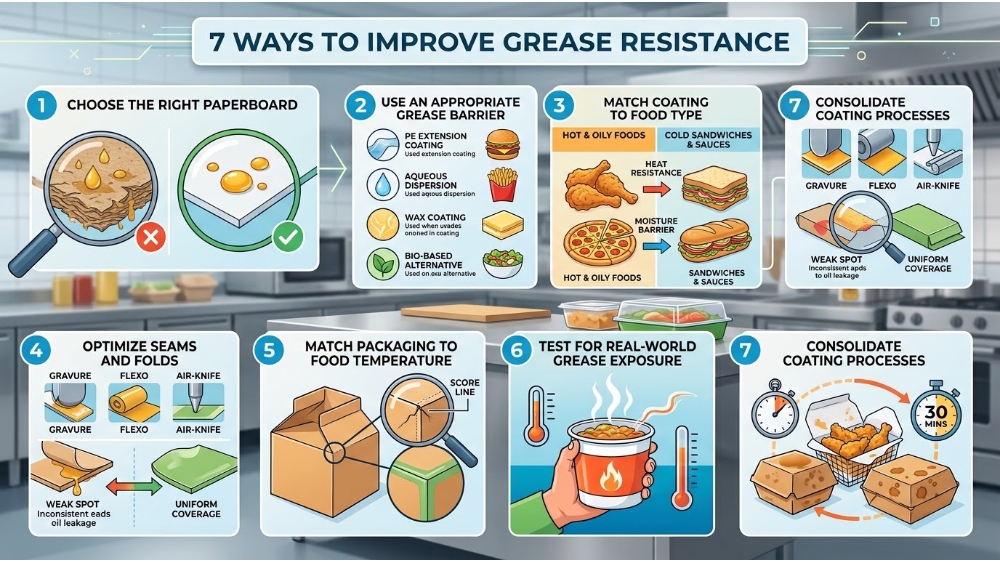
7 ways to improve grease resistance:
Choose the right paperboard — Start with a board that has a smooth, closed surface. Highly refined boards with fewer exposed fibers provide a better base for coatings.
Use an appropriate grease barrier — Select between PE extrusion coatings, aqueous dispersions, wax coatings, or bio-based alternatives based on your food type and hold time.
Match coating to food type — Hot, oily foods need heat-resistant coatings; cold sandwiches with sauce need different barrier properties.
Control coating coverage — Inconsistent coating application creates weak spots. Gravure, flexo, and air-knife coating methods each offer different coverage precision.
Optimize seams and folds — Score lines and folds can crack the barrier coating. Use creasing techniques that preserve coating integrity at fold points.
Match packaging to food temperature — Hot food releases steam that can compromise some coatings. Ensure your barrier performs at the actual serving temperature.
Test for real-world grease exposure — Lab tests don’t always predict field performance. Pack actual menu items at actual serving temperatures and observe over your typical delivery window.
Coating selection deserves special attention. Polyethylene (PE) coatings remain the industry standard for high-performance grease and moisture barriers. They offer excellent resistance to hot grease and liquids, are heat-sealable, and are relatively low-cost. However, PE-coated boards are difficult to recycle in standard paper streams.
Aqueous (water-based) coatings are the fastest-growing segment in sustainable packaging. These are water-based dispersions applied like ink during printing or converting. They are repulpable, recyclable, and often compostable. A 2025 study on wax coatings found that beeswax and biowax coatings outperformed other wax types in oil resistance, with beeswax-coated boxes showing no visible stain for up to 7 hours.
For operators seeking PFAS-free solutions, multiple manufacturers now offer FDA-compliant water-based barrier coatings that deliver excellent oil and grease resistance without fluorochemicals.
Choosing Grease-Resistant Packaging by Food Type
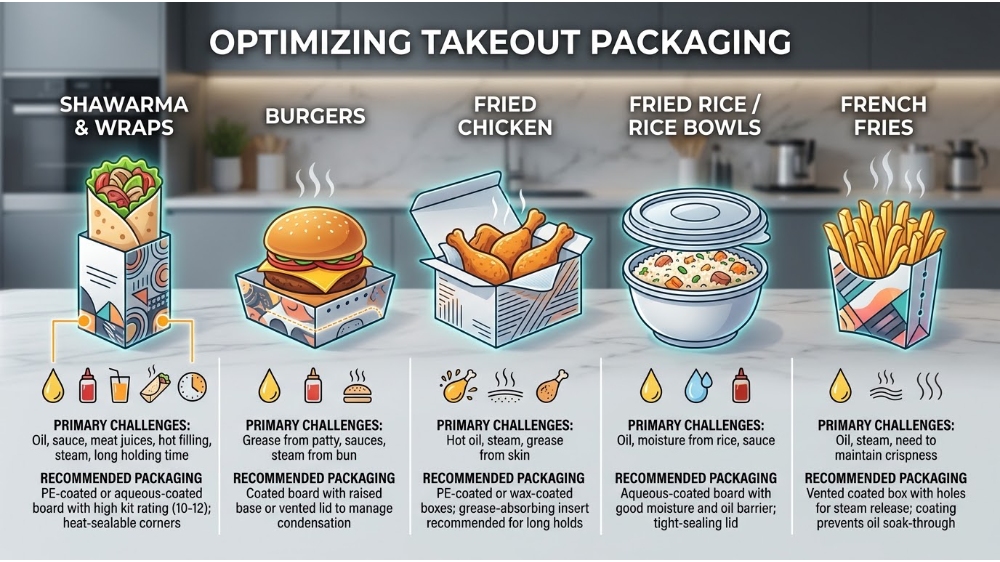
Different menu items place different demands on packaging. A one-size-fits-all approach to grease resistance will fail for at least some of your items. Here’s how to match packaging to specific food categories.
Food type
Primary challenges
Recommended packaging
Shawarma & wraps
Oil, sauce, meat juices, hot filling, steam, long holding time
PE-coated or aqueous-coated board with high kit rating (10-12); heat-sealable corners
Burgers
Grease from patty, sauces, steam from bun
Coated board with raised base or vented lid to manage condensation
Fried chicken
Hot oil, steam, grease from skin
PE-coated or wax-coated boxes; grease-absorbing insert recommended for long holds
Fried rice / rice bowls
Oil, moisture from rice, sauce
Aqueous-coated board with good moisture and oil barrier; tight-sealing lid
French fries
Oil, steam, need to maintain crispness
Vented coated box with holes for steam release; coating prevents oil soak-through
For shawarma and wraps, the combination of hot filling, sauce, and meat juices creates a triple threat. The packaging must resist oil, moisture, and steam simultaneously—and it must do so for extended periods, as these items are often held in warmers or delivered over longer distances. A dual-functional barrier that repels both oil and water is essential. Explore the packaging for shawarma and wraps
Fried chicken presents a different challenge. The surface oil is hot and abundant, and the steam released as the chicken cools can condense inside the box, softening both the chicken and the packaging. PE-coated boxes with a grease-absorbing base layer are the most reliable solution for delivery holds beyond 15 minutes. Click to find the box for fried chicken
For French fries, the priority is balancing grease resistance with steam venting. A coated box that traps all steam will make fries soggy; a box with holes but poor grease resistance will leak oil. The optimal design uses a coated board with precision-perforated vent holes—allowing steam to escape while the coating prevents oil from wicking through the paper.
Are Grease-Resistant Paper Food Boxes Safe?
Safety concerns around grease-resistant paper packaging have intensified in recent years, primarily due to the historical use of PFAS (per- and polyfluoroalkyl substances) in grease-proofing coatings. PFAS are highly persistent chemicals that have been linked to various health concerns.
Grease resistance does not equal PFAS. Many grease-resistant coatings are now available that contain no fluorochemicals. In February 2024, the U.S. FDA announced that grease-proofing substances containing PFAS were no longer being sold by manufacturers for food contact use in the U.S. market. By January 2025, the FDA determined that 35 food-contact notifications related to PFAS were no longer effective.
For foodservice operators, the key safety considerations are:
Food-contact coatings — Ensure any coating used on your packaging is approved for direct food contact by relevant regulatory bodies (FDA in the U.S., EFSA in Europe).
Migration — Coatings must not migrate from the packaging into the food under normal use conditions. The overall migration limit for packaging materials is typically 10 mg/dm² of food contact surface.
Compliance — Work with suppliers who can provide documentation demonstrating compliance with food-contact regulations.
PFAS-free alternatives — Multiple PFAS-free options are now available, including aqueous coatings, wax-based barriers, and bio-based polymer coatings. A 2025 study developed a fully bio-based grease-resistant composite coating using chitosan and microfibrillated cellulose that showed no detectable grease penetration in tests with fried chicken.
Supplier documentation is critical.Reputable packaging suppliers should provide test reports (Kit Test results, migration data) and regulatory compliance statements. For businesses concerned about PFAS, ask specifically for PFAS-free certification and confirm that coatings meet FDA or EFSA requirements for direct food contact.
Need grease-resistant packaging that performs—and complies?
Talk to a packaging specialist about matching box design, coating, and material to your specific menu items, hold times, and delivery radius.
Why do paper food boxes leak oil even when they look thick?
Paper thickness does not equal grease resistance. Oil penetrates through the fiber network via capillary action. A thick, uncoated board will absorb oil just as readily as a thin one—it simply has more capacity before the oil reaches the outside. Grease resistance comes from barrier coatings or mechanical densification, not from weight alone.
What is the Kit Test for grease resistance?
The Kit Test (TAPPI T 559 cm-22) is the industry standard for measuring grease resistance in paper and paperboard. It uses a series of numbered reagents with varying surface tension. A higher kit number (up to 12) indicates better grease resistance. Most foodservice applications require a kit rating of 8-12 depending on the food type and hold time.
Are PFAS-free grease-resistant boxes as effective as traditional ones?
Yes—when properly engineered. Modern PFAS-free coatings—including aqueous dispersions, wax-based barriers, and bio-based polymer coatings—can achieve kit ratings of 10-12, matching or exceeding the performance of fluorochemical treatments. The key is matching the coating chemistry to your specific food type and hold time.
How can I test if my current boxes are grease-resistant enough?
Pack a fresh portion of your actual menu item at serving temperature in the box, seal it in a delivery bag, and inspect at 10, 20, and 30 minutes. Look for oil staining on the outside, structural softening, and any leakage. If oil appears on the outside before your typical delivery time, you need a box with better grease resistance or a different coating type.
Post time:
Aug-25-2026
For inquiries about our products or pricelist, please leave your email to us and we will be in touch within 24 hours.