Are Paper Food Boxes Safe for Hot Food? Heat Resistance, Coatings & Food Contact Safety
Paper Food Box Safety Guide: Coatings & Heat Resistance
Foodservice Packaging Engineering
Are Paper Food Boxes Safe for Hot Food? Heat Resistance, Coatings & Food Contact Safety
A paper food box is only as safe as its coating, its construction, and the specific conditions it is exposed to. This technical guide breaks down the material science, regulatory framework, and engineering trade-offs behind heat-resistant paper packaging.
Paperboard is inherently porous, hydrophilic, and structurally weak when wet. It offers no meaningful barrier against hot grease, steam, or acidic sauces. The question “Are paper food boxes safe for hot food?” is therefore not about the paper itself—it is about the coating system applied to the paper, the construction of the box, and the specific conditions under which that box is used.
A blanket “yes” or “no” is chemically and legally meaningless. Safety is determined by the interaction between the coating, the food simulant, the contact time, and the temperature profile during use. This guide unpacks each variable with engineering precision, providing a framework for foodservice buyers to evaluate paper packaging for hot-food applications.
Why Paper Needs a Barrier for Hot Food Safety
Uncoated paperboard is a cellulose fiber network held together by hydrogen bonds. When exposed to hot food—particularly fried items or saucy entrees—three failure mechanisms occur simultaneously. First, capillary action draws liquid grease and moisture into the fiber matrix, compromising structural integrity. Second, heat accelerates the migration of low-molecular-weight substances from the board if no functional barrier exists. Third, steam generated by the hot food penetrates the board, causing delamination and loss of stiffness.
These failures are not merely aesthetic. When structural integrity collapses, the box can leak, tear, or collapse entirely. More critically, without a proper food-contact coating, the paper may transfer natural lignins, sizing agents, or residual processing chemicals into the food under thermal stress. The U.S. Food and Drug Administration (FDA) regulates paper and paperboard components under 21 CFR 176.170, which specifies that uncoated paper is only suitable for dry, non-fatty, and non-acidic foods at room temperature. For hot foods with high moisture or oil content, a functional coating is required to qualify as a safe food-contact substance.
Common Coatings Used in Paper Food Packaging
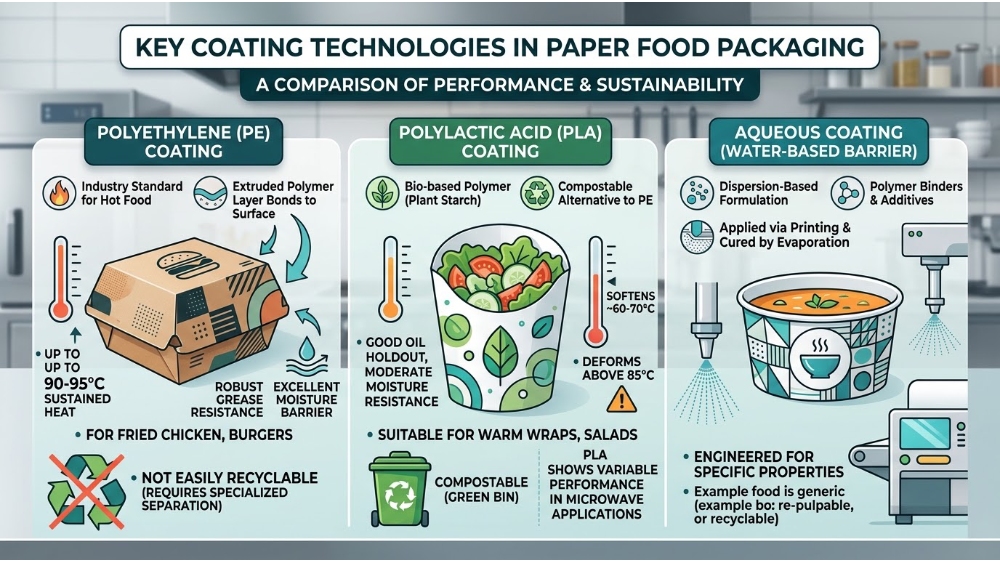
Four primary coating technologies dominate the paper foodservice packaging market today. Each offers a distinct balance of heat resistance, oil holdout, moisture protection, and environmental profile.
Polyethylene (PE) Coating
PE coating remains the industry standard for hot-food takeout boxes. It is applied as an extruded polymer layer that bonds to the paperboard surface. PE provides robust grease resistance and excellent moisture barrier performance. In terms of thermal stability, conventional LDPE and HDPE formulations typically withstand sustained temperatures up to approximately 90–95°C without significant softening. PE-coated boxes are widely used for fried chicken, burgers, and hot sandwiches. The primary drawback is recyclability—PE-coated board requires specialized separation processes and is not accepted in standard paper recycling streams in most municipalities.
Polylactic Acid (PLA) Coating
PLA is a bio-based polymer derived from fermented plant starch. It has gained traction as a compostable alternative to PE. PLA coatings exhibit good oil holdout and moderate moisture resistance, but their thermal performance is more constrained. PLA begins to soften and deform at around 60–70°C, with structural integrity declining above 85°C. This makes PLA-coated boxes suitable for warm foods—such as wraps, salads, or temperate entrees—but risky for freshly fried foods or boiling liquids. PLA also shows variable performance in microwave applications, as localized hotspots can exceed the glass transition temperature and cause deformation.
Aqueous Coating (Water-Based Barrier)
Aqueous coatings are dispersion-based formulations that combine polymer binders (often acrylic, styrene-acrylate, or polyester copolymers) with functional additives. They are applied via conventional printing or coating lines and cured by evaporation. Aqueous coatings can be engineered for excellent grease holdout, moderate moisture resistance, and good heat-seal behavior. Thermal resistance depends on the specific formulation—top-tier aqueous barrier coatings can perform reliably at 90–100°C for the duration of a typical delivery window. They are increasingly favored for their repulpable and recyclable characteristics, as they do not form a continuous film that interferes with fiber rehydration.
Grease-Resistant Paper (GR Paper) — and the PFAS Problem
Historically, grease-resistant paper relied on per- and polyfluoroalkyl substances (PFAS) to achieve extreme oil holdout. These fluorochemicals created a low-surface-energy barrier that effectively repelled grease. However, PFAS have been identified as persistent environmental contaminants with significant health concerns. In April 2024, the FDA finalized a rule revoking all previously authorized uses of PFAS in food contact applications. In January 2025, the agency issued a notice confirming that 35 Food Contact Notifications (FCNs) for PFAS-containing substances are no longer effective, effectively ending their legal use in U.S. food packaging. In the EU, a phase-out ban takes effect on August 12, 2026, with no allowable detectable PFAS in food contact materials from that date forward. Today’s grease-resistant papers are formulated with PFAS-free alternatives such as modified starches, cellulose derivatives, and silicone-based coatings—though these offer distinctly different thermal and oil-handling characteristics.
Coating Performance Comparison: Heat, Oil, and Moisture
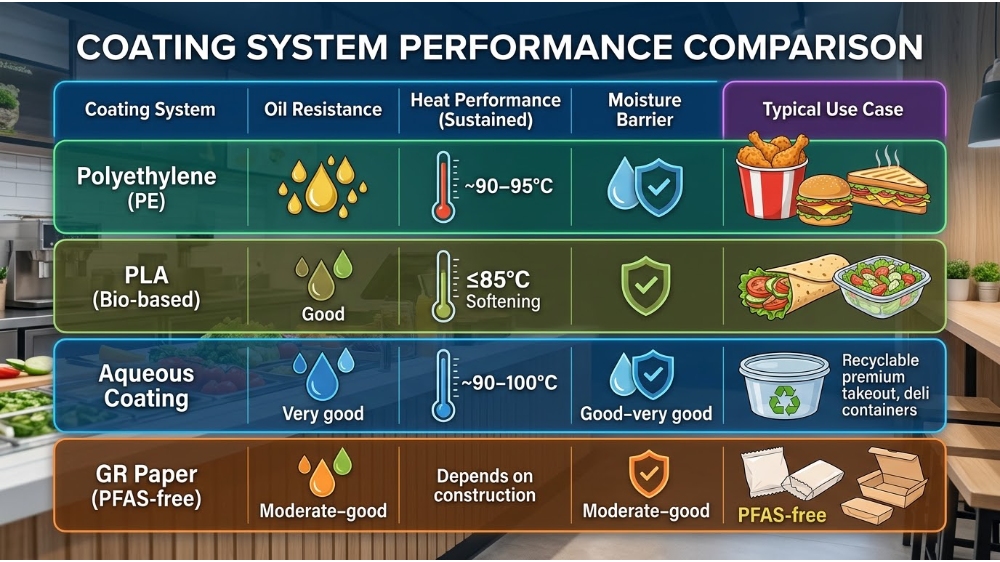
The table below compares the four primary coating systems across critical performance axes. Note that values are representative ranges—actual performance depends on formulation, substrate, and testing conditions.
Coating System
Oil Resistance
Heat Performance (Sustained)
Moisture Barrier
Typical Use Case
Polyethylene (PE)
Strong
Good (~90–95°C)
Strong
Fried chicken, burgers, hot sandwiches
PLA (Bio-based)
Good
Moderate (≤85°C, softens above)
Good
Wraps, salads, temperate entrees
Aqueous Coating
Very Good (formulation-dependent)
Good (~90–100°C, formulation-dependent)
Good–Very Good
Recyclable premium takeout, deli containers
GR Paper (PFAS-free)
Moderate–Good
Depends on construction
Moderate–Good
Wrappers, quick-serve boxes
What Safety Actually Depends On: Temperature, Time, and Food Type
There is no single “maximum temperature” for paper food boxes because thermal safety is a multivariate function. The actual heat resistance of a coated board depends on the interplay of at least six variables: the coating formulation’s glass transition temperature (Tg) and melting point, the paperboard’s basis weight and porosity, the structure and fold geometry of the box, the type of food (aqueous, fatty, or acidic), the duration of contact, and the intended conditions of use (including potential microwave exposure).
A PE-coated box that performs admirably at 95°C for 15 minutes may deform at 100°C after 30 seconds of microwave arcing. Conversely, a properly engineered aqueous coating may survive a 100°C sauce for a 20-minute delivery window but fail under direct microwave heating due to rapid superheating at the coating-air interface. This is why regulatory frameworks like FDA’s Food Contact Substance (FCS) program require safety assessments that reflect the actual intended use conditions—not generic material properties. The manufacturer’s technical data sheet and associated migration test results are the only reliable source of temperature ratings for a specific stock keeping unit (SKU).
Critical engineering takeaway:
Temperature alone does not determine safety—contact time, food chemistry, and coating integrity all matter.
Fatty and acidic foods are more aggressive extractants and require higher-performance barrier systems.
Always validate temperature claims against manufacturer testing that matches your actual menu and hold times.
FDA Compliance and the Food Contact Substance Framework
In the United States, food packaging safety is governed by the Federal Food, Drug, and Cosmetic Act (FFDCA) and its associated regulations. Any substance that is intended to come into contact with food—including coatings, adhesives, colorants, and paper treatments—is classified as a Food Contact Substance (FCS). An FCS is considered safe if it meets the criteria of a Generally Recognized as Safe (GRAS) notification, a Food Contact Notification (FCN) that has become effective, or if it complies with an existing regulation in Title 21 of the Code of Federal Regulations (CFR).
For paper coatings, 21 CFR 176.170 establishes the permissible components for paper and paperboard that contact food. It specifies that these components must not be extracted in quantities sufficient to cause health risks, and it sets testing protocols to verify compliance. The FDA evaluates the total migration of a coating’s constituents into food simulants under representative temperature and time conditions. If the migration levels fall below the established acceptable daily intakes (ADIs) or tolerances, the FCS is considered safe for its intended use. Critically, this means a coating approved for one application (e.g., room-temperature dry snacks) is not automatically approved for hot, greasy foods—the intended use conditions are integral to the safety determination.
The PFAS Ban: Why It Is Reshaping the Entire Industry
Per- and polyfluoroalkyl substances (PFAS) have historically been used in food packaging to provide extreme grease resistance and oil holdout. These chemistries created highly effective barriers for hot, greasy foods such as french fries and fried chicken. However, PFAS are persistent in the environment and bioaccumulate in the human body, with documented links to a range of adverse health outcomes. In response, the U.S. FDA systematically revoked all previously authorized food-contact uses of PFAS through a series of regulatory actions.
In April 2024, the FDA issued a final rule amending the food additive regulations to no longer authorize the use of any PFAS-containing food contact substances. This was followed by a January 2025 notice confirming that 35 specific Food Contact Notifications for PFAS-containing grease-proofing agents are no longer effective. The practical implication is that PFAS compounds cannot legally be used in new food packaging sold in the U.S. market. Similarly, the European Union has enacted a sweeping PFAS restriction under the REACH regulation, with an effective ban date of August 12, 2026, for food contact materials.
This regulatory shift has forced packaging manufacturers to reformulate entirely. Today’s PFAS-free grease-resistant papers rely on alternative technologies such as high-barrier aqueous coatings, modified starch blends, and specialized fluoropolymer-free chemistries. These alternatives often exhibit different thermal and oil-handling characteristics compared to their PFAS predecessors—meaning operators must revalidate hold times, food compatibility, and heat resistance with their suppliers.
Migration Testing: How Safety Is Verified in Practice
Migration testing is the empirical backbone of food-contact safety verification. It measures the transfer of substances from the packaging material into the food under conditions that simulate actual use. The FDA and international regulatory bodies have standardized these protocols to ensure consistency and predictability.
In a typical migration test, the coated paperboard is exposed to a food simulant—a solvent that mimics the behavior of a specific food category. For aqueous foods (e.g., soups, sauces), simulants like 10% ethanol or 3% acetic acid are used. For fatty foods, simulants like 95% ethanol or specific oil substitutes (e.g., Tenax or HB 307) are employed, depending on the regulatory framework. The test is conducted at a specified temperature (e.g., 70°C, 100°C, or even 121°C for retort applications) and duration (ranging from 10 minutes to several days, depending on the intended shelf life).
After exposure, the simulant is analyzed for total and specific migration of the coating constituents. The results are compared against regulatory limits—typically expressed in milligrams per kilogram of food (mg/kg) or micrograms per square centimeter of packaging surface. If the migration levels are within the permitted limits, the packaging system is deemed safe for that specific use condition. This is why a coating that passes migration testing at 90°C for 15 minutes may not pass testing at 100°C for 30 minutes. The conditions of the test are not arbitrary; they are designed to reflect the worst-case scenario of the product’s intended use.
What to ask your packaging supplier:
“Has this box been migration-tested for my specific food type and temperature profile?”
“Can you provide the FDA FCN number or the relevant 21 CFR reference for the coating?”
“What is the maximum temperature and contact time the box is validated for?”
Microwave Compatibility: A Separate Engineering Challenge
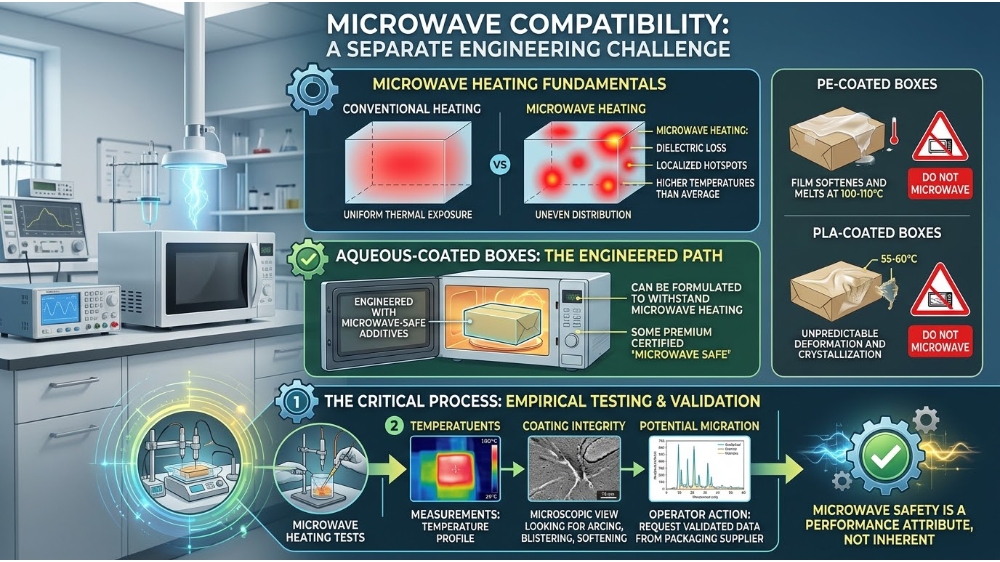
Microwave heating is fundamentally different from conventional thermal exposure. Microwaves generate heat through dielectric loss within the food and the packaging, creating localized hotspots that can reach temperatures significantly higher than the average food temperature. A coating that is perfectly safe at 95°C under uniform heating may fail in a microwave due to arcing, blistering, or rapid softening at localized hot spots.
Currently, PE-coated boxes generally carry a “do not microwave” warning because the polyethylene film can soften or melt at hotspot temperatures exceeding the polymer’s melt point (around 100–110°C). PLA-coated boxes are similarly risky, as PLA’s glass transition temperature is relatively low (approximately 55–60°C), and it can deform or even crystallize unpredictably under microwave stress. Aqueous-coated boxes, on the other hand, can be formulated to withstand microwave heating if the coating binder system is engineered with microwave-safe additives. Some premium aqueous-coated boxes carry explicit “microwave safe” certifications, but these are verified through specialized testing protocols that simulate the specific heating conditions of the target food.
The critical point is that microwave safety is not inherent to any coating material. It is a performance attribute that must be validated through empirical testing—specifically, microwave heating tests that measure the box’s temperature profile, coating integrity, and potential migration under microwave exposure. Operators should never assume microwave compatibility and should always request validated microwave data from their packaging supplier.
How to Choose the Right Safe Paper Box for Your Menu
Selecting a safe paper food box for hot foods requires a systematic evaluation of your menu’s specific characteristics and your operational hold times. The following framework will guide your decision-making process.
Step 1: Map your hold time and temperature profile
Measure the actual time between the food leaving the fryer or stove and the moment it reaches the customer. If your delivery window averages 20 minutes, design for 25 minutes of performance. Also, measure the food’s temperature at the time of packing and after 10-minute intervals. This data provides the baseline conditions for your packaging specification.
Step 2: Classify your food type
Foods are generally categorized as aqueous (high moisture, low fat), fatty (high oil content), acidic (low pH, e.g., tomato-based sauces), or dry (low moisture and oil). Fatty and acidic foods are the most aggressive extractants and require the highest-performance barrier coatings. For heavily sauced or fried items, a PE-coated or high-performance aqueous-coated box is strongly recommended.
Step 3: Match the coating to the challenge
For short-hold (< 10 minutes) service with dry or mildly warm items, PLA or PFAS-free GR paper may be sufficient. For delivery holds of 15–25 minutes with fried or saucy items, PE or aqueous coatings are the baseline standard. For extended holds beyond 30 minutes, consider multi-layer coated boards or two-component packaging systems that combine a coated inner box with an insulated outer bag to maintain both heat and coating integrity.
Step 4: Validate compliance and certification
Demand documentation from your supplier. The coating must have an effective FCN or be covered under a relevant 21 CFR regulation. Ask for migration test reports that match your food type and intended temperature profile. If the supplier cannot provide these documents, the box is not suitable for hot-food applications—regardless of what the marketing materials claim.
Need hot-food packaging that meets FDA compliance and delivers real-world heat resistance?
Consult with a packaging specialist to match the right coating, board, and construction to your menu items, hold times, and delivery radius.
Yes, but only if they are coated with an FDA-compliant food-contact substance that is validated for the specific temperature, contact duration, and food type. Uncoated paper is not safe for hot, oily, or wet foods.
Can I microwave paper takeout boxes?
Only if the box is explicitly labeled as microwave-safe by the manufacturer. PE and PLA coatings generally are not microwave-compatible, while some aqueous-coated boxes can be engineered for microwave use—but this must be validated by specific testing.
What does “PFAS-free” mean for hot food packaging?
It means the box does not contain per- or polyfluoroalkyl substances, which have been banned by the FDA for food-contact use. PFAS-free alternatives (aqueous coatings, modified starches) offer grease resistance but may have different thermal and oil-holdout characteristics than their fluorinated predecessors.
Which coating is best for hot, greasy takeout foods?
PE coating offers the best combination of high-temperature resistance (90–95°C) and strong oil holdout for delivery holds of 15–25 minutes. Aqueous coatings are a close second and offer the advantage of recyclability, but their performance depends heavily on the specific formulation.
Post time:
Aug-25-2026
For inquiries about our products or pricelist, please leave your email to us and we will be in touch within 24 hours.