What Is a PET Cup? 7 Things Buyers Should Know About Material, Performance & Applications
PET Cup Guide: Material, Performance & Uses Explained
Cup Packaging Materials Guide
What Is a PET Cup? 7 Things Buyers Should Know About Material, Performance & Applications
Pick up almost any clear plastic cup behind a bubble tea counter or on a supermarket cold-drink shelf, and there is a good chance it is made from PET. But “PET cup” is not just a marketing label—it describes a specific resin with specific strengths, specific limits, and specific sourcing questions buyers need to ask before placing a bulk order. Here is what the material actually is, where it performs best, and how to evaluate it against the alternatives.
For food and beverage brands, choosing a cup material is rarely just about looks. It affects shelf presentation, cold-chain performance, unit cost, recyclability claims, and how the cup behaves once a customer’s hand is around it. PET sits at the center of this decision for a huge share of cold-beverage packaging, which makes understanding it a practical requirement for anyone sourcing cups at volume.
This guide breaks down what the PET label actually means, why the resin became the default choice for clear cold cups, which beverages it is engineered to hold, and how it stacks up against PP, PS, and PLA. It closes with a buyer’s checklist covering the specification details that separate a cup that performs on the line from one that causes problems in production.
What Does PET Mean on a Plastic Cup?
PET stands for Polyethylene Terephthalate, a thermoplastic polyester resin. It is the same base material used in bottled water and soft drink bottles, which is one reason it is so widely recognized and so widely accepted by regulators and recyclers alike. When a cup is molded, extruded, or thermoformed from this resin, it is described as a PET cup, and the material is typically identified by the resin identification code #1 stamped inside the recycling triangle on the base of the cup.
That number matters more than most buyers realize. “Plastic” is a generic umbrella term that covers dozens of distinct polymers—polypropylene, polystyrene, polylactic acid, and more—each with different melting points, different clarity, and different recycling pathways. A cup labeled simply “plastic” tells a buyer almost nothing about how it will perform. A cup marked with the #1 PET code tells a buyer exactly which resin family it belongs to, which is why food-contact compliance paperwork, recycling instructions, and material specification sheets all reference the resin code rather than the word “plastic” on its own.
PET became the default choice for beverage cups largely because of that bottle heritage. Manufacturers already had mature, high-volume production lines, food-safety data, and recycling infrastructure built around PET, so extending it into thermoformed drink cups was a natural and cost-efficient step rather than a new material introduction.
Why Is PET Used for Plastic Cups?
PET’s popularity for beverage cups is not accidental—it comes from a specific combination of physical properties that few competing resins match at a similar price point.
Transparency
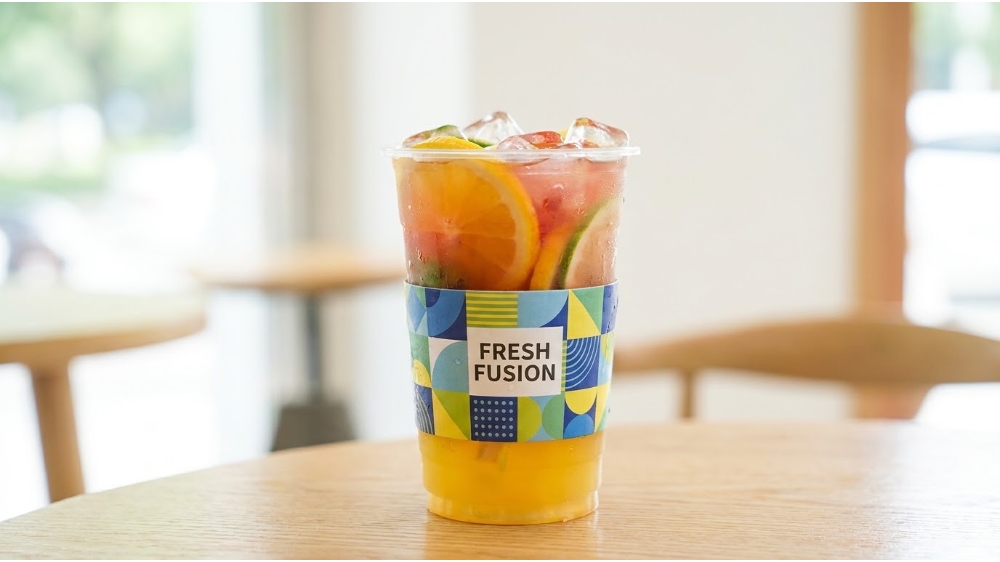
PET can be produced with glass-like optical clarity. This matters commercially: a layered fruit tea, a swirl of cream in cold brew, or fruit pulp in a smoothie is part of the product’s visual appeal, and a hazy or cloudy cup undersells it. PET’s high transparency is one of its most commercially valuable traits.
Rigidity
PET holds its shape under the weight of a filled cup and resists the kind of flexing that can cause spills when a cup is gripped firmly or set down on an uneven surface.
Lightweight construction
PET cups achieve strength at relatively low material weight, which keeps freight and shipping costs down for buyers ordering in bulk—an important factor for high-volume beverage chains.
Impact resistance
Compared with more brittle resins like general-purpose polystyrene, PET resists cracking and shattering when dropped or knocked, which reduces breakage-related waste during handling, filling, and transport.
Appearance and printability
The glossy surface finish of PET takes labels, sleeves, and direct printing cleanly, giving brands a premium presentation without extra coatings.
Cold beverage performance
PET performs reliably at refrigerated and iced temperatures, holding its clarity and structural integrity through condensation, ice contact, and cold storage. This cold-weather strength—paired with a low tolerance for heat—defines almost every use case discussed in the next section.
What Drinks Are PET Cups Best For?
PET cups are purpose-built for cold and ambient-temperature beverages, not hot ones. The resin has a relatively low heat-deflection temperature, meaning it can soften, warp, or release an odor if filled with genuinely hot liquid—so PET is the wrong choice for drip coffee straight off the brewer or hot tea. Within its intended temperature range, however, it is one of the most versatile cup materials on the market.
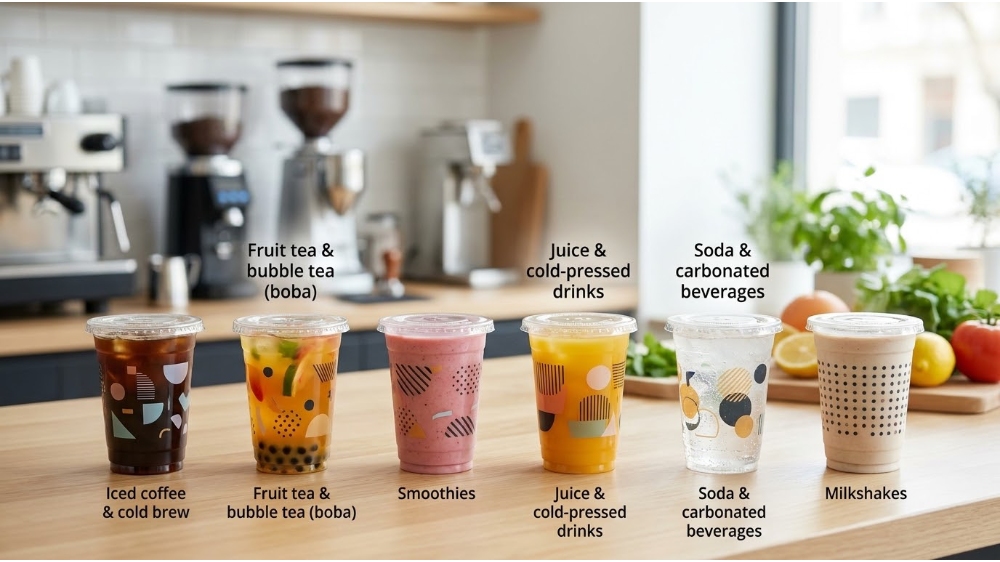
Beverages PET cups are commonly used for:
Iced coffee and cold brew
Fruit tea and bubble tea (boba)
Smoothies
Juice and cold-pressed drinks
Soda and carbonated beverages
Milkshakes
The common thread across this list is visual merchandising combined with cold-chain stability. Bubble tea and fruit tea, in particular, are almost always served in clear PET cups because the layered colors and toppings are part of the sale—an opaque or hazy cup would undercut the product’s appeal at the point of purchase. Carbonated drinks also benefit from PET’s rigidity, which helps the cup resist the internal pressure and condensation that come with a chilled, fizzy beverage.
PET vs. Other Plastic Cup Materials
PET is one of several resins used for disposable and reusable cups, and each material occupies a different niche. Understanding the broad differences helps buyers narrow down which category fits their beverage program before comparing specific products.
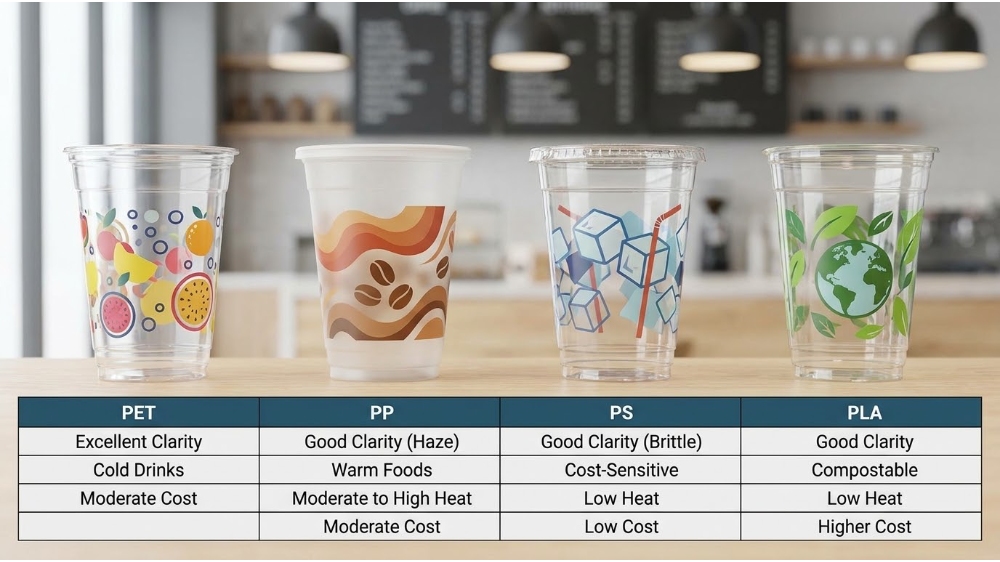
PET
Excellent clarity, strong rigidity, good impact resistance, poor heat tolerance. The default choice for cold, clear-cup applications.
PP (Polypropylene)
More heat-resistant than PET and slightly more flexible, which makes it suitable for some warm applications and microwave-safe containers. Clarity is generally lower than PET, often with a faint haze rather than true glass-like transparency.
PS (Polystyrene)
Typically the lowest-cost option and easy to mold into rigid shapes, but more brittle than PET and more prone to cracking under impact or stress. Clarity can be good in its crystal form, but it does not match PET’s toughness.
PLA (Polylactic Acid)
A plant-based, compostable resin marketed as an eco-friendly alternative. It offers reasonable clarity but generally has lower heat and moisture resistance than PET, along with a higher material cost, and it requires industrial composting conditions to break down as intended. Click to explore PLA cup
Material
Clarity
Heat resistance
Typical cost
Best use
PET
Excellent
Low
Moderate
Cold drinks, bubble tea, smoothies
PP
Good, slight haze
Moderate to high
Moderate
Warm foods, reusable cups
PS
Good, more brittle
Low
Low
Cost-sensitive cold cups
PLA
Good
Low
Higher
Compostable cold-cup programs
This comparison is meant as an overview rather than a final buying decision—choosing between PET and PP, for example, depends on factors like your typical fill temperature, branding priorities, and sustainability targets, which deserve a closer side-by-side evaluation once a buyer has narrowed the field to two or three candidate materials.
What Should Buyers Look for in a PET Cup?
Once PET is confirmed as the right resin family, the real sourcing work begins. Not all PET cups are equivalent, and small specification differences can cause big problems on a filling line or at the point of sale.
Key specifications to check before ordering:
Cup weight: a direct indicator of wall thickness and overall durability—lighter cups cost less but may flex or crack more easily
Wall thickness: affects rigidity, insulation from condensation, and resistance to cracking during shipping
Clarity: optical-grade resin versus recycled or lower-grade PET can produce a noticeably different level of transparency
Rim diameter: must match your sealing machine and lid supplier exactly, or seals and snap-fit lids will fail
Cup shape: straight-wall, tapered, or flared profiles affect stacking, branding space, and how the cup feels in hand
Capacity: confirm actual fill volume, not just the nominal size printed on the cup
Lid compatibility: flat lids, dome lids, and heat-seal films all require a matching rim design
Stacking and nesting: affects how many cups fit in a case, storage footprint, and dispenser compatibility
Printing method: offset printing, in-mold labeling, and heat-transfer printing each affect cost, minimum order quantity, and color accuracy
Food-contact compliance: confirm documentation for the markets you sell into, since food-contact regulations differ by region
Cup weight and wall thickness deserve particular attention because they are the specifications most often glossed over in a quick product listing but most likely to cause complaints once cups are in daily use. A cup that feels flimsy when filled with a cold, heavy smoothie will generate customer complaints and returns far faster than a pricing difference of a fraction of a cent per unit will ever justify. Learn plastic weight in detail by Plastic Cup Gram Weight Guide: PET vs PP for B2B Sourcing.
Common PET Cup Sizes, Shapes, and Customization Options
PET cups are produced across a wide range of formats to match different beverage categories and portion strategies. Common capacities run from roughly 8 ounces for espresso-style cold drinks up to 24 ounces or more for large smoothies and bubble tea. Within those capacities, shape variation is significant: straight-wall cups are common for juices and sodas, while U-shaped or flared cups are popular for bubble tea because the wider mouth accommodates toppings, tapioca pearls, and wide-bore straws.
Customization options have expanded well beyond a plain clear cup. Buyers can typically choose from:
Full-body offset printing for high-color-count branding
In-mold labeling for a seamless, wrap-around graphic finish
Frosted, tinted, or gradient color finishes
Embossed or debossed logo details on the cup wall or base
Tamper-evident dome lids and heat-seal film options
Shape and size choices should be made alongside lid and sealing-machine compatibility, since a cup that looks right on a spec sheet but does not match existing filling equipment will create costly production delays.
Selecting a PET cup supplier is as much about production reliability as it is about the cup itself. Buyers evaluating suppliers should look at minimum order quantities, mold customization capability, lead times, and whether the supplier can provide consistent food-contact compliance documentation across every production run, not just a sample batch.
Request physical samples before committing to volume. A sample cup makes it possible to check clarity, wall thickness, and rim fit against your actual lids and sealing equipment—details that are difficult to judge from a spec sheet or product photo alone. It is also worth confirming how the supplier handles quality consistency across repeat orders, since resin sourcing and molding tolerances can vary between production batches if a supplier does not maintain tight process controls.
For brands scaling across multiple SKUs—iced coffee cups, bubble tea cups, and smoothie cups, for example—working with a single supplier who can standardize rim diameters and lid systems across the whole product line simplifies both procurement and equipment compatibility, reducing the operational overhead of managing several disconnected packaging vendors.
Sourcing PET cups for your beverage line?
Talk to a packaging specialist about matching cup material, size, shape, and printing to your beverage menu, fill temperatures, and order volume.
PET stands for Polyethylene Terephthalate, a clear thermoplastic polyester resin identified by the #1 resin code inside the recycling triangle stamped on the cup base.
Are PET cups microwave or hot-drink safe?
No. PET has a relatively low heat-deflection temperature and can soften or warp when exposed to hot liquids or microwave heat. It is designed for cold and ambient-temperature beverages, not hot ones.
Can PET cups be recycled?
Yes, PET is one of the most widely recycled plastics, sharing recycling streams with PET bottles. Actual acceptance depends on local recycling programs, so buyers should check regional guidelines for cup-shaped PET items specifically.
What is the main difference between PET and PP cups?
PET offers superior clarity and rigidity but poor heat resistance, while PP tolerates warmer temperatures with a slightly hazier appearance. PET suits cold, clear-cup applications; PP suits warmer or reusable formats.
Post time:
Sep-08-2026
For inquiries about our products or pricelist, please leave your email to us and we will be in touch within 24 hours.