How Does Bowl Material Affect Ice Cream Melting? A Guide to Choose Foodservice Containers for Frozen Desserts
Ice Cream Bowl Materials: Which Slows Melting Best?
Frozen Dessert Packaging Guide
How Does Bowl Material Affect Ice Cream Melting? A Guide to Choose Foodservice Containers for Frozen Desserts
A scoop in a metal bowl seems to vanish in minutes. The same scoop in a paper cup barely softens sitting on the exact same counter. The difference isn’t magic—it’s thermal conductivity, thermal mass, and container engineering working together. Here’s the physics behind ice cream melting, and how to translate it into a packaging decision for dine-in, takeaway, and delivery.
Ice cream is a frozen emulsion of fat, sugar, and water, stable only within a narrow temperature band. The moment it’s scooped into a bowl, that bowl stops being a passive vessel and becomes an active part of the thermal environment. Whether that environment helps the product hold its shape for two minutes or twenty depends on decisions made long before the scoop ever touches the container: material, wall construction, thickness, and lid design.
This guide breaks down the heat-transfer science behind why some bowls melt ice cream faster than others, and turns it into a practical framework for sourcing foodservice containers for ice cream, gelato, and frozen yogurt across dine-in, takeaway, and delivery.
Why Does Ice Cream Melt Faster in Some Bowls?
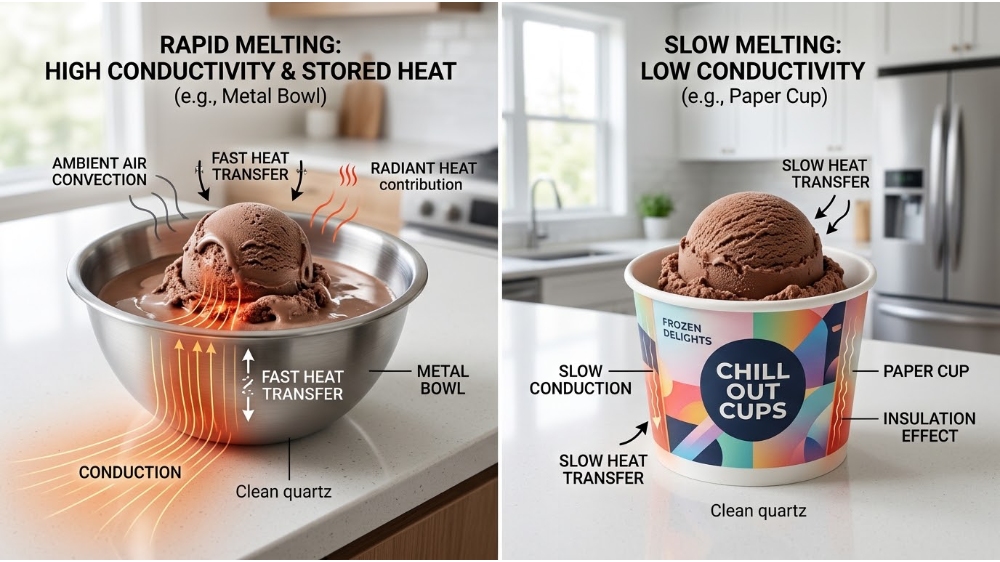
Heat moves toward ice cream in three ways: conduction from the bowl in direct contact with the product, convection from ambient air passing over its exposed surface, and a much smaller contribution from radiant heat. Of the three, conduction from the bowl itself is usually the fastest and most noticeable, because the ice cream sits in constant, tight physical contact with the container’s interior surface.
This is the mechanism behind a familiar observation: a scoop placed in a metal bowl seems to collapse into a puddle within minutes, while the same scoop in a paper or plastic cup holds its shape far longer, sitting on the exact same countertop, at the exact same room temperature. The explanation isn’t that metal is somehow “warmer” than paper—both start at the same ambient temperature. The real driver is two combined properties: how fast the bowl material conducts heat, and how much heat energy that bowl is already holding when the ice cream is added.
A bowl that has sat on a warm counter is, in effect, a small reservoir of stored heat. A highly conductive material discharges that stored heat into the ice cream almost instantly on contact. A low-conductivity material discharges the same stored heat far more slowly, over many minutes rather than seconds. This single mechanism explains most of what operators notice anecdotally about foodservice bowls, and it’s the starting point for choosing packaging that actually protects a frozen dessert through service, takeaway, or delivery.
The core mechanism, in short:
Heat reaches ice cream mainly through direct contact with the bowl (conduction)
A room-temperature bowl already holds stored heat energy before the scoop is added
High-conductivity materials discharge that stored heat almost instantly
Low-conductivity materials release the same heat far more slowly, over minutes
How Different Bowl Materials Transfer Heat
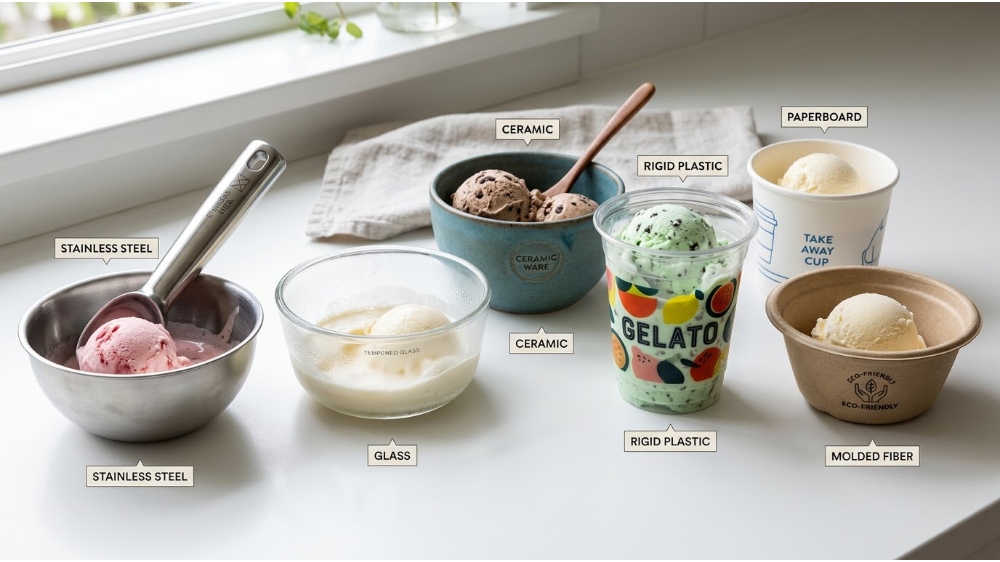
No single number fully predicts how a bowl will perform, because thermal conductivity is only one variable among several: wall thickness, total mass, starting temperature, and the ambient temperature of the room or delivery vehicle all interact with the base material. A useful comparison of common foodservice bowl materials should be read as a starting point for engineering a container, not a simple ranking of best and worst.
Material
Approx. thermal conductivity
Typical mass & thickness
How it behaves with frozen desserts
Stainless steel
~15–16 W/m·K
Thin wall, low mass, highly conductive
Absorbs and releases heat extremely fast in both directions; performance flips depending on whether it starts chilled or at room temperature
Glass
~1.0 W/m·K
Moderate mass, moderate thickness
Conducts roughly 15 times slower than steel, but its density gives it real thermal mass, so a room-temperature bowl still delivers a steady heat load
Ceramic
~1–2 W/m·K
Thick wall, high mass
Heats the product more slowly on first contact, but its higher thermal mass keeps transferring heat steadily over a longer serving window
Rigid plastic (PP/PS)
~0.1–0.3 W/m·K
Light, thin to moderate wall
Poor conductor; performs close to paperboard unless the wall is very thin or the plastic is clear and thin-gauge
Paperboard
~0.05–0.1 W/m·K
Very low mass, thin wall
One of the weakest heat conductors used in foodservice packaging; real-world performance depends heavily on coating and wall construction
Molded fiber
~0.05–0.07 W/m·K, lower with trapped air
Low mass, often thicker and more porous
Naturally insulating structure with internal air pockets from the pulp-molding process, similar to paperboard with added rigidity
The detail that changes this entire conversation—and the one most people miss—is what happens when every bowl starts at the same temperature. Pre-chill a stainless steel bowl in a freezer before the ice cream goes in, and it holds cold impressively well: its high conductivity now works in the product’s favor, pulling heat away from the surrounding air instead of dumping stored heat into the scoop. The “steel melts ice cream faster” result only holds when the steel bowl starts at room temperature, because room-temperature steel functions as a small heat battery with almost no resistance to discharging it.
This is exactly why foodservice sourcing decisions can’t simply copy a home-kitchen result. In commercial settings, bowls are rarely pre-chilled to match product temperature before filling, so a material’s natural resistance to heat flow—not its behavior when perfectly temperature-matched—is what actually determines how long a frozen dessert holds up at the counter, in a delivery bag, or on a dine-in table.
Why Paper and Plastic Can Slow Melting
Paperboard, molded fiber, and rigid plastic dominate single-use ice cream, gelato, and frozen yogurt packaging for a reason that goes beyond cost: their physical structure works against heat transfer at nearly every stage.
Low thermal conductivity
Paper fiber and most food-grade plastics conduct heat at roughly one-tenth to one-thirtieth the rate of glass, and a small fraction of the rate of stainless steel. Heat entering from a warm hand, countertop, or delivery bag has to travel through a material that resists that flow at every point along the way.
Low thermal mass
Because paper and plastic containers are light, they hold very little stored heat energy compared with a glass or ceramic bowl of the same size. There is simply less heat sitting in the container wall waiting to discharge into the product.
Coatings and multilayer structure
Most commercial paperboard ice cream containers use a polyethylene or aqueous coating primarily for moisture resistance, but the coating and the base board together form a thin composite structure with more resistance to heat flow than either layer alone. Where a container uses two full plies of board with a gap between them, that gap traps a layer of still air—one of the poorest heat conductors available, at roughly 0.024 W/m·K, well below solid paper or plastic on its own.
Wall thickness increases the distance heat has to travel
Basic heat-transfer physics states that the rate of heat flow through a material is inversely proportional to its thickness. Doubling the wall thickness of a paperboard bowl, other factors held constant, roughly halves the rate at which heat conducts through to the product inside.
Does a Thicker Paper Bowl Keep Ice Cream Colder?
Generally yes, but the relationship isn’t simply “thicker paper equals colder ice cream.” What matters is how that extra material is engineered into the container.
Paperboard caliper and GSM
Foodservice paper cups and ice cream tubs are typically specified in grams per square meter (GSM) rather than a vague “thick” or “thin” description. Single-wall ice cream cups commonly use board in the 250–300 GSM range, poly-coated on the food-contact side for moisture resistance. Increasing base GSM adds some insulating value, but the gains are incremental compared with changing the wall construction entirely.
Double-wall and multi-layer construction
The far more effective upgrade is a double-wall or multi-ply structure, where a second layer of board—often in the 190–320 GSM range per wall—is applied with a small air gap between the two plies. This is the same principle used in double-wall hot-beverage cups: the paper itself isn’t dramatically better at resisting heat, but the trapped air layer between the two walls is. This construction also keeps the outer surface noticeably cooler to the touch, which matters both for staff handling hot-weather orders and for customer perception of quality.
Bowl depth and exposed surface area
A wide, shallow bowl exposes far more of the ice cream’s surface to ambient air relative to its volume than a deep, narrow cup holding the same amount of product. Since melting begins at the exposed surface and works inward, a container with a lower surface-area-to-volume ratio generally holds shape and temperature longer, independent of wall material.
The role of the lid
Because the open top of a bowl is usually its single largest exposed surface, a properly fitted lid can matter more than any change to wall thickness—which leads directly into the next question.
Thickness upgrades, in order of impact:
Double-wall construction with an air gap outperforms simply raising single-layer GSM
Lower surface-area-to-volume shape (deeper, narrower) slows melting independent of material
A well-fitted lid removes the largest single exposed surface on the container
Raw board thickness alone offers the smallest improvement per added gram of material
Does the Lid Matter More Than the Bowl Material?
In many real-world cases, yes. The lid controls the single largest source of ongoing heat exchange: the open top surface where ambient air continuously moves across the product.
Convection through an open or poorly sealed top
Natural convection currents constantly replace the thin layer of cooled air sitting just above an exposed dessert with warmer ambient air. This process runs continuously as long as the top is open, regardless of how insulating the bowl walls are. A tight-fitting lid interrupts this convection cycle almost entirely.
Headspace as an insulating layer
A lid doesn’t need to touch the product to help. The small pocket of trapped, still air between the ice cream’s surface and the underside of the lid—the headspace—behaves the same way as the air gap in a double-wall cup: it resists heat transfer far better than direct exposure to moving ambient air.
The condensation trade-off
A fully sealed lid on a warm-filled or warm-transported container can trap humid air that condenses on the lid’s interior as the product cools it. That condensation can drip back onto the surface of the dessert, causing localized softening even when the bulk of the product is still solid. This is why lid design for frozen desserts usually favors a snug, well-fitted seal rather than an absolutely airtight one.
Lid integrity during handling and delivery
Every time a lid is removed, jostled loose in transit, or fails to reseal cleanly after a spoon is added for delivery, the container loses its main defense against convective heat gain. In practice, lid quality—fit, seal strength, and how well it survives being placed in a delivery bag—often has a larger measurable effect on melt rate over a 15–30 minute window than the difference between two comparable insulating bowl materials.
What Happens During Ice Cream Delivery?
Delivery is where every variable discussed so far—material, thickness, construction, and lid—gets tested simultaneously, under conditions the kitchen cannot fully control.
Time is the dominant variable
A ten-minute delivery and a thirty-five-minute delivery are effectively different packaging problems. Melt rate compounds over time in a way that isn’t linear: the longer a frozen dessert sits above its ideal temperature, the faster subsequent melting tends to occur, because partially melted product has less remaining structure to resist further heat.
Outdoor and vehicle temperature
Conditions during a summer afternoon delivery can be far more demanding than a climate-controlled dining room. A scooter or bicycle delivery bag sitting in direct sun, or a car trunk that has absorbed heat from the engine, both raise the effective ambient temperature the packaging has to resist.
Insulated delivery bags change the equation
An insulated delivery bag effectively adds a second, larger container around the foodservice bowl, creating a buffered microclimate far closer to refrigerator temperature than the outside air. For any order with an expected hold time beyond roughly fifteen minutes, an insulated bag typically does more to protect a frozen dessert than any single upgrade to the bowl itself.
Pickup delay is an overlooked variable
The time a finished order sits at the counter waiting for a rider or driver to arrive counts against the same melt budget as the drive itself, yet it’s rarely tracked separately. A kitchen measuring only “delivery time” from dispatch to drop-off may be missing five or ten additional minutes of uncontrolled exposure before the order ever leaves the building.
Meltwater management and presentation
Even when a dessert never fully melts, a small amount of surface softening followed by refreezing—the thaw-refreeze cycle between kitchen, delivery, and consumption—can visibly change texture, creating larger ice crystals and a grainier mouthfeel. Meltwater pooling inside the container can also find its way past an imperfect lid seal, which customers experience and report as a leak even when the packaging technically performed within its design limits. Containers with a small internal headspace or a slightly raised interior shelf reduce the chance meltwater ever reaches the lid seam.
Delivery variables that compound melt risk:
Total exposure time, including pickup delay before the vehicle even departs
Outdoor and vehicle-interior temperature, especially direct sun exposure
Whether an insulated bag is used for hold times beyond roughly 15 minutes
Lid seal quality and whether meltwater can reach the seam
How to Choose Bowls for Ice Cream, Gelato, and Frozen Desserts
The right container depends less on finding a single best material and more on matching construction to how the product will actually be served.
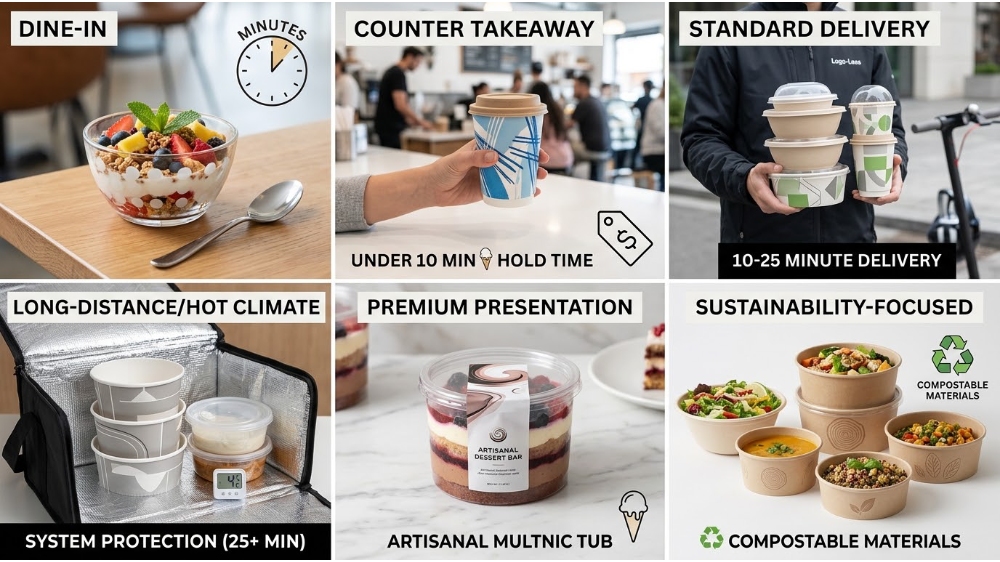
For dine-in service, where exposure time is minutes and staff control the room temperature, glass or ceramic bowls are perfectly workable and often preferred for presentation—the short serving window means their higher thermal mass rarely becomes a practical problem. For counter takeaway under about ten minutes, a single-wall PE- or aqueous-coated paperboard bowl with a flat paper lid is the most cost-efficient choice, and the short hold time doesn’t demand more insulation than that.
For standard delivery in the 10–25 minute range, a double-wall paperboard or molded fiber container with a snug-fitting lid is the practical baseline: the air-gap construction meaningfully slows conduction, and a well-sealed lid removes most of the convective loss through the top surface. For long-distance or hot-climate delivery beyond roughly 25 minutes, the bowl should be treated as one component of a larger system—pairing a double-wall container with an insulated delivery bag protects the product far more reliably than upgrading the bowl alone.
Premium and artisanal presentation—gelato counters, dessert bars, tasting formats—often justifies trading some insulation for visual appeal, using heavier single-wall board or a clear rigid tub, on the assumption that the product will be consumed shortly after purchase. And for operators building sustainability-focused programs, molded fiber made from pulp or bagasse now offers an insulation profile genuinely comparable to coated paperboard, while aligning with recyclability and compostability goals that more foodservice brands are moving toward.
Serving scenario
Recommended bowl construction
Lid type
Primary reason
Dine-in
Glass or ceramic, single wall
Open or no lid
Presentation over insulation; exposure window is short and controlled
Counter takeaway (under 10 min)
Single-wall PE- or aqueous-coated paperboard
Flat paper lid
Lowest cost option adequate for a short hold time
Standard delivery (10–25 min)
Double-wall paperboard or molded fiber
Snug-fit dome or flat lid
Air-gap insulation plus reduced convective loss through the top
Long-distance / hot-climate delivery (25+ min)
Double-wall paperboard + insulated delivery bag
Sealed lid, minimal headspace
Treats bag and bowl as one combined insulating system
Premium / artisanal presentation
Heavy single-wall board or clear rigid tub
Clear fitted lid
Visual appeal justified by a short consumption window
Sustainability-focused program
Molded fiber (pulp/bagasse)
Compostable fiber lid
Comparable insulation to paperboard with a lower footprint
Matching bowl construction, lid type, and insulation strategy to actual hold time—rather than defaulting to whatever container was ordered last year—is usually the single highest-leverage change a foodservice operation can make to reduce melt complaints across dine-in, takeaway, and delivery at the same time.
Need frozen dessert packaging built for your actual hold times?
Talk to a packaging specialist about matching bowl construction, lid design, and insulation to your dine-in, takeaway, and delivery mix.
Does bowl material really affect how fast ice cream melts?
Yes. Material affects both how much stored heat a room-temperature bowl transfers into the product and how quickly that heat moves through the container wall, so two bowls at the same starting temperature can produce very different melt rates.
Why does ice cream melt faster in a metal bowl than in a paper cup?
A room-temperature metal bowl conducts its stored heat into the product far faster than paper or plastic, which have much lower thermal conductivity and hold less heat energy to begin with. Pre-chilling the metal bowl changes this result significantly.
Is a thicker paperboard bowl always better for keeping frozen desserts cold?
Thicker board helps, but a double-wall construction with a trapped air gap typically outperforms simply increasing the GSM of a single layer, because still air between two walls insulates better than the paper itself.
Does the lid matter more than the bowl material for melting?
In many delivery and takeaway scenarios, yes—the open top is usually the largest exposed surface, and a well-fitted lid interrupts the continuous convective heat exchange that drives most of the melting.
What packaging works best for ice cream delivery in hot weather?
A double-wall or molded fiber bowl with a securely sealed lid, paired with an insulated delivery bag for hold times beyond about fifteen minutes, gives the most reliable protection against both melting and meltwater leakage.
Post time:
Sep-18-2026
For inquiries about our products or pricelist, please leave your email to us and we will be in touch within 24 hours.