Can Paper Bowls Affect the Taste of Food? 7 Packaging Factors That Can Cause Odor or Off-Flavors
Do Paper Bowls Affect Food Taste? 7 Packaging Odor Causes
Food Packaging Science & Sourcing Guide
Can Paper Bowls Affect the Taste of Food? 7 Packaging Factors That Cause Odor or Off-Flavors
Paper bowls can transfer off-notes from fiber, coatings, inks, adhesives, storage, and hot/oily food—not paper flavor. Well-made bowls are near neutral. Cheap, uncoated, poorly stored bowls with hot, oily, or seasoned food are riskier.
It is a common complaint in delivery reviews and foodservice forums: fries taste “papery,” soup tastes faintly like cardboard, or a bowl of curry picks up a musty note halfway through the meal. For a packaging buyer, the useful question is not whether this happens. It is which specific packaging variables cause it, and how to specify a bowl that avoids them.
This guide breaks down the seven packaging factors that determine whether a paper bowl stays neutral or changes what customers taste, and gives a practical checklist for evaluating paper bowls before a bulk order.
Can Paper Bowls Actually Affect Food Taste?
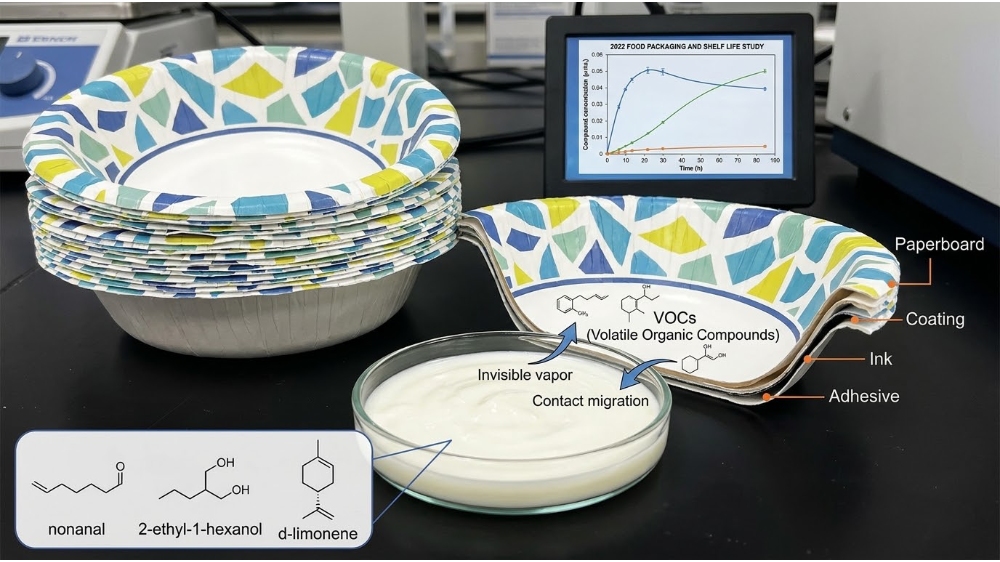
Yes, paper bowls can affect food taste, but the cause is rarely “paper” in a general sense. Paperboard, coatings, inks, and adhesives are all chemical systems that can carry volatile organic compounds (VOCs), and some of those compounds can transfer into food either through vapor-phase odor absorption or through direct contact migration.
A 2022 study published in Food Packaging and Shelf Life analyzed yogurt that had developed an off-flavor in paper-based packaging and compared its volatile compounds with the packaging material itself. The researchers identified three compounds — nonanal, 2-ethyl-1-hexanol, and d-limonene — present in both the off-flavor yogurt and the paper packaging. A migration assay, in which unpackaged yogurt was soaked directly against the packaging paper, confirmed that these compounds could move from the packaging into the food.
That result matters for two reasons. First, it shows the effect is measurable and specific, not a vague sensory impression. Second, it shows the source can be pinpointed to identifiable packaging chemistry rather than “paper” as a material category. That reframing turns a subjective customer complaint into a testable packaging specification.
The 7 Packaging Factors Behind Odor and Off-Flavors
Research on food-contact paperboard has identified a consistent group of variables that drive packaging-related odor and flavor complaints. A 2023 study in Food Additives & Contaminants: Part A examined seventeen samples of uncoated food-contact paperboard used for cups, straws, baking paper, and yogurt boxes, and tentatively identified 344 volatile organic compounds, including aldehydes, ketones, alcohols, ethers, esters, alkanes, and aromatic compounds. Of those, 66 were classified as key odor compounds capable of giving packaging — and the food inside it — a “green or plant-like” aroma.
The seven packaging factors that can cause odor or off-flavors:
Fiber source: virgin versus recycled pulp, and the wood-derived aldehydes naturally present in paperboard
Coating type: PE, PLA, aqueous, or no coating at all, each with different barrier and odor behavior
Printing inks: particularly older mineral-oil-based ink systems on the exterior surface
Adhesives: seam and base glue formulations used to form the bowl
Storage conditions: humidity, nearby odorous goods, and warehouse air quality before the bowl ever reaches a kitchen
Food characteristics: fat content, moisture, and seasoning intensity, which determine how easily any packaging-derived volatile is noticed
Heat and contact time: how hot the food is and how long it sits in the sealed bowl before it is eaten
No single factor determines the outcome on its own. A recycled, uncoated bowl holding cold, dry rice for five minutes is unlikely to cause a complaint. The same bowl holding hot, oily curry for thirty minutes is a very different risk profile. The sections below cover the factors that carry the most weight for foodservice buyers: fiber source, coatings, and food or heat conditions.
Does Recycled Paperboard Cause a Stronger Paper Smell?
Recycled paperboard tends to carry more odor-active and migration-prone compounds than virgin fiber, but “recycled equals unsafe or bad-tasting” is an oversimplification. The real variable is what went into the recycling stream and whether a functional barrier separates the food from the fiber.
Recycled pulp commonly includes de-inked newsprint and mixed paper waste, which historically carried mineral-oil-based printing ink residues. These mineral oils survive the pulping and de-inking process and can remain in the recovered fiber. Swiss and German researchers studying this issue found that mineral oil aromatic hydrocarbons migrated from recycled paperboard into dry foods such as rice, oatmeal, and noodles over months of storage, and identified a PET/polyethylene film as the most effective barrier against that migration, published in Food Additives & Contaminants: Part A. Earlier research from the same group found that even paperboard made from a carefully selected, lower-contamination recycled stock still exceeded the accepted migration limit for mineral oil by several times, which is why a barrier layer — not just a “cleaner” recycled fiber — is the more reliable fix.
This is not purely a taste issue. Under EU food-contact regulation 1935/2004, Article 3, packaging is prohibited from causing “a deterioration in the organoleptic characteristics” of food, which explicitly covers taste and odor changes, not just chemical safety. That gives buyers a compliance angle, not just a sensory one, when evaluating recycled paperboard suppliers.
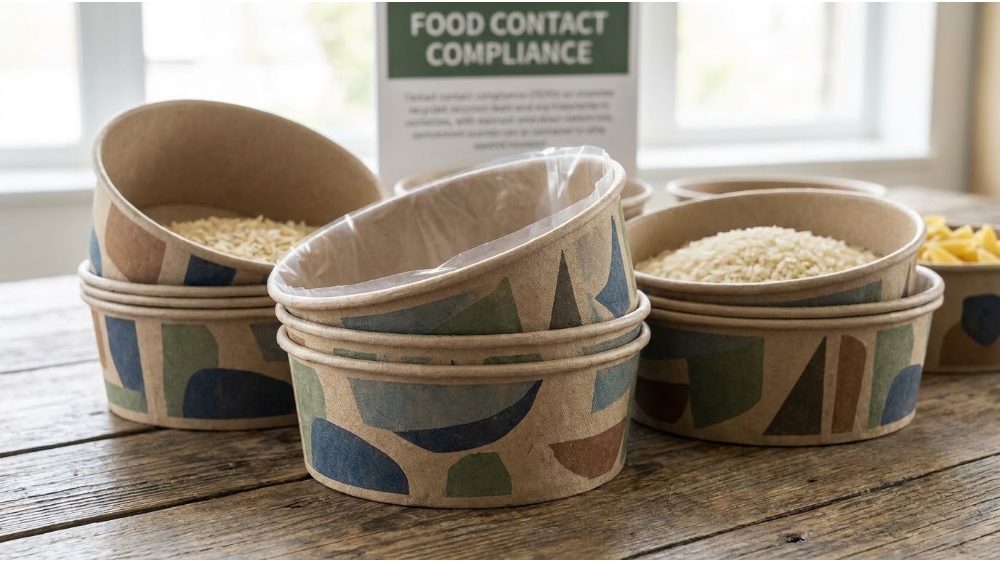
In practice, recycled paperboard is a reasonable and widely used choice for food-contact bowls when the fiber source is documented, the board is coated or lined appropriately for the food it will hold, and the supplier can confirm food-contact compliance testing. The mistake is buying unbarriered recycled board for hot, fatty, or long-dwell-time food without verifying either of those two things.
Can Coatings Prevent Paper Bowls From Affecting Flavor?
Coatings reduce flavor and odor risk, but they do not eliminate it, and the coating type matters as much as whether a coating exists at all. A coating is not only a leak-resistance feature — it also changes how much moisture, grease, and volatile compound can move between the paperboard and the food. Read Are Paper Bowls Safe? A Buyer’s Coating & Compliance Guide to learn influence of paper bowls coatings in detail.
Coating
Primary function
Heat tolerance
Odor or flavor risk
Typical use case
Uncoated kraft
None — bare fiber surface
Low with liquids or grease
Highest — fiber and any residual VOCs contact food directly
Dry, short-hold, low-fat foods
PE-coated
Moisture and grease barrier
High — handles hot, oily food well
Low, but coating quality and additive purity vary by supplier
Hot, greasy, or wet food with longer hold times
PLA / bio-based coated
Moisture and grease barrier from renewable resin
Moderate — softens at lower temperatures than PE
Low when intact, but performance drops with very hot or long-hold food
Good for most hot food; less greasy-hold capacity than PE
Marketed by several suppliers as neutral in smell and taste
General foodservice use, recycling-friendly programs
Uncoated kraft is the highest-risk option because there is nothing between the fiber’s natural volatile compounds and the food, which is consistent with why the VOC study referenced earlier used uncoated paperboard samples specifically. PE-coated board remains the most heat- and grease-resistant choice, though it is a plastic laminate with its own end-of-life trade-offs. PLA-based coatings soften at lower temperatures than PE, so very hot or long-held food can compromise the barrier and indirectly raise the chance that fiber-derived odor reaches the food. Aqueous coatings work differently: rather than laminating a film on top of the board, they are absorbed into the fiber itself, and several manufacturers describe them as food-safe with no added smell or taste, though buyers should still confirm this with their own sensory testing rather than taking any single supplier’s description as a guarantee.
The practical takeaway is that coating selection should be driven by the food’s heat, fat, and hold-time profile, not by cost alone. A coating chosen for grease resistance on a fried-food bowl will not necessarily be the right choice for a hot soup bowl with a thirty-minute delivery window. Read Paper Bowls for Soup: GSM, Coatings & Leak-Proof Buying Guide to decide the best paper bowls.
Which Foods Make Packaging Odor Most Noticeable?
Hot, fatty, strongly flavored, or long-dwell-time foods are the ones most likely to expose any packaging-derived odor. Cold, dry, low-fat foods rarely reveal it, even in the same bowl.
Heat accelerates volatile release from both the food and the packaging, a process sometimes called thermal desorption. In a sealed bowl, that raises the concentration of everything — food aroma and any packaging-derived compound alike — in the small pocket of air, or headspace, trapped under the lid. Fat and oil act as solvents that pull lipophilic compounds, including some of the mineral oil hydrocarbons discussed earlier, across the paper-food interface faster than dry, low-fat food would. Condensation forming on the underside of a lid can also redeposit trapped volatiles back onto the food surface as it cools.
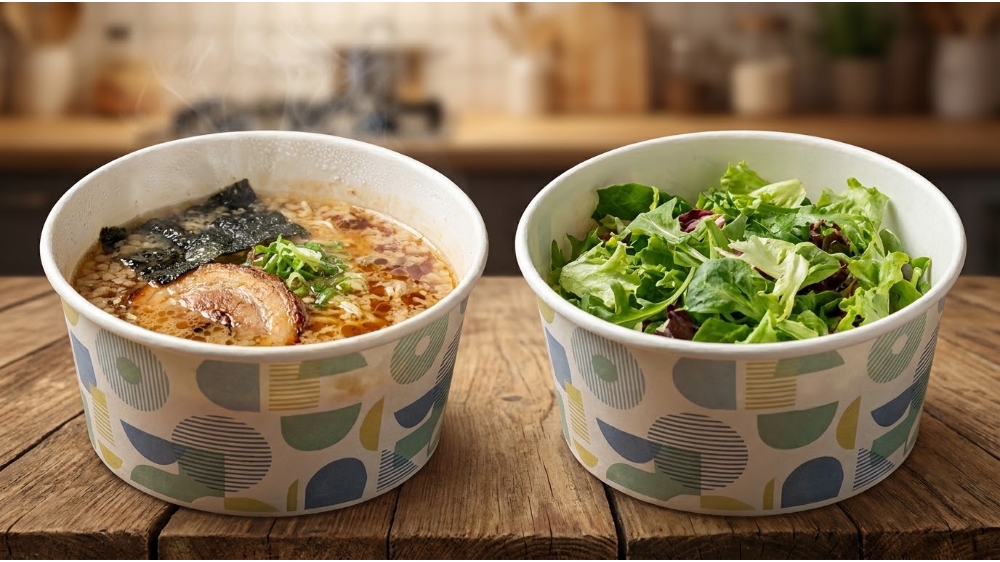
This is also where the difference between odor and taste matters. Most of what a customer describes as “the food tastes like the box” is actually retronasal odor perception — aroma reaching the olfactory receptors through the back of the throat while chewing — rather than a taste-bud response on the tongue. That is why the same bowl can seem completely neutral with a cold salad and noticeably “papery” with hot ramen or curry: the food and packaging conditions change how much volatile compound reaches the nose, not how much the paper itself has changed.
Curry, ramen, fried chicken, garlic-heavy dishes, and oily takeout are the menu items most likely to surface a packaging problem, precisely because they combine heat, fat, and strong aromatics — the three conditions that make any packaging-derived compound easiest to detect.
How to Avoid Paper Bowl Odor and Flavor Complaints
Selecting the right paper bowl comes down to matching the packaging specification to the menu item’s fat content, heat, and hold time, and verifying that specification before placing a bulk order.
Before bulk ordering paper bowls, check:
Paperboard fiber source — virgin, recycled, or a blend — and food-contact compliance documentation
Coating type, matched to the food’s fat content, temperature, and expected hold time
A blank-material smell test on unprinted, unfilled stock before it touches food
Ink and adhesive system disclosure from the supplier, including whether inks are mineral-oil-free
Storage and transport conditions between manufacturing and delivery to your kitchen
A hot-food sensory test using your actual menu items at realistic hold times, not a neutral filler
A leakage or moisture test run alongside the odor test, not as a separate evaluation
Final sample approval on a small batch before committing to a full production run
Testing with the actual menu item matters more than any single spec sheet. A box that scores well on a grease-resistance test can still pick up complaints on a hot, garlicky dish if it was never tested under those specific conditions. Packaging consistency across a full menu, not just a single product line, is usually what separates a supplier that prevents these complaints from one that only reacts to them after the fact.
Need paper bowls specified for your exact menu and hold times?
A packaging specialist can match fiber source, coating, and hold-time performance to your specific dishes before you commit to a bulk order.
Do paper bowls smell worse than plastic or foam containers?
Not inherently. Paper carries its own natural fiber compounds, while plastic and foam carry different additive and processing chemicals. The relevant comparison is whether either material has been tested and specified correctly for the specific food it holds, not which material category is “better” in general.
Is a “cardboard” smell from a paper bowl a safety issue?
A mild odor is usually a sensory or organoleptic issue rather than an immediate safety hazard. That said, some of the same compounds behind odor complaints, such as mineral oil hydrocarbons from recycled fiber, are also monitored for toxicological reasons, so a persistent smell is worth investigating with your supplier rather than dismissing.
Can refrigerating or freezing food in a paper bowl cause odor problems?
Cold storage generally slows volatile release compared with hot holding, since lower temperatures reduce how quickly compounds move from the packaging into the food. Odor complaints are far more common with hot, fatty, or long-hold food than with chilled or frozen items in the same bowl.
How long can hot food sit in a paper bowl before flavor risk increases?
There is no universal number, because it depends on the food’s fat and moisture content, the coating type, and how well the bowl is sealed. As a practical rule, the longer hot or oily food sits in an enclosed bowl, the more headspace volatile compounds accumulate, so hold-time testing with your actual menu items is more reliable than a fixed time limit.
Post time:
Sep-22-2026
For inquiries about our products or pricelist, please leave your email to us and we will be in touch within 24 hours.