Best Plastic Cups for Coffee Shops: How to Choose the Right Cup Material, Size, and Style
Best Plastic Cups for Coffee Shops: How to Choose the Right Cup Material, Size, and Style
Foodservice Packaging Guide
Best Plastic Cups for Coffee Shops: How to Choose the Right Cup Material, Size, and Style
PP, PET, and PS cups aren’t interchangeable — one melts your latte lid, one cracks in a delivery bag, one shatters on the counter. Here’s how to match resin to drink, size to menu, and certification to the label you actually put on the cup.
Most “best plastic cups” roundups rank cups by price per sleeve and call it a buying guide, which is how a shop ends up ordering a case of crystal-clear cups for an iced latte program and watching half of them deform the moment a barista free-pours a hot Americano into one by mistake. The decision that actually determines whether a cup works isn’t clarity or cost — it’s resin, and resin decides everything downstream: whether the cup survives heat, whether the lid seals, whether the drink looks good through the wall, and whether the cup you’re proud to hand a customer is even legal to recycle in the bin you tell them to use.
This guide works through plastic cup sourcing the way a packaging buyer actually has to: resin chemistry first, food-contact compliance second, size and lid compatibility third, and only then the branding and segment decisions most buying guides lead with. For the coated-paper side of the same decision, this guide covers lining chemistry and composting claims, and for the full catalog of ready-stock and custom clear cups, see this custom coffee cup packaging overview.
Why Cup Material Matters More Than Price Per Case
A plastic cup is judged by three things at once — whether the resin survives the drink’s temperature, whether it’s actually accepted where your customers throw it away, and whether the cup is food-grade compliant in the first place. Price per case tells you none of these, which is why the cheapest cup in a quote is often the most expensive mistake a shop makes in a season.
The reason plastic cup sourcing gets confusing fast is that “plastic” isn’t one material — it’s a family of resins with genuinely different physical behavior, and a cup that’s perfect for iced cold brew can be actively dangerous for a hot pour. A polystyrene cup filled with a 90°C Americano doesn’t just perform badly, it can soften, warp, and leach differently than the same cup at room temperature, which is exactly the kind of mismatch that shows up as a customer complaint or a returned order rather than as a line item anyone budgeted for. The inverse mistake is just as common: sourcing a heat-resistant cup for an all-cold iced coffee and bubble tea menu, paying a durability premium for a temperature range the menu never uses. Click to learn more about plastic and paper coffee cups comparsion.
The practical fix is to stop asking “which plastic cup is best” and start asking “which resin fits my hottest drink, my coldest drink, and my local waste stream” — because those three answers, not the marketing copy on a supplier’s homepage, are what actually separate a cup that works from one that gets returned.
PP vs. PET vs. PS: Which Plastic Actually Fits Your Menu
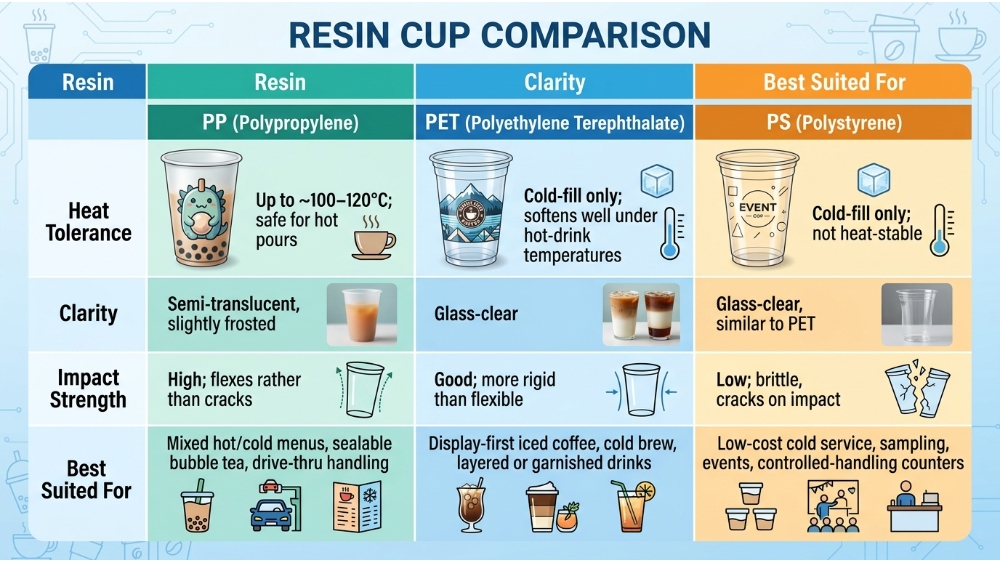
Polypropylene (PP) is the only common disposable cup resin rated for hot drinks and doubles as a durable cold-drink cup; PET is the clearest and most display-friendly option but is a cold-only material; polystyrene (PS) is the cheapest and most brittle, best reserved for low-cost cold service where breakage risk is acceptable. Matching resin to your actual temperature range, not your branding preference, is the first filter.
Polypropylene (PP): the hot-and-cold workhorse
PP is a semi-translucent, slightly frosted resin that holds its shape at sustained temperatures up to roughly 100–120°C, which is the only reason it can go anywhere near a drip coffee or tea pour without deforming. That heat tolerance is also why PP is the resin behind most sealable bubble tea cups — a film sealer presses a heated bar directly onto the rim, and a resin that can’t take sustained heat simply won’t hold a seal. Because PP tolerates both a hot fill and a cold, shaken bubble tea build without cracking, it’s the closest thing to a universal cup resin for shops running a mixed hot-and-cold menu, though it never reaches PET’s glass-like clarity. Click to explore PP cups
PET (Polyethylene Terephthalate): the display-first cold cup
PET is the resin that makes an iced caramel macchiato’s layers, a cold brew’s color, or a fruit tea’s garnish actually visible — its glass-like transparency is the main reason display-forward cold drink programs default to it. The tradeoff is thermal: PET begins softening well below the temperature of a hot drink, so it is a cold-fill-only material in any realistic foodservice setting, and a shop that tries to stretch a PET cup across both hot and cold service is choosing the resin that will fail on exactly the drinks that need it most. Click to explore PET cups
Polystyrene (PS): the economical, brittle cold option
PS shares PET’s clarity and rigidity at a lower material cost, which is why it shows up at price-sensitive cold-drink counters, sampling stations, and events. What it doesn’t share is toughness — PS is noticeably more prone to cracking or shattering on impact than either PP or PET, which makes it a reasonable choice for controlled, low-handling settings and a poor one for delivery, drive-thru, or any service where the cup gets dropped, jostled, or stacked under pressure.
The practical takeaway for a buyer is that “food-safe” and “food-grade certified” are not the same claim. A supplier should be able to produce documentation tying a specific cup’s resin lot to the applicable FDA food-contact regulation, not just a general assurance that “plastic cups are FDA approved,” which is a phrase that means nothing without a citation to the specific CFR section and food-type category (aqueous, acidic, oil-based, or dry) the cup is rated for. For a hot-fill PP cup specifically, that means confirming the cup is rated for aqueous and acidic food types at the actual serving temperature your menu uses — a detail that separates a cup certified for a shelf-stable dry snack from one actually rated for a 90°C pour.
Before signing off on a plastic cup order, confirm:
Which resin (PP, PET, or PS) the cup is made from, and whether that matches your hottest and coldest menu items
Whether the supplier can cite the specific food-contact regulation and food-type category the cup is rated for, not just a general “FDA approved” claim
Whether the rim diameter and lid profile are confirmed compatible across every size in your lineup, not assumed from a previous supplier’s spec
Whether your local recycling program actually accepts the resin curbside, since PP and PET are sorted and priced very differently from PS in most municipal streams
Recyclable vs. “Recycling-Ready”: What Curbside Programs Actually Take
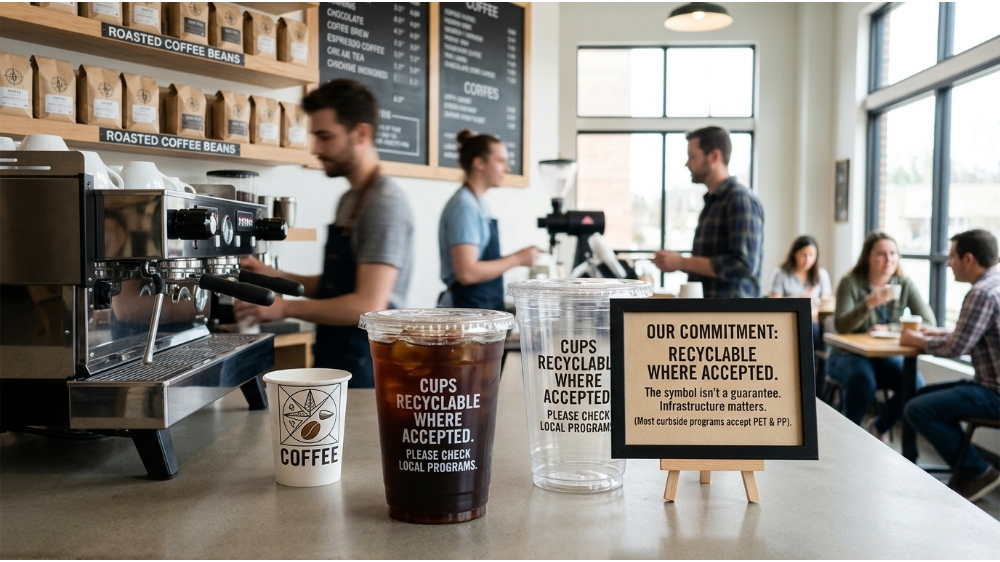
PET and PP are both technically recyclable resins, but “recyclable” only means something if a facility near your customer actually processes that resin at scale — and PET has by far the deepest, most established recycling infrastructure of the three, with PP accepted in a narrower but growing set of programs and PS rejected by most curbside systems outright. A cup printed with a chasing-arrows symbol is not the same claim as a cup your customer’s city will actually recycle.
This gap is exactly why a growing share of cold-drink brands are shifting spec sheets toward recycled-content PET (R-PET) where display clarity still matters but the sourcing story needs to hold up to scrutiny — R-PET runs through the same mills as virgin PET, so it solves the “will this actually get processed” problem without giving up the clarity a display-first drink needs. PP sits in a middle position: functionally recyclable and increasingly collected, but with a smaller base of paying end markets than PET, which is part of why PP is chosen primarily for its heat and durability performance rather than marketed as the more circular option. PS is the resin buyers should be most cautious branding as “eco-friendly” at all, since most municipal programs still route it to landfill regardless of the symbol on the cup.
The honest framing for a shop that wants a defensible sustainability claim: recyclability is a regional fact, not a resin property alone, so the accurate claim is “recyclable where accepted” rather than an unqualified “recyclable,” and that qualifier belongs on the cup or the counter signage, not buried in a supplier spec sheet nobody reads. Just in case if you’re interested in paper cups recycle, we’ve prepared paper coffee cups recycle information for you.
Matching Cup Size to Your Menu, From Espresso to Iced Venti
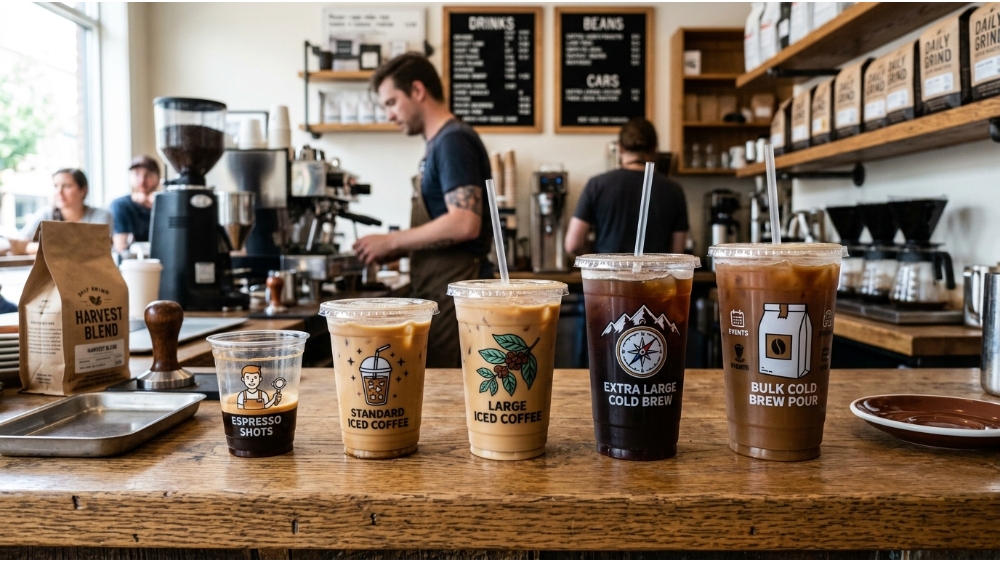
Plastic cold cups run a fairly standard ladder — roughly 12 oz, 16 oz, 22 oz, and 24 oz for coffee and tea, with smaller 2–4 oz shot or sauce cups at one end and 32 oz+ bulk sizes for bubble tea or party service at the other — and the sizing decision that actually affects cost is how many SKUs you carry, not which single size you pick. A menu with one cold size and one hot-compatible PP size covers most independent shop volumes; a menu that stocks every size on the ladder is paying for inventory complexity that rarely maps to real order-volume differences.
Size range
Typical use
Sizing note
2–4 oz
Espresso shots, sauces, tasting pours
Often overlooked in size planning but drives frequent low-cost reorders
12 oz
Standard iced coffee, small cold brew
Highest-volume SKU for most independent coffee shops
16 oz
Large iced coffee, standard bubble tea
Rim diameter must be confirmed against your sealing machine if used for boba
22–24 oz
Extra-large cold drinks, iced tea
Watch wall thickness here — larger cups need more rigidity to avoid buckling when carried
Lower per-unit margin category; usually sourced separately from daily-driver sizes
The sizing mistake that costs the most in practice isn’t choosing the wrong oz count — it’s under-forecasting how many distinct rim diameters that size range introduces, since a supplier’s “16 oz” and another supplier’s “16 oz” are not guaranteed to share a rim profile. That’s the compatibility question the next section covers, because it’s the one most sourcing guides skip entirely.
Lids, Rim Diameter, and Sealing: The Compatibility Question Most Guides Skip
A plastic cup and its lid are only compatible if the rim diameter, rim profile, and — for bubble tea — the sealing film all match within tight tolerances, and mismatches here are one of the most common, least-discussed sourcing failures in foodservice packaging. A cup that looks like a standard 16 oz size can still reject a “standard” 16 oz dome or flat lid if the rim was tooled to a different diameter, which is a detail that never shows up on a spec sheet unless you ask for it directly.
Flat, dome, and sippy lids
Flat lids are the default for straw-forward cold drinks and the cheapest option per unit; dome lids add headroom for whipped cream, boba toppings, or a mounded cold foam without denting the lid on close; sippy or valve lids are built for drive-and-sip service without a straw and matter most for delivery and rideshare orders where a loose-fitting flat lid is the single most common cause of leak complaints. Choosing the lid style before locking the cup size — rather than after — avoids discovering a headroom problem only once cold foam is already on the menu.
Sealing film compatibility for bubble tea
If a cup will go through a film sealer, the cup’s rim must be dimensionally consistent within a narrow tolerance across every case, because a sealer calibrated to one supplier’s rim profile can produce inconsistent seals — or none at all — on a visually similar cup from a different mill. This is specifically a PP-cup consideration in most bubble tea programs, since PP’s heat tolerance is what allows the seal to form in the first place; a PET cup substituted into a sealing line for cost reasons is solving the wrong problem, because the failure there is thermal, not dimensional. Click to explore plastic bubble cups
The buyer-side fix is simple but frequently skipped: request a physical sample cup-and-lid pair before a bulk order, test it on your actual sealing or lidding equipment, and only then lock the case quantity — a sample test costs a day of lead time and prevents a pallet of cups that don’t seal, dent, or stack the way the spec sheet implied.
How Coffee Shops, Bubble Tea Shops, and QSR Chains Source Differently
Independent coffee shops generally prioritize display clarity and menu flexibility across a small SKU count; bubble tea shops prioritize sealing consistency and rim tolerance above almost everything else; large QSR and drive-thru chains prioritize supply stability, drop resistance, and one resin standardized across thousands of locations. The same cup lineup rarely serves all three well.
A coffee-forward independent shop running iced lattes, cold brew, and the occasional bubble tea special has the most latitude to mix PET for display drinks with a PP cup reserved for anything sealed or heat-adjacent, since the SKU count stays low enough to manage two resins without warehouse complexity. A dedicated bubble tea shop, by contrast, is usually better served standardizing entirely on PP across its core sizes, because the operational cost of a rim mismatch on a sealing line — jammed machines, leaking cups mid-rush — outweighs whatever clarity PET would have added. Large QSR and drive-thru operators tend to weight drop and impact resistance heavily, since cups in that channel pass through more hands, more bags, and more car cupholders than a dine-in pour ever will, which is part of why chains standardizing at scale lean toward PP’s toughness even for cold service, accepting slightly less clarity in exchange for fewer field complaints.
Where the guides comparing PET, PP, and PLA cups for cold drink brands generally land is that no single material serves every drink on a mixed menu — the practical answer is almost always a small combination of resins mapped to specific drink categories, not a single “best” cup chosen for the whole shop.
How to Choose the Right Plastic Cup for Your Shop
The right resin depends on your hottest and coldest menu items, whether the cup needs to seal, how it gets handled between counter and customer, and which claim your local waste stream can actually back up — not on which cup photographs best in a supplier catalog. You could read Wholesale Coffee Cups Buying Guide to learn more in detail.
Who’s choosing
Recommended resin
Why
Coffee shop with mixed hot/cold menu
PP for hot and sealed drinks; PET for display cold drinks
Covers the full temperature range without over-speccing either category
Dedicated bubble tea shop
PP, standardized rim across all sizes
Sealing-line consistency matters more than added clarity
QSR / drive-thru chain
PP across most or all cold service
Drop resistance and single-resin supply stability at scale
Display-first cold brew or specialty iced program
PET or R-PET
Clarity sells the drink; recycled content strengthens the sourcing story
Events, sampling, low-handling counters
PS
Lowest per-cup cost where breakage risk is acceptable
Shops evaluating a full lineup rather than a single SKU can review ready-made PP, PET, and custom-branded cup options by resin, size, and lid compatibility before committing to a production run, and for the hot-cup side of a mixed menu, this coated paper cup lineup covers the equivalent decision for drip and pour-over service. Whatever the segment, the rule holds: confirm the resin, confirm the food-contact documentation, and confirm the rim fits the lid on your actual equipment — a chasing-arrows symbol on the cup base confirms none of the three. If you need a packaging partner to walk through the fit, try to contact Maibao Packaging, your cup sourcing partner.
Not sure which resin or size fits your menu?
Talk to a packaging specialist about matching plastic cup material, size, and lid compatibility to your actual hot-and-cold drink lineup.
No — PET begins softening well below hot-drink serving temperatures and will deform or leak if used for a hot pour. Reserve PET for cold and iced drinks only, and use PP for anything served hot.
Are PP plastic cups microwave-safe?
Food-grade PP generally tolerates microwave reheating better than PET or PS because of its higher heat threshold, but always confirm the specific cup’s food-contact rating with the supplier rather than assuming based on resin alone. Printed inks, lids, and sleeves are not always rated for the same temperature as the cup body.
Which plastic cup material is easiest to recycle curbside?
PET has the deepest and most established curbside recycling infrastructure of the three common cup resins, with PP accepted in a growing but narrower set of programs. PS is rejected by most municipal curbside systems, regardless of the recycling symbol printed on the cup.
Why won’t my bubble tea sealing machine seal a “standard” size cup from a new supplier?
Rim diameter and profile can vary between suppliers even at the same labeled size, and a sealer calibrated to one mill’s tolerance may not seal a visually similar cup from another. Always test a physical sample on your actual sealing equipment before committing to a bulk order.
Post time:
Jul-23-2026
For inquiries about our products or pricelist, please leave your email to us and we will be in touch within 24 hours.