

A sandwich is a complex food system: bread, moisture-rich fillings, sauces, and often delicate greens. Its structural integrity depends on maintaining a moisture balance between the bread and the filling. Once that balance tips—usually due to trapped steam or direct contact with condensation—the bread becomes soggy, the fillings weep, and the eating experience plummets. This guide breaks down the science of sandwich sogginess, compares sandwich bags and plastic wrap across key performance metrics, and provides a framework for choosing the right food packaging for your fast food operation.
Sandwich Bags vs Plastic Wrap: How to Choose Sandwich Packaging for Fast Food Restaurants
Foodservice Packaging Guide
Sandwich Bags vs Plastic Wrap: How to Choose Sandwich Packaging for Fast Food Restaurants
A sandwich leaves the prep line fresh and structurally sound. Ten minutes in the wrong wrap, and it’s a soggy, collapsed mess. The choice between sandwich bags and plastic wrap isn’t trivial—it’s a decision that affects food quality, operational speed, and customer satisfaction. Here’s how to choose the right sandwich packaging for your fast food restaurant, backed by food science and real-world service data.
Sandwich Sogginess: The Science of Moisture Migration
A sandwich’s crispness—or lack thereof—is governed by moisture migration. Bread is a hydrophilic matrix of starch and gluten; when exposed to humidity above roughly 70%, it absorbs ambient moisture, causing the starch to swell and the structure to soften. In a sealed environment, the moisture from fillings (tomatoes, pickles, meats) and the steam from a warm sandwich create a saturated microclimate. Within minutes, the bread loses its structural integrity.
The speed of sogginess depends on three factors: how much moisture is trapped, how quickly it can escape, and whether the bread is in direct contact with a wet surface. A sandwich bag with venting allows some moisture to escape, while plastic wrap creates a near-perfect seal, trapping steam against the bread. Research published in the “Journal of Food Science” has shown that bread stored in hermetically sealed packaging loses up to 40% of its sensory quality within 15 minutes due to moisture migration. For fast food restaurants, this means the choice between bags and wrap directly impacts the window of optimal freshness.
Sandwich Bags: Breathability and Convenience
Sandwich bags—typically made from low-density polyethylene (LDPE) or paper-based materials—offer a balance of protection and breathability. Their primary advantage is moisture venting: the material allows some water vapor to escape, reducing the risk of condensation forming on the bread. This is particularly important for warm sandwiches, where steam is actively being released.
However, not all sandwich bags are equal. Uncoated paper bags are highly breathable but offer little grease resistance; oils from meats and sauces can soak through, leading to stains and structural failure. PE-coated paper bags provide a grease barrier while maintaining some breathability, making them suitable for a wider range of sandwiches. Plastic sandwich bags (LDPE) offer excellent grease resistance and moderate breathability, but their sealing mechanism—often a fold-over or zip closure—can trap moisture if not designed with venting.
For fast food operations, the key metric is “breathability-to-barrier ratio”. A bag that’s too breathable will allow heat to escape too quickly, leaving the sandwich cold. A bag that’s too sealed will trap steam, causing sogginess. The optimal design balances these factors, typically with a coated paper or micro-perforated plastic construction.
Plastic Wrap: The Airtight Barrier Trade-off
Plastic wrap—typically PVC or PVDC—offers an unparalleled moisture and grease barrier. It clings tightly to the sandwich, preventing air from reaching the food and slowing oxidation. This makes it ideal for cold sandwiches or items that need to be protected from external contaminants.
But the airtight seal comes with a cost: trapped moisture. When a warm sandwich is wrapped in plastic, the steam has nowhere to go. It condenses on the inside of the wrap and, because the wrap is in direct contact with the bread, that moisture is immediately absorbed. The result is a soggy, steamed bun within minutes. For cold sandwiches, plastic wrap can be effective, but it offers no breathability, meaning any moisture from the fillings will eventually migrate to the bread.
Plastic wrap also presents operational challenges: it’s slower to apply than a bag, requires more manual dexterity, and can be difficult to open for the customer. In high-volume fast food environments, speed is critical. A burger box or sandwich box with a lid can be pre-assembled and filled quickly, whereas plastic wrap requires individual wrapping of each sandwich, adding seconds to each order—seconds that add up during peak hours.
Sandwich Bags vs Plastic Wrap: Head-to-Head Comparison
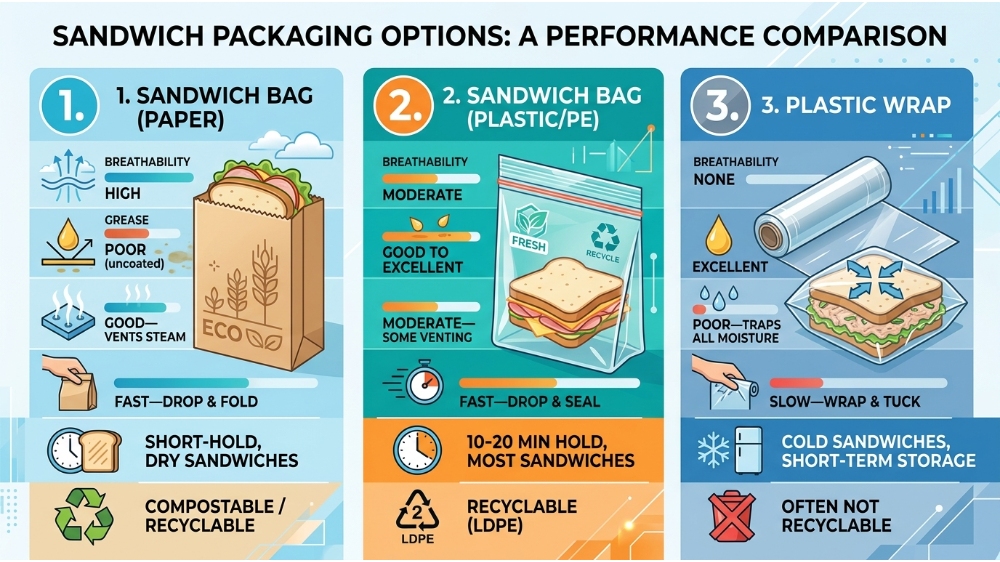
The table below summarizes the key differences between sandwich bags and plastic wrap across the metrics that matter most to fast food operators.
| Metric | Sandwich Bag (Paper) | Sandwich Bag (Plastic/PE) | Plastic Wrap |
|---|---|---|---|
| Breathability | High | Moderate | None |
| Grease resistance | Poor (uncoated) | Good to Excellent | Excellent |
| Moisture management | Good—vents steam | Moderate—some venting | Poor—traps all moisture |
| Speed of application | Fast—drop and fold | Fast—drop and seal | Slow—wrap and tuck |
| Best use case | Short-hold, dry sandwiches | 10-20 min hold, most sandwiches | Cold sandwiches, short-term storage |
| Eco-profile | Compostable/recyclable | Recyclable (LDPE) | Often not recyclable |
The data shows a clear pattern: for most fast food applications, a coated paper bag offers the best balance of moisture management, grease resistance, and operational speed. Plastic wrap is best reserved for cold items or situations where an absolute barrier is required. Learn more about fastfood packaging comparison by reading How Fast Food Restaurants Can Switch to Plastic-Free Takeout Packaging: Materials, Costs, and Benefits.
Material Matters: Coated Paper, PE, and Compostable Options
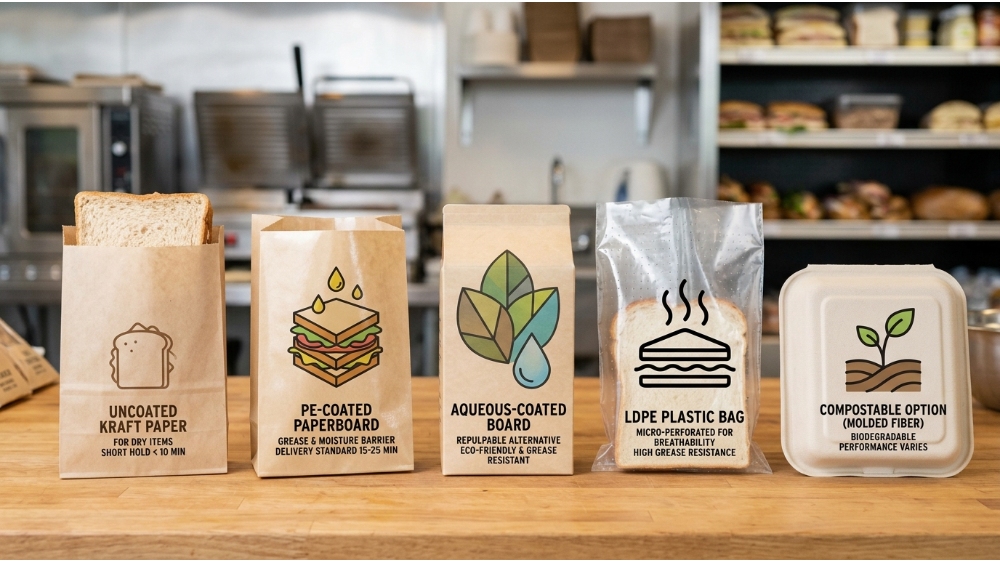
The material of your sandwich packaging determines its performance. Here’s a breakdown of the most common options:
“Uncoated kraft paper” is the most breathable and eco-friendly option, but it offers little to no grease resistance. It’s suitable for dry sandwiches with a short hold time (under 10 minutes). For anything with sauces or oils, it will stain and soften.
“PE-coated paperboard” provides a grease barrier while maintaining some breathability. The coating is typically applied to the interior surface, preventing oil from soaking through while allowing moisture vapor to escape through the uncoated areas. This is the standard for premium sandwich bags designed for delivery holds of 15-25 minutes.
“Aqueous-coated board” is a newer, repulpable alternative to PE. It offers good grease resistance and moderate moisture protection, making it a strong choice for eco-conscious brands. However, it is slightly less effective against high-heat, high-grease applications than PE coatings.
“LDPE plastic bags” are lightweight, transparent, and offer excellent grease resistance. They can be manufactured with micro-perforations to allow some breathability, but the perforations must be carefully sized to prevent moisture from escaping too quickly (which would cool the sandwich) or too slowly (which would cause sogginess).
“Compostable options”—including bags made from PLA, PHA, or molded fiber—are growing in popularity. However, their performance varies widely. Some compostable materials are highly breathable but offer poor grease resistance; others provide good barrier properties but are expensive. For most fast food operations, a PE-coated paper bag offers the best balance of performance, cost, and sustainability.
Hold Time and Temperature: Matching Packaging to Delivery
A sandwich bag that works for a 5-minute counter hold will fail for a 25-minute delivery. The longer the hold, the more critical moisture management becomes—but also the more important heat retention. This is the central tension in sandwich packaging design.
For holds “under 10 minutes”—typical dine-in or quick counter service—an uncoated kraft bag with moderate breathability is sufficient. The sandwich is consumed before moisture accumulation becomes a problem. For holds “between 10 and 20 minutes”—standard delivery—a coated paper bag with optimized venting is the baseline. For holds “beyond 20 minutes”, additional measures are needed: a bag with a grease-absorbing insert, a separate vented sleeve, or even a two-component system where the sandwich is packed in a vented inner bag inside an insulated outer pouch.
Temperature also plays a role. A hot sandwich (above 140°F) releases steam rapidly, increasing the need for venting. A cold sandwich (below 40°F) doesn’t release steam but is susceptible to condensation from temperature fluctuations during delivery. The goal is to maintain the sandwich at its target temperature while managing moisture—a balance achieved through “material choice, venting design, and packaging geometry” working in concert.
Hold-time packaging guidelines for sandwiches:
- Under 10 min: Uncoated kraft bag, basic breathability—counter service standard
- 10–20 min: Coated paper bag, 2-4 micro-perforations—delivery baseline
- 20–30 min: Coated bag + absorbent base layer + optimized perforation pattern
- 30+ min: Two-component system: vented inner bag + insulated outer pouch
How to Choose the Right Sandwich Packaging for Your Business
Selecting the right sandwich packaging comes down to four variables: “hold time, sandwich type, filling moisture, and delivery distance”. Start by measuring your actual hold time—from prep line to customer—not your ideal one. If the average delivery takes 22 minutes, design for 30.
Then evaluate your sandwich. A “cold, dry sandwich” (e.g., turkey and cheese) can be packaged in a breathable paper bag with minimal venting. A “hot, saucy sandwich” (e.g., meatball sub) needs a coated bag with grease resistance and moderate venting. A “delicate sandwich” (e.g., a BLT with fresh lettuce) requires a bag that prevents crushing while allowing moisture to escape.
Test with your actual product. Pack a fresh sandwich in the bag or wrap, seal it in a delivery bag, and check quality at 10, 20, and 30 minutes. If the bread is soggy at 20 minutes, the packaging needs more breathability or a different material. If the sandwich is cold but crisp, the packaging is too breathable—reduce venting or add insulation.
For businesses scaling sandwich delivery across multiple locations, packaging consistency is as important as food quality. Working with a packaging supplier who can provide consistent, tested sandwich packaging formats across your full menu eliminates the most common variable in sandwich quality complaints: packaging that wasn’t designed for the sandwich it’s holding. For a sourcing consultation on sandwich bags, wraps, and delivery-optimized packaging matched to your specific menu and hold times, contact Maibao Packaging.
Need sandwich packaging that keeps bread fresh through delivery?
Talk to a packaging specialist about matching bag design, material, and venting to your sandwich menu, your hold times, and your delivery radius.
Frequently Asked Questions
Which is better for sandwiches: bags or plastic wrap?
For most fast food applications, a coated paper bag is better. It offers breathability to prevent sogginess, grease resistance to contain sauces, and faster application than plastic wrap. Plastic wrap is best reserved for cold sandwiches or short-term storage where an airtight seal is needed.
Do sandwich bags keep bread from getting soggy?
Yes—when properly designed. Breathable bags allow steam to escape, reducing internal humidity. However, the bag must be matched to the sandwich type and hold time. A bag that’s too breathable will let heat escape; a bag that’s too sealed will trap moisture.
What’s the best sandwich packaging for delivery?
A PE-coated paper bag with 2-4 micro-perforations is the best all-around format for delivery holds of 10-25 minutes. For longer holds, add an absorbent base layer or use a two-component system with an insulated outer pouch.
Is plastic wrap recyclable?
Most plastic wrap (PVC, PVDC) is not recyclable through curbside programs. LDPE plastic bags are recyclable in some areas, but paper-based bags with PE coating are more widely accepted. Check with your local recycling facility for specific guidelines.
Post time: Aug-04-2026