How Fast Food Restaurants Can Switch to Plastic-Free Takeout Packaging: Materials, Costs, and Benefits
Plastic-Free Takeout Packaging Guide: Materials, Costs & Benefits for Fast Food
Foodservice Packaging Transition Guide
How Fast Food Restaurants Can Switch to Plastic-Free Takeout Packaging: Materials, Costs, and Benefits
The global fast-food industry produces over 11 million tons of packaging waste annually—much of it plastic that never degrades. With regulators clamping down and consumers demanding action, switching to plastic-free takeout packaging is no longer optional. This guide breaks down the materials, costs, and real-world benefits to help you make the transition without breaking the bank or compromising food quality.
The takeout packaging landscape is shifting faster than most restaurant operators realize. In 2025, California banned expanded polystyrene (EPS) food service ware after the material failed to meet a 25% recycling threshold. The European Union’s Packaging and Packaging Waste Regulation (PPWR) now mandates that 10% of beverages be offered in reusable packaging by 2030. And in China, the first national standard for green takeout packaging took effect in September 2025.
This isn’t a trend—it’s a structural shift. For fast-food operators, the question is no longer whether to switch to plastic-free packaging, but how to do it affordably, reliably, and at scale. This guide provides the data, material comparisons, and implementation roadmap you need. Learn Fast Food Packaging Trends to catch up with eco-friendly era.
Why Switch Now? The Regulatory and Consumer Pressure
The regulatory landscape for food service packaging has hardened dramatically. California’s SB 54 (Plastic Pollution Prevention and Packaging Producer Responsibility Act) requires that by 2032, all single-use packaging be recyclable or compostable, with a 65% recycling rate for EPS. Since EPS failed to meet the 25% threshold by January 2025, the ban is now in effect. Similar bans are active in Washington, Colorado, and Oregon.
Consumer sentiment is equally forceful. A 2025 industry survey found that 68% of diners are willing to pay more for takeout from restaurants that use sustainable packaging. The “green premium” is no longer theoretical—it’s a revenue lever. Meanwhile, brands like McDonald’s, Subway, and Starbucks have made public commitments to phase out virgin plastic, creating competitive pressure for the rest of the industry.
The bottom line: delaying the switch exposes your business to regulatory fines, brand damage, and lost revenue. The question is not if, but when—and how smoothly.
Choosing the right material is the most critical decision in your plastic-free transition. Each option has distinct trade-offs in cost, performance, and environmental impact.
Polylactic Acid (PLA) — The Bio-Based Workhorse
PLA is a bioplastic made from fermented plant starch (typically corn or sugarcane). It’s the leading alternative for clear cups, cold drink lids, and clamshells. PLA is commercially compostable and has seen dramatic cost reductions: prices dropped from $3,700/ton in 2022 to approximately $2,200/ton in 2025. However, PLA has a low heat-deflection temperature (around 60°C), making it unsuitable for hot foods unless modified—a challenge that McDonald’s China addressed through proprietary formulations. Click to explore PLA food packaging.
Paperboard — The Traditional Workhorse
Paperboard remains the most cost-effective plastic-free option for dry or low-grease applications like fry boxes, burger clamshells, and sandwich wraps. (Learn more about sandwich packaging by reading Sandwich Bags vs Plastic Wrap)
Uncoated paperboard is inexpensive but absorbs grease; PE-coated or aqueous-coated boards provide a barrier while remaining recyclable. For hot, greasy items like fried chicken or loaded fries, a coated paperboard with venting is the industry standard. Click to explore paperboard food packaging.
Molded Fiber — The Compostable Challenger
Made from recycled paper pulp or agricultural waste, molded fiber is growing in popularity for trays, bowls, and clamshells. It’s highly breathable—excellent for moisture management—but unlined versions absorb grease and moisture aggressively. Lined molded fiber (with a thin PLA or aqueous coating) bridges the gap, offering compostability with functional performance. Agricultural waste-derived biopolymers are an emerging frontier, with rice husks, corn cobs, and fruit peels being explored as feedstocks. Click to explore molder fiber food packaging.
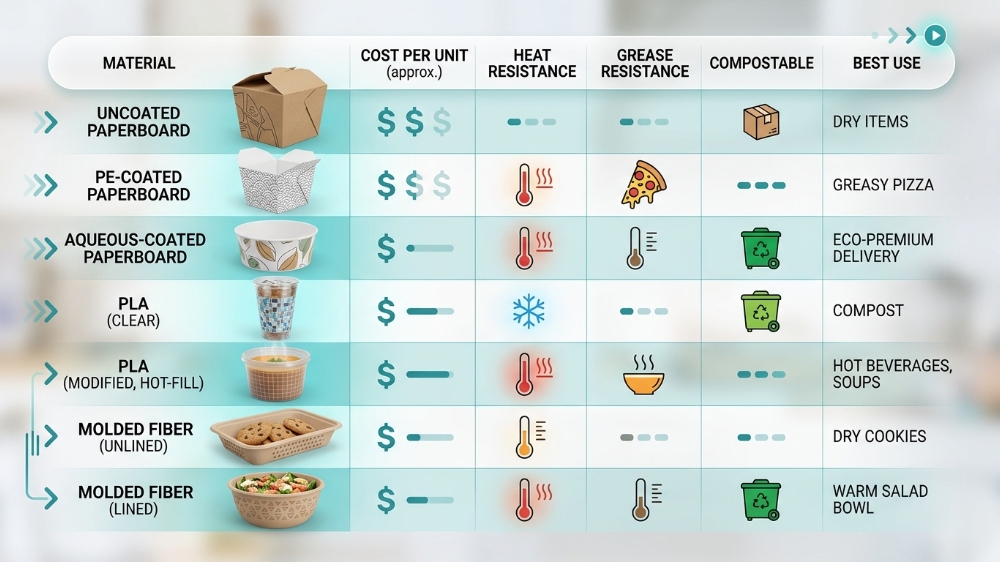
Material
Cost per unit (approx.)
Heat resistance
Grease resistance
Compostable
Best use
Uncoated paperboard
$0.04–$0.08
Moderate
Poor
Yes (home compost)
Dry items, short hold
PE-coated paperboard
$0.08–$0.15
Good
Excellent
No (recyclable)
Greasy hot items
Aqueous-coated paperboard
$0.10–$0.18
Good
Very good
Yes (industrial)
Eco-premium delivery
PLA (clear)
$0.12–$0.25
Poor (60°C max)
N/A
Yes (industrial)
Cold drinks, salads
PLA (modified, hot-fill)
$0.20–$0.35
Good (95°C)
N/A
Yes (industrial)
Hot beverages, soups
Molded fiber (unlined)
$0.06–$0.12
Moderate
Poor
Yes (home)
Short-hold, dry
Molded fiber (lined)
$0.12–$0.22
Good
Good
Yes (industrial)
Eco bowls, trays
Cost Breakdown: What Plastic-Free Packaging Actually Costs
The most common objection to plastic-free packaging is cost. And it’s true: on a per-unit basis, sustainable materials are more expensive than virgin plastic. But the gap is narrowing—and the total cost of ownership tells a different story.
PLA prices have fallen by over 40% since 2022, now sitting at around $2,200/ton. Paperboard costs have remained relatively stable, with coated boards adding $0.02–$0.05 per unit over uncoated. Molded fiber sits between paperboard and PLA in cost, but supply chain constraints can cause volatility.
However, the per-unit cost is only part of the equation. Switching to plastic-free packaging can reduce waste disposal fees (compostable materials are often cheaper to dispose of than mixed plastic waste), eliminate regulatory fines, and drive revenue through premium pricing and customer loyalty. A 2025 study found that restaurants using sustainable packaging saw an average 8% increase in repeat orders from environmentally conscious customers.
For high-volume operators, the key is supply chain partnership. McDonald’s China worked with suppliers over three years, testing nearly 100 packaging solutions and conducting over 2 million validation tests to achieve cost-effective scale. The result: a 5,800-ton annual reduction in fossil-based plastic at a manageable cost premium.
Beyond Compliance: The Business Benefits of Going Plastic-Free
The benefits of switching to plastic-free packaging extend far beyond regulatory compliance. Here are the four most compelling business advantages.
1. Brand Differentiation and Customer Loyalty
Consumers are actively seeking out brands that align with their values. A 2025 survey found that 72% of Gen Z and Millennial diners consider a restaurant’s packaging sustainability when choosing where to order. By switching to plastic-free packaging, you signal that your brand is forward-thinking and responsible—a powerful differentiator in a crowded market.
2. Premium Pricing Power
Restaurants that have transitioned to sustainable packaging report being able to command a 5–10% price premium on takeout orders. Customers are willing to pay more for packaging that doesn’t harm the planet—and they’re increasingly skeptical of brands that don’t make the switch.
3. Operational Efficiency
Many plastic-free materials are lighter than their plastic counterparts, reducing shipping costs and storage space. Molded fiber and paperboard are also more stackable, improving kitchen workflow. And with compostable materials, waste disposal can be simplified—especially in markets with municipal composting infrastructure.
4. Future-Proofing Against Regulation
Regulations are only going to get tighter. The EU’s PPWR, California’s SB 54, and China’s new green packaging standard are just the beginning. By switching now, you spread the transition cost over time, avoid last-minute rushes, and build a supply chain that’s resilient to future mandates.
How to Implement the Switch: A Step-by-Step Roadmap
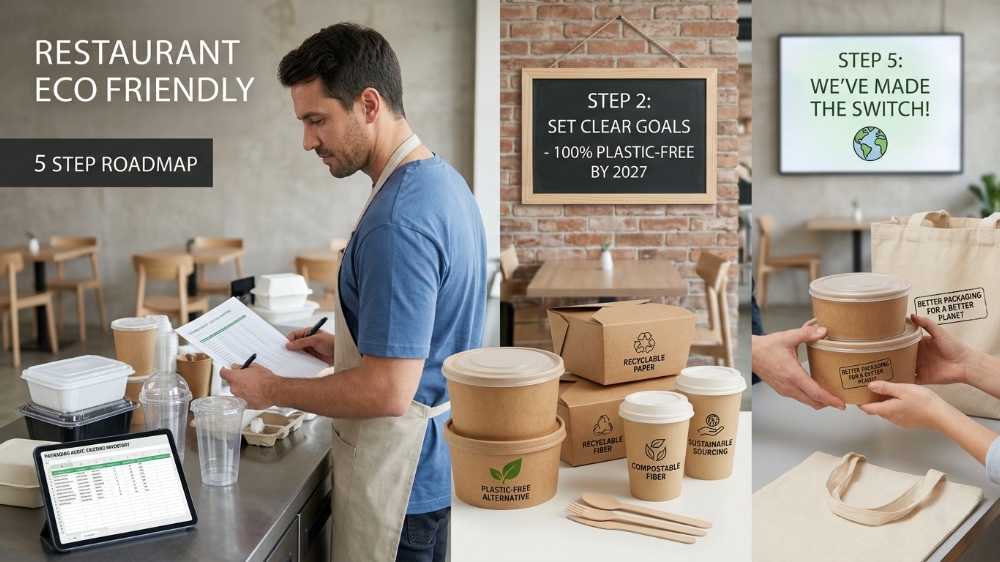
Transitioning to plastic-free packaging requires more than just swapping one box for another. Here’s a five-step roadmap based on best practices from industry leaders.
Step 1: Audit Your Current Packaging
Document every packaging item you use—cups, lids, containers, bags, wraps, and utensils. Note the material, supplier, cost per unit, and annual volume. Identify which items are the biggest plastic contributors and which are easiest to replace.
Step 2: Set Clear Goals and Timelines
Define your target: 50% plastic-free by next year? 100% by 2027? Set measurable milestones and communicate them internally and externally. Transparency builds trust.
Step 3: Test, Test, Test
Work with suppliers to get samples of alternative materials. Test them with your actual menu items under real-world conditions—delivery, dine-in, and carryout. Assess heat retention, grease resistance, structural integrity, and customer feedback. McDonald’s China tested nearly 100 packaging solutions before settling on their PLA and paperboard mix.
Step 4: Partner with a Packaging Specialist
Work with a supplier who understands the nuances of plastic-free materials. They can help you navigate coating options, venting designs, and compostability certifications. For a sourcing consultation tailored to your menu and hold times, contact Maibao Packaging.
Step 5: Communicate the Change
Tell your customers why you’re switching and what it means. Use in-store signage, social media, and packaging itself to tell the story. Customers appreciate transparency—and they’ll reward you with loyalty.
Plastic-free transition checklist:
Audit all packaging SKUs and plastic content
Set a target percentage and timeline
Source samples from 2–3 suppliers
Conduct real-world testing with your menu
Train staff on new packaging handling
Launch with a customer communication campaign
Monitor feedback and adjust as needed
Case Study: McDonald’s China and the PLA Transition
In December 2025, McDonald’s China announced a sweeping packaging upgrade across all 7,500+ restaurants. The new packaging uses PLA for cup lids and paperboard for cup bodies, replacing fossil-based plastics. The company estimates an annual reduction of over 5,800 tons of petroleum-based plastic.
What makes this case study remarkable is the rigor of the development process. McDonald’s China spent three years collaborating with supply chain partners, evaluating nearly 100 packaging solutions, and conducting over 2 million validation tests. The result: a “double-arch anti-spill” lid design that earned a design patent and a modified PLA formulation that withstands hot beverage temperatures.
According to Beijing Technology and Business University professor Weng Yunxuan, PLA prices have dropped from $3,700/ton to $2,200/ton, making large-scale adoption economically viable. McDonald’s China’s move is not just a corporate initiative—it’s a catalyst for the entire PLA supply chain in Asia.
This case study offers a blueprint for any fast-food operator: start early, test rigorously, partner deeply with suppliers, and don’t compromise on customer experience. The result is a win for the planet, the brand, and the bottom line.
Ready to make the switch to plastic-free packaging?
Talk to a packaging specialist who can help you navigate material choices, costs, and supplier partnerships—tailored to your menu and delivery radius.
Is PLA really compostable, and does it break down in home compost?
PLA is industrially compostable—it requires high temperatures (above 58°C) and specific microbial conditions found in commercial facilities. It does not break down in home compost or in the ocean. Always check local composting infrastructure before marketing PLA as “compostable.”
How much more does plastic-free packaging cost compared to plastic?
On a per-unit basis, plastic-free materials are typically 20–60% more expensive than virgin plastic. However, the gap is narrowing: PLA prices have dropped over 40% since 2022. When factoring in waste disposal savings, regulatory risk avoidance, and revenue from sustainability-conscious customers, the total cost of ownership is often comparable or even lower.
What’s the best plastic-free material for hot, greasy foods like fried chicken?
For hot, greasy items, PE-coated paperboard or aqueous-coated paperboard with venting is the industry standard. These materials offer excellent grease resistance and heat retention. Uncoated paperboard and unlined molded fiber will absorb grease and become soggy within minutes.
How do I know if my plastic-free packaging is truly sustainable?
Look for third-party certifications: FSC for paperboard, BPI or TÜV Austria for compostability, and recycled content claims verified by UL or SCS. Avoid vague terms like “biodegradable” without a certification—they often mislead consumers and regulators alike.
Post time:
Aug-03-2026
For inquiries about our products or pricelist, please leave your email to us and we will be in touch within 24 hours.